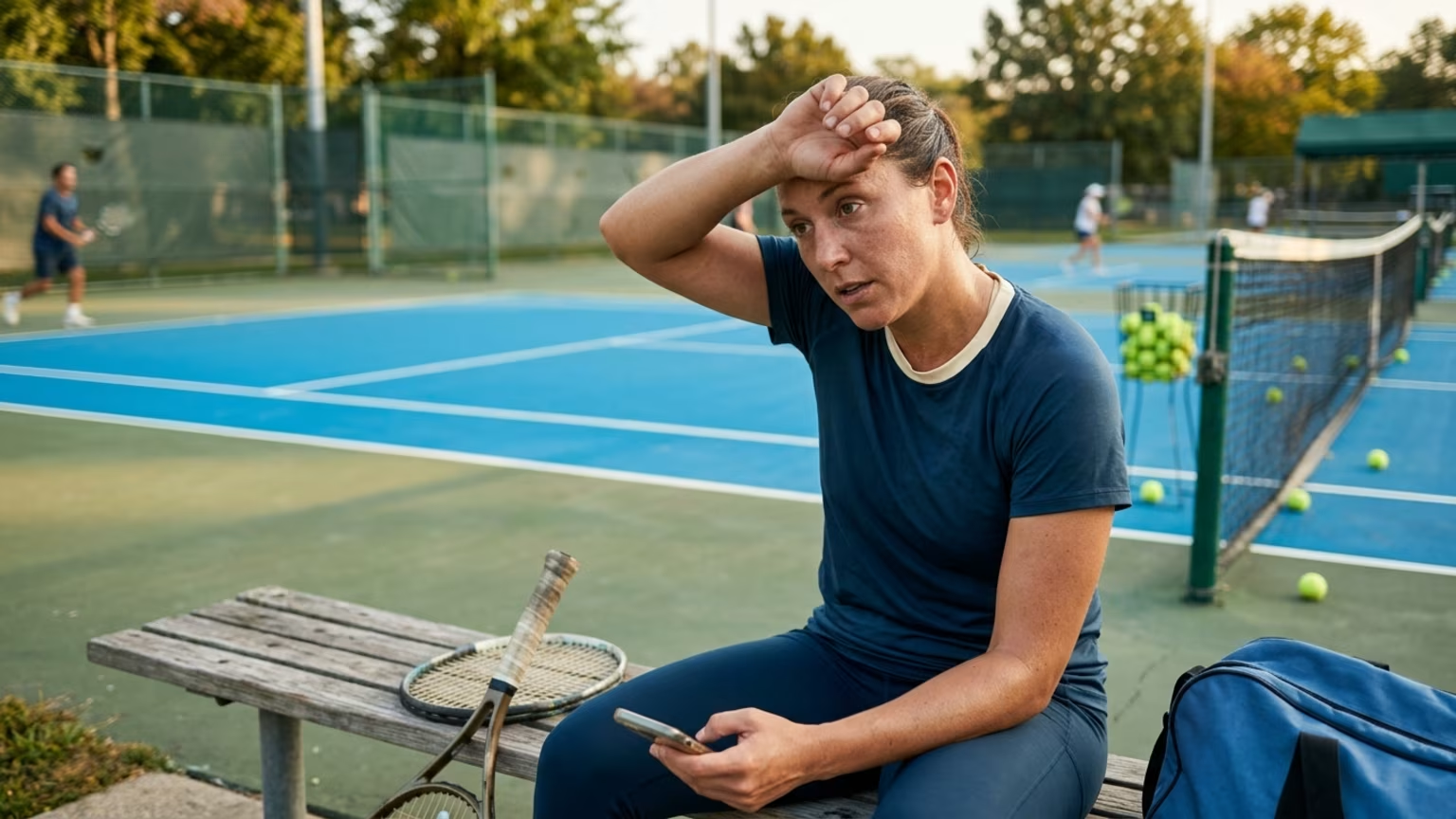

The 2026 US Open men's semifinals highlighted how "not before" start times create unpredictable preparation windows. Learn how adult racquet players can adapt.




On September 11, 2026, the US Open men's semifinals highlighted how broadcast schedules directly dictate pre-match preparation. Organizers set distinct television windows for the final four competitors. This approach forced players to adapt their physical readiness around "not before" start times rather than fixed schedules. The evening match relied entirely on the completion of the afternoon fixture, placing a premium on adaptable routines over rigid timetables.
India Today reported that the first semifinal between Alexander Zverev and Karen Khachanov carried a start time of not before 3 p.m. local time. The second semifinal featuring Frances Tiafoe and Ben Shelton was scheduled for not before 7 p.m. local time. The first men's semifinal was broadcast in a specific 3 p.m. to 6 p.m. Eastern television window according to Yahoo Sports. The second semifinal was assigned a 7 p.m. to 10 p.m. broadcast block.
In India, Star Sports Network held television rights for these matches. Live streaming was available through JioHotstar. Because the evening matchup could only begin after the first match concluded, both American competitors faced hours of uncertainty regarding their actual start. These situations show why scheduling remains a massive variable in tournament play.
These matches followed grueling quarterfinals that pushed the limits of typical athletic longevity. Shelton arrived after a five-set victory against defending champion Carlos Alcaraz that concluded at 3:33 a.m. Shelton won the five-set match with opening scores of 6-7 and 6-1. He took the third set 6-3 before dropping the fourth set 1-6, but ultimately secured the final set 7-6.
Tiafoe advanced after an equally punishing match against Alex Michelsen that lasted 4 hours and 39 minutes. Tiafoe dropped the opening sets 5-7 and 3-6 before mounting a comeback. He won the final three sets with scores of 7-5, 6-3, and 7-6.
The path to the first semifinal also featured substantial physical workloads. Zverev defeated Botic van de Zandschulp with scores of 6-2, 7-5, and 6-1 to reach his 13th Grand Slam semifinal. That victory brought his 2026 Grand Slam match-win total to 23. This milestone surpassed Boris Becker's German record of 22 set in 1989.
Khachanov reached his first US Open semifinal since 2022. He defeated third seed Felix Auger-Aliassime during his impressive tournament run and survived a five-set match against Learner Tien. Khachanov advanced again after Alexander Blockx retired. Blockx was trailing 6-2, 7-5, and 3-2 at the time.
Zverev led Khachanov 6-3 in their head-to-head record before the match. The all-American evening matchup featured a 3-1 head-to-head advantage for Shelton over Tiafoe. Ultimately, Zverev defeated Khachanov in straight sets with scores of 6-3, 7-6, and 7-6. Shelton beat Tiafoe 4-6, 6-3, 6-3, and 7-5 to reach his first Grand Slam final.
Adult recreational players rarely deal with global television broadcasts. However, anyone competing in weekend tournaments or evening league fixtures understands the challenge of delayed starts. Professional tennis routinely uses a not before time as a lower boundary rather than a guaranteed first ball. Recreational athletes can apply this same cautious approach and use smart tournament match scheduling for their own event planning.
Players should separate their main fueling from their immediate pre-match window. If you have an evening league match, eat your main meal sufficiently early. You can then keep a familiar snack available if court availability is delayed. Relying on an exact start time can leave a player hungry or digesting a heavy meal during the opening games.
A delayed match also requires a strategic physical preparation plan. Players facing a delayed start can complete a general mobility routine early. They can then perform a shorter sport-specific routine closer to the actual court time. Employing dynamic pre-match warmup plans ensures readiness without adding unnecessary fatigue before the match even begins.
Shelton's 3:33 a.m. quarterfinal finish illustrates how late play pushes the recovery window deep into the night. Adult players with morning work commitments must account for the time required to cool down after evening matches. You must allow time to rehydrate, travel home, and settle before attempting to sleep. Measuring an event solely by court time ignores the full physical toll of evening competition.
Protecting the following day is just as critical for athletic longevity. Tiafoe's quarterfinal lasted 4 hours and 39 minutes. After a comparable adult tournament match, a lighter next-day schedule is highly recommended. Proper rest management is just as important as checking your court gear condition before you compete again.
"I used to think a tough conditioning block was the only way to improve my court endurance," one of our editors shared. "Then I started tracking my sleep. I noticed that on days I slept less than six hours, my reaction time at the net was noticeably sluggish, and I felt gassed by the second set."
They emphasize, "Prioritizing consistent rest did more for my late match stamina than any extra sprints ever did. Recovery is the true foundation of performance."
The timing of a match changes the hours available for eating, cooling down, and mentally resetting. Matt Little told the BBC that the earlier-playing opponent could benefit from a full evening's rest and a good night's sleep. While a later start is not an automatic disadvantage, late play consistently alters baseline rest metrics. Preparation quality, match length, and individual routine all influence how a player responds.
A recent Oura analysis examined de-identified aggregate data from adult members across 11 global markets. This analysis spanned a one-month period from July 17 to August 17, 2026. Oura reported overnight heart rate variability suppression and a slightly elevated resting heart rate after tennis workouts. The company also noted that the lowest overnight heart rate occurred approximately 3 to 4 hours after sleep onset across regions.
These company-reported findings provide useful observational context for adult athletes. Recreational players can use personal observations like perceived soreness and sleep quality to gauge their response to evening competition. Shelton himself told the BBC he expected to feel "all right" after two days away from the court. This highlights that individual recovery perception varies widely among competitors.
Looking ahead to the next season, tournament start times will continue to test player adaptability as event schedules expand. Broadcasters and organizers will likely maintain dynamic scheduling formats to maximize viewership across different regions. Players who build flexible nutrition habits and respect their post-match sleep needs will remain highly capable. Managing your own preparation timetable is essential for success during unpredictable competitive environments.
Follow Evercourts for practical insights on tennis, pickleball and padel performance, movement, recovery and healthy ageing. Stay connected for new articles, research-led guidance and ideas to help you play well and keep playing for years.


A recent KeepActive directory update highlights a Melbourne-area padel program offering introductory coaching and social play for adults aged 65 and over.
Bhushan Akut won three 60+ gold medals at the 2026 Pickleball World Cup. Learn how sensible preparation and tactics inform recreational senior play.

Understand why racquet sports injuries spike after summer and how to safely return to the court using a phased approach to frequency and match intensity.
Read practical guidance for better movement, smarter preparation and a game that keeps working for you.
explore the Blog
