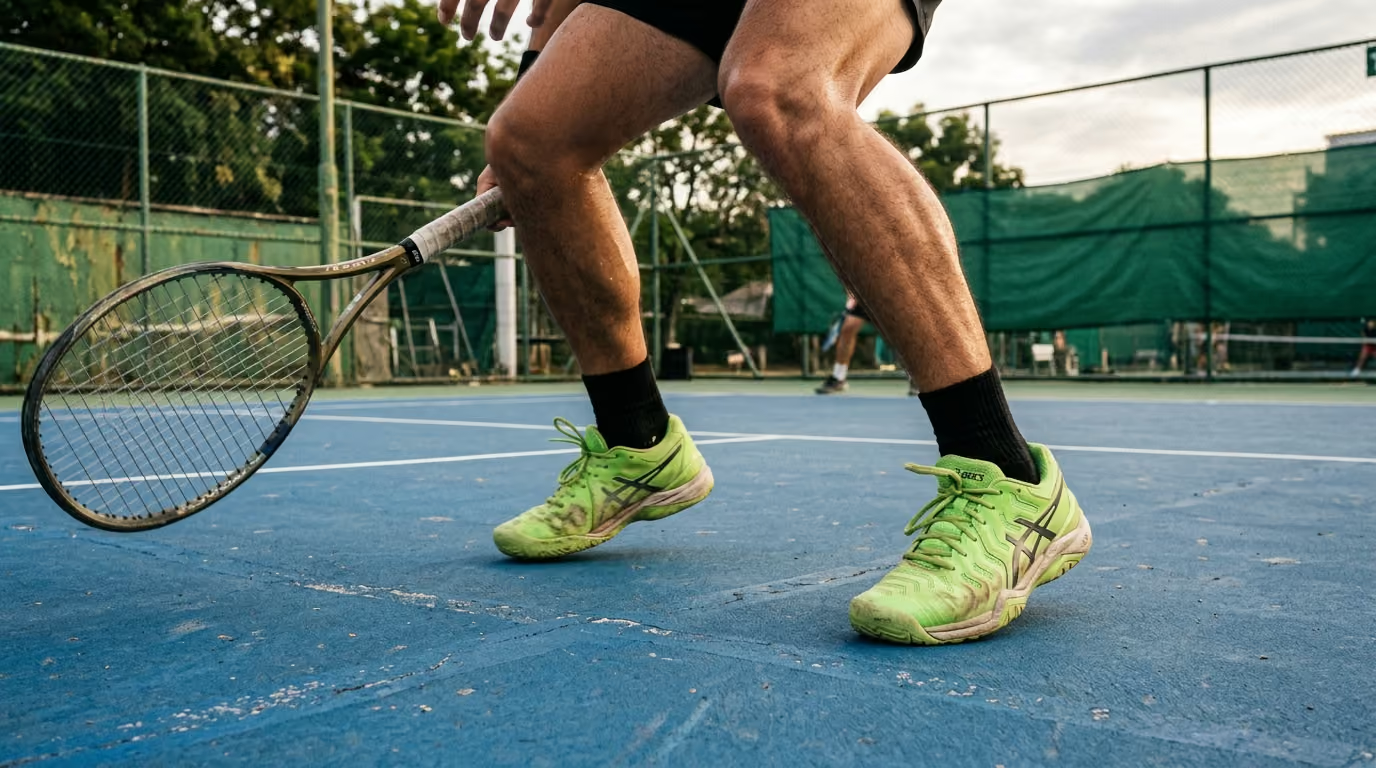
While many assume mimicking court movements in the gym builds durability, actual strength for hard court sports comes from basic, heavy, and controlled human movements.




Many court players believe they can build physical durability by mimicking their sport in the gym with light weights and balance accessories. However, swing-like exercises performed on unstable surfaces often fail to build the actual strength needed to stop and start on a hard court. The most effective way to protect your joints and increase your court speed is to build a foundation of basic, heavy, and controlled human movements.
A functional strength program for racquet and paddle sports must focus on basic movement patterns. These include squatting and hinging. You also need to train lunging, pushing, and pulling. In addition, you must practice carrying and rotating under control. By training these actions with progressive resistance, you build the physical capacity to play longer.
Ground reaction forces begin at the feet. These forces travel through the ankles, knees, hips, pelvis, and trunk. Finally, they reach the shoulder and the racket or paddle. According to research in tennis biomechanics, the whole body must work as a single unit to produce high swing speeds. If one link in this chain is weak, other joints must compensate. This compensation often leads to overload injuries in the shoulder or elbow. Therefore, we must train the lower body first to create a strong foundation for upper body power.
Research shows that court sports are characterized by intermittent work. In tennis, typical rallies involve high intensity efforts lasting four to ten seconds. These are followed by ten to twenty seconds of recovery. Padel rallies usually last ten to fifteen seconds. They involve repeated short sprints and quick direction changes.
Pickleball has a different movement profile. It often involves lower average intensity but requires many sudden lunges and quick reaction steps. In all three sports, your muscles must absorb force before they can produce it. This means eccentric strength is just as important as concentric strength.
When you deceleration on the court, your tendons and muscles must absorb multiple times your body weight. Without adequate strength, this force is transferred directly to your passive joint structures. Over time, this passive loading leads to joint wear and chronic discomfort. A structured strength program acts as an active shield for your joints.
To build an effective training plan, you must understand several key principles of physical conditioning. These terms help clarify how gym exercises transfer to actual court performance.
Maximal strength is the greatest amount of force a muscle can produce in a single effort. It is often measured by a one repetition maximum. While you do not need to lift maximal loads frequently, raising your strength ceiling makes submaximal court movements much easier.
Relative strength is your strength compared to your body weight. Since you must constantly move your own body on the court, relative strength is highly important. Building muscle without adding unnecessary body mass improves your speed and agility. This allows you to cover the court with less effort.
This concept describes how fast you can produce force. When you perform a split step or change direction, you only have milliseconds to react. Training for power helps you apply your strength quickly.
To improve this quality, you must perform exercises with high intent. Moving moderate loads as fast as possible trains your nervous system to recruit muscle fibers quickly. This is essential for first step quickness and rapid recovery steps.
Eccentric strength refers to force production while a muscle is lengthening. It is the key to braking and stopping safely. Without strong eccentric capacity, your muscles cannot control your momentum. This leads to unstable joints and increased risk of ligament strains.
Isometric strength is force production without joint movement. This helps you hold low, stable positions on the court. It is also vital for spinal bracing. A strong trunk prevents energy leaks during the transfer of force from your legs to your arms.
Rotational strength is the ability to produce or resist trunk rotation under load. Rotational mobility is the range of motion available in your hips and upper back. Many players try to generate rotation by twisting their lower back. This is a common error that leads to spinal disc irritation.
I remember finishing a tough two hour padel match on a cold Tuesday night and waking up the next morning feeling like my lower back was locked in concrete. For a long time, I just accepted this as the price of playing hard in my forties. But once I started spending just ten minutes on targeted hip mobility before heading to the club, the stiffness almost completely vanished. It taught me that we do not have to accept pain as a default state of aging. We must focus on mobility in the hips and stability in the lower back.
Acute workload is your recent training volume over the last week. Chronic workload is your average training volume over the last month. A sudden increase in acute workload is a major predictor of injury.
Research on junior and adult tennis players shows that keeping this ratio stable reduces the risk of injury. You should avoid doubling your court time or starting a high volume strength program overnight. Gradual progression is the safest path to long term health.
A balanced program does not rely on isolated muscle machines. Instead, it organizes exercises into functional movement families. This structure ensures that you train every physical quality needed for court sports.
Knee dominant exercises build strength in your quadriceps and glutes. These muscles are vital for low defensive stances and explosive jumps.
To perform a goblet squat, stand with your feet slightly wider than shoulder width apart. Flare your toes outward at a small angle. Hold a dumbbell or kettlebell vertically against your chest. Keep your elbows tucked in close to your ribs.
Initiate the movement by pushing your hips back. Bend your knees to lower your body toward the floor. Keep your chest up throughout the movement. Descend until your thighs are parallel to the ground.
Push through your entire foot to return to the starting position. Keep your knees aligned with your toes as you rise. This exercise is an excellent starting point for building squat depth.
A front squat places a barbell across the front of your shoulders. This variation targets the quadriceps and demands high trunk stiffness. To perform it safely, you must maintain a tall upper back posture.
A Spanish squat uses a thick band placed behind your knees. Stand with your feet hip width apart and step back until the band is taut. Sit back into a squat while keeping your shins vertical. This variation is highly effective for patellar tendon health because it reduces joint shear forces.
Hip dominant exercises target your glutes and hamstrings. These posterior chain muscles are the main drivers of acceleration and deceleration.
To perform a Romanian deadlift, hold a barbell or dumbbells in front of your thighs. Stand with your feet hip width apart. Soften your knees slightly. Keep your spine in a neutral position.
Initiate the movement by pushing your hips directly backward. Imagine you are trying to touch a wall behind you with your glutes. Lower the weight along the front of your legs. Only descend as far as your hip flexibility allows without rounding your back.
Squeeze your glutes to push your hips forward and return to a standing position. This exercise builds eccentric strength in the hamstrings. This is critical for deceleration control on the court.
A trap bar deadlift is an excellent option for heavy loading. Stand inside the hexagonal frame and grip the side handles. Push your feet into the floor to lift the weight. This design reduces stress on the lower back compared to a conventional barbell deadlift.
A single leg Romanian deadlift builds unilateral balance. Hold a dumbbell in the hand opposite to your standing leg. Hinge forward while extending your non standing leg straight behind you. This trains the deep hip stabilizers to control lateral movement.
Unilateral exercises match the asymmetrical demands of court movement. You rarely strike a ball with both feet flat on the ground.
To perform a reverse lunge, stand tall with your feet together. Step backward with your right leg. Lower your hips until your left thigh is parallel to the floor. Keep your front knee aligned over your ankle.
Your back knee should hover just above the ground. Push through your front heel to step back to the starting position. This movement targets the glutes and quadriceps while protecting the knees.
A lateral lunge targets the frontal plane. Step directly to the side and bend one knee while keeping the other leg straight. This builds strength in the muscles that control lateral stopping and starting.
A rear foot elevated split squat is a highly demanding exercise. Place your back foot on a bench or step behind you. Lower your hips until your front thigh is parallel to the ground. This delivers a deep strength stimulus without overloading the spine with heavy weights.
Upper body pressing exercises strengthen the chest, shoulders, and triceps. They also train the core to transfer force from the lower body.
To perform a push up, place your hands on the floor slightly wider than shoulder width. Keep your body in a straight line from head to heel. Engage your core and glutes. Lower your chest toward the floor by bending your elbows at a forty five degree angle.
Push back up to the starting position. Do not allow your lower back to sag. If this is too difficult, elevate your hands on a bench or wall. This modification reduces the load while maintaining correct movement patterns.
A landmine press is highly friendly for the shoulders. Place one end of a barbell in a pivot sleeve. Hold the other end at shoulder height. Press the bar forward and upward in a diagonal path. This allows the shoulder blade to move naturally.
A dumbbell bench press allows your wrists to find a natural path. Lie on a flat bench and press dumbbells upward. This reduces stress on the shoulder joints compared to a fixed barbell bench press.
Pulling exercises target the upper back and the posterior shoulder muscles. These muscles decelerate your arm after a fast serve or smash.
To perform a one arm dumbbell row, place your right knee and right hand on a flat bench. Hold a dumbbell in your left hand. Let your arm hang straight down. Keep your spine flat and your chest parallel to the bench.
Pull the dumbbell up toward your hip. Keep your elbow tucked close to your ribs. Squeeze your shoulder blade at the top of the movement. Lower the weight under control. This exercise trains horizontal pulling and trunk stability.
A chest supported row isolates the upper back. Lie face down on an inclined bench. Pull dumbbells toward your ribs. This prevents you from using momentum and protects your lower back from fatigue.
A face pull targets the rotator cuff and upper back. Attach a rope to a cable machine at eye level. Pull the center of the rope toward your nose while flaring your elbows. This exercise builds the endurance needed to support the shoulder during overhead strokes.
Carrying exercises build grip strength, shoulder stability, and lateral trunk control. They are simple to perform but offer massive physical benefits.
To perform a farmer carry, hold a heavy weight in each hand. Stand tall with your shoulders pulled back and down. Walk forward slowly with short, deliberate steps. Keep your head up and your core engaged.
Avoid letting the weights bounce against your thighs. This exercise builds full body tension and improves grip strength. Strong grip strength is directly linked to better racket control and elbow health.
A suitcase carry uses a weight in only one hand. Walk slowly while resisting the urge to lean to the side. This trains the lateral core muscles to resist lateral flexion.
A front rack carry requires holding kettlebells or dumbbells at chest level. Keep your elbows high and your ribs down as you walk. This targets the anterior core and upper back.
These exercises teach you how to transfer power through your torso. They also protect your spine from excessive twisting under load.
To perform a Pallof press, stand sideways to a cable machine. Hold the cable handle with both hands at chest level. Step away from the machine until the cable is taut. Stand with your feet shoulder width apart and knees slightly bent.
Press the handle straight out in front of your chest. Resist the pull of the cable to keep your body square. Hold for two seconds, then bring the handle back to your chest. This exercise trains the core to resist rotation.
A medicine ball scoop toss builds rotational power. Stand sideways to a solid wall. Hold a medicine ball at hip level. Swing the ball back, then toss it underhand against the wall by driving your hips forward.
A dead bug trains anterior core stability. Lie on your back with your arms pointing up and your knees bent at ninety degrees. Lower your right arm and left leg toward the floor. Keep your lower back pressed flat against the ground. Return to the starting position and repeat on the other side.
While the basic exercises remain the same, you must tailor their application. The specific physical demands of your sport should guide your focus.
Tennis is played on a large court. It requires long sprints and deep lateral lunges. Tennis players need high levels of eccentric strength to stop quickly from full sprints. You should place a high priority on lateral lunges and single leg squats.
Tennis serves also put massive stress on the shoulder joint. To balance this stress, include plenty of horizontal pulling and external rotation exercises. Refer to our strength and conditioning resources for specific workout designs.
We also suggest focusing on foot and ankle stability. The frequent sliding and directional changes in tennis require strong calf and ankle complex structures. Performing single leg balance work can significantly improve your stability on hard courts.
Padel is played in a smaller, enclosed court. The movement consists of short, rapid accelerations and constant changes of direction. Padel players spend a lot of time in low, bent knee positions near the walls.
Therefore, padel training should focus on calf strength, Achilles tendon tolerance, and low quadriceps endurance. Exercises like the Spanish squat and heel elevated split squat are highly useful. You also need excellent shoulder endurance to handle the high volume of overhead shots. Review our padel play guidelines to understand these physical court dynamics.
Overhead smashes are much more frequent in padel than in tennis. This means the rotator cuff muscles must be trained for endurance. High repetition band work and controlled overhead carries should be staples of your routine.
Pickleball features a smaller court and a lighter ball. However, the rapid nature of the game requires quick reflexes and deep lunging steps. A major study on pickleball injuries showed a massive increase in emergency room visits. Many of these injuries occurred in older players.
If you play pickleball, focus on balance, single leg stability, and fall reduction. Exercises like the step down and supported split squat are excellent starting points. You also need to build forearm and wrist strength to prevent common issues like tennis elbow. Our pickleball movement patterns guide offers additional tips for staying active on the court.
The quick reactions required at the kitchen line demand fast footwork. Including low volume plyometric landing drills can improve your reaction time. It also prepares your joints to absorb sudden landing forces.
Consistency is the key to building real physical changes. You must structure your training week to balance strength work with court play. The World Health Organization recommends performing muscle strengthening activities at least two days per week. For most recreational players, two weekly strength sessions are ideal. This frequency builds physical resilience without causing excessive fatigue.
This split is perfect for players who play matches two to three times per week. It keeps your legs fresh while maintaining joint strength.
Day A (typically Monday)
Day B (typically Thursday)
This structure is for players who want to build higher levels of athletic capacity. It allows you to dedicate separate days to power and strength.
Session 1: Force Focus
Session 2: Power and Movement Focus
Session 3: Unilateral Focus
You do not need a fully equipped gym to build a resilient body. You can adapt the movement families to match whatever equipment you have.
If you travel or prefer to train at home, bodyweight training is highly effective. You can increase the difficulty by using slow tempos or unilateral positions.
Bands are cheap, portable, and gentle on the joints. They provide resistance that increases as the band stretches.
Free weights are ideal for unilateral training. They allow you to train one limb at a time, which helps correct muscle imbalances.
Machines are sometimes viewed as nonfunctional, but this is a mistake. They are excellent for isolating muscles and adding training volume without balance limitations.
An effective strength program must address the most common injury areas in court sports. Physical preparation is the best tool we have to stay active.
A major scientific review of high performance tennis players found that lower limb injuries are highly common. They account for nearly half of all reported issues. Lumbar spine problems and shoulder overuse syndromes are also prominent.
A meta-analysis of exercise interventions reported that strength training reduced sports injuries to less than one third. Overuse injuries were cut by nearly half. Stretching alone did not show a beneficial injury prevention effect in this analysis. This highlights why lifting weights is so important for athletic longevity principles.
Repeated serving and overhead smashing put extreme demands on the rotator cuff. To keep your shoulders healthy, you must balance your hitting volume with targeted strengthening.
Repetitive gripping can irritate the tendons in your forearm. This issue is common in tennis, padel, and pickleball.
Your ankles, knees, and hips absorb massive forces when you decelerate. Building strength in these areas prevents chronic joint pain.
To get the most out of your training, you must avoid several frequent training errors. These mistakes can reduce your performance and increase your risk of injury.
Squatting on a Swiss ball or balancing on a foam pad may feel difficult. However, it does not build the high levels of force needed for court sports.
Unstable surfaces reduce the amount of weight you can lift. To build real strength, you need a stable base. Perform your main lifts on flat ground and build stability through unilateral exercises instead.
Some players believe a workout is only effective if they cannot walk the next day. This is a mistake.
Severe muscle soreness impairs your movement on the court. It reduces the quality of your practice sessions and matches. Your gym sessions should leave you feeling strong and energized, not completely exhausted.
Many players spend twenty minutes stretching before they play. They believe this prevents pulled muscles.
However, research shows that static stretching does not reduce injury risk. Instead, focus on a dynamic warm up before you play. Use progressive strength training in the gym to build long term tissue resilience. Read our injury prevention methods to learn more about dynamic preparation.
Let us look at how to apply these concepts to actual players. These case studies show how to adapt the program to different life situations.
This player is in their late forties and plays competitive singles matches twice a week. They have limited gym time and often feel heavy legs during matches.
We program two short, full body sessions per week. Each session lasts thirty minutes and focuses on four main exercises. We schedule the heavy lower body session at least forty eight hours before their matches. This ensures their legs are fully recovered for the court.
This player is sixty five years old and wants to start playing pickleball. They are concerned about balance, knee pain, and the risk of falling.
We begin with a gentle, progressive program. We use the sit to stand exercise to build leg strength safely. We also include suitcase carries to improve balance and step downs to build knee control. The player performs these exercises twice a week and focuses on slow, controlled movements.
This player added a third weekly match to their schedule. Soon after, they developed irritation on the outside of their elbow.
We temporarily reduce their playing volume. In the gym, we replace straight bar pressing exercises with dumbbells using a neutral grip. We also add slow, eccentric wrist extension exercises to build tendon strength. We do not try to stretch the forearm aggressively.
This player is preparing for a club tournament. They want to maintain their strength without accumulating physical fatigue.
We reduce their gym volume by forty percent. We keep the weights moderate to heavy but perform fewer sets. We focus on high quality movement and explosive power exercises like light medicine ball throws. This maintains their physical capacity while keeping them fresh for matches.
While progressive strength training is highly effective, it cannot solve every issue. You must listen to your body and know when to seek professional help.
If you experience sharp, localized pain that does not improve with rest, consult a doctor. The same applies to joint swelling, numbness, or tingling down your arms or legs. These symptoms require a professional medical evaluation.
A qualified physical therapist can help you identify specific movement limitations. They can design a targeted rehab plan that fits your physical needs. Do not try to push through pain, as this often leads to chronic tissue damage.
By building a strong physical foundation, you can continue to enjoy your favorite court sports for many years to come.
Follow Evercourts for practical insights on tennis, pickleball and padel performance, movement, recovery and healthy ageing. Stay connected for new articles, research-led guidance and ideas to help you play well and keep playing for years.


Read practical guidance for better movement, smarter preparation and a game that keeps working for you.
explore the Blog