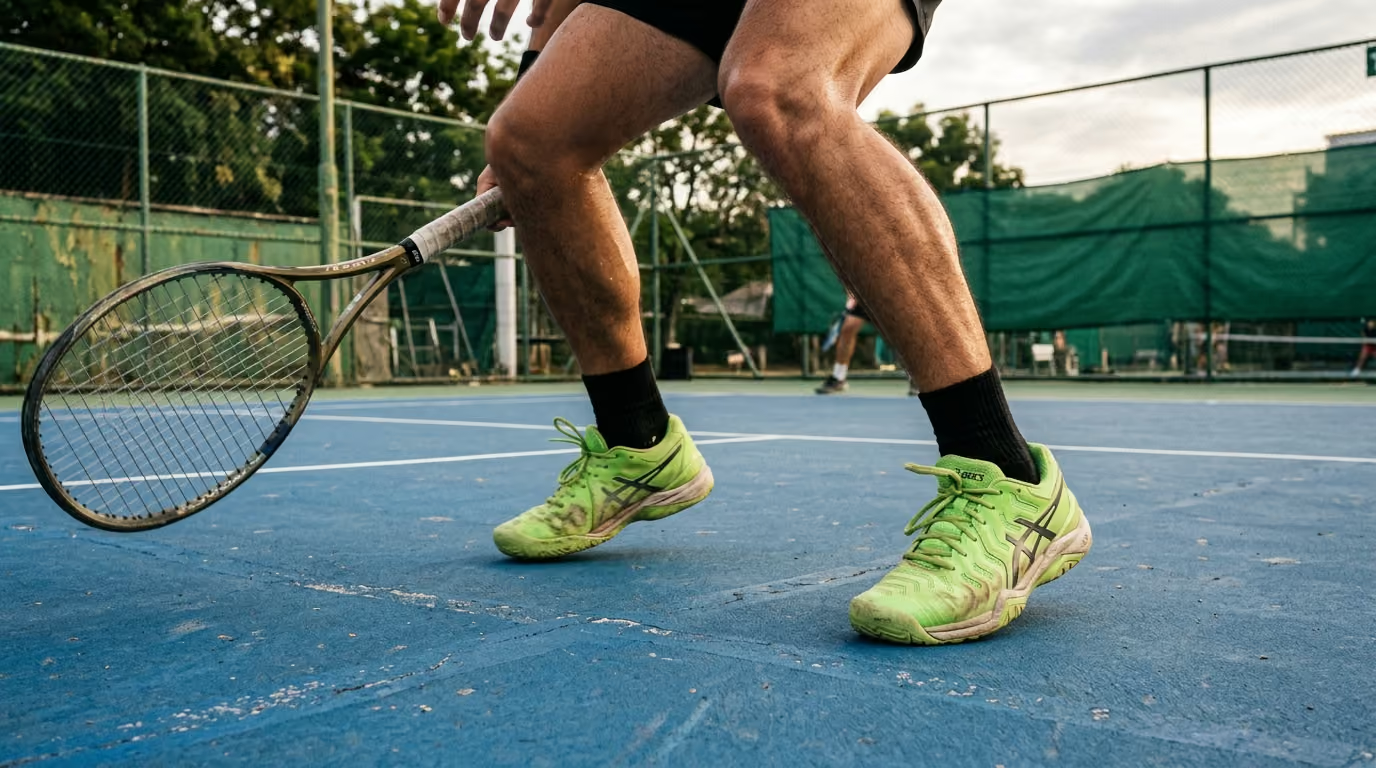
A progressive strength program can significantly improve adductor and groin health for racquet sports, enhancing lateral speed and pelvic stability.




A successful approach to groin health in racquet sports requires more than performing basic inner thigh stretches or squeezing a foam block between your knees. To protect your hips during rapid direction changes, you must build capacity in the adductor muscle group to tolerate extreme ranges of motion under load. This guide outlines a research backed strength program designed to improve lateral speed, stabilize the pelvis, and reduce the risk of common groin issues on the court.
Adductor strength is a vital part of a broader physical system that includes hip mobility, pelvic control, and lateral braking ability. Many traditional exercise routines treat the inner thigh as an isolated muscle group. On the court, however, these tissues must work in tandem with the core and glutes to control your entire body weight as you change direction. By following a progressive, criteria based strengthening framework, you can build the specific physical capacity needed to play tennis, pickleball, or padel for years to come.
To build an effective training program, you must first understand the anatomy and function of the medial thigh. The hip adductor group is not a single muscle. It consists of several distinct tissues, including the adductor longus, adductor brevis, adductor magnus, gracilis, and pectineus. Together, these muscles run from the pelvis down to the femur and inner knee, forming a complex network of soft tissue.
While their primary anatomical action is drawing the leg toward the midline of the body, their role during court play is far more complex. When you play racquet sports, the adductors perform three distinct mechanical jobs. Understanding these roles helps clarify why standard gym machines are often insufficient for court athletes.
Concentric adduction occurs when the muscles actively shorten to pull your leg inward. This action is essential when you transition from a wide stance back into a central court position. The adductor muscles contract to pull your trail leg toward your body, initiating your recovery step. A weak concentric contraction can make your lateral recovery slow and sluggish.
Isometric stabilization occurs when the adductors hold a constant length to resist external forces. As you prepare to hit a shot in a wide stance, the inner thigh muscles contract isometrically. This keeps your femur stable beneath your pelvis. It prevents your hips from shifting unpredictably, which allows you to transfer energy efficiently from the ground up through your racquet.
Eccentric braking is perhaps the most critical function for court athletes. As you step wide to reach a ball, your reaching leg moves away from your body, stretching the adductors. The inner thigh muscles must contract while they are lengthening to slow your body down and prevent your knee from collapsing. This eccentric control is what keeps you from overstretching or losing balance at the end of a wide stride.
When choosing exercises for your routine, you must distinguish between short lever and long lever movements. Short lever exercises keep the knees bent, which shortens the distance between the hip joint and the point of resistance. This setup reduces the mechanical load on the pelvis and is ideal for early stage training or warm ups. Long lever exercises keep the leg straight, which increases the rotational force around the hip joint and places a much higher demand on the adductor tendons.
A primary goal of adductor training is maintaining pelvic stability during dynamic movement. When you lunge laterally, your pelvis naturally wants to tilt or rotate toward the unsupported side. Strong adductors work alongside your deep abdominal muscles to resist this unwanted movement. Keeping your pelvis level allows you to decelerate safely and push back toward the center of the court with maximum power.
The physical demands of racquet sports place unique, high-velocity loads on the inner thigh muscles. Unlike running in a straight line, court movement is characterized by sudden lateral starts, deep lunges, and rapid directional shifts. Each of these actions requires your groin muscles to absorb and produce force in fractions of a second.
When you slide or lung to hit a wide ball, your center of mass is displaced far outside your base of support. To stop your momentum, the adductors of your lead leg must absorb the impact force of your foot strike. If your muscles lack the capacity to brake this movement, the stress is transferred directly to your tendons and pubic joints. Over time, this repetitive overloading can lead to chronic irritation and pain.
Furthermore, a fast recovery step is crucial for staying in a rally. Once you hit the ball from a wide position, you must immediately redirect your momentum back toward the middle of the court. This transition requires a rapid shift from eccentric braking to concentric push-off. If your adductors are weak or fatigued, your recovery step will be delayed, leaving you out of position for the next shot.
Unpredictable play increases this physical demand. In a controlled gym setting, you know exactly when and where you will step. On the court, you must constantly react to deceptive shots, bad bounces, and sudden changes of direction. This reactive movement often forces you into awkward, deep lunges where you cannot plan your foot placement. Building a surplus of adductor strength ensures that your tissues can tolerate these emergency positions without sustaining damage.
To design a truly effective program, we must look at what peer-reviewed research says about groin strength. Most high-quality studies on adductor training come from sports like soccer, where lateral cutting and kicking are highly prevalent. While court sports have unique movement patterns, we can use this clinical data to build a reliable training framework.
A landmark study published by Harøy and colleagues evaluated a specific adductor-strengthening program using the Copenhagen Adduction Exercise. The researchers tracked thirty-five semi-professional soccer teams over a competitive season. The intervention group, which included 339 players, performed the Copenhagen exercise three times per week during a six to eight-week preseason. They then performed it once per week during the twenty-eight-week competitive season.
The control group, consisting of 313 players, followed their standard training routines without any extra adductor exercises. The results were highly encouraging. The intervention group experienced a forty-one percent reduction in the prevalence of groin problems compared to the control group. The average seasonal prevalence of groin issues was thirteen point five percent in the strengthened group, compared to twenty-one point three percent in the control group.
This study offers strong evidence that target-specific strengthening can make inner thigh tissues more resilient. However, more recent scientific reviews suggest we should remain cautious. A systematic review published in 2025 looked at the broader impact of Copenhagen exercises on seasonal injury rates across multiple sports. This review found that while the exercise is exceptional for building absolute strength, the overall reduction in seasonal injury rates was not statistically significant across all cohorts.
This conflicting evidence reminds us that strength is only one piece of the puzzle. Having strong adductors is incredibly beneficial, but it does not guarantee you will never experience a groin strain. Your actual risk of injury is also influenced by your total playing volume, your movement mechanics, and your overall recovery quality. To maximize your resilience, you should combine adductor strength work with comprehensive injury prevention strategies that address the entire body.
Some sports medicine researchers have attempted to identify specific strength numbers that correlate with a lower risk of groin issues. For example, a prospective study on professional athletes found that players who sustained groin strains often had lower baseline isometric adductor strength. Specifically, players with an absolute squeeze force below 465.33 Newtons were found to have a seventy-two percent higher risk of injury.
The same study suggested that a strength-to-body-mass ratio of less than 0.971 Newtons per kilogram of body weight was associated with an eighty-three percent increase in injury likelihood. While these numbers are valuable for researchers, you should not treat them as strict pass or fail benchmarks for recreational play. Force measurements vary widely depending on the testing device, your hip position, and your individual body structure.
Similarly, the relationship between strength asymmetry and injury risk is often misunderstood. Some players believe that if one leg is slightly weaker than the other, they are bound to get hurt. However, multiple prospective studies have shown no direct link between adductor strength asymmetry and future groin injuries. Adaptations are normal in racquet sports because you often load one leg more than the other during serves and lunges. Instead of obsessing over perfect symmetry, you should focus on building adequate baseline strength in both legs.
To build lasting tissue resilience, you must follow a structured training progression. Rushing into advanced, long lever exercises too quickly can overload your tendons and lead to unnecessary soreness. This program is divided into five progressive phases. You should move from one phase to the next based on your movement quality and pain response, not a set calendar schedule.
Before you begin adding heavy loads to your routine, you must establish your current physical baseline. If you currently have active groin pain, your first step is to identify what movements trigger your symptoms. Gently press along your inner thigh to check for localized tenderness, and perform a light knee squeeze to see if it causes discomfort.
If you have recognizable pain during these simple tests, you must adjust your training intensity. A practical clinical milestone is to keep your pain levels very low, ideally no higher than a two on a ten-point pain scale. This low pain threshold should be maintained during and after all your exercises. If any movement causes a sharp spike in pain, you should pause and regress to an easier variation.
The goal of this phase is to build basic muscular endurance and coordination without placing high stress on your joints. We use short lever exercises and holds to gently introduce tension to the inner thigh tissues.
Lie on your back with your knees bent and your feet flat on the floor. Place a medicine ball, yoga block, or rolled-up towel between your knees. Gently squeeze the object using about fifty percent of your maximum effort, and hold the contraction for twenty seconds. Complete three to five sets of this exercise, making sure you do not experience any pinching in your groin.
Lie on your side with your top leg bent and your foot placed flat on the floor behind your bottom leg. Keep your bottom knee bent at a ninety-degree angle. Slowly lift your bottom knee toward the ceiling, hold for two seconds, and then lower it back down under control. Perform two to four sets of eight to twelve repetitions on each side.
Lie on your side on the floor, facing perpendicular to a sturdy gym bench or couch. Place your top knee on top of the bench while keeping your knee bent at a ninety-degree angle. Support your upper body on your bottom elbow. Lift your hips until your body forms a straight line from your shoulder to your top knee, and hold this position for ten to fifteen seconds. Perform two to three sets per side, focusing on keeping your hips high.
Once you can perform short lever exercises without any discomfort, you can progress to long lever movements. This phase increases the mechanical load on your tendons to build the eccentric strength needed for court play.
Set up in the same side-lying position as the short-lever plank, but place your top foot and ankle on the bench instead of your knee. Keep your top leg completely straight. Lift your hips so your body forms a line from your shoulders to your top ankle, and hold for ten to twenty seconds. This variation significantly increases the leverage on your inner thigh, so start with short holds.
Stand with your feet hip-width apart, placing your right foot on a slider disc or a towel if you are on a smooth floor. Keep your left leg planted firmly, and slowly slide your right foot out to the side. Bend your left knee and sit your hips back to lower into a lunge, keeping your sliding leg completely straight. Use your inner thigh muscles to slide your right foot back to the starting position under control. Perform two to three sets of eight repetitions per side.
Anchor a resistance band to a sturdy post at ankle height. Stand sideways next to the post, and loop the band around the ankle closest to the anchor point. Step away from the post to create light tension in the band. Balance on your outside leg, and slowly pull your banded ankle across the front of your body. Return to the starting position slowly, resisting the pull of the band. Perform three sets of ten to twelve repetitions on each leg.
This phase moves away from isolated gym exercises and focuses on functional movement patterns. We want to teach your body to decelerate during wide lunges and transition smoothly into recovery steps.
Step wide to your right side, landing with your foot flat on the floor. Allow your right hip and knee to bend together, absorbing your body weight as you lower your hips. Hold this deep lunge position for two seconds, keeping your chest up and your pelvis level. Push forcefully through your right foot to return to your starting position in one smooth motion. Perform three sets of six to eight repetitions on each side.
Stand on your left foot with your knee slightly bent. Step laterally to your right, landing on your right foot, and immediately freeze in a half-squat position. Hold this landing for three seconds without letting your knee wobble or your hips drift. This drill teaches your nervous system to stabilize your joints during sudden, lateral stops. Perform two sets of six repetitions per side.
Place two cones on the floor about ten feet apart. Start at the left cone in an athletic stance. Shuffle quickly to the right cone, plant your right foot, and drop into a wide lateral lunge. Immediately push off your right foot and use a crossover step to return to the left cone. Focus on making the transition from landing to pushing off as fast and smooth as possible. Complete three sets of five back-and-forth repetitions.
In this final phase, we combine your strength gains with unpredictable, game-like movements. This step ensures that your newly developed adductor capacity translates directly to improved performance and safety during competitive matches.
Have a partner stand in front of you holding two different colored tennis balls. As you shuffle laterally back and forth, your partner will point in a direction or drop a ball. You must immediately react, change direction, and lunge to catch the ball before it bounces twice. This drill trains your adductors to handle the sudden, unplanned braking forces that occur during real rallies.
Hold your racquet or paddle and stand in the center of the court. Perform a fast, diagonal step toward an imaginary low ball, drop into a deep lunge, and execute a full shadow stroke. Focus on keeping your trailing leg stable and your core engaged as you swing. Immediately push back to the center of the court and split-step. Perform three sets of ten alternating shadow swings.
While the fundamental biology of your muscles remains the same, the way you load your adductors varies depending on your specific sport. Each court game features unique court dimensions, ball speeds, and movement mechanics that alter the physical demands on your body. Tailoring your off-court strength training to these specific demands can maximize your efficiency.
Tennis players move across a large court and reach high sprint speeds when running down wide balls. On hard courts, this requires massive deceleration forces to stop your momentum. On clay courts, you must slide into your shots, which places an extreme eccentric demand on your adductors at very long muscle lengths.
To prepare for these demands, tennis players should focus heavily on long lever Copenhagen planks and wide, loaded lateral lunges. These movements build the necessary high-velocity eccentric strength to decelerate safely at the end of a sprint.
Pickleball is played on a much smaller court, which reduces the need for long, high-speed sprints. However, the game is characterized by constant, low-standing lateral shuffling near the kitchen line. Players must spend long periods in a deep semi-squat, making quick lateral adjustments to reach low dink shots.
Pickleball players should emphasize isometric adductor endurance and short lever strength. Exercises like the supine pad squeeze and moderate-range lateral step-and-sticks are highly beneficial. These drills help maintain pelvic stability during fast, short-distance exchanges.
Padel matches feature a unique blend of tennis and squash movement patterns. Because the court is enclosed, you must frequently turn, run backward, and lunge at awkward angles to play balls off the glass walls. This requires constant rotation of the hips and trunk while moving laterally.
Padel players should incorporate multi-planar lunges and rotational core exercises into their routines. Performing lateral lunges with a trunk rotation or adding single-leg hinges can help prepare your groin muscles to stabilize your hips during complex, turning movements.
To ensure your training is effective, you need objective ways to measure your progress. Relying on how you feel can sometimes be misleading. Using clear performance benchmarks helps you determine when you are ready to progress to more challenging movements or return to full-intensity play.
Your primary progress indicator should be your pain response during and after exercise. If you can perform all your strengthening movements with a pain score below two out of ten, your body is adapting well to the workload. Always monitor how your groin feels the morning after a heavy training session. If you experience increased stiffness or aching, it means you should reduce your exercise volume or intensity.
For strength benchmarks, a good goal is to hold a short lever Copenhagen plank for thirty seconds on each side with perfect posture. Once you achieve this, aim to perform ten slow, controlled repetitions of the long lever Copenhagen plank. For functional movement, you should be able to perform a lateral lunge with a weight equal to twenty percent of your body weight. During this lunge, you must maintain excellent control of your knee and pelvis, without letting your hips tilt or your knee collapse inward.
Before returning to full, competitive play after a groin strain, you should complete a comprehensive court movement assessment. You should be able to perform maximum-effort linear sprints, planned lateral shuffles, and reactive change-of-direction drills without any pain or hesitation. If you feel any catching, pulling, or weakness during these fast movements, you are not yet ready for match play and should continue focusing on your strength foundation.
Avoid these common training errors to prevent setback and ensure you get the most out of your groin strengthening program.
The Copenhagen plank is a fantastic exercise for building inner thigh strength, but it is not a complete solution. It is a highly isolated movement that does not train your body to coordinate your feet, knees, and hips together. To build true court resilience, you must combine Copenhagen variations with dynamic movements like lateral lunges, step-and-sticks, and recovery drills.
Because the long lever Copenhagen plank is a popular exercise on social media, many players attempt it on their first day of training. This exercise places immense leverage on your hip joints and pubic bone. If your tendons are not yet conditioned to handle this stress, jumping straight to long lever holds can cause severe tendon irritation. Always spend at least two weeks mastering the short lever variations before trying the straight-leg versions.
Many players focus only on the concentric part of their exercises, lifting the weight quickly and letting it drop back down without control. On the court, however, most groin strains occur during the eccentric phase when your muscles are stretching to slow you down. To prevent this, focus on slowing down the lowering phase of your lateral lunges and Copenhagen planks. Count to three as you lower your hips to ensure your muscles are actively controlling the entire movement.
To see how these concepts apply to real players, let us look at some common case patterns we see on the court.
This player can perform heavy barbell squats and leg presses in the gym without any issues. However, whenever they must lung wide to retrieve a deep ball during a match, they feel a sharp pull in their groin. This occurs because general lower-body exercises do not train the adductors at long muscle lengths.
To fix this, the player should replace some of their bilateral squats with sliding lateral lunges and long lever isometric holds. These exercises will help train their inner thigh muscles to tolerate high tension in stretched positions.
This player has great acceleration and can easily reach wide balls. However, after they hit the shot, they struggle to push off their outside foot to return to the center of the court. They often feel heavy and slow during long rallies, and their inner thighs feel incredibly tight after playing.
This issue is caused by a lack of concentric adductor power and poor recovery coordination. The player should focus on dynamic recovery drills, such as the crossover step drill, to teach their muscles to transition quickly from braking to pushing off.
This player has no history of groin injuries, and both of their legs feel equally strong during casual play. However, their absolute lower-body strength is very low, and they experience general hip fatigue late in matches.
This case demonstrates that having symmetrical strength does not mean you have adequate physical capacity. The player should start a progressive strengthening program using basic isometrics and gradually progress to loaded lateral lunges. This will help build a larger physical reserve to protect their hips as they play more frequently.
Because adductor strengthening exercises place high demands on your tendons and muscles, you must manage your training volume carefully. High-intensity eccentric training causes microscopic muscle damage, which is a normal part of building stronger tissues. However, if you perform these exercises right before a hard match, your fatigued muscles will not be able to stabilize your hips effectively.
To avoid this, schedule your heavy strength sessions on your non-playing days, or perform them immediately after a tennis, pickleball, or padel session. This allows your tissues to recover fully before your next high-intensity match. Ensure you have at least forty-eight hours of recovery between heavy adductor sessions to allow your tendons to adapt and grow stronger.
Using smart post-match recovery methods can also help manage groin fatigue. Light active recovery, such as gentle walking or easy stationary cycling, helps promote blood flow to your inner thighs to speed up healing. Gentle, pain-free dynamic mobility work can also help relieve post-match stiffness. Avoid performing intense, aggressive static stretching on sore groin muscles, as this can irritate sensitized tendons.
To help you integrate these exercises into your routine, here is a simple, twice-weekly training template. You can adjust this schedule based on your playing volume and fitness level.
While building groin strength is highly beneficial, you must recognize when an issue requires professional medical attention. Groin pain is notoriously complex, and not all discomfort in this area is caused by simple muscle weakness. The Doha agreement, a major clinical consensus on groin pain in athletes, classifies groin issues into several distinct categories.
If you experience pain that does not improve with progressive strengthening, or if your symptoms worsen over time, you should consult a physical therapist or sports medicine physician. Seek professional help immediately if you experience any of the following warning signs:
A qualified healthcare professional can perform specific clinical tests to identify the exact cause of your pain. Working with a professional ensures you receive an accurate diagnosis and a highly targeted treatment plan. This approach is much safer than trying to self-diagnose your issues, helping you protect your health and support your athletic longevity.
A mild feeling of tightness is common after a hard match and is usually not a cause for concern. If the tightness disappears once you warm up and does not cause pain during fast movements, it is generally safe to play. However, if the tightness is accompanied by a pinching sensation, or if it worsens during play, you should step off the court. Persistent tightness is often an early sign of muscle fatigue, meaning your tissues need rest and targeted strengthening rather than more play.
Like most strength training routines, it takes time for your muscles and tendons to adapt. You may experience improvements in your balance and pelvic stability within three to four weeks as your nervous system coordinates your movements better. However, building actual structural strength in your adductor tendons takes longer. Clinical studies, such as the Copenhagen prevention trials, show that significant increases in tissue resilience typically occur after six to eight weeks of consistent training.
Aggressive static stretching of sore, fatigued muscles can sometimes do more harm than good. If your inner thighs are sore from eccentric braking during a match, stretching them intensely can irritate the muscle fibers and tendons. Instead of deep static stretching, focus on light active recovery. Gentle walking, easy cycling, and soft dynamic movements are much better for promoting blood flow and reducing post-match stiffness.
Follow Evercourts for practical insights on tennis, pickleball and padel performance, movement, recovery and healthy ageing. Stay connected for new articles, research-led guidance and ideas to help you play well and keep playing for years.


Read practical guidance for better movement, smarter preparation and a game that keeps working for you.
explore the Blog