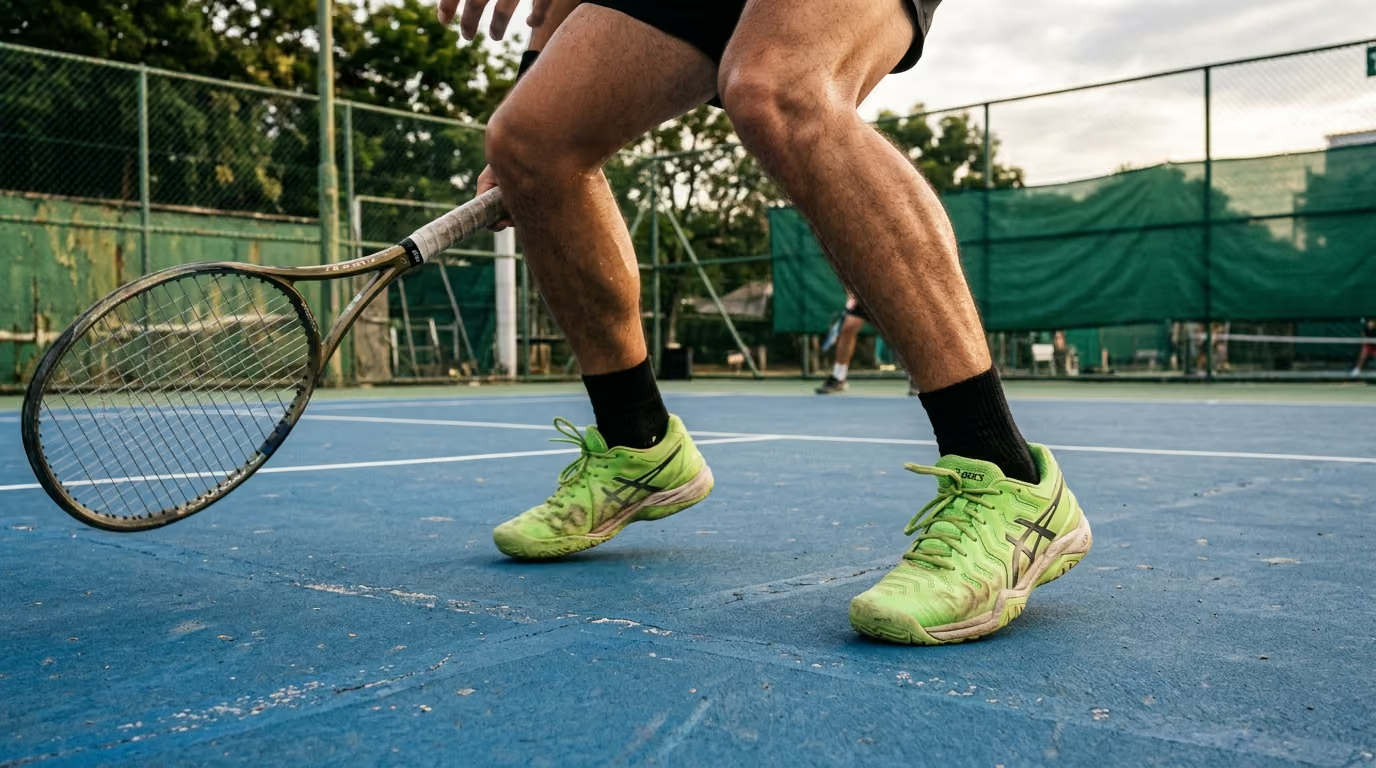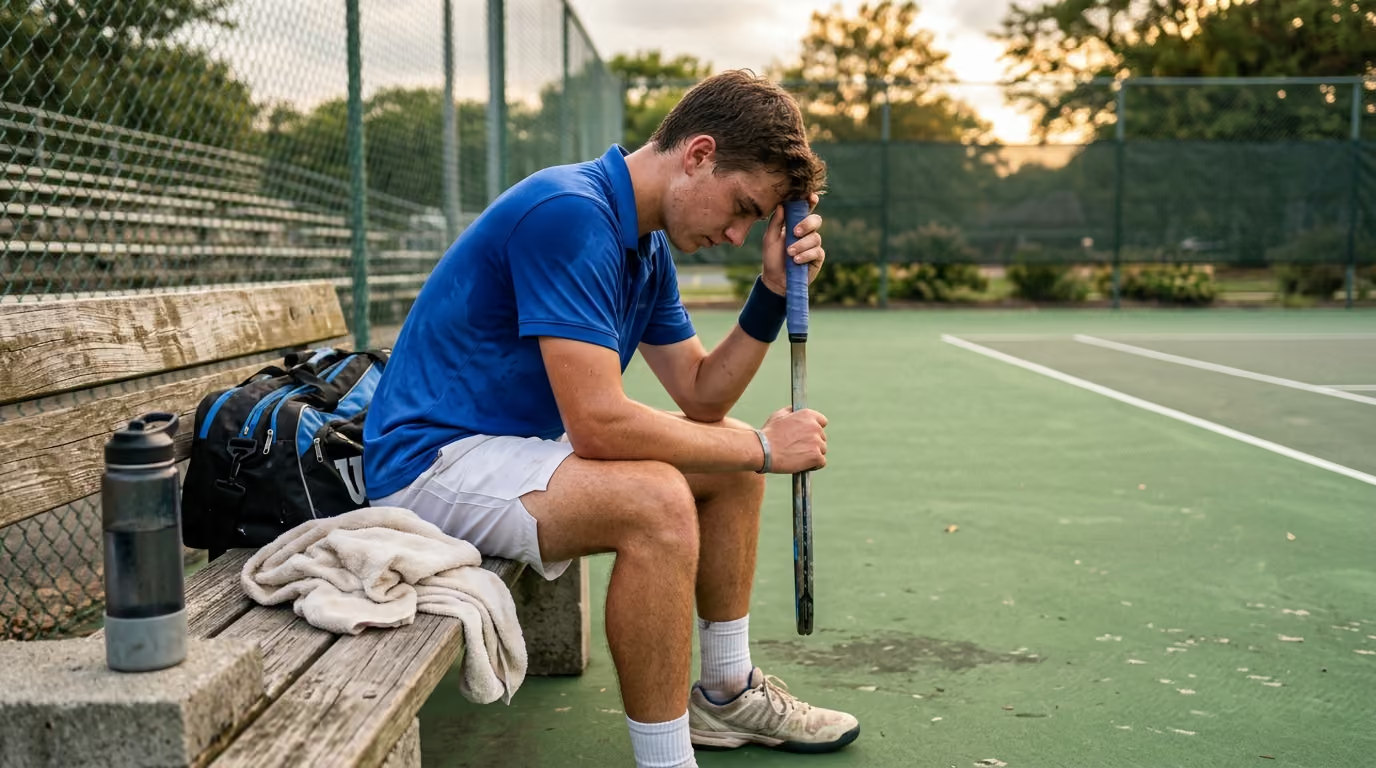

The emotional aftermath of a sports match, whether a win or a loss, significantly impacts an athlete's well-being and future performance.




Have you ever stood in the parking lot after a tough racquet sports match, feeling completely overwhelmed by what just happened on the court? Perhaps you replayed a missed overhead, or felt an unexpected sense of emptiness after a hard-earned victory. This guide provides a clear, evidence-based approach to processing your matches, extracting useful lessons, and returning to daily life with your well-being intact.
To handle the emotional aftermath of a match, players must separate their personal identity from the scoreboard and regulate their immediate physiological arousal. By evaluating performances based on controllable actions rather than final results, you can turn wins and losses into valuable training data. This balanced approach protects your mental health and supports your athletic longevity over years of play.
The period immediately following a match is often referred to as the post-match emotional window. During this time, your brain and body process a intense mix of arousal, disappointment, relief, pride, and fatigue. This window is a highly volatile period where definitive judgments about your ability should be strictly avoided.
Instead of making immediate statements about your game, treat this time as a period for stabilization. Our team suggests a simple rule to guide you through these moments: feel fully, decide slowly. This approach prevents you from making rash decisions about your coaching, your equipment, or your competitive schedule while your emotions are still raw.
Scientific research shows that post-match emotions do not always follow a simple win or loss dichotomy. A study published in the Journal of Physical Education and Sport examined elite Japanese women's field hockey players during a competitive tournament. The researchers found that emotional responses varied significantly across different matches, regardless of whether the team won or lost.
After an initial defeat, the athletes reported higher levels of anxiety, humiliation, and reduced physical relaxation. However, as the tournament progressed, their unpleasant emotions and overall stress levels actually decreased. This indicates that your initial reaction to a result is not permanent, and your system naturally seeks emotional equilibrium over time.
To process a match effectively, you must learn to distinguish between outcome emotions and performance emotions. Outcome emotions are directly tied to the final score, such as joy after winning or grief after losing. Performance emotions concern how well you actually executed your tactical plan and technical skills, regardless of the official result on the board.
It is entirely possible to win a match while playing poorly, which can leave you feeling frustrated or anxious. Conversely, you can play an outstanding match and still lose to a superior opponent, which should produce a sense of pride and constructive focus. Asking yourself separate questions about the outcome and your execution prevents you from treating a win as proof of perfection or a loss as proof of failure.
This distinction is crucial for maintaining a healthy athletic identity. Research on athletic coping indicates that players use multiple strategies across both successful and unsuccessful competitions. However, these strategies tend to be far more effective during favorable performances when the player maintains high meta-experiences. Meta-experiences are simply your beliefs about how your emotions and coping strategies impact your actual court performance.
To build a sustainable relationship with your sport, you must separate your personal identity from your competitive results. A useful framework divides your experience into four distinct areas:
A common source of post-match frustration is the tendency to take full responsibility for factors that were completely outside of your control. To perform an objective match analysis, you must categorize every event into one of three distinct categories. This practice helps you focus your energy on areas where you can actually make meaningful improvements.
These are actions and choices that are completely within your power to direct before, during, and after a match:
These are elements that you can influence through your actions, but you cannot completely command:
These are aspects of the competition that you must simply accept and manage around:
Distinguishing these factors does not mean you are making convenient excuses for a poor performance. A recognized self-forgiveness framework for athletic failure suggests that players should accept responsibility for their specific mistakes while actively restoring their self-regard. This balanced approach allows you to evaluate your match objectively, without falling into the trap of self-condemnation.
To guide yourself through the emotional aftermath of a significant match, we recommend implementing the five-stage RESET model. This structured process helps you stabilize your nervous system, organize your thoughts, and transition smoothly back to daily life.
The immediate priority after your match ends is to reduce your acute physiological arousal. The International Olympic Committee consensus statement on mental health in elite athletes recommends an integrated approach to well-being that prioritizes immediate physical and emotional stabilization. Do not rush to analyze your errors while your heart rate is still elevated.
Begin by slowing your breathing, sipping water, and changing out of your damp competition clothing. Move away from active court areas, spectators, and social media distractions to find a quiet space. Postpone making any public comments or sharing detailed match summaries with friends until you have physically cooled down.
Once your heart rate has lowered, allow yourself to feel your emotional reactions without judgment. Rather than compressing your feelings into a general sense of disappointment, identify the specific emotions you are experiencing. Labeling your emotions reduces their intensity and provides valuable clarity.
You might feel a complex mix of disappointment, relief, anger, pride, or physical exhaustion. Acknowledge that mixed emotions are completely normal after competitive sports. You can feel devastated by a close loss while simultaneously feeling proud of your competitive effort and grateful for your partner.
In this stage, you must deliberately separate the outcome of the match from your personal worth. Recall that a bad day on the court is not a reflection of your character or your overall value as an athlete. Research on self-compassion in sports demonstrates that this practice reduces shame, anxiety, and unproductive rumination after athletic failures.
Self-compassion does not mean you are avoiding accountability or making light of your mistakes. Instead, it involves acknowledging the difficulty of competition and responding to yourself in a supportive manner. This mindset allows you to maintain the motivation required to address your weaknesses in training.
Once you are emotionally stable, you can conduct a productive, structured performance review. Avoid creating an exhaustive list of every single error, as this easily turns into destructive rumination. Instead, use a simple three-step analysis to organize your observations:
The final stage is your deliberate reintegration into ordinary life outside of the sport club. Return to your planned meals, recovery hydration, family responsibilities, and work commitments. Organizations like FIFPRO suggest planning your post-competition decompression and recovery schedules before your tournament even begins. This forward planning ensures you have a clear path back to your normal routines, preventing the match from dominating your entire week.
To apply this framework on a regular basis, keep these five simple tools in your equipment bag or on your phone. They are designed to provide structure when you are feeling overwhelmed by a competitive result.
Immediately after stepping off the court, find a quiet spot and answer these five quick questions to stabilize your system:
Before you discuss the match with anyone else, write down one brief observation for each of these three columns. This keeps the final score from overshadowing your actual athletic development:
When your mind is spinning with "what-if" scenarios, draw three simple circles on a sheet of paper. Place your current worries into the correct circle:
Focus your immediate mental energy exclusively on the items you wrote inside the Control Circle.
Identify your personal support network before you head into a highly competitive match or tournament. Having this menu prepared prevents you from isolating yourself after a tough loss:
For the first twenty-four hours after an intense match, follow a pre-planned schedule that prioritizes your physical and mental well-being:
While losing is obviously difficult, winning a significant match can also introduce unexpected psychological challenges. Success is rarely a simple emotional state, and many players feel an immediate pressure to replicate their performance. Some athletes experience guilt if a teammate struggled, while others feel a strange sense of emptiness once their goal has been achieved.
To process a victory constructively, use the absorb, appreciate, and analyze sequence. First, allow the result to register fully without immediately focusing on your next opponent. Second, appreciate the hard work, coaching, and family support that made the achievement possible. Finally, analyze the match to identify what worked well and what still requires attention in your training.
Be careful to avoid identity inflation after a major win on the court. It is tempting to replace the phrase "I won a match" with the belief "I am a winner," but this links your self-worth directly to your form. A stable athletic identity recognizes that you are a complex individual with interests and roles outside of sports. The IOC mental health toolkit highlights the importance of building psychological resilience by maintaining a well-rounded identity beyond competition.
A sudden ranking increase can also introduce new pressures, including the fear of losing your new position or the temptation to overtrain. Treat your ranking as a summary of your past results, not as a complete measure of your current skill level. Focus on process metrics, such as first-serve percentage or court movement, which remain meaningful regardless of your official standing.
A competitive loss is not a uniform emotional experience, and the intensity of your disappointment depends heavily on the context. Losing a match where you had multiple match points feels very different from a one-sided defeat against a vastly superior opponent. Understanding the specific nature of your disappointment is the first step toward processing it constructively.
An important defeat often carries a genuine sense of grief, as you may be mourning a lost opportunity or a planned tournament pathway. Attempting to suppress these feelings with forced positivity is rarely effective. Instead of pretending you are fine, take the time to identify exactly what the loss means to you, whether it is a ranking drop or a missed qualification.
Research shows that social support is the most effective coping strategy for athletes processing a competitive defeat. A qualitative study of university athletes who lost major competitions identified social support as their primary coping mechanism. Helpful support does not mean receiving unprompted coaching advice; it means having someone validate your disappointment and help you step away from the sport environment.
Be careful to monitor the difference between healthy distraction and harmful avoidance. Taking a walk, watching a film, or spending time on a hobby are healthy ways to decompress after a match. However, refusing to discuss the match indefinitely, neglecting your physical recovery, or isolating yourself from your teammates are signs of avoidance. Research on elite adolescent athletes suggests that avoidance coping is associated with significantly higher levels of psychological distress over time.
Following a painful loss, many players engage in counterfactual thinking, which is the mental practice of replaying key moments and imagining different outcomes. You might find yourself repeating thoughts like, "If I had only made that volley," or "If I had served to the backhand." This process is common but can quickly become destructive if it is used to punish yourself for past mistakes.
Counterfactual thinking is only useful when it produces a highly specific, actionable training adjustment. If you are simply replaying an error without creating a plan to address it, you are engaging in unproductive rumination. Ask yourself if your thoughts are identifying a clear area for improvement, or if they are simply punishing you for an irreversible event.
Beware of the one-variable fallacy, which is the tendency to attribute an entire match outcome to a single missed shot or referee call. A tennis, pickleball, or padel match is composed of hundreds of individual points, decisions, and physical interactions. No single error is ever the sole reason for a defeat, as your preparation, tactics, opponent's play, and environmental factors all contribute to the final result.
A self-forgiveness framework allows you to take responsibility for your mistakes on the court without attacking your character. You can acknowledge that you made a poor tactical decision at a critical moment without concluding that you are a failure. This balanced perspective allows you to analyze your performance objectively and design effective training sessions to address your weaknesses.
For competitive players, selection decisions and sudden ranking changes can be exceptionally difficult setbacks to navigate. Whether you are dropped from a league team, passed over for a tournament spot, or watching your ranking fall, these events can feel like personal rejections. Research indicates that deselection has a profound impact on an athlete's sense of belonging, friendships, and confidence.
A landmark study examined the psychological impact of selection procedures on ninety-one elite adolescent athletes. The researchers assessed distress levels before the selection decisions, as well as seven and twenty-one days afterward. The data revealed that a sizable portion of the deselected athletes experienced clinical levels of psychological distress at both post-selection check-ins.
A related report showed that over thirty-six percent of released players experienced clinical distress within one week of the decision. While these statistics come from elite youth environments, they highlight the serious psychological toll that deselection can take on any competitive athlete. If you are facing a selection setback, it is essential to follow a structured response protocol:
A sudden ranking drop can also trigger reactive, short-sighted decisions, such as playing through minor injuries or changing coaches impulsively. Before making major adjustments to your training or coaching setup, implement a mandatory cooling-off period. Use this time to verify how the ranking was calculated, identify controllable process targets, and consult with a trusted advisor.
While the psychological principles of recovery apply to all court sports, the social and environmental structures of tennis, pickleball, and padel create unique post-match dynamics. Understanding these nuances can help you tailor your recovery strategies to the specific demands of your chosen sport.
Tennis is characterized by high levels of physical and psychological isolation, especially in singles play. Because coaching is limited during matches, you are left entirely alone with your thoughts, which can make a loss feel deeply personal. Additionally, the traditional ranking systems in tennis often place immense pressure on players to defend points from the previous year.
After a tennis match, the physical transition can be abrupt, moving from intense isolation directly to a quiet handshake at the net. To manage this transition, we recommend establishing a consistent post-match physical routine before you interact with spectators or check your tournament status. Utilizing Evercourts racquet sports resources can help you find structured tracking sheets designed to separate your singles performance from your personal well-being.
Pickleball is a highly social sport, often played in public parks with rapid rotations between matches. This open environment means your wins and losses are frequently observed by a large group of your peers. The constant social comparison and the physical proximity of players during recreational play can make emotional regulation challenging.
The common practice of the post-match paddle tap can sometimes feel performative or forced when you are experiencing intense disappointment. To navigate this, give yourself permission to take a brief walk away from the court area before sitting down to chat with other players. Focus on enjoying the community aspect of the sport while maintaining clear boundaries around your personal competitive goals.
Padel is played in a fast-paced, glass-enclosed court that intensifies both the physical and emotional energy of the match. Because padel is strictly a doubles game, your post-match emotional state is always shared with, and influenced by, your partner. Managing partner dynamics after a tough loss is a critical skill for long-term enjoyment of the sport.
I remember finishing a tough two hour padel match on a cold Tuesday night and waking up the next morning feeling like my lower back was locked in concrete. For a long time, I just accepted this as the price of playing hard in my forties. But once I started spending just ten minutes on targeted hip mobility before heading to the club, the stiffness almost completely vanished. It taught me that we do not have to accept pain as a default state of aging. Similarly, processing the mental weight of a partner conflict or a tough loss with a team mindset is crucial for longevity.
Even experienced players often fall into predictable traps during the post-match window. Recognizing these common errors can help you avoid unnecessary emotional distress and protect your long-term motivation.
Imposing statements like "everything happens for a reason" or "at least you had fun" can be incredibly frustrating when you are processing a genuine disappointment. Allowing yourself to feel authentic sadness or anger is a necessary part of the emotional recovery process. Do not rush to find a silver lining before you have fully processed the reality of a difficult result.
Attempting to conduct a detailed, technical analysis of your match while your nervous system is still highly activated is a major mistake. When you are emotionally charged, your brain naturally focuses on your mistakes, leading to highly distorted conclusions about your skill level. Always prioritize physical and emotional regulation before you begin reviewing video footage or analyzing match statistics.
While taking a brief break from the sport can be highly beneficial, total avoidance of your match results can prevent valuable learning. If you refuse to discuss your performance, ignore feedback, or skip scheduled training sessions, you are likely using avoidance as an unhealthy coping mechanism. Use a structured, time-limited review to process the match, then deliberately close the chapter and move forward.
Self-compassion is sometimes misunderstood as a way to make convenient excuses or avoid accountability for poor preparation. True self-compassion involves holding yourself to high standards while maintaining a supportive, non-punitive attitude when you fall short. This balance allows you to take full responsibility for your mistakes without damaging your athletic self-regard.
It is easy to interpret a coach's selection decision as a definitive statement about your worth as an athlete or a person. In reality, selection decisions are made based on a complex mix of team balance, stylistic matchups, physical fitness, and tactical needs. A selection setback is information about a specific system at a single point in time, not a judgment of your character.
We often assume that winning players do not require emotional support or structured recovery. However, successful athletes frequently experience a significant emotional drop, increased pressure, and social isolation after a major tournament victory. No matter the result on the scoreboard, every player benefits from a structured, deliberate post-match recovery routine.
The emotional stress you experience after a match has a direct, measurable impact on your physical recovery. When you remain angry, anxious, or highly self-critical, your body continues to produce elevated levels of cortisol and adrenaline. These stress hormones prolong muscle tension, disrupt your sleep architecture, and actively delay the repair of damaged muscle tissue.
To understand how stress slows tissue repair, you can consult scientific recovery protocols for racquet sports. Utilizing these resources helps you design a physical post-match routine that actively signals to your nervous system that the competitive threat has ended. By combining active physical cool-downs with structured mental decompression, you can significantly reduce your recovery time between intense court sessions.
To maintain your physical capabilities and foster sustainable practices for healthy aging on the court, you must treat emotional regulation as a key component of your recovery. A quiet, ten-minute stretching routine combined with slow, deliberate breathing can do more for your physical recovery than expensive recovery gadgets. Protecting your sleep quality in the twenty-four hours following a match is the single most important action you can take to support your long-term athletic health.
It is completely normal to experience disappointment, anger, or temporary fatigue after a highly competitive match. However, you should be aware of the signs that indicate your athletic disappointment may be developing into more significant psychological distress. For more guidance on managing athletic stress, refer to our court-focused player health guidelines.
You should consult a licensed healthcare professional, sports psychologist, or primary care physician if you experience any of the following symptoms for more than two weeks:
Seeking professional help is a proactive step that supports both your athletic longevity and your overall quality of life. Many sports organizations provide confidential helplines, campus counseling centers, and mental health resources to support athletes through difficult transitions.
This week, apply these practical steps to establish a healthy post-match routine:
Follow Evercourts for practical insights on tennis, pickleball and padel performance, movement, recovery and healthy ageing. Stay connected for new articles, research-led guidance and ideas to help you play well and keep playing for years.


Read practical guidance for better movement, smarter preparation and a game that keeps working for you.
explore the Blog