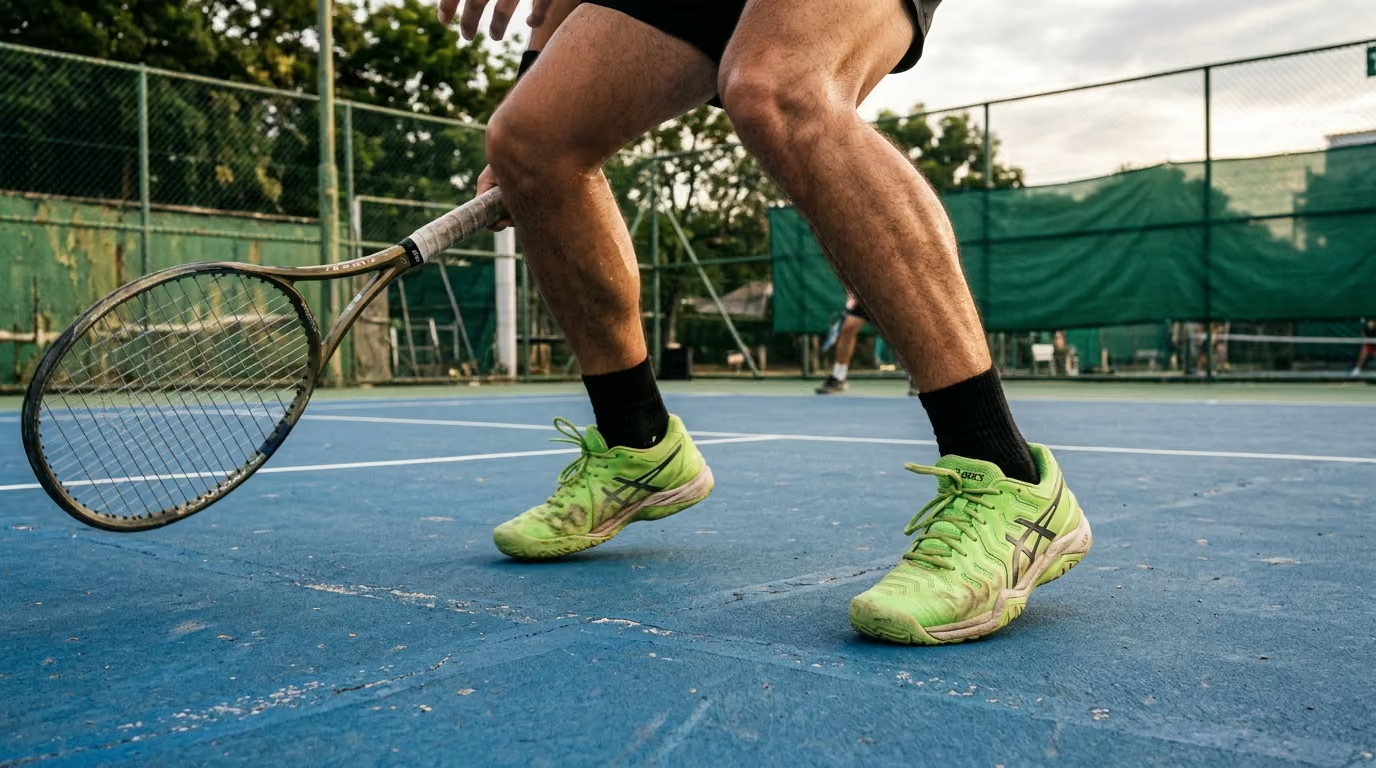
Racquet sports players can maintain a competitive edge and win matches by adapting their tactics to prioritize sustainable court geometry and functional recovery.




Imagine standing at the baseline during a competitive singles match. Your opponent hits a deep, angled groundstroke to your backhand. A few years ago, you would have sprinted to the ball, slid into a recovery step, and reset the point easily. Today, your feet feel slightly heavy, and your reaction time is a fraction of a second slower. This situation does not mean you have to stop winning matches.
Adapting your tactical approach to prioritize sustainable court geometry allows you to remain highly competitive when your physical capacities shift. By making intentional shot selections that limit your opponent's angles and recovering functionally rather than running to the geometric center, you can preserve your physical energy for the moments that matter most. This strategic shift keeps you in control of the court without overtaxing your cardiovascular system or joint health. Using these methods supports your long-term athletic longevity and keeps you playing the sports you love.
Physical changes are a natural part of the aging process. However, scientific research shows that athletic capability remains highly trainable throughout your life. To play efficiently, you must understand what happens to your body during match play.
A study published in the Journal of Sports Science and Medicine analyzed the match play demands of veteran male tennis players. Researchers found that the average heart rate during a one-hour singles match was between 148 and 150 beats per minute. The effective playing time, which measures when the ball is actually in active play, accounted for about 22 percent to 24 percent of the total match duration. Interestingly, advanced veteran players covered more total distance than recreational players of the same age.
However, these advanced players covered that distance at lower running speeds. This key finding suggests that tactical intelligence and court positioning are more valuable than raw sprinting speed. Experienced players move earlier and more efficiently. They do not need to sprint as fast because they are rarely out of position.
Regular participation in racquet sports offers profound health benefits. A study focused on older adults demonstrated that players with more court time had lower arterial stiffness. They also showed lower insulin resistance than those who played less. These benefits remained clear even when researchers adjusted for overall daily physical activity levels.
To put these demands in perspective, we can look at other court sports. In wheelchair tennis match play research, international players on hard courts showed a mean match duration of 66 minutes. Their average rally duration was six seconds, and their effective playing time was about 20 percent. Their work-to-rest ratio was approximately one to four. While these numbers are specific to wheelchair athletes, they highlight how racquet sports remain highly intermittent across all disciplines.
The World Health Organization provides clear physical activity recommendations for older adults. They suggest accumulating 150 to 300 minutes of moderate aerobic activity per week. Alternatively, adults can perform 75 to 150 minutes of vigorous physical activity. These targets are easily met through structured match play and targeted training sessions.
Research on masters athletes shows that physical declines are a natural part of aging. However, these athletes maintain much higher physiological function than sedentary peers of the same chronological age. They exhibit better cardiovascular health, preserved bone density, and lower risks of frailty. Tactics should always match your current movement profile rather than an arbitrary age bracket.
Sustainable movement is movement you can repeat throughout a match without experiencing a drop in technical execution. It does not mean playing passively or standing still on the court. Instead, it means ensuring every step you take has a clear tactical purpose. This approach preserves your stamina and protects your joints from excessive wear.
To understand this concept, you can use a simple formula. Sustainable movement combines early information, efficient positioning, controlled acceleration, and reliable recovery. When you master these elements, you reduce the physical cost of each point. This helps you maintain high-quality stroke mechanics during the final games of a long set.
We can divide court movement into five distinct categories. Necessary movement is the baseline work required to reach a ball or protect an open space. Optional movement occurs when you react slowly or make poor tactical choices. Waste movement includes extra steps that do not improve your balance or shot quality.
Protective movement consists of small adjustment steps that keep you balanced before you strike. Decisive movement is a committed step forward to take control of the point. Your goal is to maximize protective and decisive steps. At the same time, you must eliminate optional and waste steps completely.
Every player has a specific movement budget for a given match. This budget is the total amount of explosive physical effort you can expend before your performance declines. Your budget changes based on several factors. These include court temperature, humidity, your recent sleep quality, and the court surface.
Playing on clay or turf requires a different movement budget than playing on hard courts. Your current physical condition and injury history also play a major role. Instead of asking if you can reach a difficult ball, ask if the physical cost is worth it. Saving your energy for high-probability situations is the key to winning close matches.
Many players are taught to recover to the exact center of the baseline after every shot. This geometric approach is often inefficient and physically exhausting. True functional recovery means moving to a position that best protects against your opponent's most dangerous reply. This position changes depending on the depth, angle, and speed of your previous shot.
For example, if you hit a deep ball crosscourt, your opponent has limited options. They cannot easily hit a sharp angle down the line without taking a massive risk. Therefore, your recovery position should be slightly offset toward the crosscourt side. This reduces the distance you must travel to cover the open court.
Understanding court geometry helps you manage time as a tactical resource. You can gain time by hitting high, deep shots that travel slowly through the air. This height gives you several seconds to recover your court position. You can deny time by hitting the ball early on the rise or using a low, penetrating trajectory.
Trading time involves hitting a slower, safer ball to deliberately reset a chaotic point. Wasted time occurs when you hit a soft, short ball that gives your opponent an easy opportunity to attack. For sustainable play, you should focus on creating time for yourself while denying it to your opponent. This time asymmetry reduces the need for emergency sprints.
It is also vital to distinguish between raw power and ball penetration. Power is simply the speed of the ball off your strings. Penetration is how effectively your shot compromises your opponent's next contact. A slower, deep slice can penetrate just as effectively as a hard flat groundstroke.
Penetration forces your opponent to hit from an uncomfortable height or from deep behind the baseline. This prevents them from generating sharp angles against you. To make this work, you must understand the four movement states. These states are neutral, advantage, defense, and transition.
During the neutral state, both players have adequate time and neither holds a clear positional advantage. Your objective is to build pressure without overcommitting your physical resources. In the advantage state, your opponent is late or off balance. Here, you should use a high-percentage finishing pattern to end the point.
The defensive state occurs when you are stretched wide or forced far behind the baseline. Your sole goal is to buy time and restore neutral conditions. Finally, the transition state is when you move forward after a short ball. You must coordinate your movement so you do not arrive at the net in a vulnerable position.
Winning in singles with reduced mobility requires a highly structured tactical operating system. You cannot rely on winning long, physical baseline duels. Instead, you must use smart serving and returning patterns to keep points short and organized. This approach keeps your movement predictable and controlled.
Your serve is the best tool to start the point on your own terms. Instead of chasing maximum speed, focus on high first-serve percentages and precise placement. A body serve is an excellent option because it restricts the returner's hitting angles. It also reduces their ability to run you wide on the next shot.
Consider a classic serve-plus-one pattern. You serve to the opponent's body or their weaker side, expecting a central return. You then play your first groundstroke to their weaker movement side. This forces them to run while you recover to a comfortable position. This pattern keeps the physical demands of the point very low.
Your return positioning should also adapt to your movement capabilities. If you have reduced forward speed, stand slightly deeper to give yourself more reaction time. Against a weak second serve, step forward to block the ball early. This takes away your opponent's preparation time without requiring a long sprint.
Using the crosscourt direction as your default option is a highly sustainable strategy. Crosscourt shots travel over the lowest part of the net and into the longest part of the court. This provides a natural margin for error and keeps your recovery path short. You should only change direction down the line when you have a clear, balanced advantage.
When your opponent hits a short ball, you must evaluate it quickly. If you can reach it while remaining balanced, move forward and attack. If the ball requires an extreme sprint and a difficult slide, play a safe, deep reset instead. Hitting a low-percentage shot while running at full speed is a common recipe for unforced errors.
To apply these concepts, let us look at three common match scenarios.
Doubles play is inherently more sustainable because two players split the court. However, poor coordination can actually increase your movement requirements. If you and your partner do not communicate well, you will both hesitate or cover the same spaces. Establishing a clear partnership contract before the first serve is essential.
This contract should define who covers the middle of the court and who handles lobs. It should also establish rules for poaching and switching. Using explicit, loud calls like "mine" or "yours" reduces hesitation. This prevents the unnecessary steps caused by double-guessing your partner's intentions.
The one-up, one-back formation is popular but can leave a large gap in the middle of the court. If you use this setup, the baseline player must hit deep, safe shots to prevent aggressive angles. The net player must remain active and watch for opportunities to protect the middle.
Alternatively, getting both players to the net can put massive pressure on your opponents. This formation reduces the amount of baseline running you must perform. To make this work, you must practice disciplined split-steps and compact volleys. Do not stand too close to the net, as this makes you vulnerable to simple lobs.
In doubles, serve placement is far more important than raw speed. A well-placed serve to the T or the body limits the returner's options. This makes it much easier for your partner at the net to anticipate and poach. It also ensures you do not have to make sudden, explosive lateral movements to cover the return.
Targeting the middle of the opponent's court is a highly reliable doubles strategy. It creates immediate confusion about who should hit the ball. It also reduces the angles your opponents can create on their reply. This allows you and your partner to stay positioned efficiently with minimal movement.
Poaching should be a calculated decision rather than a random guess. Only poach when your partner has hit a deep serve or groundstroke that forces a weak reply. You can also use fake poaching to disrupt your opponent's concentration. Simply take a small step toward the middle just before they strike, then return to your position.
Ensure your communication is short and highly specific. Before each point, agree on the serve location and whether the net player will poach. During the point, call out switches early so your partner has time to adjust. After the point, offer a brief word of encouragement and focus immediately on the next tactical plan.
While the principles of sustainable movement apply to all racquet sports, each game has unique physical demands. Understanding these differences helps you tailor your tactics to your specific sport. The court size, equipment, and rules dictate how you should manage your energy.
Tennis features the largest court and the highest running requirements. You must accelerate over longer distances and decelerate from higher speeds. The ball bounces faster and carries more momentum, which places greater strain on your joints. To protect your body, you must prioritize deep, high-margin groundstrokes and early preparation.
You should also pay close attention to your proper mobility and movement on hard courts. Hard courts offer excellent traction but are highly unforgiving on your knees and hips. Clay courts allow you to slide into shots, which can reduce the stress of sudden stops. However, sliding requires excellent balance and core strength to execute safely.
Pickleball is played on a much smaller court, which dramatically reduces your total running distance. However, it requires exceptionally fast reaction times and constant lateral shuffling. The play is dominated by the non-volley zone, often called the kitchen line. You must be prepared for rapid, short-distance movements and quick reflex volleys.
Sustainable movement in pickleball relies on mastering the dink rally and the third-shot drop. Hitting a soft, low third-shot drop allows you and your partner to walk to the kitchen line. This transition should be controlled rather than rushed. Once at the line, use compact paddle movements and stable lateral slides to protect your side.
Padel is played inside a glass enclosure, which completely alters the geometry of the game. The walls keep the ball in play longer, leading to extended, highly physical rallies. You must deal with constant changes of direction as the ball rebounds off the glass. This requires excellent spatial awareness and frequent rotational movements.
To play padel sustainably, you must learn to let the ball pass you and hit it after it bounces off the glass. This tactic buys you extra time and reduces the need to reach or lunge. Use defensive lobs to push your opponents back and regain the net position. Keep your swings short and use the continental grip to handle low bounces off the walls.
To help you adapt your game, we can map common physical limitations to specific tactical choices. This structural approach helps you make smart decisions based on your current physical state.
Maintaining your tactical edge requires a strong physical foundation. You cannot play sustainably if your muscles are too weak to support your joints. Following structured targeted strength and conditioning plans is the best way to ensure long-term court performance. Your training should focus on the specific physical demands of racquet sports.
The World Health Organization recommends that older adults engage in multicomponent physical activity at least three days per week. This training should emphasize functional balance, strength, and gait training. These exercises are highly effective at reducing the risk of falls and improving mobility on the court. You should also perform muscle-strengthening activities at least two days per week.
Focus your training on lateral strength and deceleration. Racquet sports require constant side-to-side movement and sudden stops. Exercises like lateral lunges, step-downs, and single-leg balance drills are highly valuable. They teach your body how to absorb force safely, which protects your knees and lower back.
Always begin your sessions with a progressive warm-up. Avoid starting your matches with hard serves or full-speed sprints. Spend ten minutes performing light cardio, dynamic stretches, and tennis-specific movement patterns. This increases your tissue temperature and prepares your nervous system for fast actions.
Managing your total training load is also crucial for player health on the court. Keep track of how many matches you play each week and how your body feels the next day. If you notice persistent joint stiffness or heavy fatigue, reduce your playing time temporarily. Allow your tissues time to adapt and rebuild after hard physical efforts.
Many players make critical mistakes when trying to adapt their game for longevity. The first major error is trying to slow the game down by hitting soft, short balls. This passive approach actually invites your opponent to attack. It forces you to defend against sharp angles, which ultimately increases your running distance.
Another common pitfall is recovering to the geometric center of the court automatically. As discussed, this ignores the tactical context of the point and wastes valuable steps. You must learn to read your opponent's body language and position yourself accordingly. Recovering to a functional position saves energy and improves your defensive success.
Some players believe that switching to doubles completely eliminates the need for conditioning. While doubles covers less court, it still requires rapid acceleration and sharp lateral steps. Without proper strength and stability, you are still at risk of acute muscle strains. You must maintain your physical fitness regardless of which format you play.
Finally, many players rely solely on static stretching before they play. Holding static stretches can actually reduce your muscle power and does not prepare you for dynamic movement. Instead, focus on a neuromuscular warm-up that includes active, flowing movements. This approach has been shown to improve performance and support effective injury prevention tactics on the court.
As you age, your body's recovery kinetics naturally change. Muscles and tendons take slightly longer to repair after intense physical exertion. This means your off-court routine is just as important as your on-court tactics. Prioritizing high-quality sleep and proper nutrition is essential for tissue health.
Keep a close eye on your next-day symptoms after a long match. It is normal to feel some mild muscle soreness for 24 to 48 hours. However, sharp joint pain, swelling, or localized tendon tenderness are signs of excessive strain. These symptoms indicate that your movement budget was exceeded or your recovery was insufficient.
Do not ignore these warnings from your body. Adjust your scheduling so you have at least one full day of rest between intense sessions. Use low-impact activities like swimming or cycling to maintain your aerobic fitness on rest days. This keeps your blood circulating without placing repetitive stress on your court-weary joints.
Even with excellent preparation, you will occasionally face physical limitations. These might be temporary injuries, chronic joint issues, or challenging environmental conditions. Knowing how to adjust your tactics in these specific situations keeps you on the court safely.
If you are recovering from a minor calf strain, you must avoid explosive push-offs. Stand slightly deeper on your returns to reduce the need for sudden forward sprints. Keep your groundstrokes deep and central to prevent your opponent from pulling you into wide, lateral chases. Consider playing doubles exclusively until the tissue is fully healed and pain-free.
A stiff or painful shoulder can severely impact your serve and overhead smash. To adapt, use a shorter, more compact service motion with a lower ball toss. Rely on spin and placement rather than trying to hit the ball flat and hard. When faced with an opponent's lob, hit a controlled overhead bounce shot instead of a high-velocity smash.
Knee discomfort often makes deep lunging and sudden deceleration highly uncomfortable. Focus on early preparation so you can strike the ball while standing in a balanced, upright position. Use slice shots on both sides to keep your swing mechanics compact and controlled. Choose courts with softer surfaces, such as clay or cushioned turf, whenever they are available.
If you are playing doubles with a partner who moves much faster than you, communicate clearly. Do not try to run for every wide ball out of a sense of obligation. Let your faster partner cover the lob and the wide angles when necessary. Your role is to hold your position, protect the middle, and hit high-quality, consistent shots.
While tactical adjustments can keep you active, they are not a substitute for proper medical care. You must be able to distinguish between normal athletic fatigue and a serious underlying injury. Ignoring red flags can lead to chronic damage that keeps you off the court permanently.
Consult a qualified physical therapist or sports medicine physician if you experience any of the following symptoms:
A professional can assess your joint mechanics and provide targeted rehabilitation exercises. They can help you address the root cause of your physical limitations. This ensures you can continue to enjoy the performance benefits of sustainable racquet play for many years to come.
When to revisit this resource: Review these tactical principles at the start of every new season, or whenever you notice a shift in your physical recovery time.
Adapting your court movement is not a compromise: it is the mark of a highly intelligent player committed to lifelong competition.
Follow Evercourts for practical insights on tennis, pickleball and padel performance, movement, recovery and healthy ageing. Stay connected for new articles, research-led guidance and ideas to help you play well and keep playing for years.


Read practical guidance for better movement, smarter preparation and a game that keeps working for you.
explore the Blog