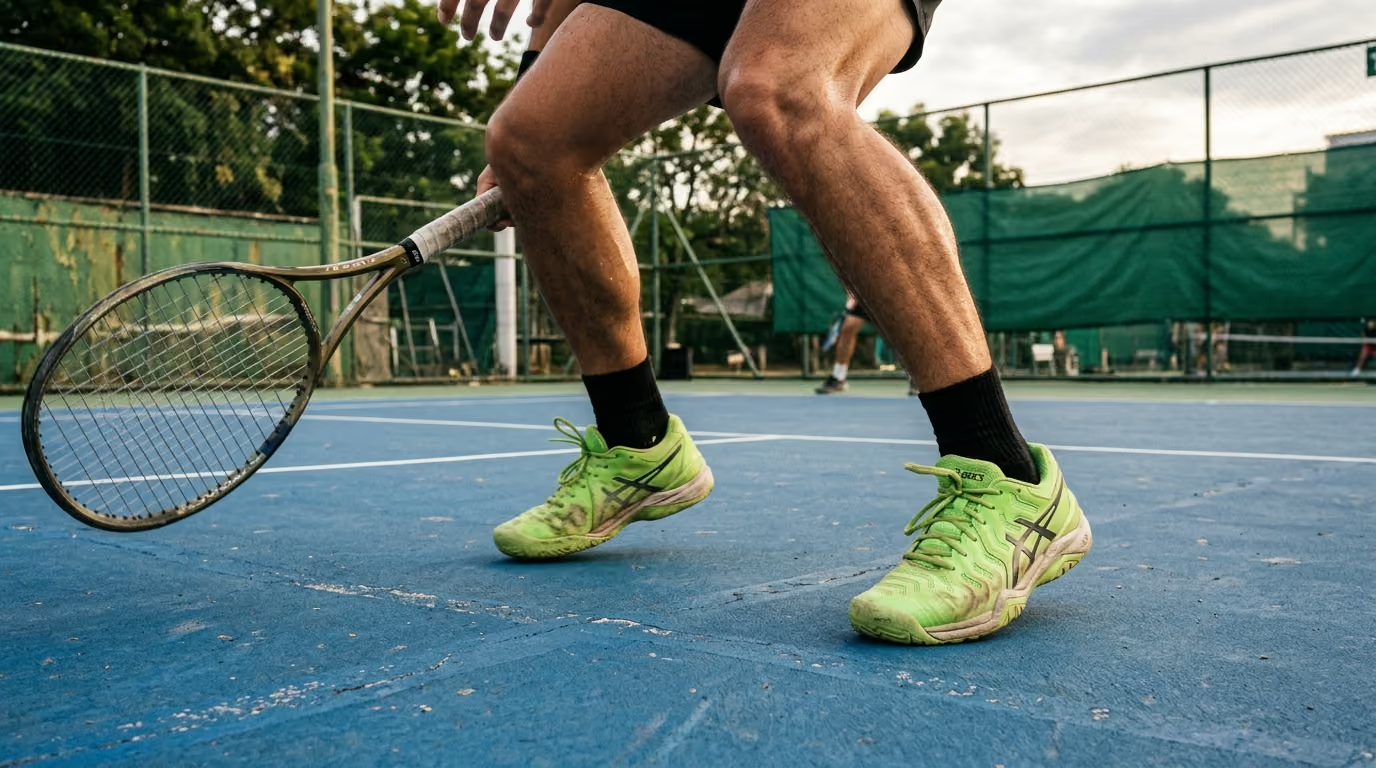
While many players assume athletic posture involves rigid stillness, effective court stability actually comes from dynamic, continuous adjustments between body segments.




Many players believe that a good athletic posture requires holding the body in a rigid, perfectly straight position. They focus on pulling their shoulders back, tucking their hips, and tightening their core muscles. However, attempting to freeze the torso actually makes you slower and less responsive during a match.
Real court stability is a dynamic process of continuous adjustment. It is a relationship among your feet, knees, hips, pelvis, rib cage, and head. This guide will show you how to maintain control without sacrificing the fluid movement needed for racquet sports.
Athletic posture on the court is not a static shape but a dynamic relationship where the pelvis and rib cage stay aligned over the base of support to transfer force efficiently. This stacking allows you to move rapidly in any direction, absorb heavy landing forces, and rotate without losing balance. Maintaining this relationship while staying relaxed, rather than freezing into a rigid posture, is the key to court speed and joint longevity.
To understand this on the court, you must distinguish between posture and postural control. Posture is simply the shape your body takes at one specific second. Postural control is your nervous system's ability to coordinate your limbs and trunk while you are moving.
A player might look perfectly aligned when standing still. If their trunk collapses during a sudden stop or wide reach, their postural control is failing. Dynamic alignment means your pelvis and rib cage are organized so that you can transfer force from the ground to your upper body.
It also means you can change your shape instantly when the ball takes an unexpected bounce. If you try to hold a stiff spine, you lose this reactivity. You also place unnecessary stress on your lower back and knees.
Current research shows that postural control is a complex movement skill rather than a static physical trait. A scoping review in Sports Medicine, Open found that postural and core stability are closely linked with sport performance measures in court athletes. However, the researchers noted that there is no simple, direct relationship between a generic core strength score and actual court success.
Instead, the ability to control the relationship between your pelvis and rib cage determines how well you move. Your pelvis acts as the main transition platform between your legs and your upper body. It must accept force from one foot, rotate relative to the trunk, and support your weight when you step laterally.
The pelvis should not be locked in place. An anterior pelvic tilt, where the hips dip forward, is a normal strategy during acceleration. It becomes a problem only if you cannot get out of that position when you need to brake.
The rib cage serves as the mobile platform for your shoulders and arms. If your rib cage is constantly lifted or flared, your lower back arches excessively. This position limits your ability to rotate through the thoracic spine.
To improve your movement, you must work within a zone of acceptable variability. This means your body needs some freedom to move slightly out of perfect alignment to adapt to a fast shot. True skill is characterized by functional variability, which allows you to maintain control under changing conditions.
According to a study in the Journal of Sports Sciences, systematic core and balance training improves dynamic balance stability. The key is to teach your nervous system to find the optimal relationship between your trunk and hips during movement.
Your postural needs change constantly during a point. To keep your movement efficient, you must apply the concept of dynamic stacking to every phase of play.
Your ready position is a temporary launch pad, not a posture to be held for a long time. A study on the tennis ready position found that the angle between your thighs is a major factor in how quickly you can move.
The researchers suggested that an optimal thigh angle of 70 to 80 degrees provides the best response times. This stance is often wider than shoulder-width, which improves your immediate lateral readiness.
Your pelvis should be positioned so your hips can turn instantly. Your trunk should be inclined forward slightly from the hips. This slight lean keeps your center of mass ready to move forward or sideways without a preparatory rise.
When you initiate movement, your rib cage and pelvis must work together to project your center of mass. This requires intentional asymmetry as you push off one foot.
If you try to keep your torso perfectly vertical, you will delay your first step. Your trunk should lean slightly toward your target direction. This lean must be controlled so that your head remains stable and your eyes can track the ball.
Stopping on the court requires your body to absorb a massive amount of momentum. A review on cutting mechanics shows that faster directional changes require high braking forces and short ground-contact times.
To brake safely, you must lower your center of mass by bending your hips and knees. Your pelvis must stay organized over your landing foot to prevent your knee from collapsing inward.
If your pelvis drops on one side, your knee experiences high lateral forces. You can learn more about protecting your joints during these movements in our guide on injury prevention resources.
During a lateral cut, your trunk should incline toward the new direction of travel. Research shows that a controlled medial trunk lean is associated with faster cutting speeds.
Conversely, letting your trunk fall away from the turn increases knee loading. The goal is to keep your rib cage connected to your pelvis as you push off the outside foot. This alignment prevents your upper body from swinging out of control.
When you hit a ball, your pelvis rotates first, followed by your thoracic spine and shoulders. This sequence requires your pelvis to stabilize as your rib cage turns.
If your core lacks control, your lower back will twist excessively to make up for stiff hips. You need temporary, direction-specific stiffness at the moment of contact to transfer power to the racquet. Once the ball is gone, your body must immediately relax to prepare for the next recovery step.
When you jump to hit an overhead, your landing strategy determines the impact on your joints. A systematic review on fatigue and landing found that tired athletes tend to land with greater trunk flexion.
The authors suggested this extra forward lean is an adaptive strategy to help absorb impact when the lower legs become stiff.
You should allow your hips and knees to bend as you land. Keep your pelvis stable to avoid a harsh, jarring impact on your spine.
These exercises are designed to build awareness and control of your pelvic and rib-cage alignment. Use them as part of your regular preparation or strength sessions to improve your movement quality on court. You can find complementary routines in our section on strength and conditioning resources.
The purpose of this drill is to develop basic awareness of your trunk alignment without any joint loading.
This exercise helps separate pelvic stability from upper-back rotation, which is vital for smooth strokes.
This drill teaches you to bend from the hips while keeping your trunk organized.
This drill connects pelvic control with single-leg force acceptance.
This exercise improves your ability to decelerate in the frontal plane.
This drill transfers posture control into sport-specific braking mechanics.
This drill builds unilateral pelvic stability, which is crucial for balanced movement.
This exercise makes your ready position highly functional.
This drill integrates trunk control with vertical force absorption.
While the principle of dynamic stacking applies to all racquet sports, the specific demands of each game require minor adjustments to your posture.
Tennis is played on a large court, which requires long sprints and heavy deceleration. You must slide or plant your feet hard on surfaces like clay or hard courts.
To manage these forces, tennis players need a wider ready position. This wide stance helps lower your center of mass for lateral movement.
Because tennis balls bounce higher, your trunk must stay adaptable to different contact heights. You need excellent rotation in your thoracic spine to generate power from the baseline.
Pickleball is played on a much smaller court, which limits your sprint distance but increases your reaction speed. You spend a large portion of the game at the non-volley zone line.
This requires you to hold a low ready position for rapid dink rallies. Many players bend from their lower back to reach low kitchen shots, which can cause discomfort.
Instead, you must bend from your hips while keeping your rib cage stacked over your pelvis. Because pickleball rallies are fast, your posture must remain compact with minimal upper-body sway.
Padel involves constant direction changes, court rebounds, and overhead play in a tight space. You must be prepared to turn 360 degrees to play balls off the glass walls.
This means your pelvis must remain highly mobile to rotate quickly over your stance leg. Padel players hit a high volume of overhead shots, which requires excellent rib-cage control.
If you flare your ribs during an overhead, you place high stress on your lower back. You must maintain trunk control to manage these repeated upward reaches.
Many players make simple mistakes when trying to improve their alignment. These errors can actually reduce your speed and increase your risk of fatigue.
A very common mistake is trying to keep your pelvis completely flat or neutral during a sprint or cut. Your pelvis is designed to tilt and rotate as you move.
If you try to lock your hips in a neutral position, you will restrict your stride length. This restriction makes your movement stiff and forces your knees to absorb more lateral force.
Instead, focus on controlling your pelvis through its full range of motion. Use your pelvic tilt to help you accelerate and decelerate naturally.
Many fitness resources tell players to pull their ribs down and squeeze their stomach muscles tightly during play. This advice can lead to shallow breathing, increased tension, and early fatigue.
If you brace too hard, you cannot rotate your torso to swing. This stiffness can also cause you to hold your breath during intense rallies, which hurts your performance.
You can find strategies to manage physical strain and breathing in our recovery science resources. Your trunk should be organized but relaxed enough to allow you to breathe deeply.
How you hold your body on the court directly affects your recovery times and physical longevity. Poor postural control causes specific muscles to work much harder than they should.
For example, if your pelvis tilts forward too much, your lower back muscles must contract constantly to keep you upright. This persistent tension leads to localized muscle soreness after matches. It can also cause early fatigue during long third sets.
Your alignment also affects your breathing efficiency. When your pelvis and rib cage are stacked, your diaphragm can move freely. This deep breathing helps clear waste products from your muscles and keeps your heart rate stable.
If you are stiff and breathe only into your chest, your body stays in a state of high stress. This tension prolongs your recovery time between points and matches.
Finally, keeping your joints aligned reduces wear and tear on your cartilage and ligaments. When you decelerate with a stacked trunk, your hips and glutes absorb the impact. These large muscle groups are built to handle heavy loads.
If your posture collapses, those forces are transferred to your knee ligaments and lumbar discs. Over time, this stress can lead to chronic joint stiffness and limit your time on court. To maintain your physical capabilities as you age, focus on dynamic balance as a tool for healthy aging and athletic longevity.
While movement training can resolve many technical issues, some symptoms require expert medical evaluation. You should consult a qualified physical therapist or sports physician if you experience any of the following signs:
A clinical specialist can perform a detailed assessment of your movement. They can help design a customized plan to address structural limitations. This care ensures you can return to the court safely and continue playing for many years.
By focusing on dynamic stacking rather than rigid alignment, you can move faster, hit more consistent shots, and enjoy your time on the court for years to come.
Follow Evercourts for practical insights on tennis, pickleball and padel performance, movement, recovery and healthy ageing. Stay connected for new articles, research-led guidance and ideas to help you play well and keep playing for years.


Read practical guidance for better movement, smarter preparation and a game that keeps working for you.
explore the Blog