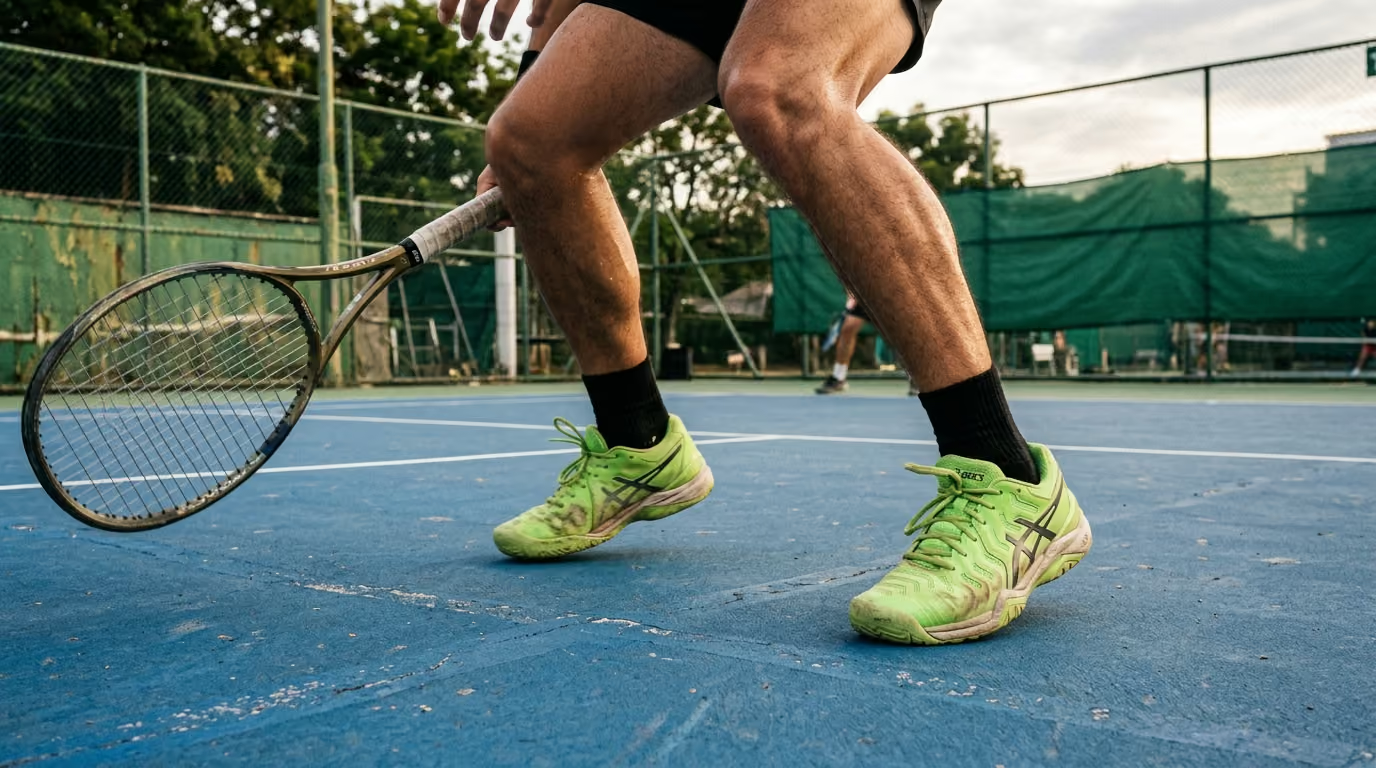
A sustainable competition framework for adult racquet sports balances physical demands with structured recovery to prevent the three dimensions of burnout.




Sustainable athletic longevity on the court is not about avoiding hard work or playing with less effort. It is the practice of balancing physical demands with structured recovery to keep playing for decades. This guide details how to spot early signs of physical and emotional fatigue. We will analyze the scientific principles of load management, examine practical screening steps, and build a structured weekly template to preserve competitive longevity.
To prevent burnout in adult racquet sports, you must match your total training and competitive load with your actual recovery capacity. It is not a matter of simply playing less, but rather organizing matches, practices, and rest days into a structured, predictable schedule. This systematic approach preserves your performance while protecting your physical and mental health for years of continuous play.
Athlete burnout is a multidimensional psychological syndrome that goes far beyond normal physical tiredness. It is not simply being tired after a tournament or having a poor week of practice. Burnout involves sustained exhaustion accompanied by deteriorating motivation, satisfaction, and perceived efficacy. The primary distinction is persistence, breadth, and meaning. Ordinary fatigue generally improves with appropriate rest, whereas burnout alters your overall attitude toward the sport.
According to psychological research, burnout consists of three distinct dimensions. The first is physical and emotional exhaustion, which is a perceived depletion of the resources needed to train and compete. The second is a reduced sense of accomplishment, characterized by the belief that effort is no longer producing meaningful progress. The third is sport devaluation, which manifests as a loss of interest, emotional detachment, cynicism, or resentment toward the game.
This syndrome can occur even when an athlete is still physically capable of playing. An adult competitor may be able to complete matches while simultaneously experiencing emotional exhaustion. You might feel resentment toward league obligations, a loss of enjoyment, or a sense that every session is an evaluation of personal worth. To identify these feelings early, it is helpful to monitor your mindset regularly.
Rather than asking only if you are tired, you can periodically rate specific practical screening dimensions. Consider how rested you feel before training and whether normal sessions produce unusual irritability or dread. Note whether performance remains poor despite continued effort and if you still experience satisfaction from improvement. Watch for signs of withdrawing from teammates, feeling relief rather than disappointment when a session is missed, or feeling that your identity is threatened by ordinary fluctuations in ranking.
Training is designed to create physical stress followed by positive adaptation. A short period of increased load can produce functional overreaching, where performance temporarily dips but subsequently improves after recovery. By contrast, non-functional overreaching involves a longer performance decline without the expected benefits. Overtraining syndrome describes a persistent maladaptive state involving performance decrement, fatigue, and psychological or physiological symptoms.
The joint consensus from the European College of Sport Science and the American College of Sports Medicine describes overtraining as an accumulation of training and non-training stress. This accumulation produces a long-term reduction in performance capacity, with restoration potentially taking weeks or months. The consensus also emphasizes that no single biological marker definitively diagnoses overtraining syndrome. Other medical and psychological causes must be excluded before making a diagnosis.
This distinction is essential for adult racquet sport players because a busy competitor may attribute every decline to overtraining. The actual contributor might be anemia, infection, medication side effects, depression, inadequate energy intake, sleep disruption, or work-related stress. Persistent or unexplained symptoms warrant medical evaluation rather than simply adding rest days. This is why understanding health and wellness resources for athletes can help you differentiate between training fatigue and underlying medical issues.
A useful conceptual ladder can help you identify where you stand on the training stress spectrum:
These categories can overlap, but they should not be treated as interchangeable.
Additionally, research highlights why keeping players on the court matters for long-term health. An observational study reported that racquet sports, specifically tennis and badminton, were associated with extended lifespan estimates of up to 5.7 years in men and 2.8 years in women. Earlier cohort findings summarized by the Mayo Clinic Proceedings reported estimated gains of 9.7 years for tennis compared with a sedentary lifestyle. These are observational associations and may be influenced by baseline health, socioeconomic status, and social connection. However, they demonstrate the immense value of sustaining your participation over a lifetime.
Training load includes much more than court time. For adult players, total stress is an accumulation of multiple life and athletic factors. Your physical load includes on-court drills, match play, strength training, and conditioning. Your environmental and life load includes tournament travel, sleep loss, work deadlines, caregiving, and emotional strain.
A practical monitoring model should combine external and internal loads. External load is the objective work you perform, such as duration, number of sessions, match minutes, and sets played. Internal load is the physiological and psychological response to that work, including perceived exertion, heart-rate response, soreness, and fatigue. Research suggests using a combination of external and internal workload measures rather than relying on a single metric to get an accurate view of stress.
A simple, validated field method to measure this is the Session Rating of Perceived Exertion (Session-RPE) method. To calculate this, use the following formula:
Session load = session duration in minutes × session rating of perceived exertion
For your rating of perceived exertion, use a simple scale from 1 to 10, where 1 is extremely easy and 10 is maximal exertion. For example, a 90-minute singles match rated as a 7 out of 10 produces an estimated load of 630 arbitrary units. Recording this number consistently allows you to identify rapid changes in your weekly volume. You can also note whether the session was primarily technical, tactical, conditioning-oriented, or competition-heavy.
This tracking helps you understand your acute-to-chronic workload ratio, which compares recent training stress with your established history. Acute load is represented by the previous seven days, while chronic load is represented by the average of the preceding three to six weeks. Older applied recommendations proposed that an acute-to-chronic ratio of 0.8 to 1.3 represented a manageable range. Ratios above 1.5 were thought to be associated with increased injury risk.
However, the ratio has been criticized because its validity depends on how load is calculated, the time windows selected, and the specific sport. You should view it as a rough planning signal, not an absolute safety threshold or an individualized injury prediction. The robust principle is simple: avoid abrupt spikes in total stress, especially when you have not recently accumulated the conditioning required for the upcoming competition.
To manage these variables, players can use the Four-Account Model to visualize their personal resources. Think of your energy as four interacting accounts:
A competition plan becomes unsustainable when you repeatedly spend from all four accounts without replenishment. A week with heavy match play may be manageable during vacation with excellent sleep, but it can cause a system crash during a work deadline or family crisis.
Before adding a tournament, extra league, or intensive training block, apply a five-part decision rule:
This approach changes the question from whether you can physically fit an event into your calendar to whether your whole system can absorb it. Applying these strategies for long-term athletic longevity helps you stay competitive without burning out.
You should also periodize your competition schedule, not just your physical training. Adult competitors often periodize drills and strength work but allow matches to accumulate randomly. A sustainable plan assigns competitions to different categories:
Not every event needs a performance peak. You might designate one tournament as a performance target, use another as tactical practice, and decline a third because it conflicts with a high-stress work period. Your calendar must contain both stress weeks and absorption weeks. A tournament is not complete when the final match ends. You also need time for tissue recovery, sleep normalization, and emotional decompression.
The risk factors for physical exhaustion and psychological burnout differ based on the structural demands of each racquet sport. Tailoring your approach to your specific discipline is key to maintaining a healthy relationship with the game.
Tennis is characterized by large court dimensions, long match durations, and high eccentric loading during acceleration and deceleration. The competitive environment often involves individual play, which can increase psychological pressure and isolation. Because matches can last several hours, a high external volume of play can quickly deplete your physical and psychological accounts.
For tennis players, sustainable play requires spacing out long matches and managing rotational torque on the lower back and shoulders. You should avoid playing back-to-back days of high-intensity singles unless you have built a deep aerobic and strength base. Incorporating doubles play is an excellent way to maintain match experience while reducing the total physical load per session. You can study specific tennis training methodologies to balance your court time with physical preparation.
Pickleball features smaller court dimensions, quick reaction times, and highly social, multi-game session structures. The barriers to entry are low, which often leads to a rapid increase in play frequency for newly active adults. This rapid transition from low exposure to frequent play can outpace tissue adaptation, particularly in the Achilles tendon, knees, and lower back.
The primary burnout risk in pickleball is schedule density. Because games are short and accessible, players often participate in long sessions four to six times a week. This high frequency, combined with rapid lateral movements and forward deceleration at the kitchen line, creates repetitive stress on tendons and joints. To keep playing safely, pickleball athletes must treat play frequency as a primary training variable and schedule non-negotiable rest days. Exploring resources on recreational pickleball health and safety can help you construct a safer play schedule.
Padel is played on an enclosed court, featuring continuous action, frequent overhead variations, and high rotational demands. The ball bounces off walls, requiring constant split-second adjustments, explosive court movement, and continuous acceleration. Because the game is almost always played in a doubles format, social pressure to fill a foursome can lead players to compete even when they are fatigued or injured.
The physical load in padel is highly concentrated in the upper limbs, shoulders, and knees due to repetitive overhead smashes and low wall rebounds. The psychological load often stems from the fast pace and the frustration of managing complex tactical situations. Sustainable padel participation requires setting clear boundaries around your weekly match count. You should resist the urge to play every time you receive an invitation, ensuring you preserve time for recovery and physical preparation. Reviewing padel match scheduling and movement strategies can help you manage your weekly court time.
Avoiding burnout requires recognizing the psychological traps and training misconceptions that lead to overreaching. Many dedicated players fall into predictable patterns that compromise their longevity.
Many players assume that if they are not experiencing sharp pain, they are recovering perfectly. However, psychological fatigue, emotional exhaustion, and mood changes often occur long before a physical injury manifests. If you feel persistent irritability, a dread of upcoming matches, or a loss of enjoyment, your system is signaling a recovery deficit. Relying solely on physical symptoms to judge your readiness ignores the critical mental components of athletic longevity.
Training through persistent pain is often moralized as a sign of dedication. In reality, ignoring persistent discomfort can convert a minor, manageable irritation into a chronic condition requiring months of rehabilitation. Pain should be evaluated by its behavior, intensity, and impact on movement, rather than being treated as a badge of honor. Utilizing proactive injury prevention strategies is a more effective way to demonstrate commitment to your sport.
Some players treat the acute-to-chronic workload ratio as an exact scientific formula that guarantees injury protection. While it is a helpful planning signal, it is not a diagnostic test. A ratio within the green zone does not make you immune to injury or burnout if your sleep is poor, your work stress is high, or your nutrition is inadequate. It is a guide for progression, not a shield against total life stress.
For some athletes, complete inactivity is highly frustrating, leading them to fill rest days with high-intensity chores or stressful cross-training. A rest day does not require sitting completely motionless. It can involve low-intensity walking, gentle mobility, light technical shadow swings, or easy cycling. The key is to avoid high-impact, high-velocity movements that prevent physical and mental recovery.
High-volume training and frequent competition place significant demands on your musculoskeletal system. When you play racquet sports, your tendons, joints, and muscles absorb repetitive, high-impact forces. If the time between these exposures is too short, your tissues cannot repair themselves, leading to gradual microtrauma and overuse conditions.
Adult athletes must pay close attention to tendon health. Tendons have a limited blood supply compared to muscles, meaning they adapt and heal much more slowly. A schedule that features constant competitive play without structured rest can lead to tendinopathy in the shoulder, elbow, knee, or ankle. Spacing out your high-intensity sessions allows these structural tissues to adapt and strengthen, rather than break down. Applying practical recovery science guidelines helps protect these vulnerable areas.
Sleep is a critical pillar of this recovery process. While one systematic review of twelve prospective cohort studies concluded that evidence was limited and did not establish poor sleep as an independent injury risk factor in adult athletic populations, persistent sleep restriction remains a significant concern. Chronic sleep loss compromises cognitive function, reaction time, spatial awareness, and psychological resilience on the court. Treating sleep opportunity as a non-negotiable part of your training plan supports both performance and tissue health.
Passive rest should also be balanced with active recovery. While complete rest is necessary after highly demanding tournaments, light movement can promote blood flow and reduce stiffness. Activities like swimming, casual cycling, or targeted mobility work help restore normal tissue length and joint function. The ultimate goal of recovery is to restore your physical and psychological capacity, preparing you for the next period of athletic challenge.
While self-monitoring is highly valuable, certain signs indicate that you should seek guidance from a qualified healthcare provider. Do not attempt to train through symptoms that suggest an underlying medical condition or a structural injury.
You must stop training immediately and seek professional medical assessment if you experience any of the following symptoms during or after play:
Consult a healthcare provider or physical therapist if you experience ongoing issues that do not improve with structured rest, including:
Overtraining syndrome is a diagnosis of exclusion. A medical professional must rule out other potential causes, such as thyroid dysfunction, iron deficiency, or clinical depression, before attributing your symptoms solely to training volume.
To see how these principles apply in practice, we can look at several common player profiles. These case patterns illustrate how to adjust training variables to match life circumstances and physical capacity.
A 52-year-old tennis player joined two different leagues, entered weekend tournaments, attended three weekly high-intensity clinics, and maintained a demanding strength routine. Initially, their play improved rapidly. Within two months, however, they developed persistent elbow soreness, struggled with sleep disruption, and felt an increasing sense of dread before matches.
The issue here is not a lack of commitment, but rather schedule density. The player stacked multiple high-load exposures without identifying which sessions were priorities. This saturated their physical and life accounts, leaving no room for adaptation.
The sustainable intervention required a structured reduction in volume:
This approach allowed the player to restore their recovery accounts while remaining active in their primary league.
A 44-year-old pickleball player began checking their local ranking daily, entering minor tournaments solely to avoid losing points. They continued to play through escalating Achilles tendon discomfort. A poor match result produced intense shame, while a victory brought only brief relief.
This player's competitive identity had become obsessive, leading them to view every match as a referendum on their self-worth. This psychological load was compounding their physical fatigue, making sustainable recovery impossible.
The intervention focused on restructuring their relationship with the sport:
By separating their self-worth from tournament points, the player recovered their enthusiasm for the game and allowed their physical symptoms to subside.
A previously inactive 60-year-old started playing pickleball and fell in love with the game. Within a month, they increased their play frequency from one weekly session to five long sessions. Soon after, they began experiencing severe calf soreness, lower back stiffness, and several near-falls on the court.
This pattern is common among adults who discover a new sport. Their psychological motivation increases much faster than their musculoskeletal system can adapt, creating a significant tissue-tolerance deficit.
The sustainable intervention prioritized gradual physical preparation:
This structured progression allowed their muscles and tendons to adapt safely to the demands of multi-directional court movement.
A 68-year-old former competitive tennis player maintained the same high-frequency, high-volume schedule they used decades earlier. While they remained highly skilled, they needed several days to recover from singles matches and developed recurring shoulder pain. They felt frustrated by their slower recovery and tried to compensate by training harder.
The objective for a master's athlete is not to abandon competition, but to adjust the training dose and spacing to match their physical capacity.
The sustainable intervention restructured their weekly structure:
These changes allowed the athlete to maintain their competitive edge while protecting their joints and reducing physical exhaustion.
A sustainable competitor might organize their week using this balanced structure:
This schedule is an example, not an absolute prescription. The essential features are the variation in intensity, the integration of dedicated rest, and a clear limit on the number of highly demanding days.
To monitor your progress, you can use a simple, one-minute daily log. Note your morning energy, muscle soreness, motivation to train, and sleep quality on a simple 1-to-5 scale. This tracking helps you recognize patterns over time, allowing you to modify your schedule before a minor warning sign becomes a significant setback.
Yes, you can play multiple racquet sports, but you must treat them as part of the same overall physical account. Playing tennis on Tuesday, padel on Wednesday, and pickleball on Thursday does not give your body a break. Although the movement patterns differ, they all place high demands on your joints, tendons, and energy systems. Ensure you track your total weekly court hours across all disciplines and schedule dedicated recovery days to let your tissues adapt.
Normal aging is a gradual process that occurs over years, whereas overtraining or non-functional overreaching is a relatively rapid decline in performance and recovery capacity. If you suddenly find that your usual schedule causes persistent exhaustion, disrupted sleep, or chronic joint pain, it is likely a training load issue rather than aging. Regardless of your age, a persistent inability to recover from your training sessions warrants a review of your schedule and a consultation with a medical professional.
No, entering the amber zone does not mean you must stop playing entirely. It is a signal to modify your training volume and intensity. You can shorten your sessions, replace high-stakes match play with light technical drills, or skip an optional weekend tournament. The goal in the amber zone is to reduce your total load to a level that your recovery systems can handle, preventing you from progressing into the red zone.
Managing social pressure requires clear communication and a commitment to your long-term health. Explain to your teammates that you are managing your weekly training volume to prevent injury and preserve your longevity on the court. Offering to help in non-playing roles, such as coaching or organizing matches, allows you to stay connected to your team without compromising your recovery schedule. True athletic longevity requires setting boundaries that protect your physical and mental accounts.
Follow Evercourts for practical insights on tennis, pickleball and padel performance, movement, recovery and healthy ageing. Stay connected for new articles, research-led guidance and ideas to help you play well and keep playing for years.


Read practical guidance for better movement, smarter preparation and a game that keeps working for you.
explore the Blog