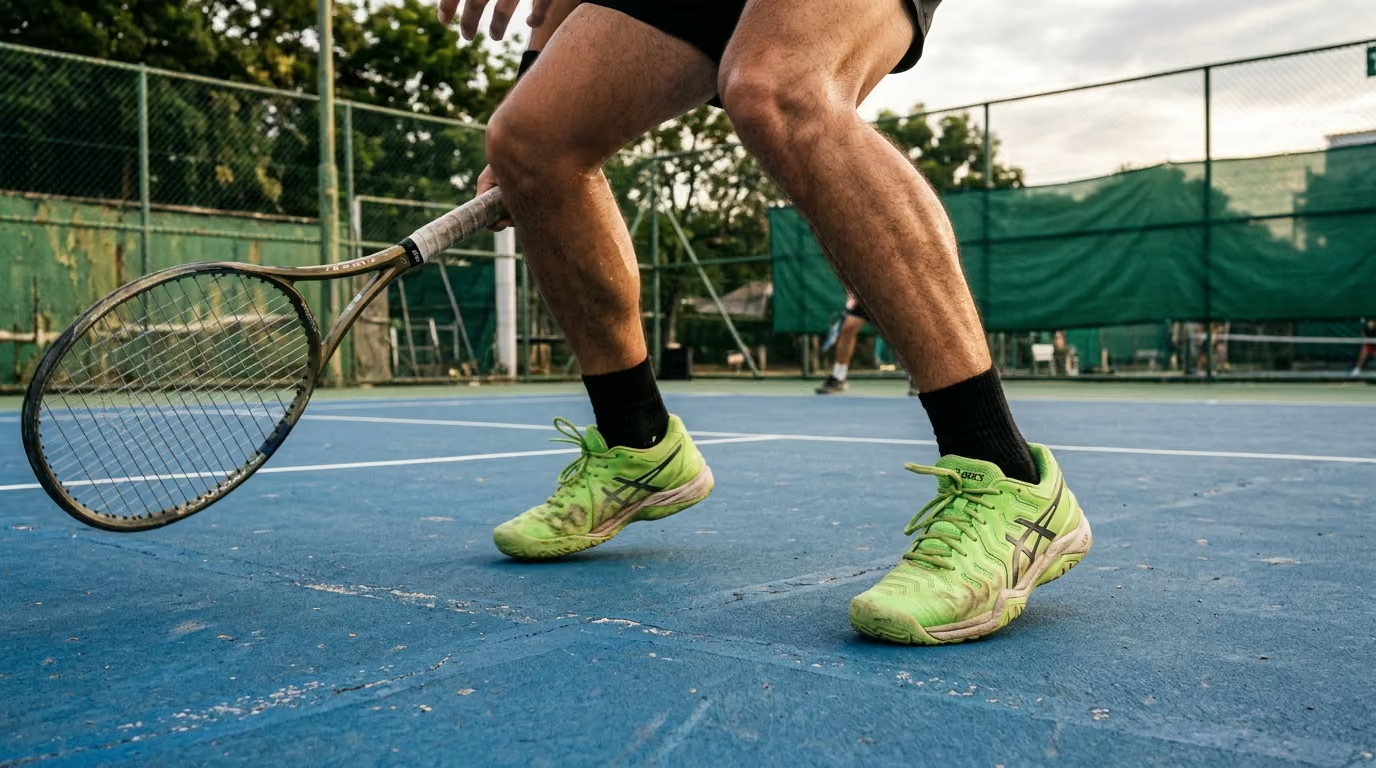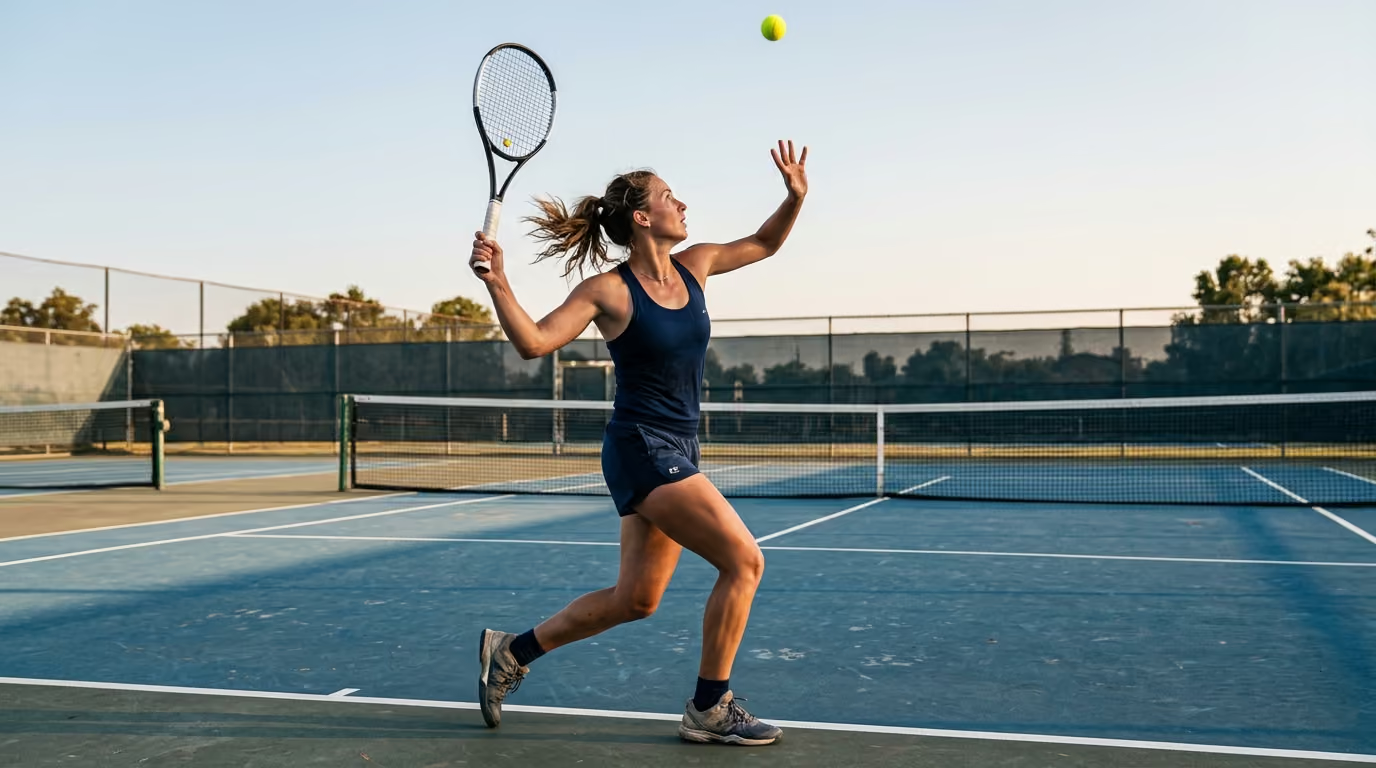

Players can effectively track lobs and execute overheads in racquet sports by mastering a systematic process that combines anticipation, spatial awareness, and balance.




You are standing near the net, ready to put away a short ball. Suddenly, your opponent strikes a high, deep lob that sails over your head toward the back of the court. You scramble backward with your feet square, head tilted up, and arms flailing, only to miss the ball and trip on your heels.
Moving backward and preparing for an overhead requires a coordinated sequence of turning your hips, tracking the ball over your shoulder, and adjusting your steps to strike the ball in front of your head. By replacing upright backpedaling with a quick drop step and side-on rotation, you can preserve your balance and hit a controlled overhead. This movement pattern protects your spine, keeps your feet under your center of mass, and lets you recover your court position quickly. To master this skill, we must break down the physical mechanics, the step-by-step footwork, and the visual tracking methods required for efficient rear-court play.
Moving backward to track a lob is not just a physical sprint. It is a systematic process that combines anticipation, spatial awareness, and balance. The entire sequence can be divided into six distinct phases that guide the player from the net to the back of the court.
The movement begins with perception, not with the feet. The athlete must identify whether the ball is short, neutral, or deep. They must judge whether the ball is rising, descending, or drifting with the wind.
This assessment must happen in a fraction of a second. A player who commits to a full retreat before the ball depth is clear can overshoot the contact point. This error leads to late braking and a rushed contact.
A high ball requires the athlete to turn their body to the side immediately. The athlete must turn the shoulders and hips toward the intended side, which allows the body to travel diagonally. This rotation helps the player keep visual contact with the ball.
The turn changes the relationship between the feet, pelvis, trunk, and racquet. It makes it easier to use a drop step or crossover rather than remaining square and stepping blindly backward.
The athlete should select a movement pattern that matches the distance to the ball. For short distances, a shuffle or short adjustment steps are appropriate. For moderate diagonal distances, a drop step followed by crossover steps is ideal.
For deep lobs, a full turn-and-run pattern is the most effective choice. When a player arrives late, a defensive response is the safest option. The player should allow the ball to bounce or use a defensive lob to regain position.
The final steps before striking must become shorter and more precise. Large running steps are effective for covering distance but are poorly suited for the final adjustment. These small steps help the athlete fine-tune their position.
During this phase, the head must remain stable to keep the ball in view. The feet should be sufficiently separated to permit braking. The trunk should remain upright, and the racquet should be fully prepared.
The contact point should be treated as a location problem, not just an arm-speed problem. If the athlete is directly underneath or behind the ball, increasing racquet speed rarely solves the issue. The non-racquet arm must act as a visual and spatial reference.
A prepared overhead is made with time to organize the feet and trunk. A desperate overhead is often taken while falling backward, which leads to awkward landings and poor ball control. The athlete should aim to contact the ball slightly in front of the head.
The movement is not complete when the racquet makes contact. The player must regain a stable base to prepare for the next shot. This recovery requires landing under control and moving back toward a central position on the court.
Recovery is one of the primary objectives of court movement. A balanced landing allows the player to react quickly to the opponent’s next return.
Understanding the physical demands of rear-court movement requires looking at sports science research. Moving backward, braking, and jumping place significant loads on the lower extremities, trunk, and shoulders.
A major review of tennis injuries by Pluim and colleagues reported that most injuries occur in the lower extremities, followed by the upper extremities and the trunk. The review found that lower-extremity injuries represent approximately 31% to 67% of tennis injuries. Upper-extremity injuries represent 20% to 49%, and trunk injuries make up 3% to 21% of cases.
A separate epidemiological study in 2024 reported that the thigh was the most common injury location at 12.3%. The shoulder followed closely at 11.9%, and the knee accounted for 10.4% of injuries. These findings highlight the physical toll that rapid court movement takes on the body.
Badminton research provides valuable data because the sport requires frequent backward movement and single-leg landings. A study of 21 badminton players with ACL injuries analyzed the exact mechanisms of injury. The researchers found that the most common mechanism was a single-leg landing after an overhead stroke.
This single-leg landing accounted for 10 of the 21 injuries. Nine of those ten players injured the knee opposite the racquet-hand side. The second most frequent mechanism was plant-and-cut movements during side-stepping or backward stepping, which accounted for eight injuries.
A related review reported that 47.6% of players in the study injured their ACL while landing on one leg after an overhead shot. Biomechanical analysis also found larger knee-valgus angles during single-leg landings when moving to the backhand-side rear compared with the forehand-side rear. This indicates that moving backward to the backhand side places unique stress on the knee.
Overhead preparation is also linked to shoulder and spinal mechanics. Research on the tennis serve shows that the late-cocking and early-acceleration phases produce the highest internal forces on the shoulder. Because the overhead stroke shares similarities with the serve, proper body positioning is essential to reduce shoulder stress.
If a player fails to get behind the ball, they must compensate by arching their lower back or reaching excessively. This compensation increases loading on both the shoulder joint and the lumbar spine. Proper footwork reduces the need for these extreme physical compensations.
Using structured training can help players build the physical capacities needed for these movements. To learn more about physical preparation, you can read our court-specific mobility and movement resources.
To move backward with balance and speed, players must master several distinct footwork patterns. Each pattern has a specific purpose depending on the distance the player must cover.
The drop step is the foundation of backward movement. To execute a drop step, the athlete turns their hips and places one foot diagonally behind the body. This opens the pelvis and allows the player to transition from a ready position into a lateral or backward run.
This step prevents the player from backpedaling with a square torso. It is the most efficient way to initiate movement when a deep lob is detected.
The crossover step is used to cover larger distances diagonally or laterally. During this step, one leg crosses over the other as the player moves across the court. This pattern covers more ground than a simple shuffle.
However, the crossover requires excellent trunk control. The player must remain aware of the landing surface to avoid tripping or losing balance.
The shuffle is a lateral movement where the feet do not cross. The player pushes off one foot and steps with the other, maintaining a wide and stable base. This step is ideal for short, precise adjustments.
It is used when the player is already side-on and needs to make minor positional corrections. The shuffle keeps the center of mass low and stable.
The unit turn is the synchronized rotation of the shoulders, trunk, and hips. It should occur as soon as the player recognizes the lob. The unit turn ensures that the racquet and body are prepared together.
Waiting to turn until reaching the ball makes the stroke rushed and unbalanced. The unit turn simplifies the transition from running to hitting.
Backpedaling occurs when an athlete retreats while facing the net with a square chest. While useful for very short distances, prolonged backpedaling is highly inefficient. It places the player's feet behind their center of mass.
This positioning reduces the ability to brake quickly and increases the risk of falling backward. Additionally, it forces the player to track the ball directly over their head, which degrades depth perception.
The quality of an overhead stroke is determined by the alignment of the hips and the upper back. When these areas lack mobility or strength, the player must compensate, which can lead to poor performance and increased physical strain.
Hip extension is the ability to drive the thigh backward relative to the pelvis. This action relies heavily on the gluteal muscles and the hamstrings. During backward movement, hip extension drives propulsion and stabilizes the pelvis.
A player must extend through the hip while keeping the ribs and pelvis connected. Pushing the pelvis too far forward arches the lower back, which increases compression on the lumbar spine. Strong hip extension allows the player to absorb forces when braking and to drive upward during the strike.
The thoracic spine, or upper back, must remain mobile to allow the arm to reach overhead. If a player has a stiff upper back, they will often arch their lower back to reach the ball. This compensatory arching is a common source of lower back strain in court athletes.
The ideal posture features an open chest with the ribs pulled down and controlled. The head should remain stable, and the pelvis should stay directly under the trunk. This alignment allows for powerful rotation without placing excessive stress on the lower back.
The non-racquet arm plays an important role in stabilizing the torso. Reaching up with the non-racquet hand helps turn the shoulders and align the upper body. It acts as a counterweight to the hitting arm, which improves balance.
This arm also serves as a visual guide to track the incoming ball. Keeping this arm elevated prevents the shoulder from dropping too early during the swing. For more details on protecting your body during these movements, see our guide on injury prevention principles for court athletes.
While the biomechanical principles of backward movement remain constant, the practical application changes depending on the sport. The court size, ball speed, and rules dictate specific movement strategies.
Tennis is played on a large court, which means lobs can travel long distances. Players often have to run back 15 to 20 feet to retrieve a deep ball. This requires a full turn-and-run pattern, followed by a transition into a classic trophy position.
Because the ball bounces high, tennis players sometimes choose to let the lob bounce before hitting an overhead. This option is useful when the wind or sun makes tracking difficult.
Pickleball courts are much smaller, and the game is played at a high tempo near the kitchen line. Lobs in pickleball are often fast and sink quickly due to the lightweight plastic ball. This makes backpedaling from the kitchen line highly tempting, but extremely dangerous.
Pickleball players must use a quick drop step to retreat safely from the non-volley zone. Because the paddle is short, contact timing is critical. Players can find more sport-specific health tips in our player health articles.
Padel introduces the unique element of glass walls. When an opponent lobs, a padel player rarely needs to sprint backward for a desperate overhead. Instead, they can allow the ball to pass over them, hit the back glass, and play it on the rebound.
This spatial strategy requires the player to turn and run toward the glass, wait for the ball to bounce, and strike it as it travels forward. When they do choose to hit an overhead, they often use a specific spin shot, which requires excellent lateral adjustments.
Even experienced players can fall into bad habits when moving backward. Recognizing these errors is the first step toward improving court movement and performance.
The most common error is backpedaling continuously while facing the net. This keeps the chest square and forces the feet to step blindly backward. The player's heels are likely to get caught, which can cause a fall.
It also limits the player's ability to run at full speed. Turning the body side-on is always the faster and safer alternative.
When a ball is slightly out of reach, players often arch their lower back instead of taking an extra step. This shift moves the center of mass backward and reduces power.
It also places high compressive loads on the lumbar spine. Players should focus on moving their feet to get completely behind the ball rather than leaning back to reach it.
Dropping the non-racquet arm early causes the shoulder axis to tilt. This action pulls the head down and disrupts visual tracking of the ball.
It also limits the rotational power of the swing. The non-racquet hand should remain pointed toward the ball until the hitting arm begins its forward acceleration.
When players get tired, they often stop running and try to reach for the ball with an extended arm. This results in a weak, unstable stroke.
The feet must continue moving until the final adjustment steps are complete. Deceleration should only occur once the player is in a stable position to strike.
To build coordination and confidence, players should integrate specific drills into their practice sessions. These drills progress from simple movement patterns to reactive, match-like scenarios.
This drill focuses on positioning and footwork without the distraction of hitting. A partner or coach tosses a high ball from across the net. The player starts in a ready position, executes a drop step, and moves under the ball.
Instead of swinging, the player must catch the ball in their non-racquet hand above and slightly in front of their head. This ensures they have moved far enough back to make clean contact.
This drill improves lateral coordination and the ability to change directions while moving backward. Set up four cones in a straight line, spaced five feet apart. The player weaves through the cones using a backward shuffle pattern.
The chest should remain oriented diagonally, and the feet must not cross. This drill teaches the athlete to stay light on their toes and maintain a low center of mass.
This drill teaches players how to transition from a fast sprint into a balanced hitting stance. Place a target marker on the court, about fifteen feet behind the starting position. The coach feeds a deep lob.
The player must turn, run to the target, plant their feet in a wide stance, and execute a shadow swing. They must hold their finish position for two seconds to demonstrate balance before recovering.
This drill helps players choose the appropriate response based on ball depth. The coach feeds lobs of varying depths and heights. Before striking, the player must call out "short," "deep," or "bounce."
If they call "short," they step forward and hit an aggressive overhead. If they call "deep," they turn, run back, and hit a controlled overhead. If they call "bounce," they let the ball bounce and play a defensive groundstroke.
This drill focuses on the landing phase to protect the knees and joints. The player starts on a low platform or stands on the court. They jump lightly, simulate an overhead swing, and land on both feet with soft knees.
Progress this drill by having the player land on a single leg under control. Ensure the knee remains aligned over the toes and does not collapse inward.
This drill tests movement mechanics under physical fatigue. The player performs ten seconds of rapid lateral side-shuffles. Immediately after, the coach feeds a deep lob.
The player must execute a clean drop step, run back, and hit a controlled overhead. This teaches the nervous system to maintain proper movement patterns even when tired. To learn more about structuring these training routines, read our resources on healthy aging and athletic longevity.
Moving backward and braking put high demands on the musculoskeletal system. Understanding how these movements affect your body can help you manage recovery and prevent soreness.
Decelerating and stopping after a sprint requires eccentric muscle contractions. During an eccentric contraction, the muscle lengthens under tension. This occurs in the quadriceps and calf muscles as you plant your foot to stop your backward movement.
Eccentric loading is a primary cause of delayed onset muscle soreness (DOMS). It places significant strain on the tendons, particularly the patellar tendon in the knee and the Achilles tendon in the ankle.
The rapid twisting of the torso during an overhead stroke stresses the abdominal obliques and the deep muscles of the lower back. If the player is off-balance, this rotational stress increases.
Maintaining core stability during these movements helps distribute forces evenly across the spine. Without proper trunk control, the risk of muscle strains in the lower back rises.
As you fatigue during a long match, your proprioception (your brain's awareness of your body's position) naturally declines. This delay in muscle recruitment makes footwork less precise.
Tired players are more likely to resort to backpedaling instead of turning. They are also more likely to land with poor knee alignment. Managing fatigue through proper hydration, nutrition, and rest is essential for maintaining movement quality.
To explore recovery strategies that support muscle and joint health, you can read our resources on recovery science for racquet sports.
While stiffness and mild fatigue are normal parts of training, certain symptoms require attention from a qualified healthcare provider. You should consult a physical therapist or sports medicine specialist if you experience any of the following:
A professional can assess your joint mechanics, identify specific muscle weaknesses, and design a customized rehabilitation program to keep you playing safely.
Revisit this guide whenever you feel off-balance during overheads, experience stiffness in your lower back after deep lob sessions, or want to refine your defensive footwork. Mastering the turn, travel, and recovery sequence will keep you moving efficiently and enjoying the court for years to come.
Follow Evercourts for practical insights on tennis, pickleball and padel performance, movement, recovery and healthy ageing. Stay connected for new articles, research-led guidance and ideas to help you play well and keep playing for years.


Read practical guidance for better movement, smarter preparation and a game that keeps working for you.
explore the Blog