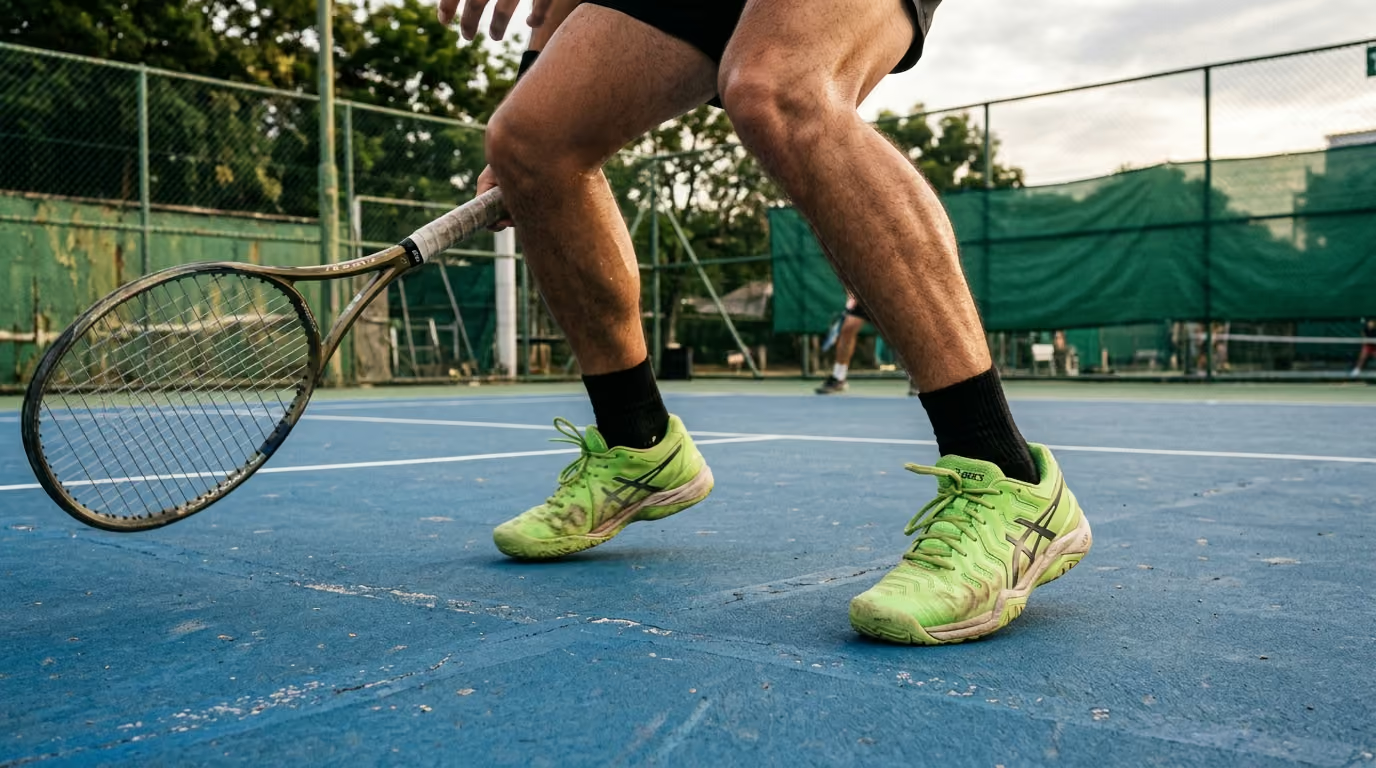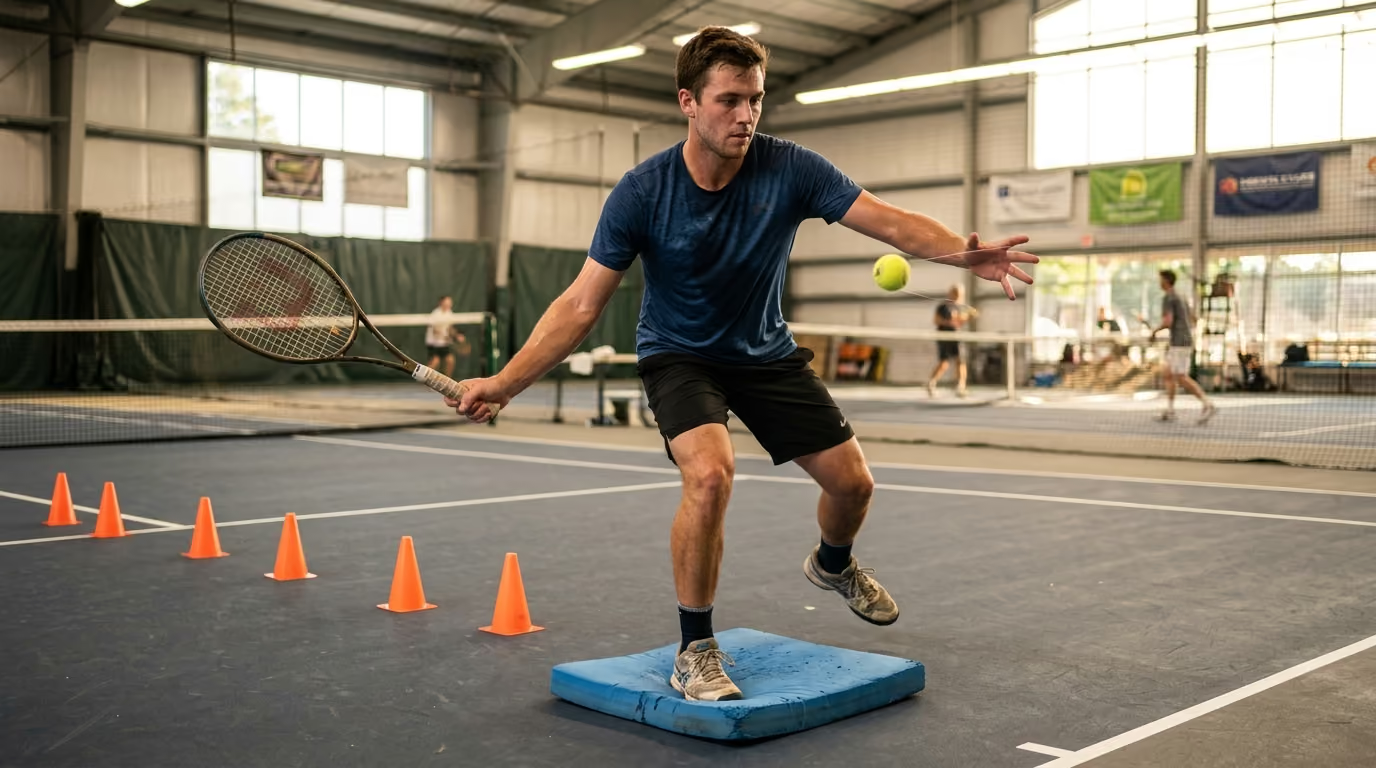

While many believe balance is a static posture, it is actually an active movement skill in racquet sports, coordinating body position, force, and sensory information.




Many racquet sports players search for ways to stop tripping over their own feet or slipping during a wide shot. They want to know why they can stand on one leg in a gym but feel completely unstable during a fast rally.
In racquet sports, balance is not a static posture but an active movement skill. It is the ability to organize your body's position, manage force, and process sensory information while running, hitting, and recovering. To build this capability, you must move beyond simple static holds and train your body to handle the dynamic demands of the court.
When you move across the court, your brain collects information from your eyes, your inner ear, and your feet. This collection of feedback loops is called the sensorimotor system. It coordinates three distinct inputs to keep you upright and moving.
The visual system tracks the ball, the boundaries, and the opponent. Visual motion can easily override other senses. If you have ever felt dizzy watching a fast ball pass you, you have experienced this visual dominance.
The vestibular system sits inside your inner ear. It registers head movement, tilt, and acceleration. This system helps you keep your eyes focused on the ball even when your body is sprinting.
The somatosensory system relies on proprioceptors. These are tiny sensory receptors located in your muscles, tendons, joints, and ligaments. They act like internal global positioning sensors, telling your brain where your limbs are without you having to look at them.
Research shows that balance training directly improves these pathways. A systematic review published in 2024 examined 19 studies with 621 participants across multiple sports. The researchers found that proprioceptive training led to significant improvements in balance, postural stability, joint position sense, and motor skills.
Another large review in 2022 analyzed 70 studies. It reported average relative improvements of about 46% in proprioceptive accuracy and 45% in general motor performance among studies reporting positive outcomes. While these numbers vary based on your age and fitness level, they highlight how trainable the sensorimotor system is.
However, scientific evidence also suggests that static balance tests do not always predict how well you will move during a match. A review of tennis-specific research found that traditional static sway measurements did not consistently correlate with high level serving performance. Instead, researchers found that more experienced players exhibited highly specialized adaptations in their center of pressure dynamics. They did not stand perfectly still. They made rapid, micro adjustments to maintain control.
To build true court stability, you must view balance as an active coordination task. You can read more about these movement principles in our mobility and movement resources.
To train your balance effectively, you need a model that reflects actual play. Rather than viewing balance as a single score, think of it as five distinct, overlapping abilities.
Orientation is the process of locating yourself in space. You must perceive your own body position while tracking the speed of the ball, the position of the opponent, and the limits of the court. An athlete with poor orientation might hit the ball well but constantly find themselves out of position.
Stabilization is the control of your joint segments during movement. You must keep your trunk, pelvis, hips, knees, ankles, and feet aligned under stress. When you lung for a low shot, your trunk must remain stable so your arms can swing freely.
Propulsion is the creation of force. You must push off the ground to sprint forward or lateral without losing control of your center of mass. If your hips sway or your feet slip, you lose valuable power.
Absorption is the deceleration of your body. When you run to the side and plant your foot, you must absorb several times your body weight in force. Coordinated ankle, knee, and hip flexion allows you to stop without placing excessive strain on your joints.
Recovery is the transition back to an athletic stance. Once you hit the ball, you must immediately push off your outside leg and return to the middle of the court. Efficient balance ensures that you finish your stroke in a position that supports this next step.
This framework shows why holding a quiet single leg stance is only the beginning. Racquet sports require you to transition between propulsion, force absorption, and recovery in fractions of a second.
To improve your movement, you must understand your limits of stability. This term describes how far you can reach or move your center of mass away from your feet without stepping or falling.
In sports science, the Y-Balance Test is often used to measure these limits. The test requires you to stand on one leg and reach with your other foot in three directions: anterior, posteromedial, and posterolateral.
Research has shown that this test is a reliable way to measure lower body control. A systematic review reported high reliability scores in adults, with correlation coefficients ranging from 0.85 to 0.91.
The test is highly relevant to racquet sports because posterolateral and posteromedial reach distances match the angles of deep court lunges. When you lung diagonally to retrieve a drop shot or a deep lob, you are testing your posterolateral stability.
A meta-analysis published in 2024 found that neuromuscular training significantly improved dynamic balance in athletes. The researchers observed the largest improvements in posteromedial and posterolateral reach distances. Interestingly, anterior reach showed less change. This suggests that lateral and diagonal control are highly responsive to targeted training.
When you practice these reaching patterns, you must focus on the quality of your joint alignment. Your standing knee should point in the same direction as your middle toes. Your pelvis should remain level, and your foot should maintain flat contact with the floor.
If your knee collapses inward or your heel lifts off the ground, you have reached the edge of your functional stability. Training at this boundary helps your nervous system build stronger motor control patterns. You can find more structured advice on this in our court-focused injury prevention strategies.
To build reliable balance, you must progress from simple, closed environments to complex, open court situations. This step by step sequence helps you build control systematically.
Before you add speed or dynamic movement, you must master basic joint alignment. The foundation of this stage is tripod foot contact. This means keeping equal weight distribution through three points of your foot: your heel, the base of your big toe, and the base of your pinky toe.
Once you can align your joints in a split stance, you must practice standing on one leg. This stage removes fifty percent of your support base.
Now you must learn to move your body away from your foot and return to the center under control.
This stage trains your muscles to decelerate your body weight. This is critical for preventing joint strain during sudden stops.
Racquet sports are rarely played in a straight line. You must be able to turn your hips while keeping your feet anchored.
This stage introduces external disturbances. This forces your nervous system to make rapid, unconscious corrections.
The final stage combines movement with court decision making. This helps translate gym balance into actual match play.
For players looking to integrate these movements into their wider routines, you can review our tailored strength and conditioning methods.
While the underlying physiology of balance is the same, tennis, pickleball, and padel place distinct mechanical demands on your body. Understanding these differences helps you tailor your training.
Tennis is played on a large court. It involves high speed sprints, long deceleration slides, and extreme diagonal lunges.
Because of the court size, tennis players must absorb massive amounts of lateral force. You need exceptional eccentric strength in your quadriceps and gluteals to slow down before hitting. Your balance training should emphasize wide lateral bounds, deep lunges, and controlled deceleration from high speeds.
On clay courts, you must also manage balance during a slide. This requires you to maintain a upright trunk while your feet are actively sliding across the surface.
Pickleball is played on a much smaller court. The movements are shorter, faster, and highly repetitive.
The primary balance challenge in pickleball occurs at the non volley zone line, often called the kitchen line. Here, you must maintain a low, wide stance for extended periods. You must quickly reach for low dinks without stepping into the kitchen.
This requires excellent static endurance in your thighs and deep hip mobility. Your balance work should focus on wide, static split stance holds, low squat reaches, and rapid lateral shuffling.
Padel is played in an enclosed glass court. It requires constant turning, backward running, and adjusting to ball rebounds off the walls.
In padel, you must frequently turn 180 degrees to play balls off the glass. This requires high levels of vestibular and visual coordination. If your head turns quickly but your feet cannot keep up, you will lose your positioning.
Your training should emphasize rotational movements, backward to forward transitions, and single leg pivots. You must practice keeping your gaze stable while your body turns.
Many well meaning athletes waste time on balance exercises that do not translate to better court performance. Avoiding these common mistakes will make your training much more effective.
Standing on foam pads, balance boards, or Swiss balls can be useful during early rehab. However, these surfaces do not mimic the hard court.
On the court, the ground is stable. You need to push against a firm surface to generate speed.
If you spend all your time training on soft, unstable surfaces, you learn to absorb force rather than produce it. This can actually make you slower on the court. Keep most of your training on firm ground, using single leg postures and movement to create the balance challenge.
Many players believe that good balance means standing perfectly still. As a result, they brace their muscles and become completely rigid.
Rigidity is the enemy of movement. If you are stiff, you cannot react to a bad bounce or a sudden change of direction.
True balance is dynamic. It is the ability to let your joints move naturally while keeping your center of mass controlled. Do not try to lock your joints. Allow your ankles and hips to make small, fluid movements to keep you upright.
Closing your eyes makes any balance exercise harder. However, you never play racquet sports with your eyes closed.
Closing your eyes forces your brain to rely almost entirely on your feet and inner ear. While this can build basic ankle awareness, it does not train the eye to hand coordination needed on court.
Instead of closing your eyes, challenge your visual system by moving your head, tracking a ball, or shifting your gaze between different targets. This keeps your visual system active while still challenging your balance.
Most balance training is done at the start of a workout. While this is great for learning new skills, it does not prepare you for the end of a tough three set match.
Fatigue degrades your sensorimotor control. Your muscles react slower, and your brain processes information less efficiently.
To build true court longevity, you should occasionally perform light balance drills at the end of your training sessions. This teaches your body to maintain joint alignment even when you are tired.
Improving your balance does more than make you faster. It also plays a key role in managing physical fatigue and protecting your joints.
When your balance is poor, your movement is inefficient. Your muscles have to work twice as hard to stabilize your joints. This unnecessary muscle activation drains your energy, leading to early fatigue during long matches.
By improving your sensorimotor control, your movements become smoother. Your muscles fire only when needed, conserving energy. This allows you to play longer without feeling exhausted.
Furthermore, good balance distributes force evenly across your joints. When you land from a jump or make a sudden stop, coordinated muscle activation absorbs the impact. This protects your articular cartilage, tendons, and ligaments from excessive wear.
Over time, this reduced joint stress supports your physical longevity on the court. It helps you recover faster between matches and reduces the wear and tear that leads to chronic aches.
While balance training is highly beneficial, some issues require professional medical evaluation. You should not try to train through balance problems that stem from underlying health conditions.
Consult a qualified healthcare professional, such as a physical therapist or sports physician, if you experience any of the following symptoms:
A professional can perform specialized testing to identify the root cause of these issues. They can ensure that your training program is safe and appropriate for your body.
To help you get started, here is a practical checklist you can apply this week. These short blocks of training can easily be integrated into your existing routine.
Spend five minutes preparing your sensorimotor system before you hit your first ball.
Integrate dynamic movement into your regular hitting drills.
Perform these exercises twice a week to build your structural stability.
By making balance a regular part of your movement routine, you build the physical foundation needed for years of active, enjoyable play.
Follow Evercourts for practical insights on tennis, pickleball and padel performance, movement, recovery and healthy ageing. Stay connected for new articles, research-led guidance and ideas to help you play well and keep playing for years.


Read practical guidance for better movement, smarter preparation and a game that keeps working for you.
explore the Blog