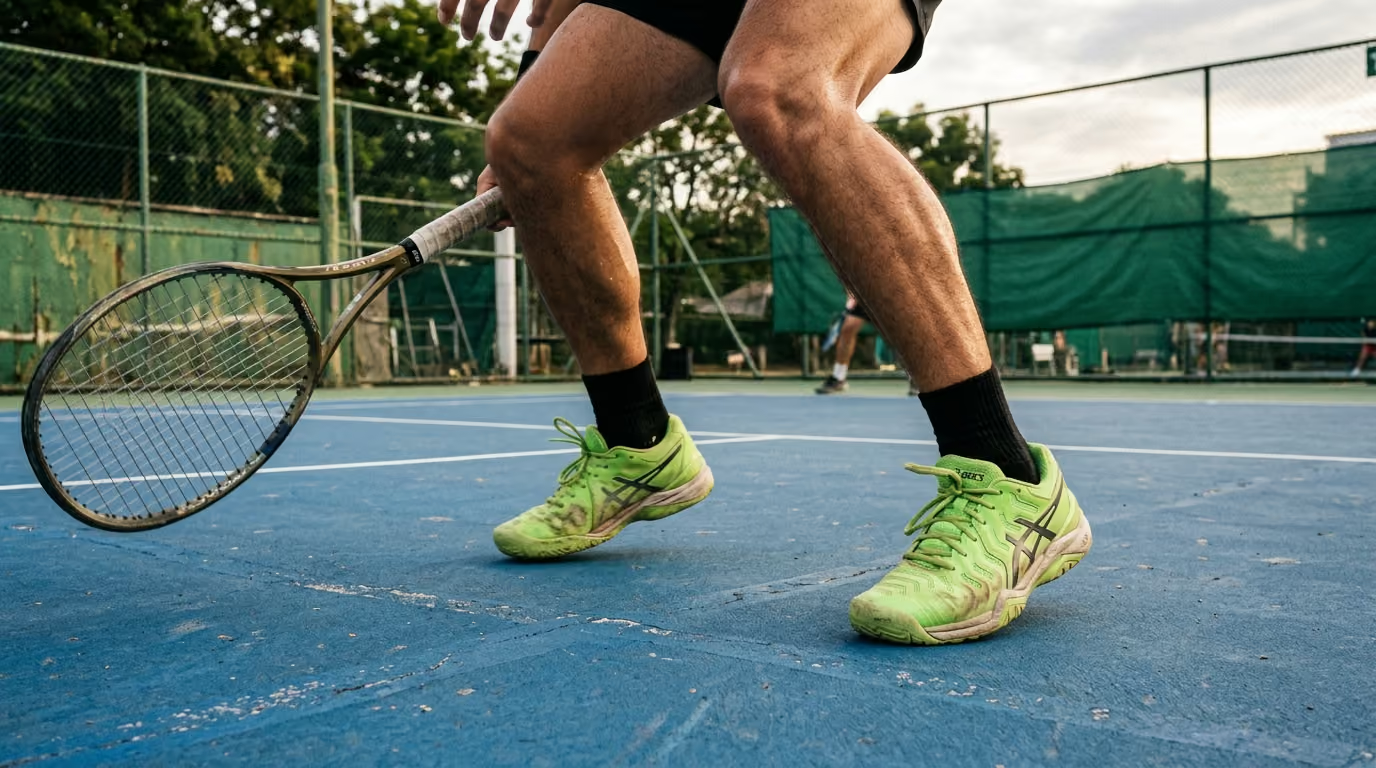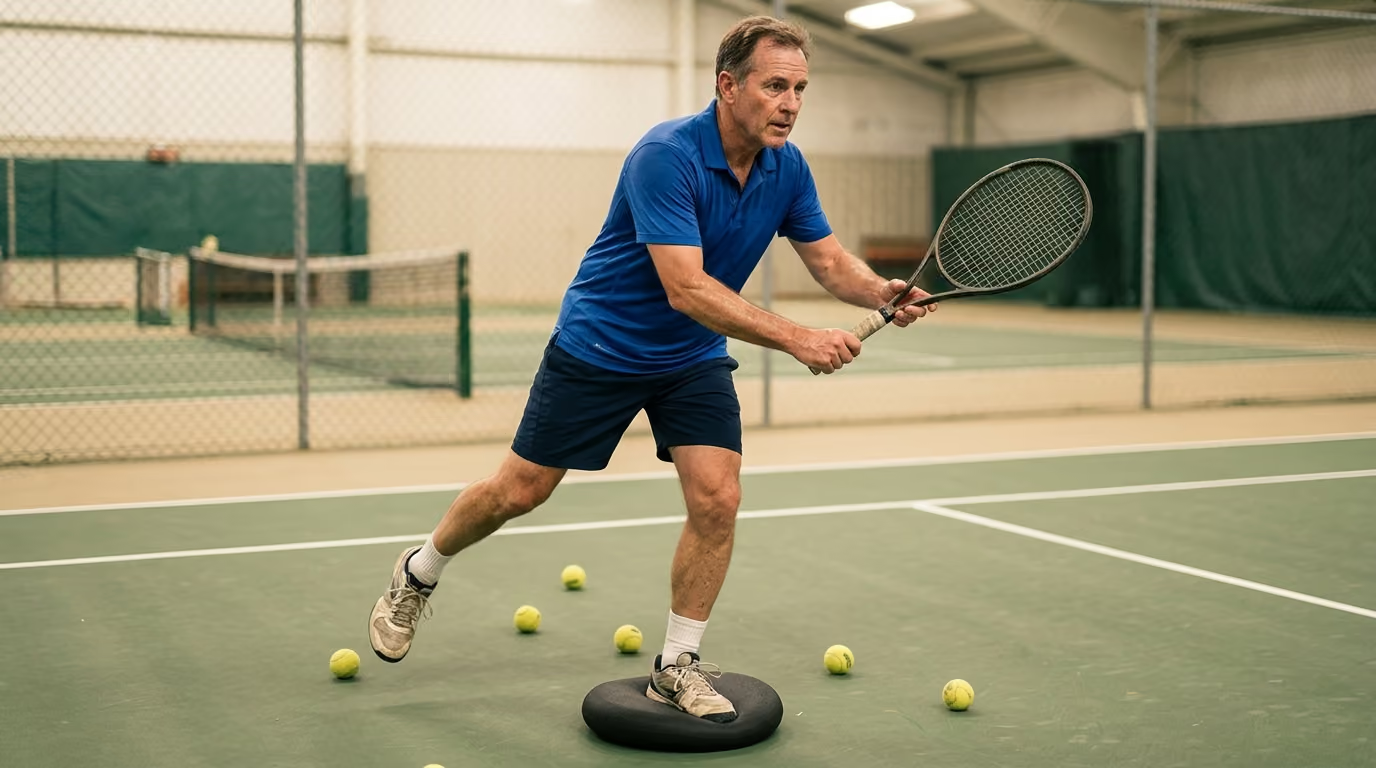

Balance training for racquet sports involves dynamic, proactive, and task-specific skills crucial for maintaining court performance and functional capacity over time.




Balance training in racquet sports is often misunderstood. Many players assume it simply involves standing on one foot on a foam pad. In reality, court-based balance is a highly dynamic, proactive, and task-specific skill. It is the foundation of every movement you make on the court.
Racquet sport balance is the dynamic ability to control your center of mass while absorbing and producing athletic force on the court. To train it effectively, you must combine functional single-leg strength, eye-gaze stabilization, and rapid recovery movements rather than relying on static standing postures alone. This integrated approach ensures you can decelerate safely and transition smoothly between shots as you age.
An in-depth understanding of balance will help you maintain your court performance. It will also help preserve your functional capacity over decades of active play. This comprehensive resource outlines the underlying science of postural control. It provides practical on-court training applications for tennis, pickleball, and padel. It also details how to assess your own balance baseline at home.
To train your balance, you must first understand how your body maintains stability. True court balance is not a single, isolated physical capacity. It is the result of multiple physiological systems working in harmony. Scientists divide balance into four distinct categories, which all contribute to your performance.
Static balance is your ability to maintain a stable posture when your feet do not move. This occurs when you hold a split stance before a serve return. It also happens when you stabilize on one leg for a brief fraction of a second after a wide reach.
Dynamic balance is the control of your body when your center of mass and your base of support are actively changing. Lunges, lateral shuffles, and split-step landings are prime examples of dynamic balance tasks.
Research published in systematic reviews demonstrates that balance training significantly improves both categories in healthy older adults. One major meta-analysis found substantial positive changes in static and dynamic balance after structured training. The analysis showed that targeted exercises help the nervous system adapt to challenging movement patterns.
Proactive balance refers to adjustments your nervous system makes before a voluntary movement. Your brain anticipates the physical demand of a step or a lunge. It lowers your center of mass and widens your stance to prepare for the shot. The same meta-analysis revealed that proactive balance training yields the largest training effects of all categories.
Reactive balance is your ability to recover from an unexpected disturbance. This includes recovering from a misjudged ball bounce, a slippery spot on the court, or a sudden change in direction.
Your body manages these demands by adjusting the relationship between your center of mass and your base of support. Your base of support is the physical area beneath and between your feet. When you reach far outside this base, your center of mass moves toward the edge of stability. You must use muscular force at your ankles, knees, hips, and trunk to maintain control.
Proprioception is your internal sense of joint position and movement. It relies on sensory receptors in your muscles, tendons, and joint capsules. This system helps you know where your limb is positioned without looking directly at it.
However, proprioception is only one part of the balance puzzle. Your brain must integrate this information with visual and vestibular inputs.
As we navigate athletic longevity and physical preservation, our reliance on these different sensory inputs can shift. Research shows that older adults often rely more heavily on visual feedback to maintain postural control. If visual feedback is delayed or interrupted, postural sway can increase. This has major implications for how we train on the court under changing light conditions.
The clinical evidence for balance training is exceptionally strong. The World Health Organization reports that multicomponent exercise programs reduce fall rates in older populations by 23 percent.
When these programs include specific balance and functional exercises for at least three hours per week, the fall rate drops by 42 percent. These programs are highly effective when they combine balance, strength, gait, and functional movements.
Additionally, research on sport-specific movements shows how pain can alter your balance strategies. A study on badminton players with chronic knee pain revealed that pain changes how players perform diagonal lunges. The pain group displayed reduced knee and trunk motion to complete the lunge. This shifts muscular work to other areas of the body, which can cause secondary strain.
To design a highly practical training plan, you can organize your preparation around the Balance-Force-Vision-Recovery model. This model addresses the specific physical and neurological demands of racquet sports.
The balance component focuses on training postural control under progressively harder structural conditions. You should practice maintaining stability across different foot positions.
Start with a bilateral stance where both feet are wide. Progress to a staggered split stance, a tandem heel-to-toe stance, and finally a single-leg stance.
Once you can hold a single-leg stance, you should introduce active reaches with your arms or your opposite leg. This forces your hip stabilizers to work harder. It also teaches your nervous system to manage a shifting center of mass.
You cannot separate balance from strength. You need sufficient muscular force to decelerate your body weight when you sprint to a ball.
The American College of Sports Medicine recommends training your lower body with resistance exercise to build this capacity. For older or recreational athletes, this involves performing one or more sets of 10 to 15 repetitions at moderate intensity. This equates to roughly 60 to 70 percent of your one-repetition maximum.
Focus on functional patterns like squats, step-ups, controlled step-downs, and lateral lunges. These movements build strength in your quadriceps, hamstrings, gluteals, and calf muscles. This physical strength provides the structural braking system required for safe court movement. You can find more detail on building this base in our strength and conditioning guidelines.
Vision is a primary driver of athletic balance. Your eyes tell your brain where your head is positioned relative to the court surface.
Research indicates that a stable visual background reduces postural sway. When you track a moving ball or watch a moving opponent, your postural sway naturally increases.
To train your visual-postural connection, practice keeping your head and eyes stable during simple movements. Focus on a single target on the wall while performing stepping or lunging drills.
As you progress, practice tracking a moving object while maintaining single-leg stability. Avoid doing balance exercises with your eyes closed unless you are in a highly controlled, supervised setting. For court sports, we want to train our eyes to work efficiently with our movement, not shut them down.
Every movement on the court consists of two phases. First, you must arrive at the ball and produce your stroke. Second, you must recover back to a central position to prepare for the next shot.
A spectacular reach is useless if it leaves you completely off-balance and unable to move. Your training should always emphasize the recovery step.
When you practice a lunge or a wide reach, do not just hold the end position. Practice pushing off the ground with control and returning to your ready stance. This teaches your body to transition immediately from force absorption to force production.
Every shot on the court requires a specific coordination of balance, strength, and visual focus. By examining these movements individually, you can improve your technique and protect your joints from excessive wear.
The split step is a small, timed hop that you perform just as your opponent strikes the ball. It is not designed to get you high in the air. Instead, it prepares your muscles to spring in any direction.
A study on simulated tennis responses found that players were 13.1 percent faster when using a split step compared to a standing start. This speed advantage comes from faster movement initiation.
To execute a balanced split step, land with your feet slightly wider than hip-width apart. Your knees and ankles should be slightly bent to absorb the impact. Your center of mass should be low and centered between both feet. This neutral landing allows you to push off instantly in any direction.
Lunging is the most frequent movement pattern in racquet sports. You use it to reach low volleys, drop shots, and wide groundstrokes.
When you lunge, your front leg must absorb several times your body weight. You must place your foot deliberately and keep your knee aligned over your second toe.
Avoid letting your knee cave inward. This inward movement, known as knee valgus, places high stress on the joint.
If you have underlying knee pain, you may find that your body unconsciously shortens your lunge. This compensation can reduce your reach and overload your lower back. Focus on controlled, shallow lunges first, and gradually increase your depth as your strength improves.
When a ball is struck wide, you must often stretch your torso far beyond your feet. This action moves your center of mass outside your base of support.
To maintain control, you must rely on your trunk and your hip stabilizers. Keep your core muscles engaged to prevent your upper body from collapsing forward.
Your head should remain as level as possible. Excessive head tilting disrupts your visual tracking and makes it harder for your brain to calculate the ball's trajectory.
Always utilize a dynamic recovery step. Instead of trying to freeze your body on one leg at the end of the reach, step through the movement to restore your base of support.
Volleys require rapid adjustments because the ball reaches you quickly. You have very little time to set your feet.
Focus on maintaining a wide, stable stance. Keep your feet moving with short, choppy adjustment steps.
When hitting an overhead, you must look upward while moving backward or sideways. This upward gaze challenges your vestibular system.
Practice backing up with cross-behind steps while keeping your chest open and your core engaged. Avoid arching your lower back excessively to reach the ball. Instead, use your legs to get behind the ball so you can strike it in front of your body.
When you are forced to run hard to save a ball, you must eventually slow down and change direction. This requires high eccentric leg strength.
Use a series of small, rapid braking steps rather than trying to stop all at once. This spreads the deceleration force over multiple foot strikes.
Once you strike the ball, transition immediately into a crossover step or a lateral shuffle. Keep your hips low during this transition.
This low position keeps your center of mass close to the ground, which makes you more stable. It also reduces the workload on your lower back and hip joints during the recovery phase.
While all racquet sports share common balance themes, each sport has unique physical demands. Understanding these differences allows you to tailor your training to the specific sport you play.
Tennis is played on a large court, which requires long sprints and high-velocity stops. You must cover significant distances to reach the ball.
This creates a high demand for dynamic deceleration. You must be able to slide on clay or brake hard on hard courts.
Because of the court size, tennis players require exceptional single-leg strength to absorb forces during wide lunges. You must also manage the rotational forces of a full groundstroke swing.
Your balance training should emphasize long lateral shuffles, deep diagonal lunges, and explosive recovery steps. You must prepare your body to handle high kinetic energy over wide movement arcs.
Pickleball is played on a smaller court, which reduces the need for long sprints. However, the game is exceptionally fast, especially near the non-volley zone, also known as the kitchen.
You must perform frequent, rapid split steps. You must also hold a low, bent-knee ready position for extended periods.
The primary balance challenge in pickleball is managing low reaches. You must bend your knees and sink your hips to get below a low-bouncing ball.
Pickleball players should focus on endurance in a wide, low stance. Your training should emphasize lateral stepping, quick weight transfers, and short, controlled lunges. Keeping your chest relatively upright during these low reaches is key to preserving your lower back. For more sport-specific strategies, view our pickleball articles.
Padel is played in an enclosed court surrounded by glass and metal walls. This environment introduces unique movement dynamics.
You must frequently track balls that rebound off the walls behind or beside you. This requires constant turning, backing up, and spinning.
Your vestibular system is highly active as you rotate to track these rebounds. You must maintain your balance while turning your head and torso quickly in three-dimensional space.
Padel players should prioritize rotational core strength and gaze-stabilization drills. Practice turning 180 degrees quickly while maintaining a stable lower body. Your training should prepare you to transition smoothly from backward movement to forward movement without losing your spatial orientation.
Before you begin a balance training program, it is helpful to assess your current abilities. You can use simple, validated screening tools to establish a baseline and track your progress over time.
The Centers for Disease Control and Prevention developed the STEADI framework to help healthcare providers assess fall risk. You can use several of these tests safely at home to check your functional balance.
The first test is the Four-Stage Balance Test. This test assesses your stability in four progressively harder positions.
Try to hold each position for 10 seconds without moving your feet or grasping for support. If you cannot hold the tandem stance (Position 3) for at least 10 seconds, research indicates you have an increased risk of instability. Always perform these tests near a sturdy wall or countertop so you can catch yourself if you lose your balance.
This test measures your lower-body strength and endurance, which are critical components of your balance system.
Count the number of full stands you complete. For men and women over the age of 60, completing fewer than 12 repetitions generally indicates a need to improve lower-body strength. This test is a highly reliable indicator of the muscular power you need to push off and recover on the court.
You can also assess your balance while practicing on the court. Have a partner watch you play, or record a video of your movement during a practice session. Look for the following common signs of movement instability:
If you note any of these patterns, it indicates that your physical capabilities are being stretched to their limit. You can use these observations to target specific areas in your physical preparation. For more on-court movement analysis, see our mobility and movement drills.
To achieve lasting improvements in your court stability, you should follow a structured, progressive program. This 12-week plan progresses from basic postural control to dynamic, sport-specific movements.
Consistency is essential for neurological adaptation. The World Health Organization recommends performing balance-challenging and functional exercises on three or more days per week.
You do not need to spend hours on these drills. A brief 10 to 15-minute session is highly effective.
You can integrate these exercises into your pre-match warm-up or perform them at home. As you progress, you should change only one variable at a time.
You can make an exercise harder by narrowing your base of support, increasing your movement speed, or adding a visual challenge. Do not advance to more complex movements until you can perform the foundational exercises with perfect control.
The focus of this first phase is to build a reliable foundation of static balance and lower-body strength.
This phase introduces dynamic movement and forces your muscles to absorb impact.
This final phase combines movement, visual tracking, and rapid transitions to mimic real match conditions.
Even dedicated players can run into setbacks if they approach balance training incorrectly. Recognizing these pitfalls and understanding how fatigue affects your body will help you stay healthy and active.
The first common pitfall is overusing unstable surfaces. Many players perform complex exercises on soft foam pads, half-balls, or wobble boards.
While these tools are useful in early-stage clinical rehabilitation, they do not replicate court conditions. Courts are hard, flat surfaces that require rapid force production.
Overusing unstable surfaces can actually reduce your ability to produce force quickly. It is much more effective to train on a firm surface while narrowing your stance or adding movement speed.
Another frequent error is neglecting basic lower-body strength. If your quadriceps and gluteals are weak, no amount of balance practice will keep you stable during a deep lunge.
Strength and balance must be trained together. You can learn more about combining these elements in our guide to court-specific injury prevention.
Finally, some players try to push through joint pain during balance training. As research on lunge mechanics demonstrates, knee pain causes your body to alter its movement patterns.
This can lead to poor alignment and secondary strain on your back or hips. If an exercise causes joint pain, you should scale back the range of motion or consult a professional.
Fatigue is a major contributor to balance breakdown during a match. Research shows that physical fatigue impairs your postural control and negatively affects your lunge biomechanics.
As you tire late in a set, your nervous system slow down its reactions. Your muscles take longer to contract, which makes your split step less effective.
Your landings become heavier, and your knees may start to cave inward during deep lunges. This increases the physical stress on your joint cartilage and ligaments.
To combat this, you must prioritize recovery between your playing sessions. Adequate sleep, proper hydration, and light active recovery steps help restore your nervous system.
When you perform balance drills, do them when your body is fresh. This ensures you are training high-quality movement patterns rather than reinforcing fatigued, sloppy habits. For more on recovery physiology, read our player health and physical readiness articles.
While a progressive home or court program is highly beneficial, some situations require specialized medical evaluation. Your balance relies on complex interactions between your eyes, your inner ear, your nerves, and your muscles.
You should consult a qualified healthcare provider, such as a physical therapist or sports physician, if you experience any of the following symptoms:
These symptoms can indicate underlying vestibular disorders, neurological issues, or structural joint injuries. A clinical professional can perform specific diagnostic tests to identify the root cause of your instability.
If you are recovering from an injury or surgery, a clinical specialist can help you design a safe path back to the court. They can assess your movement symmetry to ensure you are not overloading one side of your body.
They can also provide hands-on therapy to restore joint mobility and guide you through progressive loading. This specialized support is invaluable for maintaining your athletic longevity and physical preservation.
Yes, performing light balance exercises before a match is highly beneficial. You can integrate simple movements like single-leg stands, short lunges, and light split steps into your warm-up routine. This helps prepare your nervous system and muscles for the physical demands of play. Avoid doing long, exhausting drills that could fatigue your legs before the match begins.
Yes, wearing appropriate footwear is critical for maintaining stability. Racquet sports require frequent lateral movements, which demand shoes with robust lateral support and a stable sole. Running shoes are designed primarily for forward movement and often lack the lateral stability needed for court sports. Ensure your court shoes fit securely, provide adequate traction for your specific court surface, and are replaced regularly when the cushioning and grip wear down.
As we age, our proprioception, visual tracking, and muscular strength can naturally decline. This can lead to increased postural sway and slower reaction times on the court. However, clinical evidence shows that your balance system remains highly adaptable throughout your life. Engaging in regular, progressive balance and strength training can significantly improve your postural control, reduce your risk of falls, and help you maintain your court performance for years to come.
To achieve lasting adaptations, you should perform balance-challenging exercises at least three times per week. This aligns with guidelines from major health organizations, including the World Health Organization. You do not need to dedicate hours to these drills. Incorporating 10 to 15 minutes of targeted exercises into your warm-up, home routine, or strength sessions is highly effective for preserving your court mobility.
Follow Evercourts for practical insights on tennis, pickleball and padel performance, movement, recovery and healthy ageing. Stay connected for new articles, research-led guidance and ideas to help you play well and keep playing for years.


Read practical guidance for better movement, smarter preparation and a game that keeps working for you.
explore the Blog