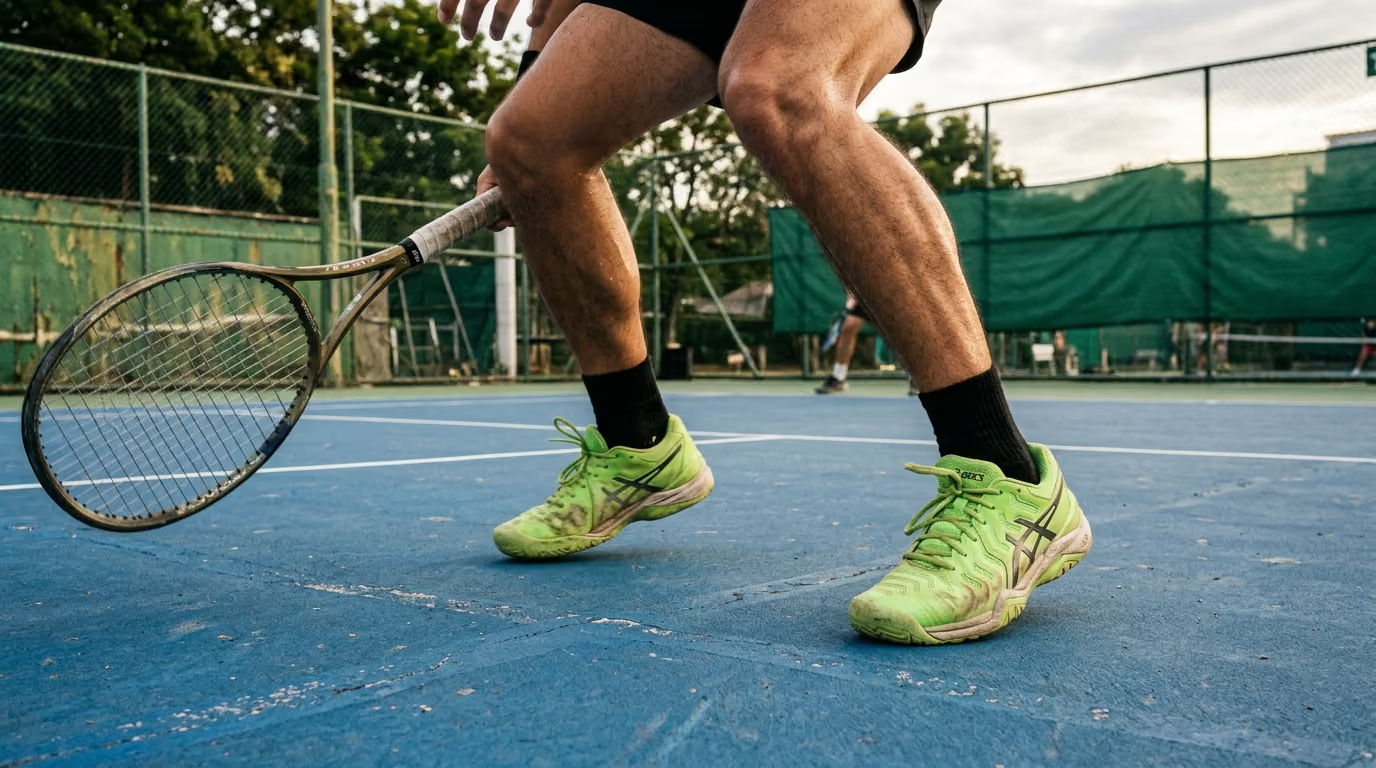
A structured four-stage routine, paired with individualized hydration and thermal cooling, preserves competitive readiness in racquet sports.




Many tennis, pickleball, and padel players believe that recovery only starts when they walk off the court. In reality, the most decisive recovery happens during the active seconds between points, games, and matches. Effective in-match recovery is the deliberate management of your heart rate, emotional state, and strategic focus during the brief intervals built into play. By pairing a systematic four-stage routine with individualized hydration and thermal cooling, you preserve your competitive readiness rather than simply trying to calm down. This systematic approach ensures your body and mind remain prepared for the physical demands of high-level competition.
We often focus on our technical strokes or our physical conditioning when looking to improve our performance. Yet the spaces between the action are where matches are frequently won or lost. If you cannot reset your physiology and attention within twenty five seconds, your physical execution will inevitably suffer. This comprehensive resource outlines the structured recovery science you need to maintain peak physical and mental performance on the court.
In racquet sports, performance is characterized by repeated cycles of brief, high-intensity work followed by short periods of rest. Research in tennis indicates that average points last less than 10 seconds. Meanwhile, formal rest intervals between points are generally capped at 25 seconds. This leaves very little time to lower your heart rate, clear metabolic byproducts, and restore mental focus.
During these short windows, complete physiological recovery is impossible. Instead, the goal of in-match recovery is to manage physiological strain so that it does not degrade your motor skills. When you run, change direction, and strike the ball, your body produces substantial metabolic heat. According to sports science research, approximately 80% of the energy released during tennis is released as heat rather than mechanical work. This heat accumulation raises your core temperature, increases cardiovascular strain, and accelerates the onset of fatigue.
Physical fatigue directly impairs cognitive performance on the court. A field study of 16 university tennis players assessed how physical exertion affected their cognitive flexibility during singles matches. The researchers found that higher perceived exertion and longer durations of vigorous activity were associated with poorer attention shifting. Conversely, players who maintained a high level of attention shifting performed significantly better in their matches.
This research highlights a vital link between physical strain and mental performance. As you tire, your brain struggles to switch focus from a previous mistake to the tactical demands of the upcoming point. This is why a structured, repeatable recovery routine is not just a mental exercise. It is a biological necessity that preserves your ability to make rapid, accurate decisions under pressure.
To combat the cognitive decay caused by physical fatigue, you should implement a structured four-stage between-point routine. This routine is designed to fit entirely within the 25-second window between points. It moves you systematically from emotional reaction to physical recovery, tactical selection, and final execution.
The first five to ten seconds after a rally are the most emotionally volatile. The goal of this stage is to create immediate psychological distance from the previous result. You must acknowledge the outcome without letting it dominate your attention or dictate your body language.
Functional neutrality is the target here. Walk with your head up, keep your shoulders back, and avoid displaying physical signs of defeat. Briefly turn away from the court or the opponent to disrupt your visual focus on the error or the disputed line call. Release your grip on the paddle or racket, letting your hands and shoulders relax. Treating a winner or an unforced error as neutral information rather than an emotional identity keeps you grounded.
Once you have detached from the previous point, you must actively lower your physical arousal. High heart rates and rapid, shallow breathing impair fine motor control and narrow your visual field. This stage uses targeted breathing to initiate a quick physiological reset.
Take one or two deep, controlled breaths while walking back to your position. Inhale deeply through your nose, then let out a slow, extended exhalation through your mouth. As you exhale, consciously drop your shoulders and relax your jaw. This simple protocol helps interrupt escalating emotional activation and lowers muscular tension before you prepare for the next point.
With your emotions managed and your breathing controlled, you can now allocate cognitive bandwidth to the next point. Avoid complex technical analysis during this window. Instead, select a single, highly actionable tactical intention for the upcoming play.
Your tactical cue should be short, simple, and focused on the target or trajectory of the ball. Examples include aiming high to the opponent's backhand, hitting a deep crosscourt return, or protecting the middle of the court. Choosing a single external objective prevents cognitive overload and keeps your focus on execution rather than mechanics.
The final stage of the routine prepares your body and mind for immediate action. Turn back toward the court, establish your physical target, and commit fully to your chosen play. This is where you perform your consistent pre-serve or pre-return ritual to anchor your focus.
Your final ritual might involve a fixed number of ball bounces, looking at your racket strings, or performing a light split-step. Use a single cue word, such as "commit" or "smooth," to trigger your movement. This structured transition ensures that you enter the next point with high competitive intensity and clear focus.
To perform consistently, you must learn to regulate your arousal level throughout a match. Arousal is your state of physical and mental activation, ranging from deep lethargy to extreme excitement. Peak performance requires matching your activation level to the demands of the point.
When pressure increases, your autonomic nervous system can push you into a state of over-arousal. Signs of excessive arousal include rushed serving, a tight grip on the racket, shallow breathing, and impulsive shot selection. You may also notice yourself arguing with partners or opponents, or over-hitting short balls due to excessive muscle tension.
If you recognize these signs, you must use down-regulation strategies. Slow your walking pace between points and maximize the allowed time. Use a prolonged exhalation, letting your hands hang loose at your sides. Select a high-percentage, conservative tactical pattern to reduce decision-making stress, and use a calming internal cue word like "easy" or "tempo."
Conversely, long matches, high temperatures, or mental fatigue can cause your arousal to drop too low. Signs of under-arousal include flat body language, slow footwork, passive returns, and a wandering mind. You may find yourself reacting late to the ball and failing to accelerate through your contact zone.
To raise your activation level, use positive, energizing interventions. Adopt an upright, assertive posture and introduce rhythmic, active footwork before the point starts. Use sharp, motivating cue words like "active" or "go." You can also use a more forceful final physical action, like a pronounced split-step, to snap your nervous system back into a state of readiness.
An important element of in-match recovery is directing your focus where it will yield the best physical results. Sports science divides attention into internal focus, which targets your body's physical movements, and external focus, which targets the effect of those movements.
A systematic review published in the field of racket sports analyzed nine studies involving 452 participants to evaluate attentional-focus strategies. The review examined performance and learning across tennis, table tennis, and badminton. The researchers found that external-focus instructions consistently produced better learning and performance compared to internal-focus instructions or control conditions. These benefits were particularly evident in technical development, decision-making, and shooting accuracy.
External focus allows your motor system to organize itself naturally and automatically. Examples of effective external cues include focusing on the flight of the ball, targeting a specific spot on the court, or feeling the ball compress against the strings. These cues keep your attention on the task rather than your body mechanics.
In contrast, internal cues, such as focusing on your wrist angle or elbow rotation, can disrupt automatic movement patterns. This is often called "paralysis by analysis." While internal cues can sometimes help during slow, technical drills in practice, they should generally be avoided during competitive play. In a fast-paced match, rely on simple external cues to guide your execution.
Hydration is a cornerstone of performance preservation and thermal management during racquet sports. Dehydration raises your core temperature, increases cardiovascular strain, and accelerates the onset of fatigue. However, a generic advice to "drink as much as possible" can be counterproductive and cause physical discomfort.
According to clinical reviews, tennis players can lose between 0.5 and 3.0 liters of water per hour of play. This wide variance depends on body size, fitness level, acclimatization, and environmental heat. To build an effective hydration plan, you must understand your own sweat rate by weighing yourself before and after training sessions.
The human body faces a physical limit when processing fluids during exercise. Gastric emptying rarely exceeds 1.2 liters of fluid per hour. If you consume more than 1.25 liters per hour, you run a high risk of experiencing bloating, cramping, and gastrointestinal distress. Therefore, a player with a high sweat rate cannot fully replace all fluid losses during play and must focus on minimizing excessive deficit.
When you sweat, you lose essential electrolytes, with sodium being the most critical for athletic performance. Sodium is necessary for maintaining fluid balance, blood volume, and the physiological drive to drink. A significant depletion of sodium is also a major contributor to heat-related muscle cramping on the court.
An individualized hydration study compared high-level tennis players using standard, self-directed drinking against those using a personalized hydration plan. The personalized plan provided fluid to replace approximately 70% of sweat loss, paired with 860 milligrams of sodium per liter of water. The study found that the individualized plan significantly reduced the players' heart rates, lowered their core temperatures, and improved thermal comfort.
Interestingly, this precise hydration strategy did not prevent post-match lower-limb strength loss or slower sprint times. Both groups recovered their physical capacity within 24 hours. This suggests that while proper hydration and sodium intake significantly reduce cardiovascular and thermal strain, they cannot entirely eliminate the structural muscular fatigue caused by prolonged play.
For matches or training sessions lasting longer than 90 minutes, incorporating carbohydrates into your hydration plan can help maintain performance. Research shows that consuming 30 to 60 grams of carbohydrates per hour helps preserve blood glucose levels and delays glycogen depletion.
However, in shorter sessions lasting under an hour, carbohydrate drinks have not demonstrated a significant performance benefit over plain water. If you are playing a quick singles match or a doubles set, stick to water and electrolytes. Save the carbohydrates for longer matches or days when you have to play multiple matches in a short period.
Managing your body temperature during changeovers and set breaks is critical, especially when playing in hot and humid conditions. High environmental heat limits your body's ability to dissipate thermal energy, which quickly degrades your endurance and cognitive performance.
A comprehensive survey of 129 competitive male tennis players examined how athletes handle thermal stress in different climates. Over 98% of the surveyed players reported a distinct physical difference between hot-dry and hot-humid conditions, with hot-humid environments rated as significantly more stressful. International-level players reported a much higher use of advanced cooling strategies, such as cold towels, cold packs, and cold-water immersion, compared to regional players.
You can implement several practical cooling strategies during changeovers and set breaks to manage thermal stress:
While these strategies are highly effective, you should avoid extreme cooling methods that cause shivering. Shivering is your body's natural mechanism to generate heat, which defeats the purpose of your cooling efforts. Additionally, over-consuming ice slurries can lead to brain freeze or gastric discomfort, so use them in moderation.
While the core principles of recovery apply to all court sports, the physical demands and rule structures of tennis, pickleball, and padel require distinct adaptations. Understanding these differences allows you to tailor your recovery strategies to your specific sport.
Tennis features the largest court dimensions and the longest match durations, resulting in the highest total cardiovascular and musculoskeletal strain. Points are highly explosive, demanding intense lateral sprints, sudden decelerations, and powerful hitting. Fortunately, the rules of tennis provide structured rest periods: 90 seconds during changeovers and 120 seconds between sets.
Because of the high physical output and ample rest time, tennis players should focus on comprehensive thermal cooling and precise hydration during breaks. Use cold towels, sip electrolyte drinks, and take time for a brief tactical review. The 25-second window between points should be used fully to execute the four-stage routine, ensuring your heart rate recovers as much as possible before the next rally.
Pickleball is played on a much smaller court, which reduces the distance traveled per point but increases the speed of play. Points are rapid, and the transitions between rallies are incredibly fast. The game features fewer formal rest periods, meaning you have less time to lower your heart rate or implement complex cooling protocols.
In pickleball, recovery must be immediate, concise, and focused on mental clarity. Your between-point routine must be shortened to fit within a ten- to fifteen-second window. Focus on a single deep breath to reset your nervous system, a quick shake of your hands to release tension, and a simple tactical cue like "protect the kitchen line." Hydrate with small, frequent sips during quick timeouts rather than waiting for changeovers.
Padel is played on an enclosed court with glass walls, which often traps heat and humidity in indoor facilities. Because the ball remains in play after bouncing off the walls, rallies are typically longer and require sustained aerobic and anaerobic endurance. The constant changing of directions, twisting, and reacting to wall bounces places a high eccentric load on your lower back, knees, and hips.
Padel players must prioritize active recovery and mobility. Use changeovers, which occur every odd game, to hydrate with sodium-rich fluids to prevent cramping in humid indoor environments. Focus your between-point routine on relaxing your grip and maintaining a balanced, athletic posture. Because padel involves high rotational forces, keeping your core stable and your lower body warm during quick breaks is essential for maintaining movement efficiency.
Even experienced players can make mistakes that undermine their recovery efforts during a match. Identifying these common pitfalls can help you stay physically and mentally resilient on the court.
A common error is executing the exact same routine regardless of your emotional or physical state. If you have just committed a frustrating double fault, you need a routine focused on down-regulation and calming your nervous system. Conversely, if you are feeling physically flat after a long, grueling game, your routine should focus on activation and raising your energy levels. Your recovery structure should remain consistent, but the content must adapt to what your body and mind need in that moment.
Trying to fix complex biomechanical issues during a match increases your cognitive load and leads to hesitation. If you miss a forehand, do not spend the next twenty seconds analyzing your elbow position or racquet swing. Instead, quickly categorize the error as a tactical choice or a timing issue, take a deep breath, and select an external target for the next point. Save the technical corrections for your practice sessions.
Thirst is a delayed indicator of dehydration. By the time you feel noticeably thirsty, you may have already lost up to 1.5 liters of body water, which can impair your performance and increase cardiovascular strain. Establish a proactive, scheduled drinking routine during changeovers and set breaks, rather than relying solely on your perception of thirst.
Using a towel break to avoid facing the score, show frustration, or delay play can hurt your competitive focus. A towel break should be a functional transition to wipe away sweat, take a deep breath, and reset your tactical intention. If you use it to hide from the pressure of the match, you remain stuck in a defensive, anxious state of mind.
What you do immediately after stepping off the court determines how quickly your body repairs tissue damage, replenishes energy stores, and prepares for your next session. Post-match recovery is a vital component of maintaining athletic longevity and staying active for years to come.
During a competitive match, your muscles burn through their stored glycogen for energy. Replenishing these stores quickly is essential, especially if you have another match scheduled the same or the following day. Delaying your carbohydrate intake by just two hours can reduce your rate of muscle glycogen synthesis by up to 47% compared to consuming nutrients immediately after play.
A practical target for rapid recovery is to consume approximately 1.5 grams of carbohydrates per kilogram of body weight during the first hour after exercise. Adding a source of protein to your post-match snack or meal can increase the rate of glycogen storage by up to 27% while initiating muscle tissue repair. This combination of carbohydrates and protein helps speed up physical recovery and reduces muscle soreness.
To maintain healthy joints and prevent chronic tightness, you should incorporate targeted mobility work into your post-match routine. Prolonged play causes muscles to shorten and joints to become stiff, which can alter your movement mechanics over time.
I remember finishing a tough two hour padel match on a cold Tuesday night and waking up the next morning feeling like my lower back was locked in concrete. For a long time, I just accepted this as the price of playing hard in my forties. But once I started spending just ten minutes on targeted hip mobility before heading to the club, the stiffness almost completely vanished. It taught me that we do not have to accept pain as a default state of aging.
Incorporate gentle, active stretching and mobility exercises targeting your hips, hamstrings, calves, and shoulders after your matches. These movements help restore your natural range of motion, improve local blood circulation, and reduce muscle tension. Taking just ten minutes to cool down after playing is an excellent investment in your long-term movement health and overall comfort.
While minor muscle soreness and mild fatigue are normal responses to intense training, you must be able to recognize the signs of more serious physical issues. Distinguishing between normal physical strain and acute medical conditions is essential for your safety on the court.
Playing racquet sports in high temperatures and humidity carries a risk of heat-related illnesses, such as heat exhaustion or heat stroke. If you or your playing partner experience any of the following symptoms, stop playing immediately and seek medical attention:
These symptoms are serious medical red flags that cannot be resolved with a breathing routine or a simple towel break. They require immediate cooling, hydration, and professional medical evaluation.
You should also monitor your body for signs of acute musculoskeletal injuries. If you experience sharp joint pain, sudden pops or tearing sensations, persistent swelling, or an inability to bear weight on a limb, stop playing. Do not attempt to "play through" acute pain, as this can worsen tissue damage and prolong your recovery time.
For persistent joint pain, muscle strains, or chronic stiffness that does not improve with rest, consult a qualified physical therapist or sports medicine physician. A professional can provide an accurate diagnosis, guide your rehabilitation, and help you implement tailored injury prevention strategies to keep you moving well on the court.
Developing a consistent recovery routine between points and matches is just as important as perfecting your groundstrokes. By taking control of these quiet moments on the court, you protect your physical health, maintain your mental focus, and ensure you can enjoy playing your favorite racquet sports for years to come.
Follow Evercourts for practical insights on tennis, pickleball and padel performance, movement, recovery and healthy ageing. Stay connected for new articles, research-led guidance and ideas to help you play well and keep playing for years.


Read practical guidance for better movement, smarter preparation and a game that keeps working for you.
explore the Blog