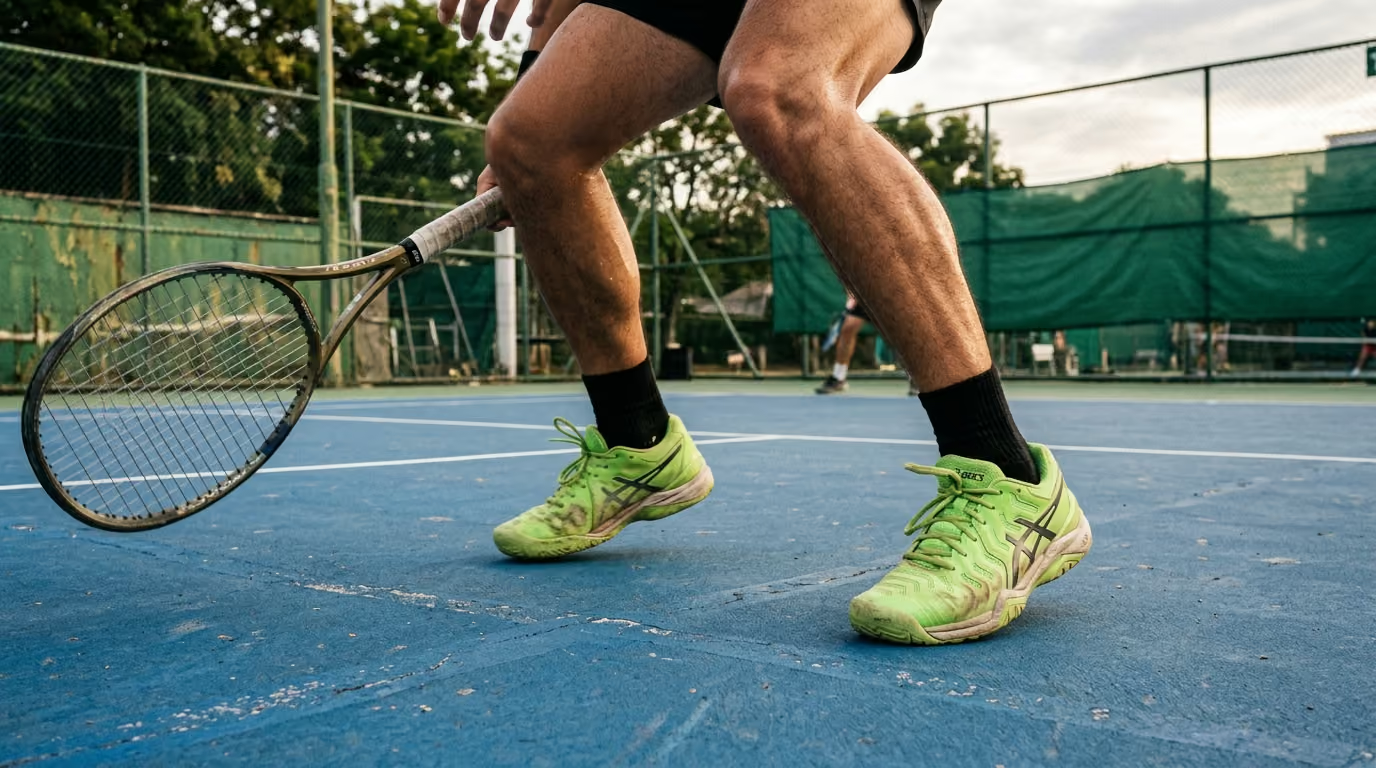

When a racquet sports player experiences persistent upper back and shoulder stiffness, the issue often stems from how they breathe and move their rib cage.




Many racquet sports players struggle with a persistent stiffness in their upper back and shoulders that stretching never seems to resolve. You might find yourself turning less during your forehand or struggling to reach overhead without arching your lower back. The solution often lies not in the joints themselves, but in how you breathe and move your rib cage.
Integrating coordinated breathing mechanics directly into your movement allows your rib cage to expand and your thoracic spine to rotate naturally. This practice improves your shoulder mobility and trunk rotation during strokes while keeping your body relaxed under pressure. By treating respiration as a dynamic movement pattern rather than just a recovery tool, you can build athletic longevity and perform better on the court.
We often think of breathing as a simple way to get oxygen into our muscles. However, the mechanical movement of breathing is just as important as the chemical exchange of gases. Every time you breathe, your rib cage must expand and contract in three dimensions. This movement directly influences the position of your spine, pelvis, and shoulder blades.
The primary driver of this mechanical process is the diaphragm. A 2025 study published in the journal of physical therapy research highlighted the deep connection between the diaphragm and postural control. The researchers identified the diaphragm, lower chest, abdominal muscles, and spinal stabilization as interconnected elements of efficient breathing and posture. When your diaphragm contracts, it moves downward toward your pelvis, creating space for your lungs to fill.
This downward movement increases pressure within your abdomen, which helps stabilize your spine. At the same time, your lower ribs should expand outward to the sides and back. If your rib cage is rigid, your body cannot access this natural expansion. Instead, it must rely on accessory respiratory muscles to lift the chest.
These accessory muscles include the scalenes and sternocleidomastoid in your neck. When these muscles work too hard, they create chronic tension in your neck and shoulders. This tension can alter the position of your shoulder blades, making it harder to reach overhead without pain. It also locks your upper back into a rigid position, limiting your ability to turn during your strokes.
To understand how common these breathing inefficiencies are, we can look at a large cross-sectional study. Researchers screened 1,933 athletes from multiple sports and age groups between 2017 and 2020. They used the standing Hi-Lo test to assess abdominal movement, chest expansion, rib-cage migration, and shoulder elevation.
The findings were striking. The study classified 90.6 percent of the athletes, which is 1,751 out of 1,933 participants, as displaying biomechanically dysfunctional breathing patterns. Only 9.4 percent, or 182 athletes, demonstrated clean diaphragmatic breathing patterns. This does not mean these athletes had a clinical medical disorder. Rather, it indicates that the vast majority of athletes use breathing strategies that do not support optimal movement.
When you play tennis, pickleball, or padel, your body needs to change positions constantly. We call this ability respiratory posture. It is not about holding a static posture, which is often rigid and inefficient. Instead, it is your ability to continuously reposition your ribs, pelvis, and spine as demands change.
A player who maintains an excessively flared rib cage or a collapsed thorax will struggle to adapt. This rigid position limits your options for rotation and lateral bending. By focusing on three-dimensional rib-cage expansion, you can release this unnecessary tension. This is a foundational step in injury prevention resources for modern court athletes.
To understand this, let us look at the structure of your ribs. The lower ribs move outward in what biomechanists call a bucket-handle motion. This sideways movement is essential for expanding your thoracic cavity. The upper ribs move forward and upward in a pump-handle motion.
Both patterns must work together for efficient breathing. When you play a fast game, your muscles require a constant supply of oxygen. If your ribs cannot expand, your breathing becomes shallow and rapid. This shallow breathing pattern signals your nervous system to stay in a sympathetic state.
A sympathetic state is characterized by high muscle tension and increased anxiety. By improving your rib cage expansion, you can keep your nervous system balanced. This balance helps you stay calm during tight match situations, such as a tiebreak or a match point.
A powerful swing relies on the efficient transfer of energy from the ground up. Biomechanists call this sequence of energy transfer the kinetic chain. In racquet sports, your trunk acts as the central link in this chain. If your trunk cannot rotate freely, your swing loses power and precision.
To generate clean power, you must separate your upper body movement from your lower body. This dissociation between your pelvis and your rib cage allows you to stretch your trunk muscles. This stretch stores elastic energy, which is then released into the ball. If your rib cage is locked in a rigid position, you cannot access this elastic recoil.
The tennis serve provides a perfect example of this mechanical sequence. Research outlines an eight-stage model for the tennis serve. These stages are divided into three major phases. The first phase is preparation, which focuses on storing mechanical energy.
The second phase is acceleration, where that energy is released into the ball. The final phase is follow-through, which decelerates your body safely and prepares you for the next shot. During the preparation and loading stages, elite servers display a distinct lateral rear tilt of the shoulder and pelvis. This specific alignment allows the player to develop lateral trunk flexion and rotation.
If your thoracic spine is stiff, you cannot achieve this lateral tilt. Your body will likely compensate by over-extending your lumbar spine. This puts excessive stress on your lower back joints. It can also force your shoulder to work harder than necessary to accelerate the racquet, increasing your risk of injury.
In our experience, teaching players to coordinate their breathing with these phases can improve their stroke mechanics. During the loading phase, a controlled inhalation can help expand the rib cage. This expansion prepares the trunk to rotate and tilt. As you swing forward, a natural exhalation helps release that tension and stabilize your core.
This approach is supported by broader research on movement training. A systematic review examined the application of mobility training in sporting populations. The review looked at 22 different studies on the topic. It found that 20 of those 22 studies reported performance benefits or better maintenance of athletic qualities compared to control groups.
The researchers concluded that comprehensive mobility programs help athletes maintain performance and are highly unlikely to cause any harm. Integrating your breathing with your stroke mechanics is a highly functional form of mobility work. It helps you build a more fluid, powerful swing without forcing your joints past their safe limits.
In Stage 1, which is the Start, the player balances their weight and focuses on the target. In Stage 2, which is the Release, the player tosses the ball and begins to turn their shoulders. Stage 3 is the Loading phase, where the player bends their knees and tilts their pelvis and shoulders backward. This lateral rear tilt is crucial for developing angular momentum.
Stage 4 is the Cocking phase, where the racquet drops behind the back while the shoulders reach maximum external rotation. Stage 5 is the Acceleration phase, where the player pushes off the ground and rotates their trunk forward. Stage 6 is the Contact phase, where the racquet impacts the ball at peak elevation.
Stage 7 is the Deceleration phase, where the arm and racquet slow down as the player lands. Stage 8 is the Finish, where the player completes their recovery step and prepares for the next shot. Coordinating your breath across these stages helps maintain a smooth, uninterrupted rhythm.
To understand how breathing affects your movement, we can look at direct clinical data. A landmark study investigated the acute effects of a 22-minute diaphragmatic breathing intervention on healthy adults. The researchers measured several aspects of trunk mobility, shoulder movement, and lung function before and after the session.
The findings demonstrated significant changes across multiple key physical markers. The group that practiced the breathing intervention showed an immediate 22.2 percent increase in chest expansion. This indicates a substantial improvement in the flexibility of the rib cage and surrounding muscles. The effect size for this change was recorded at 0.62.
The improvements in spinal mobility were even more pronounced. Thoracic spine rotation increased by 21.7 percent on the left side, with an effect size of 0.76. On the right side, thoracic rotation improved by 23.3 percent, with an effect size of 0.84. This means the participants could turn their upper backs significantly farther after just one session.
The study also tracked lateral trunk flexion, which is the ability to bend sideways. Left lateral flexion improved by 11.7 percent, with an effect size of 0.62. Right lateral flexion increased by 15.4 percent, with a strong effect size of 1.00. These specific movements are essential for loading a serve or reaching for a low volley.
Furthermore, shoulder-girdle mobility showed remarkable gains. The left shoulder improved by 20.2 percent, while the right shoulder improved by 21.5 percent. This confirms that your shoulder mobility is closely linked to how well your rib cage moves. When your ribs expand, your shoulder blade can glide more freely across your back.
Finally, the breathing intervention improved forced vital capacity by 4.7 percent. This measure represents the maximum amount of air you can exhale after a deep breath. All of these reported improvements achieved statistical significance at the p ≤ 0.01 level. This data shows that breathing exercises can act as a powerful input for your movement system.
We must interpret these results with appropriate care. This study examined the immediate, acute effects in healthy young adults. It does not prove that a single breathing session will instantly make you a better player. It does, however, provide a strong scientific rationale for using breathing as a tool in your physical preparation.
To learn more about how to structure your training for long-term health, you can check out our resources on healthy aging and athletic longevity.
Forced vital capacity measures the total amount of air you can exhale after taking the deepest breath possible. The 4.7 percent improvement shows that the lungs became more efficient at moving air. The ratio of forced expiratory volume to forced vital capacity decreased by 4.6 percent. This minor change indicates that the airways experienced less resistance during exhalation.
This relaxation reduces the effort required to breathe during intense exercise. Together, these measures indicate that breathing exercises can lower the physiological cost of play. When your breathing requires less effort, you can focus more energy on your tactical performance.
Before you begin any new exercise routine, it is helpful to assess your current movement baseline. We recommend using a five-layer assessment framework. This progression helps you identify where your movement chain might be restricted. You can perform these simple self-tests right at home or on the court side.
Begin by sitting or lying down in a quiet room. Place one hand on your upper chest and the other on your lower ribs. Breathe naturally for one minute and observe how your body moves.
Notice if your upper hand rises significantly before your lower hand. Look for any tension in your neck or a shrugging motion in your shoulders. A quiet breathing pattern should involve three-dimensional expansion of your lower ribs with very little shoulder movement.
If your shoulders rise first, your neck muscles are likely doing too much work. This pattern can contribute to tension and restricted movement when playing.
Sit upright on a chair with your feet flat on the floor. Hold a light dowel or your racquet across your shoulders. Keep your hips facing forward and turn your upper body as far as you can to the left, then to the right.
Observe if you can turn equally in both directions without shifting your hips. Next, try bending your torso to each side to check your lateral flexion. Note any stiffness or asymmetry between your left and right sides.
Asymmetric rotation can limit your efficiency on either the forehand or backhand side. It can also force your shoulders to work harder to compensate.
Stand with your back flat against a wall. Keep your knees slightly bent and your lower back gently touching the wall. Slowly raise both arms overhead, keeping your elbows straight.
Observe whether your thumbs can touch the wall without your ribs flaring upward or your back arching. If your ribs pop out, it suggests your shoulders are relying on spinal compensation to reach overhead. This test shows how your ribs and shoulders must cooperate for overhead strokes.
If you struggle with this, your overhead serves will likely put excess pressure on your lower back. This compensation is a common source of fatigue.
Stand in your typical athletic ready position. Hold your racquet and perform a slow shadow forehand preparation. Observe whether your chest rotates naturally with your hips, or if your arm moves independently.
Next, mimic the loading phase of your serve. Check if you can create a comfortable lateral tilt with your shoulders without straining your lower back. If you feel restricted, your rib cage may be holding too much tension.
This loading phase is critical for storing elastic energy. When restricted, you will likely lose power in your strokes.
The final step is to assess how your movement holds up under physical demand. Perform these same checks after a hard rally or at the end of a practice session.
You might find that your mobility is excellent when you are rested, but deteriorates as you get tired. Identifying this drop-off helps you target your endurance and recovery strategies. If you want to go deeper into court preparation, check out our mobility and movement resources.
Once you have assessed your movement, you can begin implementing targeted exercises. These drills are designed to combine breathing mechanics with physical movement. They help teach your body how to expand, rotate, and stabilize under controlled conditions. Use them as part of your warm-up or during a dedicated mobility session.
This exercise helps you develop three-dimensional breathing without the challenge of standing balance. Lie flat on your back with your knees bent and feet flat on the floor. Place your hands on the outer edges of your lower rib cage.
Inhale slowly through your nose for a count of four. Focus on pushing your hands outward with your ribs rather than just lifting your belly. Hold the breath gently for two seconds, then exhale slowly through your mouth for six seconds.
Repeat this sequence for two to three minutes. Focus on keeping your neck, jaw, and shoulders completely relaxed throughout the drill.
If your ribs do not push outward, try relaxing your abdomen slightly during the inhale. Avoid forcing the breath or gasping.
This exercise combines rib-cage movement with thoracic rotation. Lie on your left side with your knees bent at a ninety-degree angle. Extend both arms straight out in front of you, stacking your right hand on top of your left.
As you inhale through your nose, slowly sweep your right arm up and over to the right. Let your head and chest follow your arm as you rotate your upper back. Stop when you feel a comfortable stretch in your chest and spine.
Hold this open position and take one slow, deep breath. Focus on expanding the right side of your rib cage as you inhale. Exhale fully, then return your arm to the starting position and repeat five times before switching sides.
Make sure your knees stay stacked on top of each other. This keeps your pelvis stabilized and ensures the rotation comes from your thoracic spine.
This drill helps you connect your breathing with your on-court footwork and readiness. Stand in a relaxed athletic posture on the court. Inhale quietly as you perform a small preparation jump, landing softly on the balls of your feet.
As you land, allow your rib cage and hips to remain loose and adaptable rather than tensing up. Immediately transition into a short lateral shuffle while exhaling smoothly. Stop, take one calm breath to reset your system, and repeat the sequence ten times.
This practice teaches your nervous system to maintain a relaxed trunk during sudden, explosive movements. It is especially useful between points to lower your heart rate and refocus.
Hold your racquet in a neutral grip and stand in your ready position. Begin your unit turn by rotating your shoulders and hips together. As you turn backward, take a slow, smooth breath in through your nose.
Feel your rib cage expand to accommodate the rotation of your torso. Hold this loaded position for a brief moment, keeping your grip relaxed. As you swing forward to mimic ball contact, let out a soft, controlled exhalation.
Perform fifteen to twenty shadow swings on both your forehand and backhand sides. This build-up helps automate your breathing rhythm so it occurs naturally during a live match.
Focus on keeping your hands and shoulders relaxed as you rotate back.
Place a foam roller on the floor and lie on your back with the roller positioned horizontally across your mid-back. Support your head with both hands, keeping your elbows pointed forward. Keep your hips on the floor and slowly lean back over the roller.
Inhale deeply as you begin to lean back, allowing your ribs to expand. Once you reach a comfortable end-range, exhale completely while letting your chest sink toward the floor. Avoid arching your lower back to create the movement.
Perform five repetitions at three different segments of your mid-back. This exercise helps mobilize the ribs and vertebrae that often become stiff from daily sitting.
Start in a half-kneeling position with your right knee on the floor and left foot forward. Hold a racquet in front of your chest with both hands. Inhale deeply through your nose as you rotate your torso toward the left side.
Exhale fully in this rotated position, allowing your ribs to sink down. Inhale again to create expansion in your upper back, then return to the center as you exhale. Perform six repetitions on each side.
This exercise teaches you to find thoracic rotation when your pelvis is stabilized by your lower body.
While all racquet sports share some physical demands, each has unique movement patterns. Understanding these differences allows you to tailor your breathing and mobility work to your specific sport. The court dimensions, ball speed, and paddle weight all influence how your body manages energy.
Tennis involves a large court, heavier racquets, and high ball speeds. This requires players to cover long distances and produce explosive rotational power. The serve is a prime example of a movement that demands extreme thoracic extension and lateral flexion.
To load a tennis serve effectively, you must be able to tilt your shoulders and hips back. If your rib cage is rigid, you will struggle to access this lateral tilt. This restriction can limit your racquet-head speed and increase the strain on your shoulder joint.
Tennis players should prioritize thoracic rotation and dynamic chest expansion in their warm-ups. A review of thirty-two high-quality studies found that a proper warm-up improved performance in seventy-nine percent of the physical criteria examined. There was also no evidence that a well-designed warm-up was harmful to the players.
To build a thorough pre-match routine, tennis players can check out our court performance resources.
Pickleball is played on a much smaller court, which demands rapid reaction times and low defensive positions. Players spend a significant amount of time in a deep crouch near the non-volley zone line. This sustained low stance requires excellent hip flexion and a stable lower back.
If your hips are stiff, you may compensate by rounding your thoracic spine to reach low dinks. This collapsed upper-body posture compresses your rib cage and makes diaphragmatic breathing difficult. You might find yourself holding your breath during fast kitchen exchanges, which leads to early fatigue.
Pickleball players should focus on maintaining a long, active spine while breathing in a low stance. Practicing rib-cage expansion while holding a half-squat can help you stay relaxed and reactive. This integration ensures you can breathe efficiently even during intense, close-range rallies.
This stability is vital for maintaining court position during long kitchen rallies.
Padel is characterized by its glass walls, rapid transitions, and a high volume of overhead shots. Players must frequently hit the bandeja, vibora, or smash while moving backward. These shots require you to track the ball overhead while rotating your torso in mid-air.
If your upper back is stiff, you will struggle to reach these high balls without arching your lower back. This constant hyperextension can lead to muscle strains and joint irritation over a long match. Padel players need a highly adaptable rib cage that can rotate and extend in multiple directions.
For padel, we recommend focusing on rotational mobility drills that incorporate diagonal reaching. Combining these movements with deep, controlled breathing helps prepare your trunk for the asymmetric demands of the game. It allows you to maintain balance and power when hitting difficult overheads off the glass.
By targeting these specific needs, you can reduce post-match soreness and improve your shot consistency.
As players begin to focus on breathing and mobility, several common misunderstandings can arise. These misconceptions can lead to inefficient training or even limit your progress on the court. It is important to clear up these errors to ensure your practice remains safe and effective.
One of the most frequent errors is the belief that efficient breathing means your chest should never move. Many fitness guides instruct players to breathe solely into their bellies. While abdominal movement is important, pure belly breathing is actually an incomplete strategy.
True diaphragmatic breathing involves three-dimensional movement of the entire lower chest and rib cage. If you only push your belly out, you miss the lateral and posterior expansion of your ribs. This limit can actually restrict your thoracic mobility rather than improving it. Your goal should be a balanced, whole-body expansion that supports your posture.
We must aim for a coordinated movement where both the chest and abdomen participate naturally.
Another common pitfall is assuming that a highly visible rise of the abdomen proves perfect breathing. An athlete can easily push their stomach out while keeping their lower ribs rigid. This movement is often a compensation for stiff rib joints rather than true diaphragmatic work.
To avoid this, focus on how your lower ribs move sideways during inhalation. You can place your hands on your lower ribs to feel this outward expansion. If your ribs do not move, you are not getting the full biomechanical benefits of the breath.
This distinction is crucial for improving your physical efficiency on the court.
Many players make the mistake of performing long, passive static stretches right before they step onto the court. While flexibility is useful, static stretching can temporarily reduce your muscle power and reaction time. It does not prepare your cardiovascular or respiratory systems for the demands of the game.
Instead, your pre-play routine should focus on dynamic, sport-specific movements. Use breathing drills to help wake up your rib cage and coordinate your spine. Save your longer, passive stretching sessions for after your match or on rest days.
To get more practical tips on how to prepare your body, read our latest articles on the Evercourts blog.
Many players have been taught to constantly contract their abdominal muscles to protect their spine. While bracing is useful during a heavy lift, maintaining rigid tension during a match is counterproductive. This constant tightness prevents your rib cage from expanding and limits your rotation.
It can make your strokes look stiff and mechanical. Instead, practice maintaining a responsive trunk that can relax and stiffen as the movement demands. This flexibility allows for smoother energy transfer and more natural stroke mechanics.
I remember finishing a tough two hour padel match on a cold Tuesday night and waking up the next morning feeling like my lower back was locked in concrete. For a long time, I just accepted this as the price of playing hard in my forties. But once I started spending just ten minutes on targeted hip and thoracic mobility before heading to the club, the stiffness almost completely vanished. It taught me that we do not have to accept pain as a default state of aging.
This personal experience highlights how physical tension can build up when we neglect our movement mechanics. When you play a demanding match, your body experiences significant physical stress. If your breathing is shallow and rapid, your nervous system remains in a high-alert state.
This prolonged state of tension can delay your recovery and increase muscle soreness. Practicing slow, diaphragmatic breathing after a match helps shift your body into a restful state. This shift improves blood flow, reduces muscle guarding, and helps your tissues heal more quickly.
When you deep-breathe, you stimulate the vagus nerve, which helps lower your heart rate and blood pressure. This down-regulation is essential for initiating the recovery process. Without it, your muscles can remain tight for hours after you finish playing.
By focusing on these recovery strategies, you can reduce your downtime between sessions. This is a key focus area of recovery science resources for active court players.
While self-directed breathing and mobility work is highly beneficial, it is not a substitute for professional medical care. It is important to know your limits and recognize when your symptoms require an expert evaluation. Ignoring warning signs can lead to more serious issues down the road.
You should consult a qualified healthcare provider if you experience any of the following symptoms:
A physical therapist or sports physician can help you identify the root cause of your physical limitations. They can design a safe, individualized program that addresses your unique biomechanical needs. If you would like to reach out to our team for general guidance, you can use our contact page.
To help you apply this knowledge, we have created a simple checklist for this week. Focus on making these small changes consistent rather than perfect.
By taking these steps, you can help protect your joints and keep playing the sports you love for years to come. For more information about our mission and research-led approach, visit our about page.
Follow Evercourts for practical insights on tennis, pickleball and padel performance, movement, recovery and healthy ageing. Stay connected for new articles, research-led guidance and ideas to help you play well and keep playing for years.


Read practical guidance for better movement, smarter preparation and a game that keeps working for you.
explore the Blog