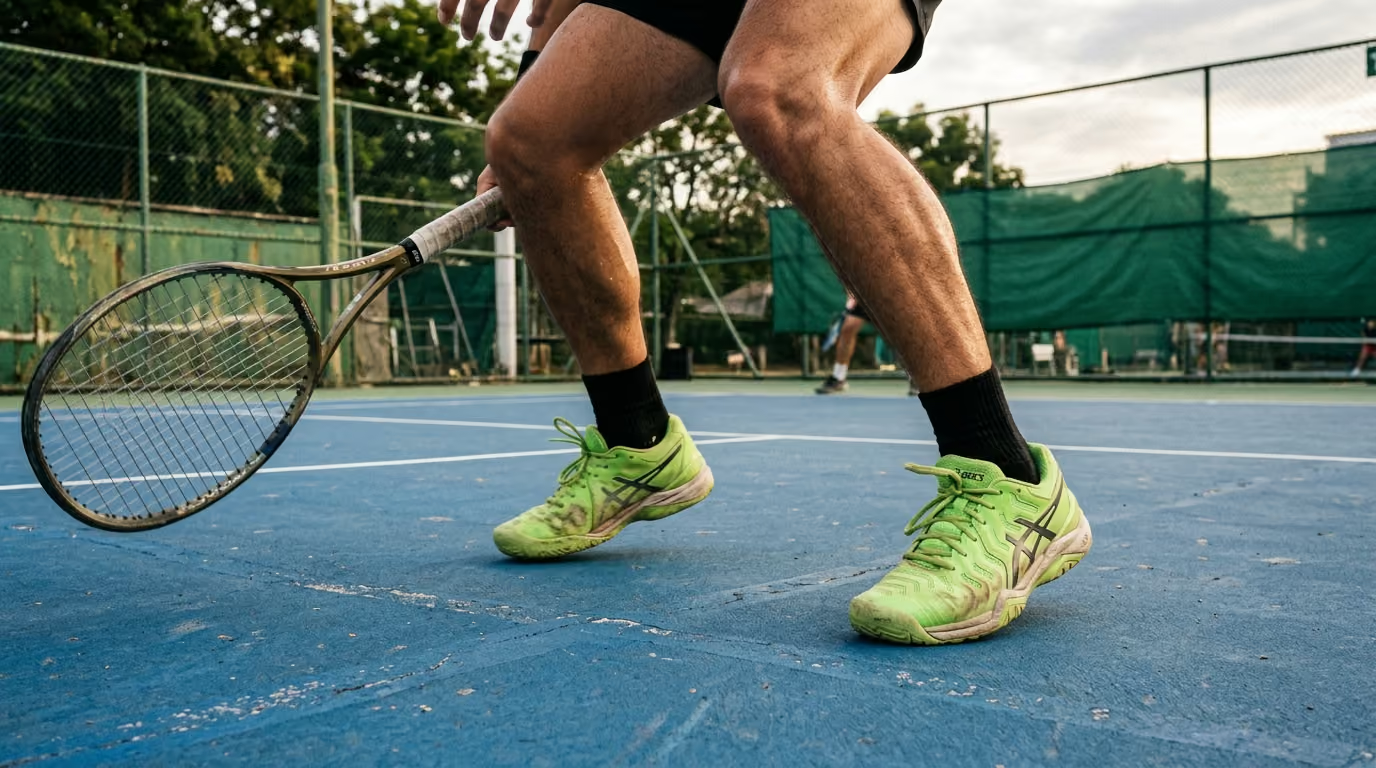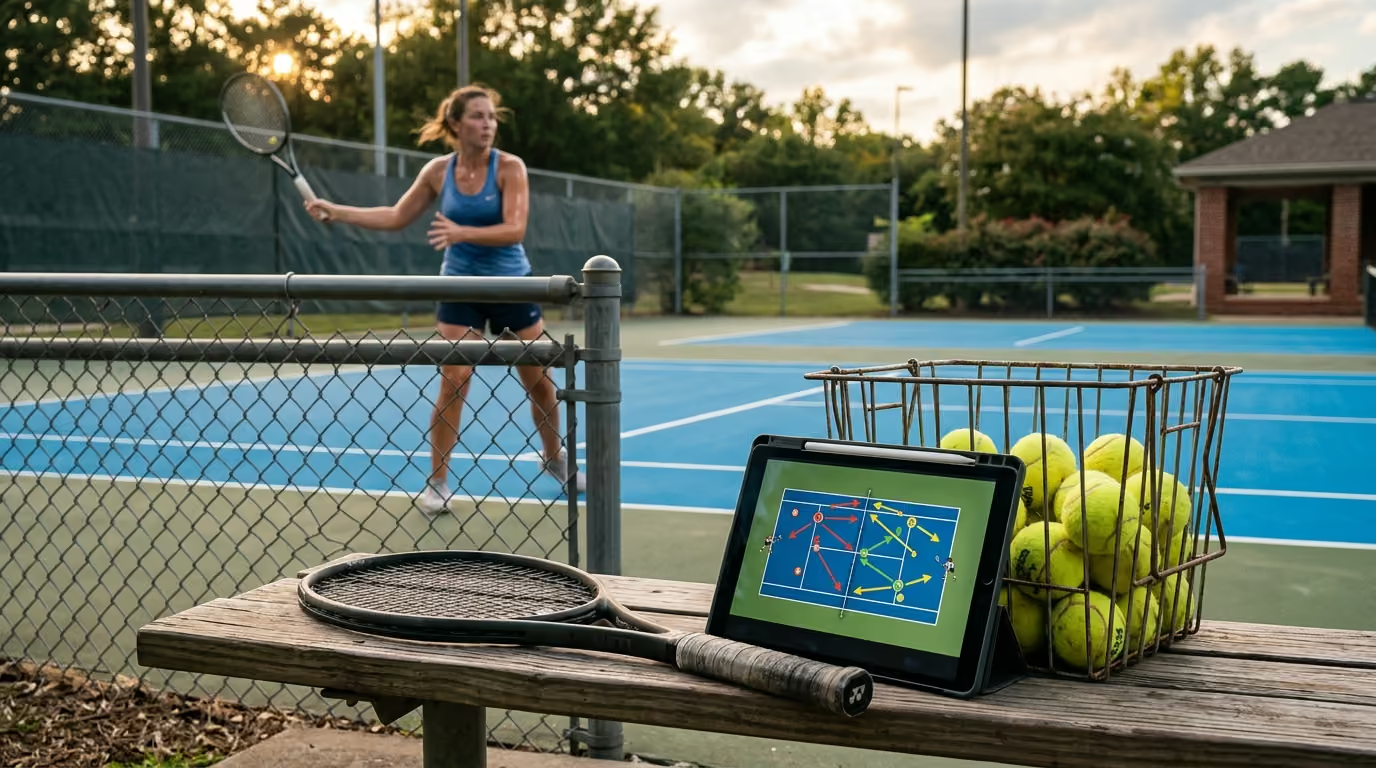

Many racquet sports players assume improvement comes from hitting cleaner shots, but an effective game is actually built on a coherent game model.




Many racquet sports players believe that improvement is simply a matter of hitting cleaner shots. They spend hours trying to perfect their technique, yet they often struggle when facing a smart opponent. A truly effective game is not built on flawless strokes alone. Instead, it is built on a coherent game model that connects your physical traits, court position, and tactical choices into a single operating system.
Building a personal game model requires linking your reliable physical weapons, tactical court positioning, and preferred playing tempo into a repeatable operating system. Rather than relying on a rigid style label, you create specific shot sequences that maximize your physical advantages and limit movement costs. This structured approach helps you maintain performance as your physical capabilities evolve over time.
By moving away from rigid style labels, you can focus on building a sustainable framework for your matches. This guide will show you how to design a personal game model that holds up under pressure. We will examine the scientific principles of movement, look at how demands change across different racquet sports, and provide a practical template to help you structure your weekly sessions.
Players often use terms like style, strategy, and tactics interchangeably. This confusion can make it difficult to identify why a particular match went wrong. To build a reliable game, you must understand how these concepts fit together.
Style is the recurring shape of your game. It describes your general tendencies, such as your typical court position, your preferred rally length, and your risk tolerance. For example, some players prefer to stay behind the baseline, while others look to move forward at every opportunity. Your style is descriptive rather than prescriptive, representing your natural comfort zone on the court.
Strategy is your overall plan for a specific match. It is the high-level mission you choose to execute based on your opponent’s characteristics. If you decide to target an opponent’s weaker backhand, you are using a strategy. If you choose to extend rallies because your opponent is visibly fatigued, that is also a strategic decision.
Tactics are the point-level decisions you make to execute your strategy. Tactics are concerned with whether you selected the correct shot for the situation, regardless of whether you hit it perfectly. For instance, hitting a drop shot when your opponent is far behind the baseline is an excellent tactical choice. Conversely, hitting that same drop shot when your opponent is already near the net is a poor tactical decision.
To help remember this hierarchy, we can use a simple rule: strategy chooses the mission, tactics choose the option, and technique executes the shot. If your technique is excellent but your tactics are poor, you will still struggle to win.
Another core concept in your tactical framework is your recovery position, which is often called your home base. Many players are taught to return to the geometric center of the court after every shot. However, treating the center as a fixed, unchangeable spot is a mistake.
Your ideal recovery position depends on where you hit the ball and where your opponent is standing. If you hit a deep crosscourt shot, your opponent’s possible reply angles are different than if you hit a short down-the-line shot. You should always recover toward the middle of your opponent’s potential hitting angles, not the physical center of the court.
This dynamic approach is supported by the United States Tennis Association coaching materials. They distinguish between recovery paths after crosscourt and down-the-line shots. Recovering according to your opponent’s options, rather than an abstract geometric center, saves valuable energy and keeps you balanced.
To build an effective game model, we must look at what current research reveals about racquet sports performance. Many popular coaching ideas are based on tradition rather than data. Modern sports science allows us to examine which patterns actually lead to success on the court.
A study analyzing professional tennis matches on hard courts evaluated key performance indicators over several seasons. The researchers found that baseline points won, first-serve points won, and points won in short rallies of four shots or fewer were the strongest predictors of match success. The study also highlighted that forced errors, rather than unforced errors, were most associated with losing performance. This suggests that creating pressure to force an opponent into an error is often more valuable than simply waiting for them to make a mistake.
The researchers also noted that simple "serve-plus-one" tactical formulas did not show a strong association with winning outcomes. This does not mean these patterns are useless, but it warns us against relying on generic formulas. Your patterns must be tailored to your specific physical capabilities.
Other research shows that short rallies dominate racquet sports. A study of competitive junior tennis players found that over sixty-seven percent of all rallies lasted between zero and four shots. The average rally duration was just over seven seconds, while the actual playing time made up about twenty percent of the match. While this study focused on younger athletes on clay courts, the dominance of short points is also observed in recreational adult play.
Movement tracking technology has also revealed how different styles affect physical load. The same study compared aggressive baseliners with defensive counterpunchers. Aggressive baseliners performed significantly more high-intensity decelerations per match. They also showed a higher workload in volleys and end-range strokes, which researchers linked to their frequent forward movement.
This has a major practical implication for players looking to maximize their court performance. If you want to play an aggressive, forward-moving style, you must train your body to handle rapid deceleration and lateral adjustment steps. Without this specific physical preparation, an aggressive style can lead to early fatigue or joint strain.
Physiological demands also vary significantly depending on the specific sport you play. A systematic review examined badminton, padel, table tennis, and tennis to compare internal physical loads. The research confirmed that heart rate and lactate levels differ widely across these disciplines.
For example, table tennis players showed average heart rates of around one hundred and four beats per minute. In contrast, badminton players reached average heart rates of over one hundred and eighty beats per minute. Lactate levels followed a similar pattern, ranging from very low in table tennis to highly elevated levels in badminton.
These differences show that your tactical style must be physically sustainable for your specific sport, format, and age group. A style that requires constant, explosive sprinting might work well in a short doubles match but become counterproductive during a long singles match on a hot day.
To transition this knowledge from theory to practice, you must build a structured system for your matches. This starts by categorizing every incoming ball by its quality. Instead of reacting randomly, you can use a simple traffic-light system to guide your decisions.
The green ball represents an clear opportunity to attack with acceptable risk. These balls are usually short, slow, and high enough to contact comfortably. You are balanced, well-prepared, and have enough time to choose an aggressive target.
The yellow ball is a neutral exchange. These balls are deep, have moderate pace, and do not invite an immediate attack. Your goal with a yellow ball is to maintain depth, hit with high margins, and keep your opponent from taking control. High-margin crosscourt shots are the standard response here.
The red ball represents a defensive emergency. You may be stretched wide, off-balance, or dealing with a very low contact point. In this situation, your only priority is damage limitation. Your best choice is a high, slow shot that buys you time to recover your position.
Many avoidable mistakes happen when players try to attack a yellow or red ball. They mistake a short ball for an attack trigger, ignoring the fact that they are off-balance or out of position.
A complete game model divides every point into four distinct phases:
First is the start phase, which includes the serve, the return, and the immediate following shot. This phase sets the tone and determines who takes the initiative.
Second is the build phase, where you use depth, spin, and direction to create an advantage. You are not trying to hit a winner yet. Instead, you are trying to move your opponent out of position.
Third is the convert phase, where you capitalize on the opening you created. This might involve stepping inside the baseline to hit an aggressive groundstroke, moving to the net, or hitting into open space.
Fourth is the recover or reset phase, which occurs after your attack. You must immediately regain your court position and prepare for the reply. A good attacking shot is never complete until you are ready for the next ball.
While the core principles of strategy remain the same, court geometry and equipment change how you apply them. A game model that works on a large tennis court must be adapted for the smaller dimensions of a pickleball or padel court.
In tennis, the court size is large, and the ball bounces with significant variation. This means that movement efficiency and court positioning are critical. Because clay courts produce longer rallies and higher physical demands, clay-court models must prioritize patience and high-margin endurance.
On hard courts, points are shorter, making first-strike patterns much more effective. If you play tennis, your game model must account for these surface differences. You can learn more about managing these physical adjustments by reading about healthy aging and athletic longevity.
In pickleball, the non-volley zone, commonly known as the kitchen, completely changes the geometric landscape. You cannot hit volleys from inside this zone, which means the transition from the baseline to the kitchen line is the most important phase of the point.
The start phase in pickleball is highly standardized, focusing on the third-shot drop or drive. The build phase often involves patient dinking exchanges at the kitchen line, waiting for the opponent to lift the ball too high. Conversion happens in a split second when a ball rises above net height, triggering a rapid hand battle.
In padel, the surrounding glass and mesh walls alter recovery geometry. If you hit a hard, deep shot down the line, it will often rebound off the back wall and give your opponent an easy reply.
Therefore, your padel model must focus on patience and court positioning rather than pure power. The lob is a fundamental building and resetting tool in padel. A high lob forces your opponents away from the net, allowing you and your partner to transition forward and take control of the point.
Even experienced players frequently fall into tactical traps that undermine their performance. Recognizing these common errors is the first step toward building a more stable game.
Many players believe that their style is a fixed identity. They label themselves as an aggressive baseliner or a counterpuncher and refuse to adapt. This rigidity makes them highly predictable and easy to play against.
If you are committed to only hitting hard groundstrokes, a clever opponent will simply use variation and slice to disrupt your rhythm. Your style should be a flexible set of patterns, not an unyielding personality trait. You must be willing to defend when necessary and step forward when given a short ball.
Another frequent mistake is assuming that any short ball is an automatic invitation to attack. Shortness is only one variable in the equation. You must also consider your physical balance, your contact height, and your opponent’s position.
If you rush forward to hit a low, dipping ball while sliding sideways, your chances of hitting a successful attack are very low. In this situation, a neutral, high-margin placement is the smarter tactical choice. Attacking when your body position does not support it is a leading cause of unforced errors.
The tactical choices you make during a match have a direct impact on your physical well-being. A chaotic style that requires constant, desperate running will drain your energy and increase your risk of joint wear. A structured game model, however, helps protect your joints and supports long-term play.
High-intensity decelerations and sudden changes of direction place massive loads on your knees, ankles, and lower back. If your game model lacks clear recovery patterns, you will constantly find yourself out of position. This forces you to make emergency movements, which are highly demanding on your muscles and tendons.
I remember finishing a tough two hour padel match on a cold Tuesday night and waking up the next morning feeling like my lower back was locked in concrete. For a long time, I just accepted this as the price of playing hard in my forties. But once I started spending just ten minutes on targeted hip mobility before heading to the club, the stiffness almost completely vanished. It taught me that we do not have to accept pain as a default state of aging.
By focusing on movement efficiency, you can significantly reduce the physical toll of your matches. For example, serving to restrict your opponent's angles or returning deep through the middle reduces the need for lateral sprinting. This proactive approach to player health allows you to stay competitive without overtaxing your body. You can support these efforts by incorporating targeted mobility and movement exercises into your weekly routine.
While a smart game model can reduce physical stress, it cannot replace medical care when you have an injury. You must be able to distinguish between normal muscle fatigue and signs of a more serious issue.
If you experience sharp joint pain, swelling, or persistent stiffness that does not improve with rest, you should consult a qualified healthcare provider. Playing through pain to maintain a tactical pattern will only worsen the underlying issue. A physical therapist can help you identify biomechanical limitations and guide you back to safe play.
Working with a certified coach is also highly valuable. They can observe your movement patterns and identify if a technical flaw is causing unnecessary physical strain. Combining professional coaching with medical guidance is the best way to support your athletic longevity.
To see how these concepts work in practice, let's examine five common player profiles and how we can adjust their game models.
This player strikes the ball with great pace but makes a high number of unforced errors. They often try to hit winners from deep in the court or from difficult, low-contact positions.
To adjust this model, the player must use the traffic-light system. They should commit to hitting deep, high-margin crosscourt shots on all yellow and red balls. They are only allowed to play aggressively when they receive a genuine green ball, meaning they are balanced and inside the court. The success indicator for this adjustment is a significant reduction in errors on neutral balls, while still maintaining pressure on short balls.
This player has excellent hand-eye coordination and striking skills but struggles in long, lateral running rallies. They often find themselves out of breath and vulnerable to wide angles.
The adjustment here focuses on reducing movement costs. The player should serve and return predominantly through the middle of the court to restrict the opponent’s hitting angles. They should also look to move forward to the net selectively, shortening points before they turn into physical endurance contests. The success indicator is a decrease in the number of points that require maximum lateral sprinting.
This player retrieves balls exceptionally well and rarely makes errors. However, they struggle to finish points, often letting opponents back into the rally after forcing a weak reply.
This player needs a clear transition trigger. We must design a rule: if the opponent's ball lands short of a specific line and the player is balanced, they must step forward and take the ball early. They can practice this using specific training constraints that reward them with extra points for winners hit after a short ball. The success indicator is an increased percentage of points won within three shots of receiving a short ball.
This player loves to dominate from the baseline but often rushes to the net without adequate preparation. They are frequently passed or lobbed because they transition on low-quality balls.
The model adjustment requires improving approach-shot selection. The player should only move forward behind deep, heavy groundstrokes that force the opponent to hit from below net height. They must also practice their deceleration and split-step timing to ensure they are balanced when the opponent strikes the ball. The success indicator is a higher winning percentage on net approaches, combined with fewer errors on transition volleys.
This player possesses a wide variety of shots, including spins, slices, and drop shots. However, they use these options randomly, which leads to high error rates and tactical confusion.
This player must define three default patterns to anchor their game. They need a primary baseline rally pattern, a transition pattern, and a defensive reset pattern. They should only introduce variety when they have a clear tactical reason, such as drawing a slow opponent forward. The success indicator is the player’s ability to explain the tactical purpose behind their shot choices after the match.
To help you build your own game model, we have created a structured template. Take the time to fill out each section honestly based on your current physical capabilities and match observations.
Describe where you make the fewest errors and feel most comfortable. For most players, this is either on the baseline, just behind it, or transitioning toward the net. Your preferred position should allow you to contact the ball at a comfortable height without feeling rushed.
Define your most reliable sequence for starting points. For example, you might serve wide to the opponent's backhand and expect a crosscourt return. Having a structured starting pattern helps you settle into matches and reduces early errors.
Identify the shot that remains stable under pressure and physical fatigue. This is not necessarily your fastest shot, but rather the one you trust most when the score is tight. It could be a deep, rolling forehand or a precise, placement-oriented serve.
Specify your go-to response when you receive a neutral, yellow ball. This shot should have a high margin over the net and target a deep, safe area of the court. A deep crosscourt ball is the standard choice for most players.
Choose your emergency shot when you are stretched wide or off-balance. This is typically a high, slow loop that gives you enough time to recover your court position. It should buy you several seconds to get back to your home base.
Define the exact situation that allows you to step forward and play aggressively. This requires a green ball, meaning the incoming shot is short and slow, and you are balanced and prepared. Having a clear trigger prevents you from attacking too early.
Identify where you want to end points most frequently. This could be from the net with a volley, or from inside the baseline with a penetrating groundstroke. Knowing your finishing zone helps you guide your build phase toward a specific goal.
Anticipate how a smart opponent will try to disrupt your preferred patterns. They might use low, slicing shots to keep the ball out of your strike zone, or lob you to test your overhead recovery. Preparing for this counter prevents you from being surprised during a match.
Develop a specific plan for when your primary pattern is disrupted. If an opponent uses low slices, your response might be to use more knee bend and focus on depth rather than pace. This secondary pattern keeps you competitive when your main game is challenged.
Create a simplified version of your game model for when you are tired, playing in hot weather, or returning from a break. This model should prioritize central placement, higher net clearance, and selective forward movement to conserve energy. Having a low-energy plan supports your physical longevity on the court.
Choose three simple metrics to record after your matches. Examples include first-serve percentage, unforced errors on neutral balls, and points won at the net. Tracking these numbers helps you make data-driven adjustments to your training.
Select one specific area of your game model to focus on during your upcoming practices. This could be improving your split-step timing during transition or maintaining better depth on your neutral shots. Focusing on one priority at a time leads to faster, more reliable improvement.
Environmental factors require immediate adjustments to your game model. In windy conditions, you should increase your margins over the net and target larger areas of the court to account for sudden drafts. In extreme heat, you must adopt a lower-energy version of your game, prioritizing depth and placement over physical movement to prevent premature fatigue.
If your primary weapon is failing, you must immediately shift to your secondary, high-margin patterns. Avoid the temptation to over-hit or force the shot to work, as this will only increase your unforced errors. Focus instead on deep, central targets and let your opponent take the risks until you regain your rhythm.
Playing a left-handed opponent changes the geometry of your standard patterns. Your typical crosscourt shots will now go to their forehand rather than their backhand, which can expose you to counterattacks. You must adjust your targets, often directing more balls down the line or serving to different zones to test their backhand wing.
You should review your game model every three to four months, or after returning from an injury. This regular review ensures that your tactical choices align with your current physical capabilities. If you notice changes in your recovery speed or movement comfort, adjust your model to prioritize energy efficiency and protect your joint health.
To support your ongoing development, you can use our detailed guides on injury prevention to keep your body moving well. For more practical matches and lifestyle tips, explore our competition and court lifestyle resources.
Follow Evercourts for practical insights on tennis, pickleball and padel performance, movement, recovery and healthy ageing. Stay connected for new articles, research-led guidance and ideas to help you play well and keep playing for years.


Read practical guidance for better movement, smarter preparation and a game that keeps working for you.
explore the Blog