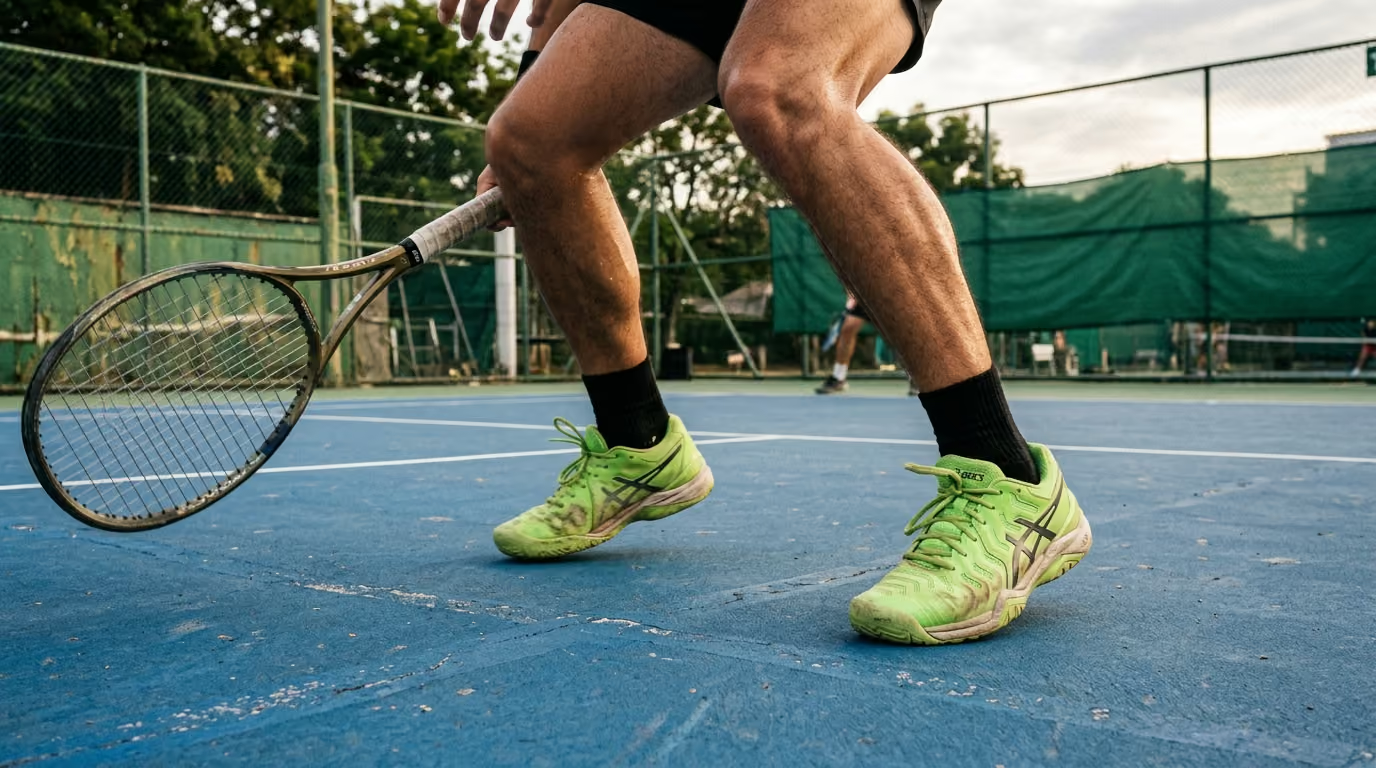
While many believe an aerobic base for racquet sports is about marathon-like endurance, it actually optimizes recovery between intense, explosive rallies.




How do you stop your legs from turning to lead in the final set of a close match? Many racquet sports players struggle with late-match fatigue, watching their stroke quality and decision-making crumble as the minutes tick by.
An effective aerobic base for racquet sports is not about preparing for a marathon, but about recovering between intense rallies. Developing this capacity requires a structured combination of low-intensity continuous movement, targeted intervals, and sport-specific court drills. This long-term training plan builds the stamina you need to preserve your technical skills and physical speed from the first point to the final match point.
To build an effective training plan, we must first understand how our bodies produce energy on the court. Racquet sports are highly intermittent, featuring short bursts of maximum effort followed by brief periods of rest. The primary movements on the court are explosive, requiring you to sprint, jump, and change direction in a fraction of a second.
These movements rely heavily on anaerobic energy systems. Specifically, they use the phosphagen system and fast glycolysis to produce rapid, powerful contractions. However, these anaerobic energy reserves are limited, meaning they drain quickly during a long rally.
This is where the aerobic system steps in. The aerobic system does not directly power your explosive sprints. Instead, it works behind the scenes to rebuild your anaerobic energy stores. It replenishes phosphocreatine, clears metabolic byproducts, and helps bring your heart rate down.
A simple performance model helps explain this relationship. Anaerobic power produces the decisive movement, while aerobic fitness determines how well the player can recover and repeat it.
If you neglect your aerobic base, your recovery between rallies will slow down. You will start the next point with partially drained energy reserves. Over the course of a match, this deficit accumulates. Your explosive speed will drop, your reaction times will slow, and your coordination will suffer.
Current research supports this integrated view of court performance. A applied physiology review suggested that competitive tennis players should develop a high aerobic capacity, citing a target VO2max above 50 milliliters of oxygen per kilogram of body weight per minute. While this specific number is a helpful reference, it is not a strict rule for every age, sex, or playing level.
The key takeaway is that a strong aerobic system supports recovery during play and between training sessions. It allows you to tolerate a higher weekly training volume without burning out.
Furthermore, your aerobic fitness directly influences how well you can perform technical work late in a match. When you are exhausted, your stroke mechanics break down, leading to unforced errors. By building a robust aerobic base, you protect your technical skills under fatigue. You can maintain your tactical plan even when the match enters its second or third hour.
To train effectively, we must define the core concepts of cardiovascular fitness. Many players confuse general stamina with specific court endurance. Understanding these terms will help you select the right workouts for your goals.
Your aerobic base is your body's ability to perform submaximal work using oxygen. It depends on changes in your heart, blood vessels, and muscles. A strong base increases the amount of blood your heart can pump per beat.
It also improves capillary density, allowing more oxygen to reach your working muscles. In practical terms, a solid base means you can jog, cycle, or move on the court at a moderate pace without gasping for air. It is the foundation upon which all high-intensity training is built.
VO2max is the maximum rate at which your body can take in, transport, and use oxygen during exercise. It is measured in milliliters of oxygen per kilogram of body weight per minute.
VO2peak is the highest value recorded during a specific exercise test when a true physiological plateau cannot be proven. While VO2max is a valuable marker of general fitness, it does not tell the whole story. It does not measure your footwork efficiency, braking ability, or mental toughness.
Therefore, a player with a lower VO2max can sometimes outlast a fitter opponent by moving more efficiently.
Aerobic power refers to the upper limit of your oxygen energy system. It is your ability to work at high intensities using oxygen.
Aerobic endurance is your ability to sustain a submaximal pace for an extended period. Aerobic recovery capacity is how fast your heart rate and breathing return to normal during rest breaks.
Intermittent endurance is the ability to repeat short, explosive movements with incomplete rest. Racquet sports require a balance of all four qualities.
We can divide training intensity into five simple categories to guide your workouts. Easy intensity is conversational, with controlled breathing and low muscular strain. Moderate intensity makes conversation slightly harder, requiring more focused breathing.
Hard aerobic intensity requires sustained focus, but it is not an all-out sprint. Very hard intensity involves intervals near your maximal aerobic limit. Maximal intensity consists of short, explosive efforts where movement quality and speed are the top priorities.
Using heart rate zones can help you monitor these intensities. However, heart rate is not always a perfect guide. Heart rate lags behind your actual physical effort during short, intense rallies.
It is also affected by heat, dehydration, caffeine, and stress. Therefore, you should combine heart rate data with your Rating of Perceived Exertion (RPE).
RPE is a simple scale from 1 to 10, where 1 is sitting on the couch and 10 is absolute exhaustion. Using RPE helps you adjust your training based on how your body actually feels.
Not all racquet sports place the same demands on your cardiovascular system. While tennis, pickleball, and padel share some similarities, their specific movement patterns differ. Understanding these differences will help you tailor your conditioning plan.
Tennis is played on a large court, requiring long sprints and wide lateral slides. A typical tennis point lasts between 4 and 10 seconds, followed by 10 to 20 seconds of rest. Players have 90 seconds during changeovers and 120 seconds between sets to recover.
Singles tennis requires massive court coverage and places high demands on your aerobic recovery. Doubles tennis reduces your running volume but requires faster reaction times and explosive first steps.
To prepare for tennis, your conditioning must include high-speed linear sprints and deep lateral lunges. You can read more about specific tennis court movement demands to refine your on-court footwork drills.
Pickleball is played on a much smaller court, which changes the physical demands. You rarely perform long, 20-yard sprints in pickleball. Instead, you make hundreds of rapid micro-adjustments, short lateral steps, and quick lunges.
Dink rallies can last a long time, requiring you to hold a low, bent position. This creates high isometric tension in your quadriceps and glutes. The aerobic demand in pickleball is about maintaining focus and local muscular endurance.
You must be able to stay low and alert through long, patient rallies, then explode during a fast volley exchange. To learn more about preparing your body for these unique patterns, review the details on pickleball physical demands to structure your workouts.
Padel is played in an enclosed court with glass and mesh walls. Because the ball can bounce off the walls, rallies are often much longer than in tennis. Padel requires constant transitions from the back of the court to the net.
You will perform many low lunges, overhead smashes, and lateral shuffles. The continuous nature of padel rallies means your aerobic system is constantly working.
Padel players need a strong aerobic base to recover from repeated overheads and deep lunges. Understanding padel court strategies can help you design conditioning drills that mimic real match play.
Squash and badminton are known for their incredibly high cardiorespiratory demands. Rallies are dense, with very little rest between points.
Badminton players perform many vertical jumps and rapid lunges. Squash players face continuous, high-speed movement in a small space. Both sports require an exceptionally well-developed aerobic system to survive long matches.
An effective aerobic training plan does not rely on a single type of workout. Instead, it combines three distinct layers of conditioning to build a complete athletic profile.
This layer is the foundation of your training plan. It is developed through low- to moderate-intensity continuous work. Activities like easy running, cycling, rowing, swimming, or elliptical training are perfect.
The goal is to keep your heart rate in a comfortable, conversational zone. This training improves your heart's stroke volume, meaning it pumps more blood with less effort. It also increases the capillary networks in your muscles, making oxygen delivery more efficient.
For racquet athletes, Layer 1 work should be low-impact whenever possible. If you are already playing several hours of court sports, easy cycling or rowing is often better than running. This protects your joints from the repetitive pounding of hard court surfaces.
This layer bridges the gap between easy cardio and high-speed sprinting. It involves longer intervals performed at a high, sustained effort. An example of Layer 2 training is running intervals of 3 to 5 minutes.
You can also perform sport-specific on-court drills at this intensity. A study on tennis conditioning used a protocol of four 2-minute court-specific intervals.
The players worked at 90 to 95 percent of their maximum heart rate, with 90 seconds of passive recovery. This protocol produced cardiovascular improvements equivalent to traditional running intervals. Layer 2 work teaches your body to handle metabolic stress while maintaining good movement mechanics.
This layer represents the highest level of court conditioning. It mimics the exact work-to-rest ratios of your sport. Layer 3 training involves short, explosive movements followed by incomplete recovery.
Examples include court shuttles, change-of-direction drills, and simulated rally sequences. You should only introduce Layer 3 training after building a solid foundation in Layers 1 and 2.
Without that foundation, high-intensity court drills can easily lead to excessive fatigue and poor movement quality. Always prioritize movement quality over speed during these sessions. If your footwork or stroke mechanics collapse, the drill is no longer helping your sport performance.
To build a lasting aerobic base, you must organize your training over time. A year-round periodization model helps you peak for competition while staying healthy. Let us break down a practical six-phase approach.
This phase lasts 2 to 4 weeks. The primary goal is to establish consistency and prepare your tissues for harder work. If you are returning from a break, do not jump straight into hard intervals.
Focus on two or three low-intensity aerobic sessions per week. Combine this with basic strength training to improve your joint stability. Keep your court sessions technical and controlled.
The focus should be on moving smoothly and finding your rhythm, not on running yourself into the ground.
This phase lasts 4 to 6 weeks. Here, we gradually increase your weekly aerobic training volume. You will continue with your low-intensity sessions, making them slightly longer.
You can also introduce one moderate-intensity session per week. This could be a steady 30-minute bike ride or a controlled, extensive court movement session. Ensure you are meeting basic physical activity guidelines.
The American College of Sports Medicine recommends at least 150 minutes of moderate activity or 75 minutes of vigorous activity per week. As a competitive player, you will likely exceed this, but ensure the volume is built gradually.
This phase lasts 4 weeks. The focus shifts from volume to intensity. You will replace one of your easy sessions with a high-quality aerobic power interval session.
For example, you might perform 4 intervals of 3 minutes at a hard pace, with 2 minutes of easy recovery. Keep your other weekly sessions light and focused on recovery.
Continue your strength training to maintain your power and protect your joints. This phase will raise your aerobic ceiling, making high-intensity court play feel more manageable.
This phase lasts 3 to 4 weeks leading up to a tournament or league season. We now transition your hard work into sport-specific patterns. Perform one or two Layer 3 intermittent sessions per week.
Use work-to-rest ratios that match your specific sport. For tennis, this might be 10 seconds of explosive movement followed by 20 seconds of rest. For pickleball, use shorter, quicker steps with rapid direction changes.
Reduce the total volume of your off-court conditioning to keep your legs fresh for match play.
During your competitive season, your main goal is to perform well on the court. Match play itself provides a powerful physical stimulus. Therefore, you should reduce extra conditioning to a minimum.
Use a "minimum effective dose" strategy to maintain your fitness. One short, low-intensity session and one brief interval session per week are usually enough to preserve your aerobic base.
Focus on sleep, nutrition, and mobility to stay healthy between matches.
After your competitive season ends, take a physical and mental break. Spend 1 to 2 weeks doing light, unstructured activities. This could be hiking, swimming, or easy cycling.
Avoid hard court play and intense lifting. This transition phase allows your joints and tendons to heal, preparing you for the next training cycle.
Let us look at how to structure your training week. These templates can be adapted based on your experience and schedule.
This schedule balances hard physical work with dedicated recovery time. If you are a beginner, you should scale this down. Replace the Wednesday court conditioning with 20 minutes of easy continuous movement. Ensure you always listen to your body and adjust the training intensity as needed.
How do you know if your aerobic base is actually improving? You do not need an expensive sports science lab to track your progress. Several practical field tests can help you measure your cardiovascular fitness.
This is the gold standard of fitness testing. It involves running on a treadmill or riding a stationary bike while wearing a mask that measures your oxygen intake. While highly accurate, it is expensive and not easily accessible for most recreational players.
Furthermore, a treadmill test does not measure your ability to change direction or strike a ball. It is best used for elite athletes or individuals with specific medical monitoring needs.
The Yo-Yo Intermittent Recovery Test (IR1) is a fantastic option for racquet sports. It involves running 20-meter shuttles at progressively faster speeds, controlled by audio bleeps. After each 20-meter run, you get 10 seconds of active recovery, consisting of walking around a cone.
This test mimics the start-stop nature of court play. It measures your ability to recover from repeated high-intensity efforts. Track the total distance you cover before you can no longer keep pace with the bleeps.
The standard 20-meter multistage shuttle run is another popular option. Unlike the Yo-Yo test, the Beep Test is continuous, with no rest periods. A systematic review showed a high correlation between Beep Test performance and directly measured VO2max.
However, the study also noted a standard error of 3 to 6 ml/kg/min. Therefore, you should use the Beep Test to track your raw stage progress, rather than focusing on the estimated VO2max number.
Be aware that shuttle tests are highly demanding on your calves and Achilles tendons. Ensure you are well-warmed up before testing.
The 1.5-mile run or the 12-minute run/walk test are simpler options. A meta-analysis found that these continuous tests have strong validity for estimating aerobic fitness.
They are easy to perform on a running track or flat path. However, they do not include the quick turns and braking required on the court. Use them primarily to track general cardiovascular health.
In addition to formal tests, you can track simple daily metrics to gauge your fitness.
Many players wonder how to combine cardiovascular training with weight lifting. This combination is known as concurrent training. If not managed carefully, hard cardio sessions can interfere with your strength and power gains.
A systematic review showed that concurrent training can cause small interference effects for lower-body strength adaptations in men, while not observing the same trend in women. This interference is largely determined by training volume, frequency, and timing. To minimize this interference, we must follow smart scheduling rules.
First, always prioritize your primary goal in your daily schedule. If your main goal is to build explosive leg power, perform your strength session first. If you perform a hard interval run immediately before lifting, your nervous system will be too fatigued to produce maximum force.
Second, separate hard strength training and hard conditioning sessions by at least 4 to 8 hours. This time gap allows your muscles to restore their energy supplies and reduces acute interference.
Third, make use of low-impact cardiovascular modalities. If you need to build aerobic volume, choose cycling or rowing over running. This provides a strong cardiovascular stimulus without adding joint stress to your lower body.
Finally, keep your easy aerobic sessions truly easy. If your easy recovery runs are too fast, they will drain the energy you need for your strength sessions.
Remember that cardiovascular training can actually support your strength gains when programmed correctly. An improved aerobic base increases blood flow to your muscles, helping them recover faster between heavy sets of lifts. For comprehensive templates on how to balance these components, consult the strength and conditioning plans on the Evercourts platform.
To get the most out of your training, you must avoid several common pitfalls that plague many court athletes.
Many players believe that every conditioning session must leave them exhausted. They run every mile as fast as possible and push every interval to failure. This approach quickly leads to chronic fatigue, joint pain, and overtraining.
Low-intensity training is not wasted time. It builds the structural foundation that allows you to tolerate hard court play. Keep your easy sessions easy, and save your maximum efforts for specific, targeted workouts.
While playing your sport is highly specific, it is often unpredictable. You may stand around during double faults, long court disputes, or slow warm-ups. This unpredictability means you might not get the consistent, controlled cardiovascular stimulus needed to build a strong base.
Dedicated off-court conditioning allows you to control your heart rate and ensure you are getting the correct physiological adaptation.
Sprints are easy to perform, but stopping is what causes joint wear and muscle strain. If your court conditioning only focuses on running forward, you are missing half the demands of the sport.
Ensure your drills include controlled decelerations, backpedaling, and lateral lateral braking. This prepares your muscles for the eccentric load of stopping and changing direction. Review the injury prevention guidelines to learn how to prepare your body safely for these intense braking forces.
Some players become so focused on building stamina that they stop lifting weights entirely. This is a critical mistake. Strength training protects your joints from the repetitive impacts of court play.
Without adequate strength, a high volume of aerobic training will quickly lead to overuse injuries in your knees, hips, and lower back. Maintain at least two short strength sessions per week year-round.
While building an aerobic base is highly beneficial for healthy aging and athletic performance, safety must always come first. As an adult athlete, you must listen to your body and recognize when to seek professional help.
Consult a qualified healthcare provider or sports physician if you experience any of the following warning signs:
A physical therapist or sports medicine specialist can help you modify your training plan to stay active safely. If you are recovering from an injury, always follow their guidance before resuming high-intensity court drills.
Now that you understand the principles of building an aerobic base, it is time to take action. Do not try to change your entire training routine overnight. Instead, apply these four practical steps this week to start building your foundation.
Follow Evercourts for practical insights on tennis, pickleball and padel performance, movement, recovery and healthy ageing. Stay connected for new articles, research-led guidance and ideas to help you play well and keep playing for years.


Read practical guidance for better movement, smarter preparation and a game that keeps working for you.
explore the Blog