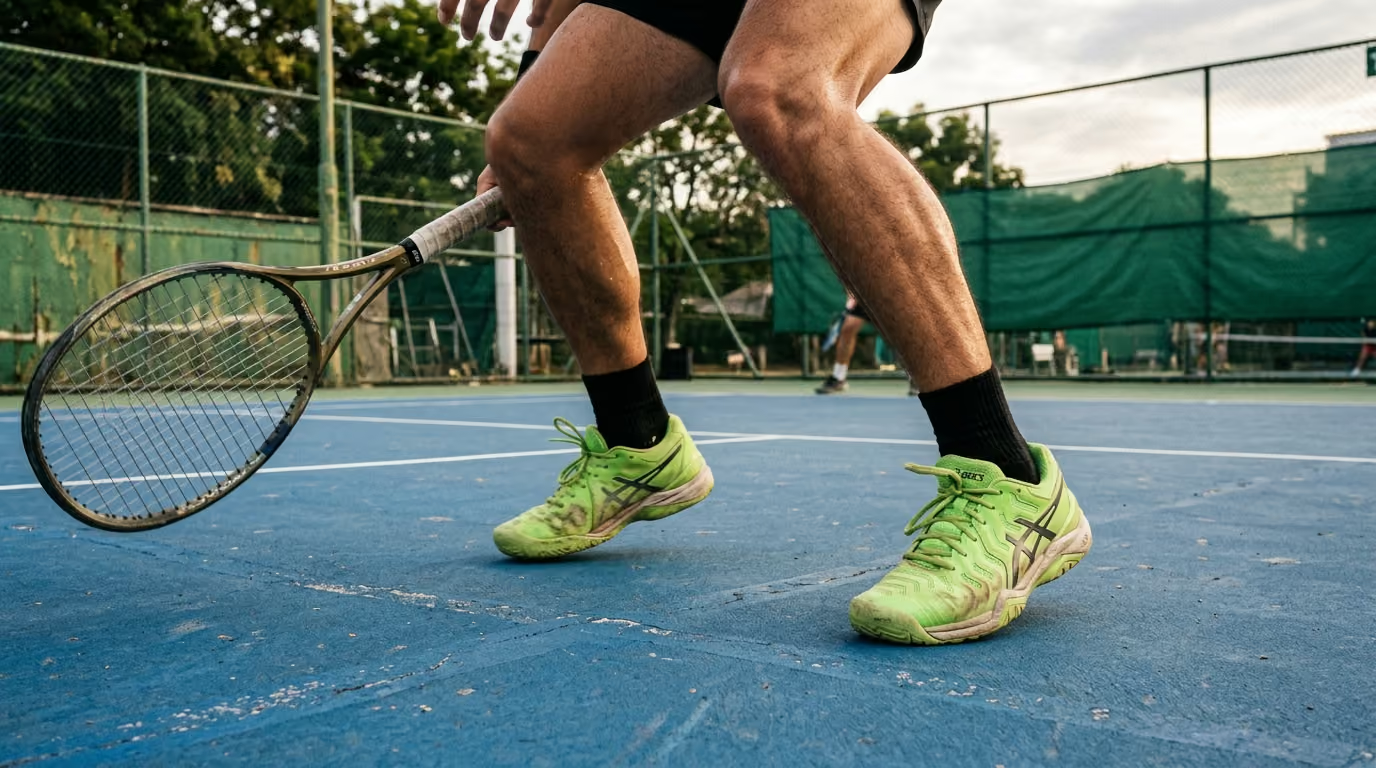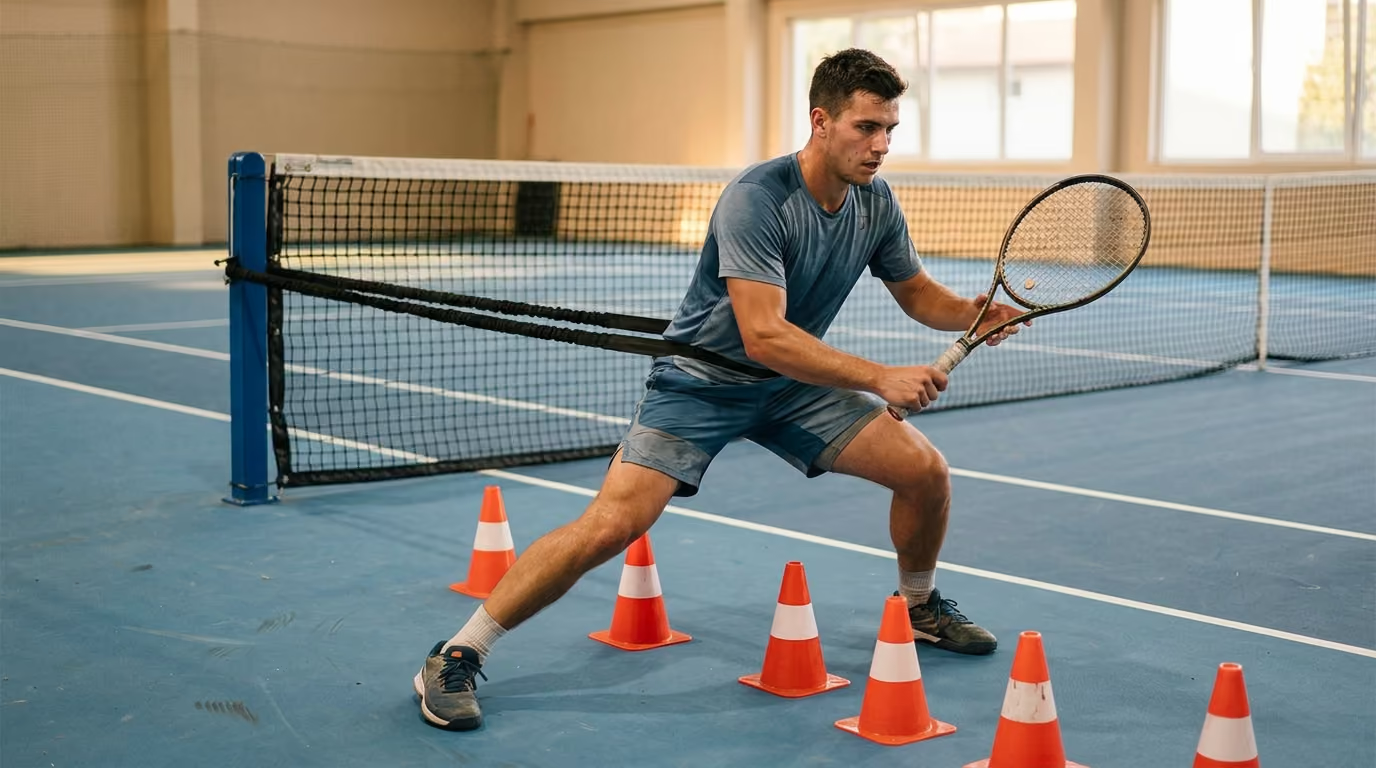

While general fitness helps, true movement resilience for racquet sports requires systematically preparing your body for the specific, high-impact demands of match play.




Imagine a familiar court scenario. A recreational player steps onto the court after a long winter break. During the very first game, they sprint forward, lunge deeply to retrieve a drop shot, and feel an immediate twinge in their Achilles tendon or lower back. They assumed that their general fitness from gym workouts would protect them on the court, but the specific forces of the racquet sport proved otherwise.
Movement resilience is built by systematically preparing your muscles, tendons, and joints for the exact physical stresses of match play. This is achieved through a structured, progressive loading framework that slowly increases the intensity, speed, and complexity of your court movements over time. By gradually exposing your body to these demands, you allow your tissues to adapt and develop the necessary capacity to handle repetitive court forces safely.
Racquet sports combine high movement variability with repeated unilateral and multiplanar actions. Unlike steady-state running or traditional linear weightlifting, court movement requires you to constantly switch between explosive acceleration and intense braking. Every single shot demands a rapid sequence of movement. You must prepare your posture, accelerate toward the ball, brake hard to establish a stable hitting base, rotate your torso to swing, and then immediately push off to recover back to the center of the court.
This sequence generates massive mechanical forces that your body must absorb and redirect. The mechanical load on your lower limbs is exceptionally high, even if the total distance you run during a match seems modest. A single short rally can contain several high-force braking actions and deep lunges. Unless you track these specific movements, the total mechanical stress on your joints can easily go unnoticed until overuse symptoms appear.
To understand how to prepare your body, you must distinguish between different types of training loads. External load is the physical work you perform on the court, such as the number of lunges, jumps, court contacts, or total minutes played. Internal load is how demanding that work is for your individual body, which is influenced by your heart rate, fatigue, and muscle soreness. Mechanical load refers to the physical forces generated within your tissues, such as the stress on your patellar tendon during a deep lunge. Technical load is the coordination required to execute a movement precisely, while psychological load includes the mental focus and quick decision-making needed during a tight match.
Scientific research shows that injury risk is not determined by a single training variable. Instead, injuries often occur due to a complex relationship between your current physical capacity, your recent training history, your sleep quality, and your overall recovery. According to systematic reviews of racquet sport injuries, the lower extremities are the most frequently injured anatomical region. In badminton studies, lower-limb injuries account for between 41% and 92.3% of all reported issues. A separate meta-analysis of court sports found that lower-limb injuries represented over 52% of all injuries, with ankle sprains and Achilles tendon issues being the most common presentations.
To build a court-ready body, you must understand the key physical qualities that make up movement resilience. This preparation is not just about raw strength or cardiovascular fitness. It is about how your tissues, nervous system, and movement patterns interact under stress.
Tissue capacity is the maximum amount of mechanical stress a specific structure can tolerate before it begins to break down. Your body is made up of different tissue types, and each adapts to physical work in its own way. Muscles require blood flow and active contraction to grow stronger, while tendons require heavy, slow loading to increase their stiffness and spring-like qualities. Bones require impact and compression to maintain their density, while joint cartilage needs movement and light pressure to stay lubricated.
Tissue capacity is highly specific to how you load the body. You might be able to perform a heavy bilateral squat in the gym, but still lack the specific tissue capacity required for a deep, high-speed lateral lunge on a hard court.
Load tolerance is the relationship between the physical demands of your sport and your current physical capacity. This relationship is highly individual and constantly changes. For a young, highly trained athlete, playing three matches in a single weekend might represent a moderate physical demand. For a master's player or someone returning from a long layoff, that same schedule represents a massive physical demand that far exceeds their current capacity.
Progressive loading is the planned, gradual increase of physical demands over time. Instead of making sudden jumps in training volume or intensity, you systematically adjust specific variables to allow your body to adapt. This can mean increasing your total weekly playing time, adding more complex footwork drills, or performing movements at higher speeds.
Exposure refers to the total time you spend training or competing. Research shows that your injury risk is closely tied to your overall exposure, meaning that sudden, unaccustomed spikes in playing hours are a primary trigger for joint and tendon irritation.
Your training load can be divided into acute and chronic phases. Acute load represents the physical work you have performed very recently, typically over the last week. Chronic load represents your historical training volume, usually measured over the last four to six weeks. Your chronic load represents your physical foundation. If your acute load suddenly rises far above your chronic foundation, your risk of injury or severe fatigue increases.
However, sports science literature cautions that there is no universal, magic ratio that guarantees safety. Every player must find their own balance based on their history and recovery rate.
Coordination capacity is your ability to organize your body movements, foot placement, and balance while reacting to a moving ball or opponent. On the court, you cannot simply focus on your movement technique. You must track the ball, read your opponent, and execute a stroke, all while moving at high speed.
Recovery capacity is your body’s ability to restore its physical and mental readiness between training sessions. Your recovery is heavily influenced by sleep, nutrition, hydration, and daily life stress. If you are sleeping poorly or dealing with high occupational stress, your overall recovery capacity drops, making your usual training load much harder for your body to tolerate.
To design an effective progression, you must look beyond simply adding more playing time. You can systematically increase court resilience by adjusting five distinct dimensions of movement.
You must build structural strength in the specific tissues that absorb the most force on the court. For racquet players, this means targeting the calf muscles and Achilles tendons for spring-like jumping and landing forces. You also need to strengthen the quadriceps and patellar tendons for braking, the hamstrings for high-speed lunging, and the adductors for wide lateral movements. Do not ignore your upper body. The shoulder girdle, rotator cuff, and forearm muscles must be conditioned to handle repetitive, high-velocity racquet swings.
Your brain must learn to coordinate muscle actions at the correct millisecond to stabilize your joints. A simple progression moves from highly stable positions to less stable ones. You should master predictable movements before introducing reactive ones. For example, you should practice slow, planned lunges in a straight line before attempting fast, reactive lunges where you must respond to a coach's visual cue.
This coordination training is a vital component of structured mobility and movement training, which helps you move efficiently on the court.
Intensity can be adjusted in several ways. You can increase your movement speed, make your braking actions more abrupt, jump higher, or use heavier resistance in the gym. High-velocity movements place a much higher mechanical demand on your tendons and joints than slow strength exercises.
For this reason, you must introduce speed gradually, ensuring your movement mechanics remain clean before trying to move at maximum velocity.
Density refers to how much work you perform within a specific timeframe. You can make a court session denser by shortening your rest periods, playing longer consecutive rallies, or increasing the number of movement contacts you make per minute.
Higher density challenges your cardiovascular system and tests your movement mechanics under physical fatigue. You should only progress training density after you have demonstrated excellent technical quality during lower-density drills.
Complexity increases when you combine multiple physical and mental challenges. A simple movement drill becomes complex when you add a reactive decision, a specific stroke target, or physical fatigue.
However, complexity should never be used to hide a lack of basic physical capacity. If you cannot control your knee alignment during a slow, planned single-leg landing, you are not ready to perform a fast, reactive lunge in a competitive match. To build this physical foundation, players often utilize target-specific strength and conditioning resources to prepare their muscles and joints.
To safely build movement resilience, you can follow a six-stage preparation framework. This pathway helps you transition from basic physical preparation to the highly unpredictable demands of competitive match play.
The first stage focuses on building a foundation of strength, mobility, joint stability, and low-level movement control. You do not need to mimic sport-specific movements in this stage. The goal is simply to build the physical capacity that you will need for more advanced training later.
Excellent exercises for this stage include slow, heavy calf raises to strengthen the Achilles tendon. You can also perform split squats to build quad strength and step-downs to improve knee tracking. Hip hinges develop the gluteals and hamstrings, while lateral squats prepare your groin and hips for side-to-side movement. Target three sets of 10 to 12 slow, controlled repetitions for these exercises, focusing on keeping your joints aligned.
In this stage, you teach your nervous system and muscles how to accept and decelerate force with perfect control. Learning how to stop safely is the most important step in protecting your joints.
Begin with double-leg snap-downs, where you start on your tiptoes and quickly drop into a stable, athletic squat position. Progress to small step-offs from a low box, landing softly on both feet, then moving to single-leg landings. You can also perform low-level lateral bounds, focusing on sticking and holding the landing for two seconds without losing your balance.
Your coaching priorities here are quiet landings, stable ankles, and keeping your knees aligned over your toes without any rapid collapse.
Once you can absorb force safely, you can begin training your body to produce force quickly. This stage introduces low-level plyometrics to build tendon elasticity and springiness.
Begin with ankle hops, also known as pogos, where you bounce repeatedly using only your ankles and calves. You can also perform light skipping drills and low-amplitude lateral hops. These exercises train your Achilles and patellar tendons to store and release elastic energy efficiently. Keep your ground contact times short, as if the floor is hot. Start with two to three sets of 15 to 20 low-amplitude contacts, twice per week.
This stage is the core of court-specific preparation. Here, you learn to combine fast acceleration with abrupt deceleration.
Start by jogging forward for five yards and coming to a controlled, multi-step stop in a split stance. Progress to faster runs, coming to a sudden stop on a single step. You can then introduce planned 45-degree and 90-degree cutting maneuvers. Finally, practice lateral shuffles where you push off hard, slide sideways, and brake abruptly on your outside foot.
Always focus on lowering your center of gravity by bending your knees and hips as you brake, which distributes the deceleration forces safely through your major muscle groups.
This stage integrates your physical capacity with the actual movement patterns of your sport. You will combine the split step, first-step acceleration, directional movement, lunging, and recovery back to your base position.
Start with scripted footwork patterns, where you know exactly where you are moving. For example, perform a shadow lunge to the front right corner, push back to the center, and then shuffle to the back left corner. Once you master these scripted movements, transition to random feeding drills where a coach or training partner points to a corner, forcing you to react and move immediately.
This bridges the gap between physical conditioning and the unpredictable nature of real play.
The final stage prepares your cardiovascular system and tissues to maintain high-quality movement even when you are tired. This is where you build match-specific endurance.
Useful drills include high-intensity ghosting, where you perform rapid shadow footwork across the entire court for 30 to 45 seconds, followed by a short rest. You can also perform repeated sprint-and-brake intervals over five to ten yards.
The goal in this stage is not simply finishing the drill. You must maintain precise footwork, joint alignment, and fast reaction times even as physical fatigue begins to set in.
To build complete court resilience, you must systematically train the five primary movement patterns that dominate racquet sports.
Jumping and landing demand incredible vertical force absorption. To train this pattern, always master landing control before you try to jump higher.
Track your weekly jump volume by counting your total foot contacts. Start with 40 to 50 low-impact jumps per session, and only increase this number when you can land silently and stably.
Lunging is a major movement exposure on the court. In racquet sports, lunges are often performed at high speed, in multiple directions, and at extreme depths.
To build a resilient lunge, you must focus on both the entry phase and the recovery phase.
The push-off phase is critical. If your hip and ankle muscles are weak, you will struggle to recover quickly, which places excessive mechanical stress on your knee joint.
Racquet sports require repeated, short accelerations rather than long-distance speed. You must train your body to reach top speed in just two or three steps.
Short, explosive accelerations act as a powerful stimulus to protect your hamstrings and calves from strain.
Every swing you take involves rotational forces that travel from the ground, up through your hips, into your torso, and out through your shoulder.
Make sure your rotation comes from your hips and upper back rather than twisting your lower spine.
The sheer volume of small, repetitive foot contacts during a long match can cause joint and tendon irritation if your body is unprepared. You must gradually build your tolerance for these low-level impacts.
Building tolerance for repeated court contacts is a key element of effective injury prevention strategies for any competitive player.
While the basic principles of movement resilience apply to all racquet sports, the specific physical demands differ significantly depending on the sport you play.
Tennis is characterized by longer movement distances, higher running velocities, and massive deceleration forces. Players must move across a large court, which requires longer sprints and deep, sliding lunges. The hard-court surface is unforgiving, generating high impact forces on the ankles, knees, and lower back. Clay courts allow for sliding, which demands unique adductor strength and hip control to decelerate safely.
Because tennis matches can last for several hours, players need exceptional tissue capacity in their calves, quads, and shoulders to handle the high volume of high-velocity impacts.
Pickleball is played on a much smaller court, which changes the movement demands completely. Sprints are very short, but the game requires rapid, low-amplitude steps and constant lateral shuffling. The most unique demand of pickleball is the sustained, low crouch required at the kitchen line. Players must spend long periods in a deep knee and hip bend, which places a high isometric demand on the quadriceps and patellar tendons.
Additionally, the fast-paced nature of the kitchen game requires rapid, small reaction steps, making ankle stability and quick foot coordination crucial.
Padel is a fast-growing sport played in an enclosed glass court, which introduces high rotational demands and unique movement angles. Players must constantly rotate and change direction to chase balls bouncing off the back and side glass walls. Padel requires a very high volume of overhead strokes, such as the bandeja and vibora, which places massive repetitive stress on the shoulder joint and rotator cuff.
The movement in padel is highly multidirectional, involving constant transitions from backward running to forward sprinting, requiring excellent calf and Achilles resilience.
To ensure your progressive loading framework is working, you must monitor how your body is responding to the training. You do not need expensive technology to do this effectively.
The simplest and most reliable way to track your internal training load is the session rating of perceived exertion. After every court session or workout, rate the overall intensity of the session on a scale of 1 to 10. Then, multiply this rating by the total duration of the session in minutes to calculate your daily training load in arbitrary units.
$$\text{Daily Load} = \text{Session RPE (1-10)} \times \text{Duration (minutes)}$$
For example, if you play a moderately difficult match that lasts for 60 minutes, your calculation would look like this:
If you perform a highly intense drill session for 45 minutes, your calculation might be:
Keep a simple training log of these numbers. If your weekly total jumps by more than 30% to 40% from one week to the next, it is a clear sign that you are progressing too quickly, which may increase your risk of injury.
Depending on your resources, you can track simple external metrics to understand your weekly playing volume. Excellent variables to monitor include your total weekly court hours, the number of matches played, and your total practice sessions.
If you are performing structured footwork or fitness drills, you can track the number of high-speed lunges you perform or your total foot contacts during jump training. Tracking these basic metrics helps you avoid accidental spikes in volume, especially when transitioning to a busier playing season.
Every morning, perform a quick self-check to evaluate your body's readiness to train. Rate the following variables on a scale of 1 to 5, where 1 is very poor and 5 is excellent:
If your daily wellness scores are consistently low, it indicates that your body is struggling to recover. In these moments, you should reduce the intensity or volume of your next court session to avoid overloading your tissues.
To help optimize this balance, you can utilize structured recovery science methods to support your body between matches.
It is vital to distinguish between normal muscle soreness and joint or tendon irritation. Normal muscle soreness usually peaks 24 to 48 hours after a hard workout and feels like a dull, generalized ache across the muscle belly.
Tendon or joint irritation, however, is typically localized to a specific spot, such as the point of your elbow or the front of your knee. If you experience pain that worsens during your warm-up, forces you to change your movement mechanics, or causes you to limp the following morning, your current training load has exceeded your tissue capacity.
To see how these principles work in practice, let's examine five common player profiles and how they can safely build movement resilience.
To maintain long-term physical capacity, you must organize your weekly schedule so that high-stress days are balanced by dedicated recovery periods. The following template shows how a competitive player can distribute these physical demands over a typical seven-day week.
This structure ensures you never stack high-impact lower-limb days back-to-back, giving your tendons and joints the essential time they need to rebuild and strengthen. This systematic approach is highly effective for supporting your athletic longevity resources over decades of active court life.
Many dedicated players make simple, avoidable mistakes when trying to prepare their bodies for the court. Recognizing these pitfalls can save you from unnecessary setbacks.
Many players believe that because they are strong in the gym, they are automatically ready for the court. While having a strong foundation of muscle is highly beneficial, gym strength does not automatically transfer to the court. Traditional gym exercises are performed in slow, predictable, and linear patterns. Court movement is fast, unpredictable, and multi-directional. You must train your nervous system to apply your gym strength at high speeds and in complex, single-leg landing situations.
When players want to improve their fitness, they often make the mistake of increasing their playing hours (volume) and their movement speed (intensity) at the exact same time. This dual increase represents a massive physical shock to your soft tissues.
If you want to play more matches per week, keep the intensity of those sessions moderate. If you want to perform high-intensity sprint and jump training, reduce your total weekly playing hours to balance the overall load.
After an injury or a long break, many players treat their return to the court as a simple on-off switch. Once they are cleared of pain, they immediately return to playing full-intensity, competitive matches.
This approach ignores the fact that their tissues have lost their physical conditioning during the layoff. Your return to the court should always be a gradual process, transitioning from light shadow footwork to partial practice, then to full practice, and finally to competitive match play.
When performing lunge drills, players often focus entirely on the forward step and the reach for the ball. They ignore the recovery phase, where they must push off forcefully to return to their starting position.
If you lack the leg strength to push back to your base in a single, controlled step, you will use multiple small, awkward adjustment steps. This inefficient movement patterns increases the total mechanical load on your knee joints and calf muscles.
Your body does not grow stronger during your workouts. It grows stronger when you are resting and recovering after your workouts. If you schedule your hardest matches, sprint drills, and heavy leg workouts on consecutive days, you never give your tissues the time they need to adapt. This continuous physical stress leads to progressive tissue fatigue, which is a primary cause of chronic overuse injuries like Achilles tendonitis and patellar tracking issues.
While a progressive loading framework is highly effective for building court resilience, it is vital to recognize when physical symptoms require a professional medical evaluation. You should consult a qualified sports physiotherapist, physical therapist, or orthopedic specialist if you experience any of the following warning signs:
A qualified healthcare provider can perform a comprehensive movement assessment, identify any specific physical limitations, and design a targeted rehabilitation plan to help you return to the court safely and confidently.
You should return to this loading framework whenever you are preparing for a major transition in your playing career. Revisit these stages when you are returning to the court after a long winter break, transitioning to a different playing surface, or recovering from a physical injury. It is also highly beneficial to review these movement progressions before you begin a new, busier competitive tournament season, ensuring your body is fully prepared for the increased physical demands.
Building lasting movement resilience is a gradual journey of consistent, planned physical preparation rather than a quick fitness fix.
Follow Evercourts for practical insights on tennis, pickleball and padel performance, movement, recovery and healthy ageing. Stay connected for new articles, research-led guidance and ideas to help you play well and keep playing for years.


Read practical guidance for better movement, smarter preparation and a game that keeps working for you.
explore the Blog