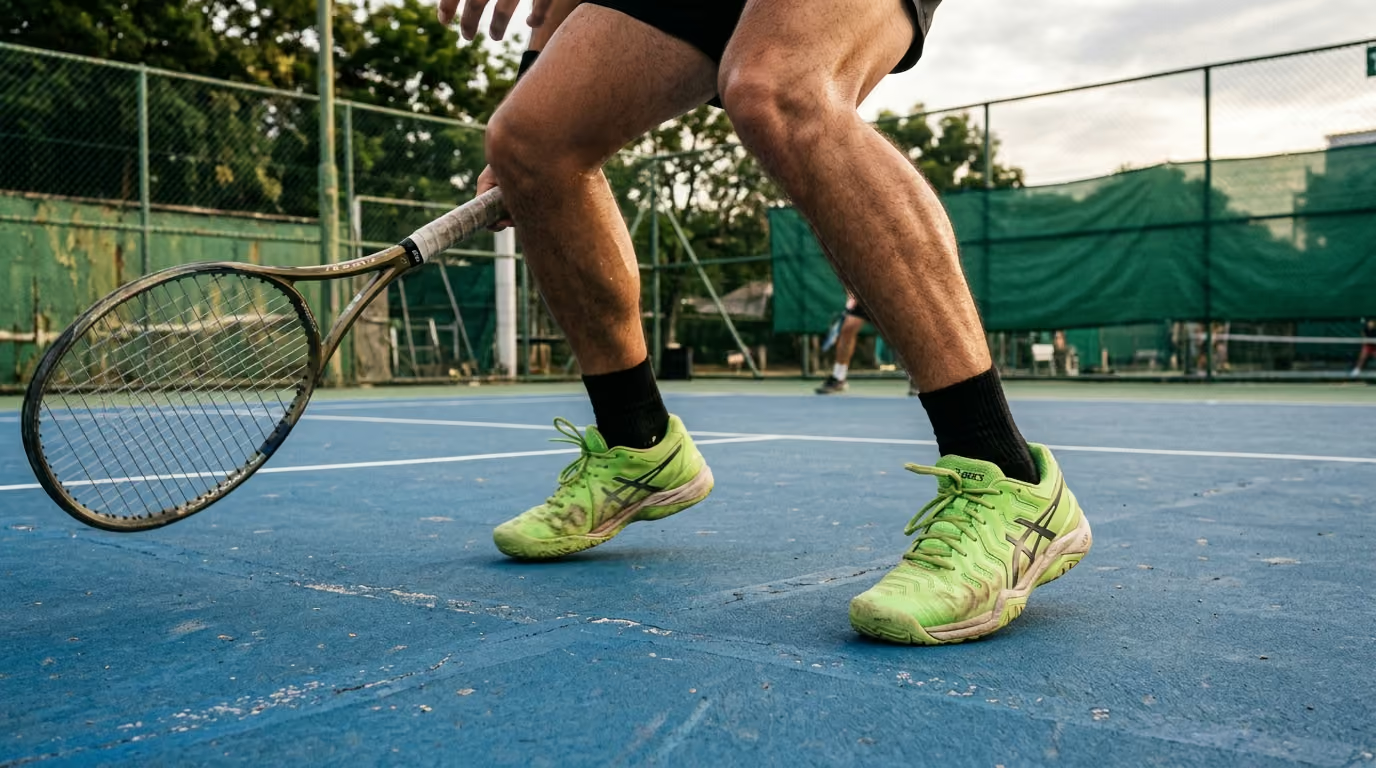
Racquet sports redirection involves altering an incoming ball's trajectory, combining early technical preparation with court geometry understanding to succeed.




Redirection is the tactical and physical act of altering the path of an incoming ball from its current trajectory to a new one. We define it as intentionally changing the ball’s direction, rather than returning it along the same path. To redirect a ball safely and effectively under pressure, a player must combine early technical preparation with a clear understanding of court geometry. Success relies on hitting from a balanced position, adjusting the contact point, and immediately executing a recovery step to cover the opponent's next shot.
Making these adjustments is crucial for any player who wants to maintain a high level of play over time. Developing clean movement mechanics not only improves performance but also supports your long-term health on the court. If you want to maintain your physical capabilities over time, focus on our specialized resources for athletic longevity.
Research on racquet sports groundstrokes shows that changing direction is not an isolated upper-body action. Elite players exhibit significantly higher velocities at impact compared to recreational or high-performance amateur players. Studies show elite players achieve a shoulder linear velocity of 2.0 meters per second, compared to 1.2 meters per second for high-performance players. Their pelvic angular velocity reaches 295 degrees per second, while the high-performance group averages 168 degrees per second. Additionally, upper-trunk angular velocity is measured at 453 degrees per second for elite players, compared to 292 degrees per second for others.
This data indicates that redirection is a whole-body task. The kinetic energy must travel from the ground up through the pelvis, trunk, and shoulders before reaching the racquet. A separate study on topspin backhands confirms that changing direction from crosscourt to down-the-line alters the mechanics of the entire arm. The body must coordinate these segments to transfer energy safely. If you try to change direction with your wrist alone, you lose power and increase joint stress.
Changing direction is primarily a deceleration task before it is an acceleration task. A 2025 scientific review highlighted that faster change-of-direction performance relies on specific biomechanical markers. These markers include shorter final-contact ground times and higher approach velocities. They also include greater braking and propulsive forces, a lower center-of-mass height, and proper trunk inclination. Finally, the hips, knees, and ankles must contribute to absorb the force.
However, the same review warned that these high braking forces increase lower-limb joint moments. This means that rushing a directional change under pressure dramatically increases the mechanical stress on your joints. If you do not decelerate with control, your joints absorb the force instead of your muscles. To reduce your risk of injury during lateral movements, consult our guide on injury prevention strategies.
Research on the forward-stepping backhand demonstrates how foot placement impacts joint torque. When a player orientates their front foot toward the net, it reduces ankle rotational torque. This simple alignment creates a more efficient kinetic chain than keeping the foot parallel to the net. Inversion ankle sprains are commonly associated with sudden stopping or rapid directional changes.
These injuries frequently occur during groundstrokes when the foot becomes a locked pivot. If the pelvis rotates aggressively while the foot is fixed, the ankle or knee must twist to accommodate the force. For practical movement drills, view our articles on court mobility and movement.
Real-world match data from the Australian Open reveals the physical toll of these movements. Researchers analyzed 182 professional singles matches to track movement demands. On average, players perform 1.6 change-of-direction movements per point. Both male and female players cover approximately 4.8 meters per movement. Men execute these movements every 2.7 seconds, while women execute them every 3.1 seconds.
Interestingly, medium-intensity movements represent 88% to 94% of these changes. High-intensity cuts are less frequent, but they are highly demanding. Roughly two-thirds of all directional changes involve angles greater than 105 degrees. This means players are constantly reversing their momentum on the court. High-intensity cutting maneuvers below 45 degrees are particularly stressful. Men perform these intense cuts twice as frequently as women, averaging one every five points. While these numbers represent elite athletes, they show the sheer volume of rotational stress court sports require.
To execute a clean redirection, you must arrive at the ball with your stroke organized. In our experience, rushing the swing leads to errors and joint strain. We recommend using a three-step model to prepare.
The exact contact point is the primary technical difference between crosscourt and down-the-line shots. For a crosscourt shot, make contact earlier and more in front of your body. This early contact allows the racket face to naturally direct the ball diagonally. For a down-the-line shot, contact the ball slightly later and more toward the inside of the ball. This adjustment prevents you from pulling the ball wide. For an inside-out pattern, create extra space from the ball to allow a full, uncrowded swing.
Tactical timing prevents you from attempting high-risk shots from defensive positions. Use this simple framework to guide your decision-making on court.
Green Light: Change Direction
Consider redirecting when you are inside or near the baseline. The ball should be slower, shorter, or less threatening. You must be balanced, and the opponent should be out of position. Tennis Australia notes that having both feet inside the baseline is ideal for changing direction.
Yellow Light: Controlled Change
Execute a controlled change with extra height, spin, or a safer target. Use this option when the ball is deep but manageable, or when you are slightly late. The U.S. High School Tennis Association recommends aiming down-the-line shots three feet inside the sideline for safety. This margin reduces the risk of making an error.
Red Light: Maintain the Pattern
Do not attempt a directional change. This applies when you are stretched wide, behind the baseline, or under heavy pressure. In these situations, return the ball crosscourt. Crosscourt shots cross the lower center of the net and travel over a longer distance. This choice offers the greatest geometric safety margin.
Do not change direction randomly during a point. Use repeated crosscourt shots to build rhythm and force a weak reply. The U.S. High School Tennis Association suggests practicing three or four crosscourt shots before switching down the line. As your skills improve, extend this to six or eight shots. This disciplined approach teaches you to wait for the right ball.
Also, evaluate your redirection by the outcome of the next shot. A successful change should force a weak reply or open up the court. If your opponent easily reaches your shot, your tactical timing was off. Always treat the recovery step as part of the stroke itself. Strike the ball, land, recover to the middle, and read the reply.
Tennis requires coverage of a large 78-foot court. The singles width is 27 feet, making the diagonal corner-to-corner distance about 82.5 feet. The net is 3 feet high in the center and 3 feet 6 inches at the posts. These dimensions make crosscourt shots highly favorable. Down-the-line shots must travel over the higher part of the net with less distance to land. Thus, tennis redirection requires high physical output and excellent deceleration.
Pickleball uses a much smaller court of 20 by 44 feet. The net is 34 inches high in the middle and 36 inches at the sidelines. Because players stand close to the non-volley zone, reaction times are extremely short. Redirection in pickleball is less about raw racket-head speed and more about paddle-face control. You must use compact blocks and volleys to redirect pace. Changing direction from the kitchen line requires subtle wrist adjustments rather than large body rotations. For more tips on this sport, check our dedicated pickleball articles.
Padel is played inside a 10 by 20-meter glass cage. This environment completely changes the recovery equation. Redirection often involves using the glass walls to neutralize pace. You can let a fast ball pass, hit the glass, and then redirect it. The court is smaller, but the lateral movements are frequent and intense.
I remember finishing a tough two hour padel match on a cold Tuesday night and waking up the next morning feeling like my lower back was locked in concrete. For a long time, I just accepted this as the price of playing hard in my forties. But once I started spending just ten minutes on targeted hip mobility before heading to the club, the stiffness almost completely vanished. It taught me that we do not have to accept pain as a default state of aging. Focus on keeping your hips mobile to protect your spine. You can read more about movement demands in our specialized padel articles.
Many players try to steer the ball at the last second with their wrist. While the racket face controls direction, the movement must involve the whole body. Elite players use coordinated shoulder, pelvic, and trunk rotation to redirect pace safely. Trying to flick the wrist increases the risk of elbow and wrist strain. Prepare early and use a stable swing path.
Trying to hit a low-margin down-the-line shot while stretched wide is a major error. If you are behind the baseline or off-balance, your chances of making the shot are low. Tennis Australia advises players to default to crosscourt when defending. Crosscourt shots offer a lower net and a longer court. Respect the geometry of the court to avoid unforced errors.
When a player reaches wide, they often plant their foot firmly and twist their body. This action creates immense rotational torque on the ankle and knee joints. Research shows this mechanical pattern is a common cause of ankle sprains. Keep your feet active and avoid locking your foot into the court. Use adjustment steps to distribute the forces.
Players often watch their redirection and forget to move. A down-the-line shot gives your opponent a shorter path to the ball. If you do not recover immediately, they can easily hit a crosscourt winner into the open space. Your recovery step is the final part of the redirection technique. Start moving back to the center as soon as you make contact.
Redirection is physically demanding because of the eccentric load. Decelerating to change direction requires your muscles to absorb immense force. This stress can lead to micro-tears in the muscle fibers, resulting in post-match soreness. Managing this load is essential for maintaining your athletic longevity. Focus on proper hydration, light active recovery, and mobility work after intense matches.
If you are experiencing persistent stiffness, review our resources on recovery science. Keeping your body healthy allows you to play the sports you love for years. To learn more about our philosophy, visit our About Evercourts page.
While mild fatigue and muscle soreness are normal, persistent joint pain is not. If you experience sharp pain, swelling, or instability in your knees, ankles, or hips, stop playing. These symptoms can indicate a ligament sprain, tendon issue, or structural wear. Consult a qualified physical therapist or sports medicine physician for a proper assessment. They can help you design a safe return-to-play plan. Never try to play through joint pain or mask it with medication.
Topspin is generally safer because it provides net clearance and pulls the ball down into the court. A slice can be useful to neutralize pace, but it travels slower and can leave you vulnerable if it lands short. Use topspin for aggressive redirections and slice for defensive or change-of-pace shots.
Focus on strength training for your quadriceps, hamstrings, and glutes. This strength helps absorb the braking forces. Additionally, practice low-impact agility drills to improve your footwork and body control. Always warm up thoroughly before playing.
Yes, clay and grass allow for sliding, which can reduce the peak braking forces on your joints. Hard courts require abrupt stopping, which increases the impact on your knees and ankles. Adjust your movement style to match the surface you are playing on.
Follow Evercourts for practical insights on tennis, pickleball and padel performance, movement, recovery and healthy ageing. Stay connected for new articles, research-led guidance and ideas to help you play well and keep playing for years.


Read practical guidance for better movement, smarter preparation and a game that keeps working for you.
explore the Blog