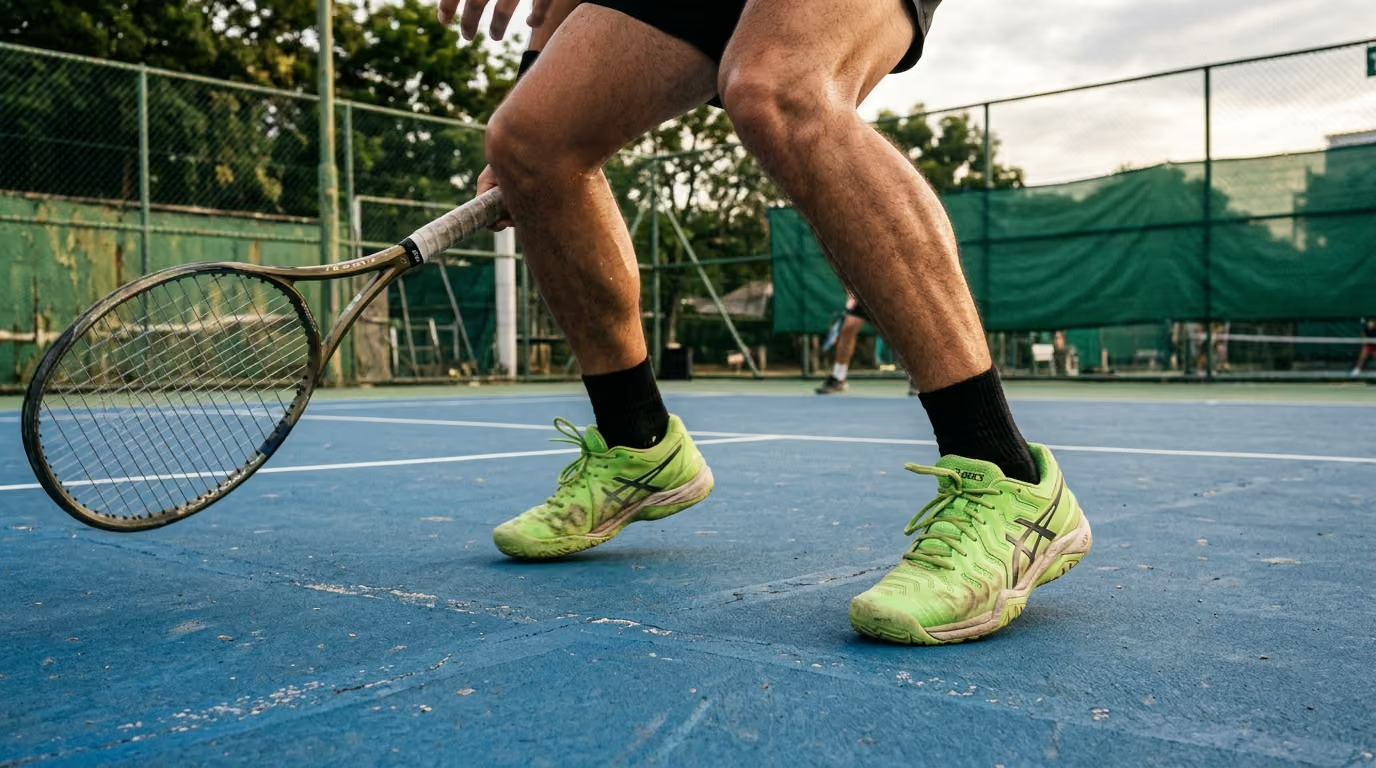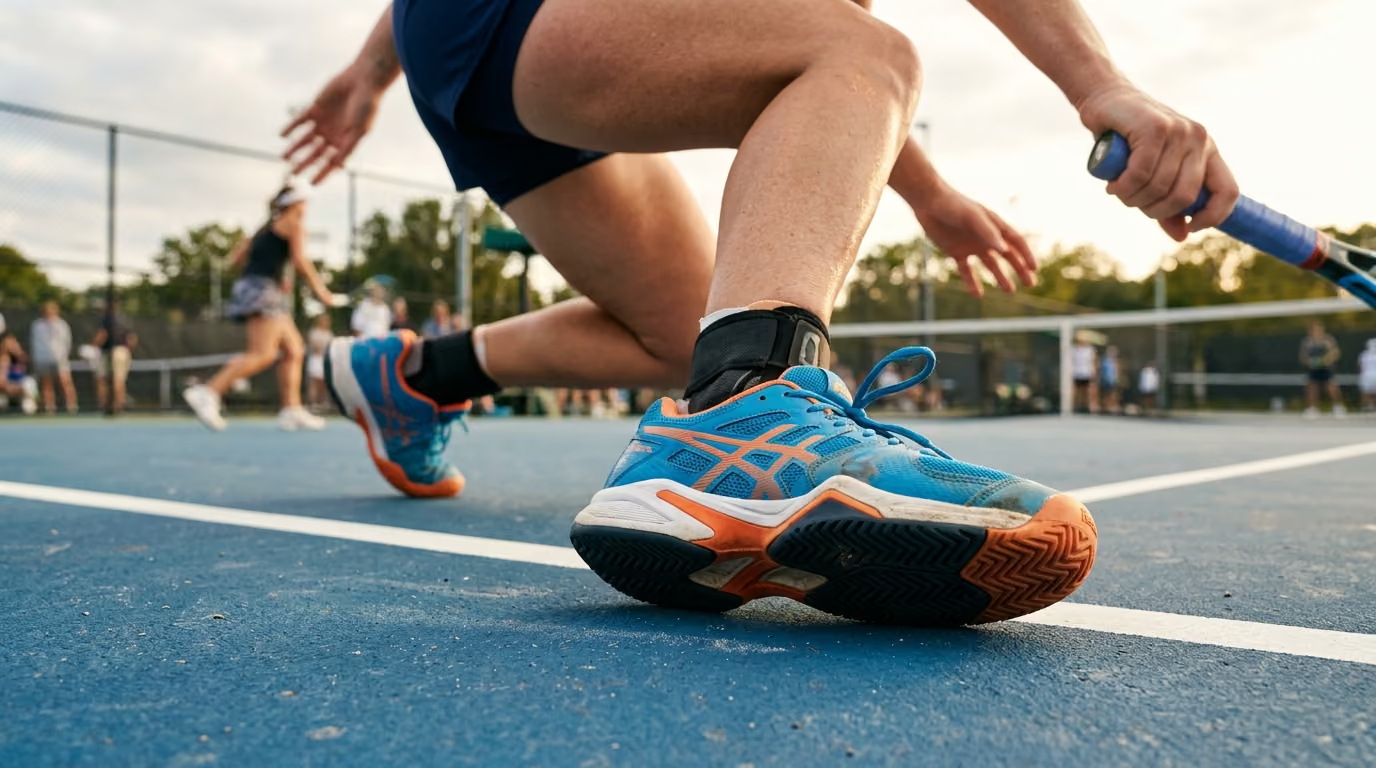

Racquet sports shoes are essential for managing lower-extremity forces and balancing forward grip with controlled rotational release to prevent injuries.




Footwear selection in racquet sports is not merely about finding a comfortable sneaker or choosing a stylish design. Instead, court footwear represents a technical interface within a complex system that includes the athlete, the shoe and the court surface. Understanding this system is key to managing repetitive physical stress on the joints. This knowledge helps players maintain control during sudden stops, rapid acceleration and lateral shifts.
Selecting the right racquet sports shoes requires matching the outsole traction and stability features to your specific court surface. Proper footwear helps manage lower-extremity forces by balancing forward grip with controlled rotational release. However, court shoes must be viewed as tools to reduce environmental hazards, rather than as substitutes for proper movement technique and physical conditioning.
When you step onto a tennis, pickleball, or padel court, your movement depends on a highly dynamic relationship. Biomechanists view this relationship as an athlete-shoe-surface system. Every step you take, every sudden brake and every lateral slide involves a transfer of force through this system. If any part of this system is mismatched, your physical performance declines and the risk of joint strain increases.
To understand how shoes protect your body, you must first understand traction. Traction is not a single, uniform force. Instead, sports scientists divide it into two primary categories. These are translational traction and rotational traction.
Translational traction describes a shoe's resistance to sliding in a straight line across the court surface. This is the grip that allows you to accelerate quickly when rushing toward a short ball. It also provides the stopping power needed to decelerate and change direction without sliding past your target. If translational traction is too low, you may experience unexpected slips and lose your balance. If it is too high, the abrupt stop can transfer excessive force up through your knees and hips.
Rotational traction is the resistance to twisting or pivoting while your foot is planted on the court. This force is particularly active when you rotate your hips and torso to strike a ball during a lunge. High rotational traction can prevent your shoe from releasing naturally from the court surface. This resistance forces your ankle and knee joints to absorb the twisting energy instead. This kinetic transfer is a major contributor to joint strain during sudden changes of direction.
To evaluate these forces, researchers look at the coefficient of friction. This is the ratio between the horizontal force of your slide and the vertical force of your body weight. Biomechanists refer to this as the utilized coefficient of friction. Court players constantly adapt their movements to match this friction level.
For example, a tennis study published on Sciety showed that players alter their landing mechanics based on court friction. On higher-friction hard courts, players used greater knee flexion to help absorb braking forces. On lower-friction clay courts, they used less knee flexion and allowed their shoes to slide.
There is also a difference between static traction and dynamic traction. Static traction is the resistance that prevents you from slipping when you are standing still or starting a run. Dynamic traction governs how the shoe behaves after it is already in motion. This distinction is vital because a shoe that feels incredibly stable while standing can still behave unpredictably during a high-speed lunge.
The court surface itself is never completely uniform. Moisture, dust and worn court coatings can drastically alter how your shoes perform. On artificial clay courts, research from the University of Bologna shows that particle size and moisture alter traction.
Small, dry particles generate higher traction, while larger particles and dampness reduce traction. This means you cannot judge a shoe solely by its tread pattern. You must also consider the immediate environmental conditions of the court you are playing on.
Current scientific research highlights a clear relationship between shoe traction and the physical loads placed on human joints. A prominent study in the American Journal of Sports Medicine examined how traction affects the knees and ankles during rapid changes of direction. In this study, researchers measured joint moments while athletes performed a V-cut movement.
The results showed that increased shoe traction significantly raised ankle and knee joint moments. Crucially, this higher traction provided no performance advantage during the test.
This finding challenges the popular belief that maximum grip is always better for athletic performance. Instead, it suggests that excessive grip simply increases joint stress without helping you move any faster. When your shoe grips the court too aggressively, your body must find another way to dissipate the kinetic energy of your movement. This energy is typically absorbed by your tendons, ligaments and cartilage.
Another major piece of evidence comes from a systematic review in the British Journal of Sports Medicine. Researchers analyzed data from three prospective studies involving 4,972 male athletes. The analysis found that higher rotational traction at the shoe-surface interface was associated with a 2.5-fold increase in lower-extremity injury risk. This represents a significant increase in hazard when a shoe does not allow for rotational release.
However, we must apply this science to racquet sports with healthy caution. This systematic review focused on football codes played on turf and grass surfaces. While the physical mechanics of pivoting and cutting are highly similar, racquet sports athletes move on different surfaces like concrete, clay and indoor wood.
Direct, long-term injury trials focusing exclusively on tennis, pickleball, or padel footwear remain limited. We cannot say with absolute certainty that a specific court shoe will double your injury risk.
The primary biological mechanism of concern is known as the foot-locking effect. This occurs when a player attempts to pivot or slide, but the shoe outsole remains firmly fixed to the court. While the shoe is locked in place, the athlete's momentum continues to carry their upper body forward.
The ankle and knee joints are forced to twist under load. This sudden rotational stress can overwhelm the passive stability of the knee ligaments or the active control of the ankle muscles.
High rotational traction also interacts poorly with unexpected movement disturbances. If you catch your foot on an uneven patch of court or step into a dusty spot, your nervous system must react instantly. When rotational traction is high, your joints have a much smaller margin of error to adjust your posture. This can lead to non-contact injuries, where your own muscle forces and momentum cause damage because the shoe failed to give way.
Because of these findings, biomechanists generally recommend looking for a shoe that sits within a balanced traction window. You need enough translational traction to push off and stop safely without slipping. At the same time, you want low enough rotational traction to allow your foot to pivot without binding.
Finding this balance is a key part of protecting your joints over years of regular play. To learn more about managing joint stress and physical longevity, you can review our healthy aging and athletic longevity resources.
Every court surface presents a unique set of physical demands. The way a shoe interacts with a cushioned acrylic hard court is fundamentally different from how it interacts with clay or indoor timber. Using the wrong shoe for a specific surface can compromise your stability and increase joint strain.
Hard courts are constructed from concrete or asphalt covered with a textured acrylic coating. This texture provides a high level of friction, which offers excellent translational traction for quick starts and stops. However, this high friction also means that hard courts do not naturally allow for sliding, unless a player uses highly advanced techniques.
For hard courts, you need an outsole made from highly durable rubber. The constant grinding against the abrasive acrylic surface will quickly wear down softer rubber compounds. Hard court shoes typically feature a modified herringbone tread pattern. This design provides multidirectional grip while still allowing for a small amount of slide during extreme deceleration.
You also need sufficient cushioning to absorb the repetitive vertical impact forces of hard court play. Unlike clay or grass, hard courts do not yield under your weight. Research in the Journal of Sports Sciences suggests that player movement speed, rather than shoe wear, is the main driver of peak impact forces. However, a supportive midsole can help distribute these forces more evenly across your foot.
Finally, look for shoes with reinforced toe caps. Many players drag their trailing foot during serves or deep lunges on hard courts. A durable toe guard prevents the upper material from wearing through and exposing your foot to painful scrapes.
Clay courts consist of a solid base topped with loose, fine particles. This construction allows players to slide into shots, which reduces the need for abrupt braking. Sliding on clay is a deliberate movement strategy that can lower peak joint forces when executed correctly.
To play safely on clay, you must use a clay-specific outsole. These shoes feature a full herringbone tread pattern with deep, sharp grooves. This specific geometry is designed to grip the clay particles when you push off. It also allows the loose clay to slide out of the grooves when you bend your foot, preventing the outsole from clogging.
If your tread becomes clogged with clay, the shoe essentially becomes a flat, slick surface. This leads to unpredictable slipping, which is an uncontrolled loss of traction. Uncontrolled slipping is far more dangerous than deliberate sliding. It often results in groin strains, ankle sprains, or falls because your body cannot prepare for the sudden loss of support.
Moisture levels on clay also change how the surface behaves. A dry clay court will slide differently than a freshly watered court. As the court moisture changes, you must adjust your movement style rather than assuming your shoes will grip exactly the same way.
Grass courts offer a unique combination of high compliance and potentially low friction, especially when damp. The surface can be soft underfoot, but the grass blades can become incredibly slick from morning dew or sweat. This makes traction highly unpredictable.
Traditional grass court shoes feature small, rubber studs or pimples on the outsole. This textured pattern is designed to penetrate the thin layer of grass to reach the soil below. This provides the translational traction needed to move without slipping.
You should never wear aggressive clay court shoes or heavily textured hard court shoes on grass. They can damage the delicate turf and fail to provide adequate grip on the slippery blades. Conversely, grass court shoes should never be worn on hard courts, as the small studs will wear down in a single session.
Indoor courts for badminton, squash, and indoor pickleball are often made of wood or polyurethane. These surfaces are highly sensitive to dust and moisture. Even a small amount of dust can turn a clean wood court into a slippery hazard.
Indoor court shoes must utilize non-marking, natural gum rubber or specialized synthetic rubber outsoles. This rubber is softer and tackier than the compounds used for outdoor hard courts. It is designed to grab the smooth indoor surface without leaving scuff marks.
The stability requirements for indoor shoes emphasize a low-to-the-ground profile. A lower heel-to-toe drop brings your center of gravity closer to the court. This design reduces the leverage forces that can roll your ankle during rapid lateral shuffles.
Do not wear outdoor court shoes on indoor wood courts. The hard, durable rubber used for outdoor shoes will not grip the smooth wood or synthetic floor properly. This mismatch can lead to frequent slipping and unstable lateral movements.
Carpet courts are common in some indoor tennis and multi-sport facilities. These surfaces can vary from low-pile carpets to highly textured synthetic grass. They often generate high rotational friction, which can increase the risk of the foot-locking effect.
For carpet courts, players typically need smooth outsoles with minimal tread pattern. This smooth design prevents the shoe from catching too aggressively on the carpet fibers. It allows for a safe amount of slide and rotation during directional changes.
Always check with your facility before playing on a carpet court. Many venues have strict rules about acceptable footwear to protect both the player and the carpet fibers. To see more detailed discussions on court surfaces, review our court life articles.
When selecting a court shoe, players often struggle to balance the need for stability with the desire for comfort. These two physical properties are central to how a shoe manages joint forces. However, more cushioning or more support is not always the safest choice for every individual.
The primary difference between a court shoe and a running shoe lies in their directional design. Running shoes are engineered for forward travel, guiding your foot through a linear heel-to-toe transition. They often feature soft, flexible uppers and thick midsoles that can collapse easily under lateral loads.
Court shoes, by contrast, must support multi-directional movement. According to the American Academy of Orthopaedic Surgeons, court shoes are specifically designed to provide stability in all directions. They feature several structural elements designed to keep your foot centered over the sole.
First, court shoes have a firm heel counter. This is a rigid plastic cup built inside the back of the shoe that cradles your heel. It prevents your heel from sliding sideways inside the shoe when you make a hard lateral cut. If your heel shifts, your ankle can easily roll over the edge of the sole.
Second, court shoes utilize a supportive, reinforced upper. This upper is often constructed from synthetic leather, TPU overlays, or durable woven meshes. These materials resist stretching when you push off the outer edge of your foot, keeping your foot locked in place.
Third, court shoes feature a wider outsole base, often with a lateral outrigger. This is a small extension of the sole on the outer edge of the forefoot. It acts like a kick
Follow Evercourts for practical insights on tennis, pickleball and padel performance, movement, recovery and healthy ageing. Stay connected for new articles, research-led guidance and ideas to help you play well and keep playing for years.


Read practical guidance for better movement, smarter preparation and a game that keeps working for you.
explore the Blog