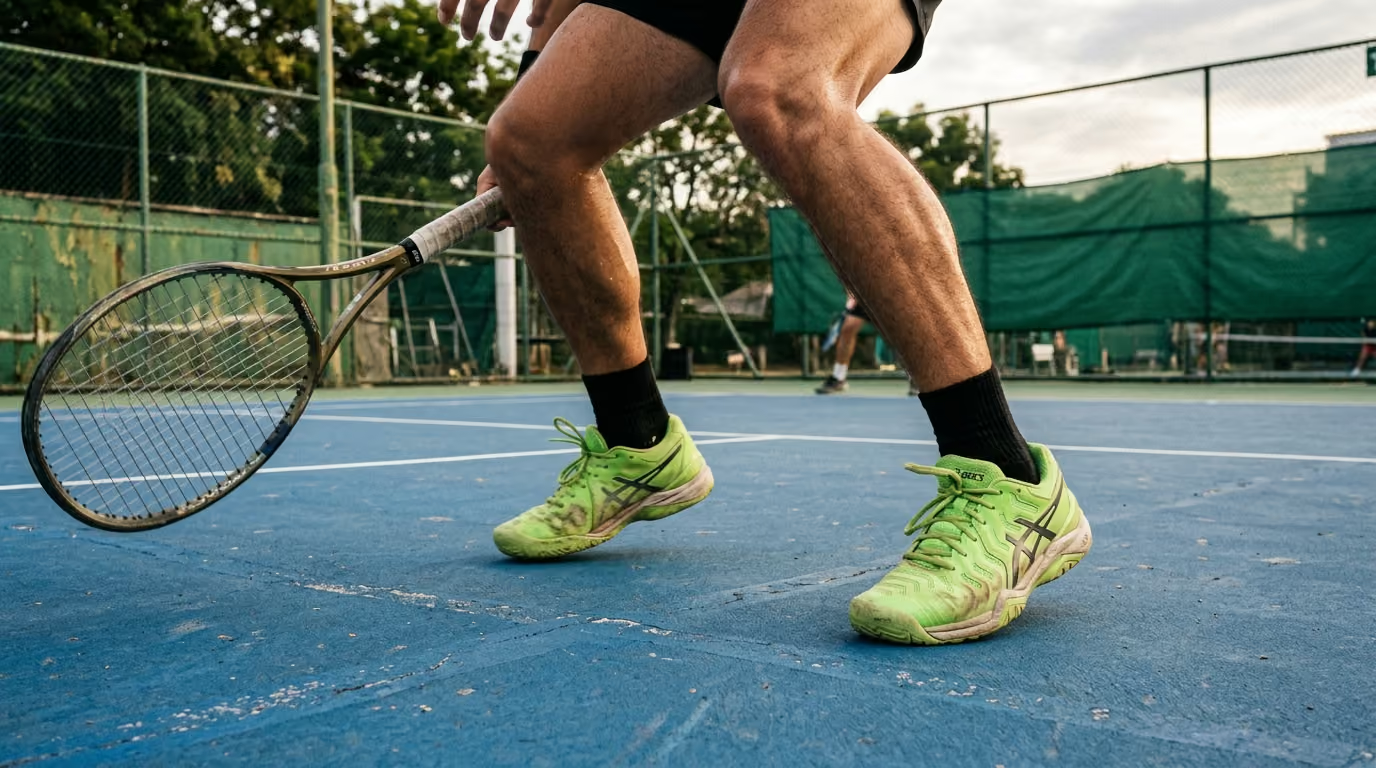
When a high lob sends both doubles partners scrambling for the same spot, clear communication and coordinated movement prevent collisions and falls.




A high, floating lob sails over your partner’s head and drifts toward the baseline. You both sprint backward toward the same spot on the court. Neither of you speaks a word. In a split second, your shoulders collide, your racquets clash, and both of you fall hard onto the court surface.
This scenario happens every day on tennis, pickleball, and padel courts. While individual training focuses on stroke production and cardiovascular fitness, safe partner movement is often completely ignored. This comprehensive guide details how to move safely with a partner, communicate effectively, and prevent dangerous falls during doubles play.
Preventing on-court doubles collisions requires active verbal communication, structured court coverage agreements, and highly developed spatial awareness. By using specific verbal cues and practicing coordinated footwork drills, you can protect yourself and your partner from injury. These physical habits ensure safe positioning without sacrificing your performance during competitive matches.
Doubles play is dynamic and fast. When two players share a confined space, the risk of accidental contact increases significantly. To stay safe, you must treat partner coordination as a fundamental skill, just like your forehand or volley.
To prevent collisions, it helps to understand why they happen from a scientific perspective. On-court accidents are rarely the result of simple laziness. Instead, they stem from cognitive overload, visual limitations, and rapid physical deceleration.
During a fast-paced rally, your brain must process multiple streams of information simultaneously. You must track the flight of the ball, monitor the positions of your opponents, and control your own balance. According to cognitive research in sports science, adding a partner to this equation drastically increases your mental workload.
When you focus entirely on the ball, your peripheral vision narrows. This phenomenon, known as tunnel vision, makes it difficult to see where your partner is moving. Without clear auditory cues from your teammate, your brain cannot accurately predict their location. This lack of awareness often leads to unexpected physical contact.
When two adult athletes collide at high speeds, the physical forces are substantial. A player running at moderate speed carries significant kinetic energy. If a collision forces you to stop suddenly, that energy must go somewhere.
This force is often absorbed by your joints, ligaments, and bones. Falls on hard court surfaces frequently cause acute injuries. These include wrist fractures, AC joint sprains in the shoulder, and concussions from head impact.
Even if you do not actually collide with your partner, near-misses can still cause injury. When you suddenly change direction to avoid hitting your teammate, your body undergoes extreme deceleration.
According to sports biomechanics studies, these sudden stops put immense stress on your anterior cruciate ligament, meniscus, and ankle tendons. Developing smooth, predictable movement patterns is essential for healthy aging and athletic longevity on the court.
The most effective tool for preventing collisions does not cost any money and requires no physical training. It is your voice. Establishing a clear, simple, and consistent verbal cue system with your partner is the foundation of court safety.
Many doubles partners wait too long to speak, or they use confusing language. Words like "I got it" or "You have it" can sound very similar in the heat of a point. Instead, you should use five distinct, single-syllable commands.
A verbal cue is only helpful if your partner hears it in time to react. You must call for the ball before it crosses the net. If you wait until the ball is on your side of the court, your partner will already be committed to their movement.
Speak with loud, clear, and assertive tones. Do not whisper or hesitate. Even if you make the wrong tactical decision, committing to a loud call keeps both of you safe.
During practice matches, make it a rule that you must call every ball that lands near the center line. If a point is played without a verbal call on a shared ball, stop the play.
Over time, this practice builds strong neural pathways. Calling for the ball will eventually become as automatic as swinging your racquet.
Good positioning reduces the need for last-second, desperate scrambles. By understanding where you should stand in relation to your partner, you can maintain excellent court coverage while staying out of each other's way.
Imagine a ten-foot rope connects you and your partner. If your partner is pulled wide to the left alley, you must slide to the left as well. This movement protects the middle of the court.
If you do not slide, a massive gap opens up in your defense. If you slide too far, you risk running into your partner. Staying "tethered" ensures you maintain a safe, consistent distance from your teammate at all times.
The center line is the most common collision zone in doubles racquet sports. To prevent accidents, you must establish a clear rule for center balls before you step onto the court.
The standard rule is that the player with their forehand in the middle takes the shot. This is because forehands offer a wider reach and better control. However, this rule must be discussed and agreed upon with your partner during your warm-up.
In many doubles formats, one player stands near the net while the other plays near the baseline. This setup is generally safe, but it can turn dangerous quickly.
If the baseline player hits a short ball, the net player may try to back up to hit it. This is a major safety hazard. The net player should never back up into the baseline player's territory. Instead, the baseline player must move forward to cover the short ball.
While the principles of partner safety apply to all racquet sports, each game has unique physical demands. Understanding these differences will help you adapt your safety strategies. Learn more about general safety by visiting our injury prevention resources page.
Tennis courts are large, and the ball travels at very high speeds. The greatest safety risk in tennis doubles occurs during deep lobs or fast, angled volleys.
Because the court is wide, players must run long distances to cover open space. This high momentum makes it harder to stop or change direction suddenly.
If you must chase a lob, never run straight backward. This movement pattern frequently leads to tripping and falling on your back. Instead, turn your body, sprint forward toward the baseline, and look over your shoulder to track the ball.
Pickleball is played on a much smaller court, which brings partners closer together. Because the space is tight, paddle clashes and physical bumps are very common.
When I first started playing pickleball, I noticed how many people skipped warming up entirely. They would jump straight out of their cars and right up to the kitchen line. I tried doing that and immediately pulled a calf muscle.
Pickleball requires just as much explosive lateral movement as tennis, just in a tighter space. Since then, I always spend five minutes doing dynamic lunges and ankle rolls. It changes everything about how confident I feel pushing off the baseline.
To move safely in pickleball, you must master lateral sliding at the kitchen line. Avoid crossing your feet when moving sideways, as this can cause you to trip over your partner's feet. If you want to improve your agility, consider incorporating targeted on-court mobility and movement training into your weekly routine.
Padel is unique because the court is enclosed by glass walls and metal fencing. This enclosure creates a highly pressurized playing environment.
The greatest risk in padel is not just hitting your partner. You also run the risk of being compressed between your partner and the glass wall.
When a ball rebounds off the back wall, both players must understand who has the right of way. The player playing on their natural side should handle the rebound.
You must also learn to use "wall awareness" techniques. Always keep your non-dominant hand slightly extended when playing near the back of the court. This hand acts as a sensor to help you feel where the glass is without looking away from the ball.
You cannot expect to move safely during a high-stakes match if you never practice coordination. These three simple drills will help you and your partner build better spatial awareness.
This drill requires no racquets or balls. It is an excellent way to warm up before a match.
This exercise trains your peripheral vision to track your partner's body movements while you focus forward.
This drill teaches players how to safely chase deep lobs without backpedaling.
Practice this drill until both players can transition from the net to the baseline without looking at each other.
Sometimes, a fall is completely unavoidable. In those moments, knowing how to land can prevent severe fractures or head trauma.
Even experienced players fall victim to bad habits on the court. Recognizing these common errors is the first step toward correcting them.
As mentioned earlier, backpedaling is the single most dangerous movement on a racquet sports court. When you run backward, your center of gravity shifts behind your feet.
If you hit a small crack, a wet spot, or your partner's foot, you will fall directly onto your back or head. Always turn your hips, run forward, and chase the ball down.
Poaching is a great tactical move in doubles. It involves the net player crossing over to intercept a ball meant for the baseline player.
However, poaching without warning is a major safety hazard. If your partner does not know you are crossing, they may swing at the ball anyway. This can result in you getting hit in the back of the head with a racquet or ball.
Always communicate your intention to poach. You can use a quick hand signal behind your back before the serve, or yell "Switch" as you make your move.
When both you and your partner are close to the net, the playing area becomes highly congested. In these moments, taking a massive, wild swing at a high ball is incredibly dangerous.
Your partner's head or face could easily be in the path of your follow-through. When playing in tight spaces, focus on short, controlled punching motions rather than long, looping swings.
If you are involved in a collision, the physical consequences can linger long after you leave the court. Understanding how to manage these injuries is vital for your long-term health. For a deeper look at recovery strategies, explore our recovery science principles.
A direct collision causes acute trauma, such as bone bruising, muscle contusions, or joint sprains. However, the fear of colliding can also lead to chronic physical issues.
When you play with anxiety about hitting your partner, your muscles remain tense. This constant muscle guarding limits your natural range of motion. Over time, this tension can lead to chronic neck pain, lower back tightness, and shoulder fatigue.
If you experience a minor collision or a near-miss that causes you to twist awkwardly, your body's natural defense mechanism is to tighten up. This muscle guarding protects the joint from further damage, but it can also delay your recovery.
In the first 24 to 48 hours after an incident, focus on gentle movement and light stretching. Avoid aggressive stretching or returning to competitive play too quickly. Allowing your nervous system to calm down is just as important as letting your muscles heal.
While minor bumps and bruises are a normal part of sports, some signs indicate a more serious underlying issue. Do not ignore these warning signs.
If your head collides with your partner, their racquet, or the court surface, you must monitor yourself for concussion symptoms. These symptoms can sometimes take several hours to appear.
Consult a physician immediately if you experience any of the following:
Musculoskeletal injuries require professional evaluation if they limit your basic daily activities. Seek medical care if you experience:
A physical therapist or sports medicine specialist can help you rehabilitate these injuries safely. They can also provide targeted exercises to prevent future incidents.
Court safety is not a one-time conversation. It is an ongoing practice that requires regular attention.
Before every match with a new partner, take two minutes to discuss your safety protocols. Agree on your verbal cues, decide who covers the center line, and establish how you will handle deep lobs.
If you play with a regular partner, review your movement patterns every few weeks. Discuss any near-misses you experienced and adjust your strategy accordingly.
By prioritizing communication, practicing safe movement patterns, and staying aware of your surroundings, you can enjoy competitive doubles play for years to come.
Follow Evercourts for practical insights on tennis, pickleball and padel performance, movement, recovery and healthy ageing. Stay connected for new articles, research-led guidance and ideas to help you play well and keep playing for years.


Read practical guidance for better movement, smarter preparation and a game that keeps working for you.
explore the Blog