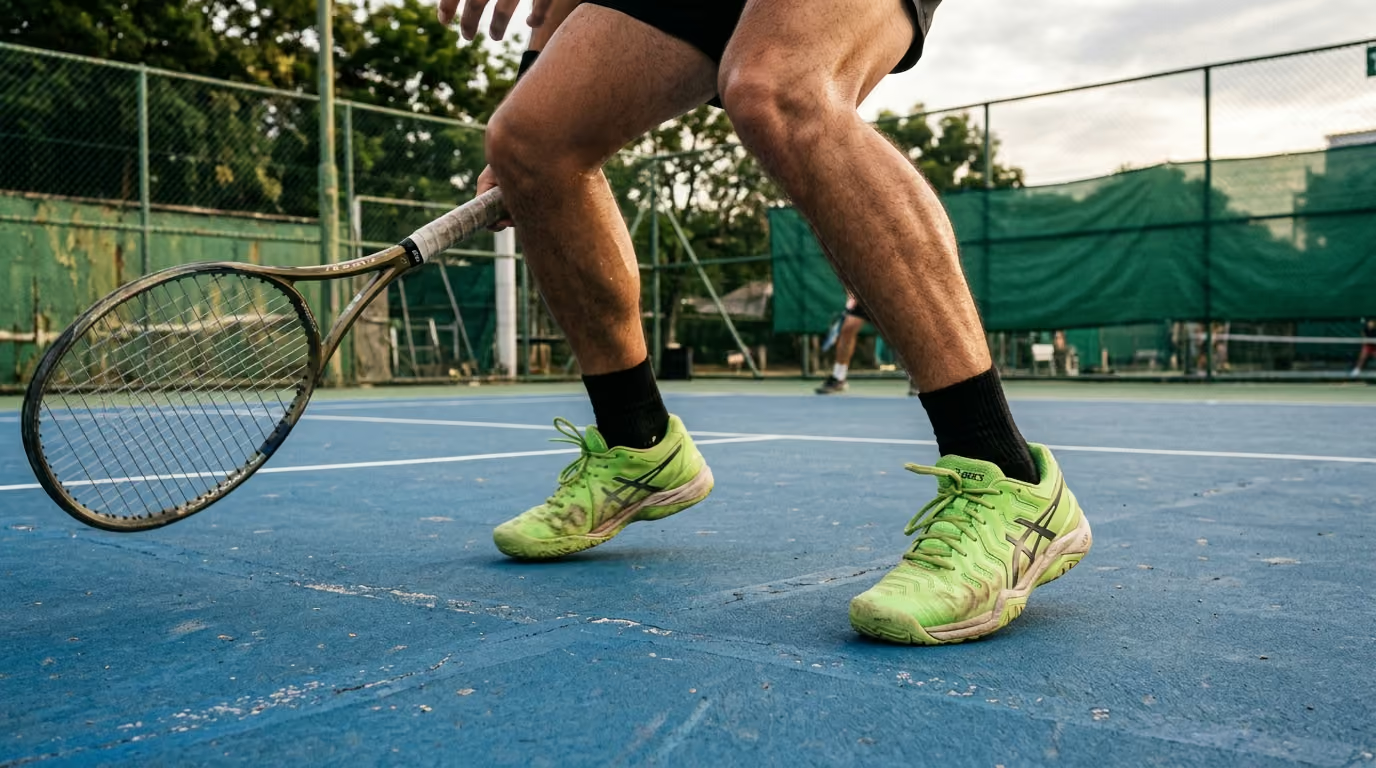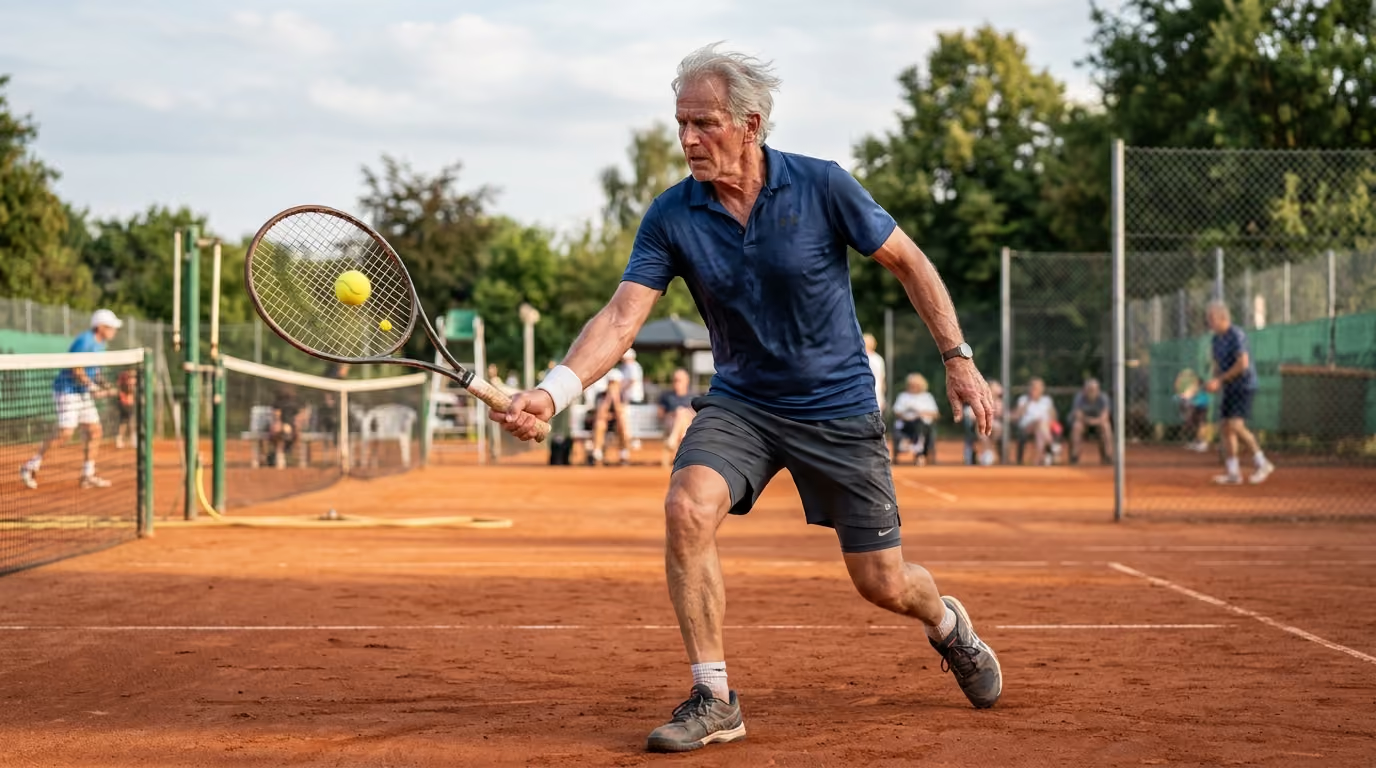

While many believe aging means slowing down in racquet sports, maintaining high competitiveness is possible by focusing on strategic efficiency and smart preparation.




If you have searched the internet for ways to maintain your court speed or stop chronic joint stiffness, you have likely run into generic advice. Most guides tell you to slow down, play doubles, or accept a steady physical decline. This resource offers a different path based on sports science and movement efficiency.
Remaining highly competitive in racquet sports as you age is entirely possible by shifting your focus from raw physical output to strategic efficiency, movement economy, and structured physical preparation. While absolute biological limits do change over time, targeted training and smart pacing allow you to maintain your overall match effectiveness. By treating age as a changing performance environment rather than a fixed limitation, you can continue playing at a high level for decades.
This guide details how to adjust your match tactics, court movement, training priorities, and weekly scheduling. It treats biological changes not as an identity, but as variables you can measure and manage. With the right adjustments, your competitive years can stretch far into the future.
To perform well over time, you must understand how your body changes. Aging alters several physical systems, but structured training can slow these changes significantly. Understanding these shifts helps you target your training where it matters most.
Aerobic capacity naturally decreases as the years pass. This decline is linked to reductions in maximal cardiac output, including lower maximal stroke volume and maximal heart rate. This means a high-intensity rally will feel harder than it did in the past. Your cardiovascular system must work harder to supply oxygen to your working muscles.
However, the rate of decline is not fixed. Research on masters athletes shows that regular, vigorous endurance training can cut the rate of aerobic decline in half compared to sedentary individuals. Your training creates a larger performance reserve. This reserve makes matches feel more manageable and speeds up your recovery between points.
Sarcopenia is the age-associated loss of skeletal muscle tissue. This loss primarily affects fast-twitch muscle fibers, which are responsible for explosive actions on court. Losing muscle mass directly reduces your mechanical power, making quick movements more difficult.
Neuromuscular power is highly vulnerable to age-related loss. Without targeted training, your first-step acceleration will slow down. You will also find it harder to brake quickly and recover your position. Fortunately, regular resistance and power training can preserve these capabilities.
Your ability to tolerate and clear lactate can diminish over time. High-intensity rallies produce metabolic waste products in the muscles, which can lead to fatigue. Slower clearance means your muscles may feel heavy sooner in a match.
Regular, intense training helps maintain lactate clearance. Interval sessions prepare your muscles to handle the repeated bursts of speed required on court. You do not need laboratory testing to benefit from this concept. You simply need to include planned, high-intensity intervals in your weekly routine.
Court sports require constant changes of direction. You must stop suddenly, reach outside your balance base, and rotate your torso. Balance performance naturally declines, which increases your risk of falls and awkward landings.
A Cochrane review found that exercises combining balance, functional, and resistance work reduced fall rates in older adults by 34 percent. Another review showed that targeted balance work improves static, dynamic, and reactive stability. Improved balance keeps you upright during emergency defensive movements. It also ensures you can strike the ball from a stable, powerful position.
To stay competitive, you should view every match through an economic lens. Every shot you hit and every step you take has a biological cost. Your goal is to maximize tactical results while minimizing physical energy expenditure.
Do not define your performance by speed or stamina alone. True match effectiveness is multidimensional. It is the sum of technical quality, tactical efficiency, movement economy, repeatability, recovery, and decision quality.
If your raw speed decreases, you can offset this loss by improving your anticipation and shot selection. You can place your serves better and position yourself smarter on returns. This framework prevents you from focusing solely on physical attributes that naturally decline.
Racquet sports are not steady-state cardiovascular exercises. Match play consists of short, explosive bursts of work followed by brief recovery periods. Points can last from three seconds on fast courts to fifteen seconds on slower surfaces.
Work-to-rest ratios usually range from 1:2 to 1:5. This structure means you do not need to run continuously for hours. Instead, you must be able to accelerate, decelerate, rotate, and recover repeatedly. Your ability to recover during the brief moments between points is a distinct, trainable skill.
Every competitive choice has a physical price. A full-court sprint to chase a drop shot might win a point, but it increases your fatigue. A high-percentage cross-court shot keeps you in the point without requiring an emergency recovery run.
Ask yourself if you can get the same tactical outcome with less physical effort. Shifting to this mindset changes how you select your shots. You begin to play with higher tactical discipline, saving your physical energy for the moments that truly matter.
Pacing is not passive play or running slowly. It is the smart allocation of your physical resources. By using tactical pacing, you can control the match tempo and force your opponent to do the hard work.
Think of each match as having a limited physical budget. You spend this budget on explosive accelerations, heavy serves, and deep defensive slides. If you spend too much energy early, you will struggle late in the match.
To conserve your budget, start matches at a controlled, sustainable intensity. Use the opening games to read your opponent's movement and patterns. Look for opportunities to win points with placement rather than raw power. This approach keeps your energy reserves high for the crucial final games of each set.
The rules of your sport provide legal recovery windows. Under international tennis guidelines, you have up to 25 seconds between points. Changeovers allow up to 90 seconds of rest. You must use these intervals deliberately to lower your physiological arousal.
Develop a consistent, repeatable routine between points. Immediately reset your emotions and take deep, controlled breaths. Walk purposefully to retrieve balls rather than rushing. Use this time to plan your next serve or return placement, entering the next point calm and organized.
You can influence match tempo through your shot selection. Hitting a deep, heavy slice ball slows the game down and buys you recovery time. Using height on your defensive shots gives you extra seconds to recover to the center of the court.
Varying your spin and depth keeps your opponent off-balance. It also prevents them from establishing a fast, repetitive rhythm. By breaking the rhythm of the match, you reduce the physical demands placed on your own body.
Adjust your risk level based on the current score. At 0 to 0, focus on high-percentage patterns to find your rhythm. When you are ahead, like 30 to 0, play high-margin shots to force your opponent to take risks.
Avoid going for low-percentage winners when the score is tight. On key points, use your most reliable serves and placement strategies. This structured risk management reduces avoidable physical and emotional exhaustion.
Efficient movement on court is about moving smarter, not just faster. If you stand in the right position and read the play early, you do not need extreme speed. This section breaks down how to improve your movement economy.
Anticipation allows you to start moving before your opponent hits the ball. Watch your opponent's racket face, shoulder angle, and balance as they prepare to strike. These cues tell you where the ball is going before it crosses the net.
A study on motor skills showed that regular sport participation helps older adults preserve temporal organization in complex movements. This means your years of court experience have built a deep library of movement patterns. Lean on this experience to predict shot direction, reducing your reaction time and saving steps.
Your court positioning determines how far you must run. Against a player with a weak second serve, stand closer to the baseline. This reduces the distance you need to travel to attack the ball.
When defending, use deep, high shots to push your opponent back. This buys you time to return to a neutral position. By controlling your recovery depth, you make the court feel smaller and easier to defend.
Many players practice sprinting but neglect stopping. Stopping quickly requires immense eccentric muscle strength. If you cannot brake under control, you will lose your balance and hit from an unstable position.
Practice controlled stopping during your warm-ups and training sessions. Use short, rapid adjustment steps as you approach the ball. This footwork helps you absorb force through your lower body, keeping you balanced for your next movement.
The surface you play on changes the physical demands of the match. A study of recreational senior tennis players compared clay and hard courts. Clay-court matches produced higher average heart rates, longer rallies, and greater total running distance.
However, clay courts also offer lower impact forces on your joints. Hard courts are faster and require sharper, high-impact braking. Choose your playing surfaces based on your current physical needs and joint health.
Tennis, pickleball, and padel have unique movement patterns and physical costs. Understanding these differences helps you tailor your training and tactical approach.
Tennis features the largest court size and the longest running distances. The physical demands of singles tennis are highly strenuous, demanding excellent aerobic capacity. You must cover large open spaces and change direction over wide distances.
Additionally, the tennis serve is a complex, high-force movement. It places significant stress on your shoulder, core, and lower back. To enjoy tennis articles for years, prioritize shoulder stability and lower-body power.
Pickleball is played on a much smaller court, which reduces long-distance running. However, the sport demands extremely fast reaction times and rapid hand-speed. You must play many points from a low, bent-knee position at the non-volley zone.
This low stance requires significant isometric strength in your quadriceps and glutes. The quick, lateral shifts at the kitchen line also place unique demands on your ankles and knees. Focus your pickleball training on lateral agility, single-leg stability, and lower-body strength. Read more on how to prepare for these unique demands in our pickleball articles.
Padel is played inside a glass-walled court, creating a continuous, fast-paced game. You must deal with complex ball rebounds off the walls, which requires excellent spatial awareness. The sport involves a high volume of overhead shots, such as the bandeja and vibora.
This repetitive overhead hitting demands strong scapular control and shoulder endurance. The enclosed court also requires constant turning and rotational movement. To protect your lower back and knees, focus on thoracic mobility and core rotation control. You can find more targeted strategies in our padel articles to help maintain your court presence.
To support your athletic longevity, your off-court training must match the demands of your sport. Focus on building strength, power, and movement capacity rather than generic fitness.
Strength training is the most effective way to protect your body and maintain court performance. Your program should include compound movements that target major muscle groups. Focus on single-leg exercises, posterior chain work, and core stability.
Exercises like Goblet squats, Romanian deadlifts, and step-ups build the strength needed for deep court movements. Resistance exercise has been shown to improve lower-body strength, balance, and grip strength in older adults. For a detailed guide on structuring your routines, visit our resource on strength and conditioning.
Once you have a foundation of strength, you must train your muscles to produce force quickly. Power training preserves your first-step acceleration and explosive recovery speed. This training should be progressive and carefully controlled.
Include low-amplitude jumps, medicine ball throws, and rapid step-ups. Focus on moving with maximum speed and perfect form. Rest fully between sets to ensure your nervous system recovers, as the goal is quality rather than fatigue.
Your aerobic system powers your recovery between points and sets. Maintain your conditioning with a mix of steady-state exercise and interval training. Cycling and rowing are excellent low-impact options when you need to reduce joint stress.
To simulate match play, include repeated-effort intervals. Run hard for six seconds, recover for twenty seconds, and repeat. This structure trains your body to handle the specific energetic demands of racquet sports.
Mobility work should target key joint restrictions that limit your movement. Prioritize thoracic spine rotation, hip mobility, and ankle flexibility. These areas are critical for reaching wide balls and rotating during swings.
Avoid relying on static stretching alone to prevent injuries. A systematic review found that stretching alone does not reduce sports injuries, whereas strength training cuts injury rates significantly. Combine mobility drills with strength training to build strong, resilient joints. Learn more about preserving your movement quality in our guide on mobility and movement.
Many recreational players make mistakes in their training and recovery. These errors can lead to chronic fatigue, poor performance, or avoidable injuries.
When players feel stiff or tired, they often take weeks off from all activity. While rest is necessary, complete inactivity leads to rapid deconditioning. You lose muscle strength, cardiovascular fitness, and court timing quickly.
Instead of stopping completely, practice active recovery. Reduce your playing volume or intensity but keep moving. Easy walking, mobility work, or light cycling maintains your physical capacity without overloading your joints.
Many athletes assume they are fully recovered once their muscle soreness disappears. However, your nervous system and joint tissues recover at different rates. You may feel fine but still exhibit slower reaction times and reduced power.
Pay attention to functional markers of fatigue. If your first step feels sluggish or your decision-making is slow, your body is still recovering. For more scientific insights into tracking your readiness, explore our resources on recovery science.
Stretching is a popular pre-match ritual, but static stretching does not prevent injuries or prepare you for explosive movement. In fact, prolonged static stretching before play can temporarily reduce muscle power.
Replace static stretching with a dynamic warm-up. Move your body through active ranges of motion, including lunges, arm swings, and light jogging. Save static stretching for after your matches to help relax tight muscles.
Professional athletes have access to full-time coaches, therapists, and recovery equipment. They do not have the daily stress of full-time jobs, family caregiving, or limited sleep.
Copying their intense training volume without their recovery resources is a recipe for overuse injuries. Design a sustainable schedule that fits your actual lifestyle, stress levels, and sleep habits. Consistent, moderate training always beats erratic, excessive training.
Staying highly competitive over the long term requires smart scheduling. You must balance high-intensity matches with adequate recovery time.
Organize your training week using a high-low system. A high day features intense match play, hard drilling, or heavy strength training. Follow this with a low day of light mobility, technical work, or passive rest.
This contrast prevents you from staying in a state of constant, low-grade fatigue. It ensures you can bring maximum effort to your hard sessions. Adjust the sequence based on how your body responds each week.
Singles and doubles matches create very different physical loads. Research shows that singles play produces higher heart rates and greater movement distances than doubles. Recovery times are also significantly longer after singles.
Use doubles matches strategically to maintain your competition exposure when you need to reduce physical wear. Reserve singles play for times when you feel fully rested and physically prepared. Treating both formats as identical court time can lead to overtraining.
When playing tournaments, plan for the cumulative load of multiple matches. Consider the surface, the weather, and your match times. High heat and humidity increase cardiovascular strain and extend recovery times.
Allow extra rest days after a demanding tournament. Neuromuscular and perceptual recovery can remain incomplete for several days after intense competition. Do not rush back to hard training until your coordination and energy levels return to baseline.
Every player has a unique physical profile, athletic background, and competitive schedule. These practical scenarios show how to apply these training and recovery principles.
A 52-year-old singles player notices they are losing speed on wide balls but feels healthy. Adding more running drills will only increase their fatigue.
The priority for this player is to build lower-body strength and explosive power. They should focus on squats, single-leg steps, and low-amplitude jumps twice a week. On court, they should work on anticipation and reading the opponent's racket face to get an earlier start.
A 60-year-old player wins the first set easily but struggles as matches go on. They start making unforced errors and moving sluggishly.
This player needs to manage their match intensity budget better. They should use a more consistent 25-second routine between points to lower their heart rate. Tactically, they should use deep slice shots and high-margin patterns to shorten points and reduce running.
A player who loves clay-court rallies enters a hard-court event. The faster surface and high-impact braking present a physical challenge.
This player should spend two weeks preparing their joints for hard courts. They need to practice controlled deceleration and short, rapid adjustment steps. Tactically, they should focus on shorter points and earlier return positions to adapt to the faster speed of play.
An active player wants to stay competitive but can no longer handle the physical toll of singles multiple times a week.
This player can transition to playing mostly doubles while maintaining singles-style fitness off the court. They can use low-impact cycling and targeted strength work to preserve their physical capacity. On court, they should focus on rapid net reactions and overhead shoulder stability.
While physical training and smart pacing can keep you playing longer, you must listen to your body's warning signs. Knowing when to see a professional prevents minor issues from becoming major setbacks.
It is normal to feel mild muscle soreness or general fatigue after a hard match. This discomfort usually peaks 24 to 48 hours after exercise and then gradually improves.
However, sharp joint pain, swelling, or pain that worsens during play are not normal. If you must alter your swing mechanics or movement patterns to avoid pain, stop playing. This is a clear sign of an underlying issue that needs professional evaluation.
Consult a physical therapist or sports medicine physician if you experience persistent pain that does not improve with rest. Seek professional help for numbness, tingling, or joint instability.
A qualified healthcare provider can help you identify the root cause of your symptoms. They can design a safe, effective recovery plan to get you back on court. To learn more about managing your health and preventing injuries, visit our guide on injury prevention.
To start building your long-term court performance, focus on small, consistent changes. Use this simple checklist to guide your training and matches this week.
Follow Evercourts for practical insights on tennis, pickleball and padel performance, movement, recovery and healthy ageing. Stay connected for new articles, research-led guidance and ideas to help you play well and keep playing for years.


Read practical guidance for better movement, smarter preparation and a game that keeps working for you.
explore the Blog