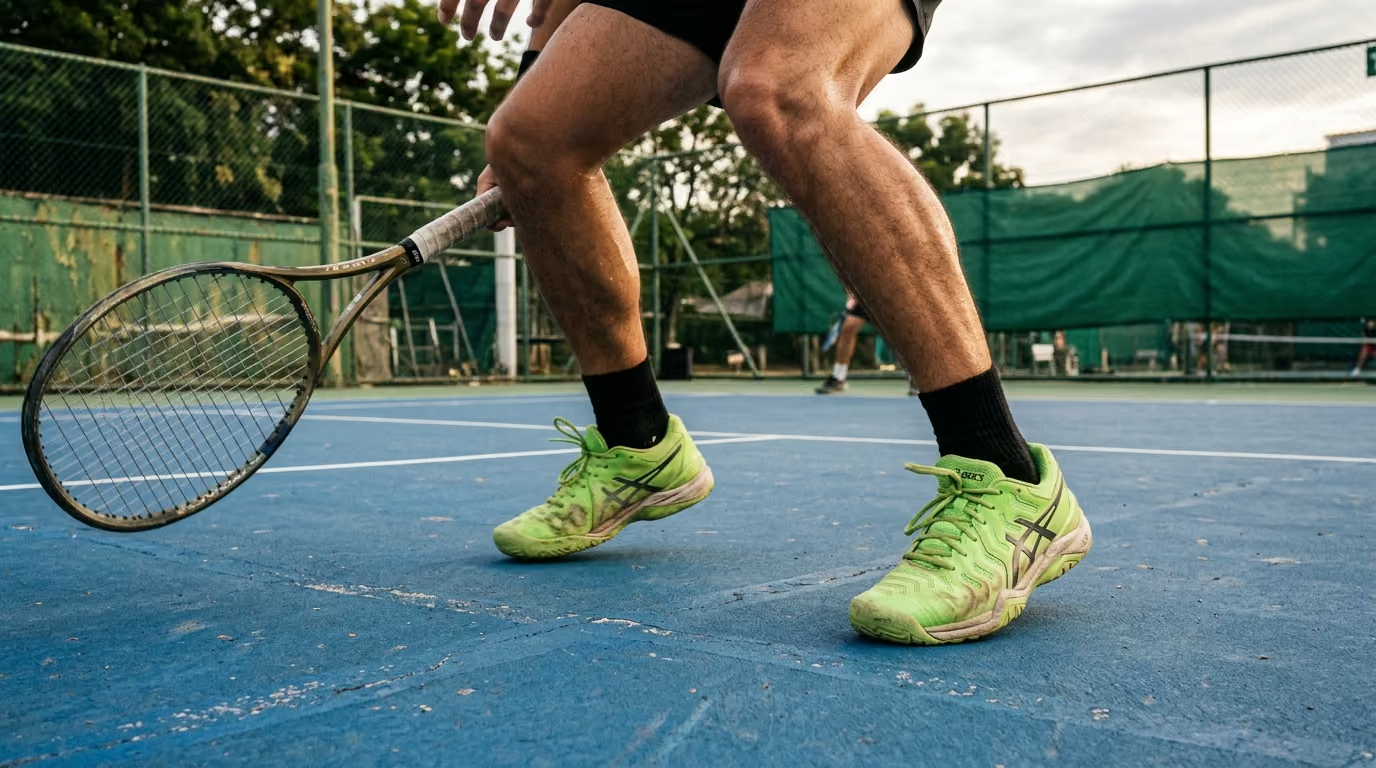
Concurrent training for racquet sports involves strategically combining strength and cardiovascular endurance to optimize performance without overtraining.




How do I build leg power, upper body strength, and court endurance at the same time without burning out? If you have searched for ways to combine weights, cardio, and court practice, you have probably found conflicting advice.
Many players search for ways to build strength, quickness, and stamina at the same time without feeling chronically exhausted on the court. The answer lies in structured scheduling that prioritizes neuromuscular freshness for speed and skill, while placing heavy strength and metabolic work later. By managing the timing, volume, and order of your workouts, you can develop all these qualities concurrently and preserve your long-term performance.
Concurrent training refers to the practice of training strength and cardiovascular endurance within the same overall program. Historically, researchers and coaches believed that these two training styles competed directly. This concept is known as the training interference effect.
The early scientific view was that endurance work shut down the pathways responsible for muscle growth and strength. Specifically, endurance exercise activates an enzyme called AMPK, which supports cellular energy. Conversely, resistance training activates a pathway called mTOR, which drives protein synthesis and muscle growth.
For decades, sports scientists believed that AMPK directly blocked mTOR. This led to the belief that running would wash away your gym gains.
Recent research provides a much more nuanced view of how our bodies adapt. A landmark 2012 meta-analysis by Wilson and colleagues analyzed the physical outcomes of concurrent training across many studies. The researchers reported distinct differences based on training methods.
For instance, the mean effect size for muscle growth was 1.23 for strength training alone, but fell to 0.85 when combined with endurance work. For strength development, the effect size was 1.76 for strength alone, compared to 1.44 for concurrent programs.
Crucially, the meta-analysis revealed that the mode of endurance exercise matters. Combining strength training with running resulted in significant reductions in both muscle growth and strength. However, combining strength training with cycling did not produce these same negative effects.
The difference comes down to the mechanical demands of the exercises. Running involves high levels of eccentric muscle actions, where muscle fibers must absorb impact while lengthening. This eccentric stress causes micro-tears in the muscle tissue.
This tissue damage requires substantial recovery resources. Cycling is a concentric-focused activity with very little impact. It places less mechanical stress on the legs, which preserves recovery capacity for strength and power.
More recent research from 2023 shows that the interference effect is not a universal rule. A systematic review published that year found only small lower body strength interference in male athletes. It found no equivalent interference effect in female athletes.
The review also showed that concurrent training did not impair aerobic improvements in trained court athletes. This means you can build a strong aerobic engine without sacrificing your physical foundation.
However, explosive performance requires careful protection. A 2022 meta-analysis confirmed that while general strength and muscle growth remain largely unaffected, explosive power shows a significant negative response to concurrent training. The standardized mean difference for explosive strength improvement was reduced.
Power depends on rapid nerve signaling, muscle tendon stiffness, and fast-twitch muscle fiber recruitment. These neural qualities are highly sensitive to residual fatigue. If your legs are tired from a long run, you cannot jump or sprint with the intensity needed to trigger power adaptations.
For racquet sports, the message is clear. You do not need to avoid conditioning. Instead, you must manage its volume, intensity, and timing to protect your speed and power on the court.
To manage multiple fitness qualities, you must establish a clear hierarchy. Trying to maximize every physical trait at once leads to mediocre results and chronic fatigue. Instead, organize your training into three distinct tiers based on your current physical needs and match schedule.
This tier contains the qualities that directly dictate your success and safety on the court. For a competitive player, this includes high-velocity power, split-step acceleration, and pain-free serving mechanics.
It also includes specific joint protection, such as wrist and shoulder stability. These qualities require a completely fresh nervous system to develop and maintain.
This tier supports your primary court skills. It includes maximal strength, local muscular endurance, and your aerobic base.
A strong aerobic system helps you recover between long rallies and matches. These qualities are highly resilient. You can train them under moderate fatigue without losing the training effect.
This tier includes general physical fitness, muscle hypertrophy, and experimental training methods. You should only focus on these qualities during the off-season.
Attempting to build substantial muscle mass during a dense competitive league will drain the energy needed for your matches.
To understand how to apply this hierarchy, you must understand the specific physical qualities.
Maximal strength is the greatest amount of force your muscles can produce against a resistance. Relative strength is how strong you are compared to your body weight.
In racquet sports, relative strength is highly valuable. Moving your body weight across the court requires high relative force.
Your strength training should emphasize basic human movements. Focus on squatting, hinging, lunging, pushing, and pulling. According to the American College of Sports Medicine, advanced individuals should train with heavier loads around 80% of their one-repetition maximum to build strength.
However, you should adjust these loads based on your court volume and joint health.
Eccentric strength is your ability to absorb force as your muscles lengthen. When you sprint toward the ball and stop suddenly, your muscles must absorb your entire body weight.
Without adequate eccentric strength, your joints and tendons take the brunt of this impact. This can lead to patellar tendinopathy or Achilles issues over time.
Unilateral strength refers to single-leg and single-arm force production. Racquet sports are played almost entirely on one leg at a time. Lunges, step-ups, and single-leg Romanian deadlifts build the unilateral stability needed for balanced court movement.
Power is the rate at which you produce force. Two players might have the same squat strength, but the more powerful player will move faster because they can apply that force in milliseconds.
Plyometric training involves rapid jumping, hopping, and bounding. This training teaches your tendons to store and release elastic energy.
A systematic review of plyometric training in tennis found that these exercises improve serve velocity, sprint speed, and agility. Dynamic movements like medicine ball rotational throws also build the rotational power needed for powerful groundstrokes.
To gain these benefits, you should use moderate loads of 30% to 70% of your maximum. You must also perform the concentric phase of each repetition as fast as possible.
Your conditioning should target different energy systems. Aerobic conditioning supports your long-term recovery and general health.
Anaerobic conditioning targets high-intensity efforts lasting longer than 15 seconds. Repeated-sprint ability is your capacity to perform short bursts of speed with short rest intervals.
Alactic power represents your absolute top-end speed, which relies on the phosphagen system. You must train this system with brief efforts of under 6 seconds and full recovery.
To combine these qualities without causing excessive fatigue, use the High-Low organization model. This model alternates days of high physical and neural stress with days of low stress.
High days focus on speed, power, heavy lifting, and competitive match play. Low days focus on mobility, active recovery, light technical work, and low-intensity aerobic conditioning.
This structure concentrates stress on specific days. This allows your body to experience deep, uninterrupted recovery on the intervening days.
To see how this works in practice, review these sample weekly schedules. They are structured for different styles of play and availability.
This template is designed for an active player who plays three court sessions per week and wants a balanced approach to fitness.
This structure ensures that you never perform heavy strength work the day before a demanding match.
This schedule is designed for players who compete in two organized league matches each week, typically on Wednesdays and Saturdays.
By keeping Monday as your only heavy lifting day, you prevent muscle soreness from affecting your Wednesday match.
This template is designed for the week of a tournament where play begins on Friday and can continue through Sunday.
During a tournament, your goal is physical readiness. Extra training will not improve your fitness this week, but it will increase your fatigue.
Use this block when you have no competitive matches for 6 to 8 weeks. This is your chance to make physical gains in strength and power.
Because you do not have to save energy for matches, you can tolerate the higher fatigue levels of this developmental block.
When you must train multiple qualities in a single workout, the order of your exercises is critical. Performing exercises in the wrong order reduces the safety and effectiveness of your training. To get the most out of every session, arrange your exercises to protect your nervous system.
Use this systematic sequencing model for your workouts:
This sequence ensures that you perform highly coordinative and high-velocity exercises first. Speed and power training rely on the recruitment of fast-twitch muscle fibers. If you perform heavy squats or a hard run first, you exhaust these fibers.
Trying to jump or sprint after a hard workout is ineffective. It also increases your risk of injury because your coordination is compromised.
The American College of Sports Medicine support this exercise order. They recommend placing large-muscle and multi-joint exercises before small-muscle and single-joint exercises. They also advise placing high-intensity exercises before lower-intensity work.
When you combine strength and conditioning in the same session, sequence matters. A systematic review led by Schumann in 2021 found that performing resistance training before endurance training is superior for building lower-body dynamic strength.
If you run first, the local muscular fatigue in your legs reduces the amount of weight you can lift. It also degrades your lifting mechanics.
By lifting first, you can apply maximum effort to your strength exercises. You can then complete your cardiovascular conditioning at the end, where fatigue will not compromise your safety.
You can also apply this sequencing concept directly on the court. If you plan to practice your serve, do it at the start of your court session.
Serving is a complex, high-velocity movement that requires precise coordination between your legs, core, shoulder, and wrist. If you wait until the end of a two-hour hitting session, your shoulder stabilizers will be fatigued.
This fatigue alters your arm path, which reduces your power and increases the stress on your rotator cuff.
To learn more about structuring these sessions, you can read our detailed strength and conditioning guidelines.
While tennis, pickleball, and padel share many qualities, their physical demands differ. Understanding these differences allows you to customize your concurrent program to your specific sport.
Tennis is played on a large court. This requires players to cover significant distances.
An international best-of-three-set tennis match averages roughly 1.5 hours, according to research on tennis match duration. During this time, players experience an intermittent movement profile.
This profile consists of high-intensity efforts lasting 4 to 10 seconds, interspersed with recovery periods of 10 to 20 seconds. Between games and sets, players have longer rest intervals of 90 to 120 seconds.
Because of the court size, tennis players must run at high speeds. They must also perform long lateral slides and deep lunges on clay or hard courts.
This requires high eccentric leg strength to decelerate your body. Tennis also features a high volume of maximal overhead serves.
This action places tremendous stress on the shoulder joint and the abdominal muscles.
Tennis injuries commonly affect the lower extremity through acute trauma and the upper extremity through chronic overuse. A large clinical review showed that the lower extremity accounts for 31% to 67% of tennis injuries. The upper extremity accounts for 20% to 49%, and the trunk accounts for 3% to 21%.
Ankle sprains and thigh strains are common in the lower limb. Shoulder and elbow tendon pain are highly prevalent in the upper limb.
To train for tennis, prioritize relative strength and eccentric braking power. Your program should include lateral lunges, single-leg hops, and rotational medicine ball work.
You must also focus on shoulder health. Balance your overhead actions with rear deltoid and lower trapezoid exercises to protect the rotator cuff.
Pickleball is played on a much smaller court. This smaller area reduces the need for long sprint distances.
However, it increases the demand for rapid reactions and lateral quickness. The rally pace in pickleball is fast, requiring quick hand-eye coordination at the non-volley zone, also known as the kitchen.
In pickleball, players spend a significant amount of time in a low, loaded squat position at the kitchen line. This stance requires isometric endurance in your quadriceps and glutes.
It also demands excellent ankle mobility to stay low without rounding your lower back. The quick lateral steps place lateral stress on your ankles and knees.
Overuse injuries in pickleball often affect the lower back, knees, and elbow. The repetitive dinking motion can lead to lateral elbow issues if your mechanics are poor.
Your pickleball training should focus on isometric quad strength, ankle stability, and lateral quickness. Exercises like goblet squats with a pause, lateral band walks, and lateral hops are highly valuable.
You do not need to spend hours on long-distance running. Instead, focus on short-duration agility drills and hand-eye reaction training.
For more information on preventing pickleball injuries, read our guide on racquet sport player health.
Padel is played on an enclosed court surrounded by glass and mesh walls. This design keeps the ball in play longer than in tennis or pickleball.
Rallies are often extended, requiring high aerobic endurance to sustain long points. The movement profile in padel involves constant multi-directional changes.
You must move forward, backward, and diagonally to respond to bounces off the walls. Padel is also characterized by a high volume of overhead strokes.
Movements like the bandeja and vibora require precise shoulder control and rotational power. These overheads are played from various body positions, placing demands on your core and thoracic spine.
Common padel injuries include shoulder tendon problems, lower back strains from constant rotation, and calf or Achilles strains.
Your padel training program should emphasize thoracic spine mobility, core rotational strength, and calf durability. Exercises like half-kneeling cable rotations, face pulls, and eccentric calf raises are essential.
Your conditioning should focus on repeated-sprint ability and aerobic capacity. This ensures you can recover during long rallies.
To explore further resources on court movement, browse our athletic longevity materials.
Even with a well-planned program, minor errors can lead to poor results. Recognizing these common pitfalls allows you to adjust your training before fatigue or injury occurs.
Some players believe that any cardiorespiratory exercise will instantly destroy their muscle strength. This belief is incorrect.
As the 2023 research shows, the interference effect is not an absolute barrier. It is a volume-dependent reaction.
Low-to-moderate amounts of cardiorespiratory exercise can actually improve your strength training. Aerobic fitness increases capillary density in your muscles.
This improved blood flow helps deliver nutrients and clear metabolic waste. This allows you to recover faster between sets of heavy lifts.
Do not avoid aerobic work out of fear. Instead, use cycling or swimming to support your recovery without overloading your joints.
Doing a hard run or cycling session right before explosive training is a major mistake. A review of acute concurrent-training interference showed that high-intensity endurance work reduces subsequent power output.
This reduction occurs because of localized muscular fatigue and a temporary drop in central nervous system drive. If your brain cannot signal your muscles to contract rapidly, your power training will be ineffective.
Always place your speed and power sessions first. If you must do both on the same day, separate them by at least 4 to 8 hours.
This recovery window allows your nervous system to recover, ensuring you can train with maximum intensity.
Many players complete a heavy chest and shoulder workout in the gym and then head straight to the court to practice their serves. This is a dangerous practice.
The shoulder joint relies on small stabilizing muscles, including the rotator cuff and scapular retractors, to keep the upper arm bone centered in its socket.
Heavy pressing and pulling exercises exhaust these small stabilizers. When you serve with fatigued stabilizers, your shoulder mechanics alter.
This leads to subacromial impingement, where tendons are pinched between bones. Over time, this can cause rotator cuff tears or labrum damage.
Always keep your heavy upper-body workouts separate from your serving sessions. If you must serve on the same day, do it when you are fresh.
Holding long, static stretches right before playing or lifting is counterproductive. Static stretching for longer than 60 seconds relaxes your muscle spindles.
This relaxation reduces muscle-tendon stiffness. While this temporary increase in range of motion might feel good, it reduces your explosive power.
Your tendons act like springs. If you make a spring too loose, it cannot store and release energy efficiently.
This reduces your vertical jump, sprint speed, and court quickness. Save static stretching for after your workouts or during separate evening sessions.
Before playing, use a dynamic warm-up. This should include arm circles, leg swings, lunges, and light skipping to prepare your muscles.
To manage concurrent training successfully, you must track how your body responds to the total workload. This helps you balance physical stress with recovery.
You should monitor both objective and subjective indicators to adjust your training week.
Every morning, take 60 seconds to assess your physical state. Rate the following markers on a scale of 1 to 5, where 1 is very poor and 5 is excellent:
If your total score drops for three consecutive days, your body is struggling to recover. This is a clear signal to reduce your training volume.
Cut your gym sets in half or replace a hard conditioning session with light mobility work.
Track the physical cost of each training session using the Session Rating of Perceived Exertion (sRPE) method. Multiply the duration of your session in minutes by your rate of perceived exertion on a 1-10 scale.
For example, a 60-minute court session rated at a 7 out of 10 gives a score of 420 arbitrary units. Keep a log of these scores.
An abrupt increase in your weekly total score can signal an increased risk of injury. A 2025 systematic review of high-performance tennis players identified rapid increases in workload as an important predictor of injury.
The review noted that junior players who increased their workload too quickly had higher injury rates. While these workload calculations have limitations, they show the importance of avoiding sudden spikes in your training.
If you decide to increase your court time, reduce your gym volume to keep your total weekly stress manageable.
Monitor your performance during your workouts. If your running speed, jump height, or lifting weights begin to decline, you are likely experiencing systemic fatigue.
Another early sign of overreaching is a drop in technical accuracy on the court. When you are tired, your footwork slows, causing you to strike the ball from poor positions.
If you notice your performance slipping, reduce your low-priority training. Cut out extra cardio sessions first.
Keep your strength training intense but low in volume. This helps preserve your fitness while giving your body the rest it needs.
For practical advice on managing fatigue, explore our sports recovery science resources.
While mild muscle soreness is a normal part of training, you must learn to distinguish between healthy adaptation and injury. Pushing through joint pain or structural damage will only lead to long-term setbacks.
If you experience any of the following warning signs, stop training and consult a qualified healthcare professional, such as a physical therapist or sports medicine physician:
Working with a healthcare provider early can prevent minor tendon issues from becoming chronic injuries. A professional can assess your movement, identify strength imbalances, and design a safe path back to play.
Taking care of your body is the most important step you can take to support your long-term health on the court.
To apply this concurrent training approach this week, use this step-by-step checklist:
Follow Evercourts for practical insights on tennis, pickleball and padel performance, movement, recovery and healthy ageing. Stay connected for new articles, research-led guidance and ideas to help you play well and keep playing for years.


Read practical guidance for better movement, smarter preparation and a game that keeps working for you.
explore the Blog