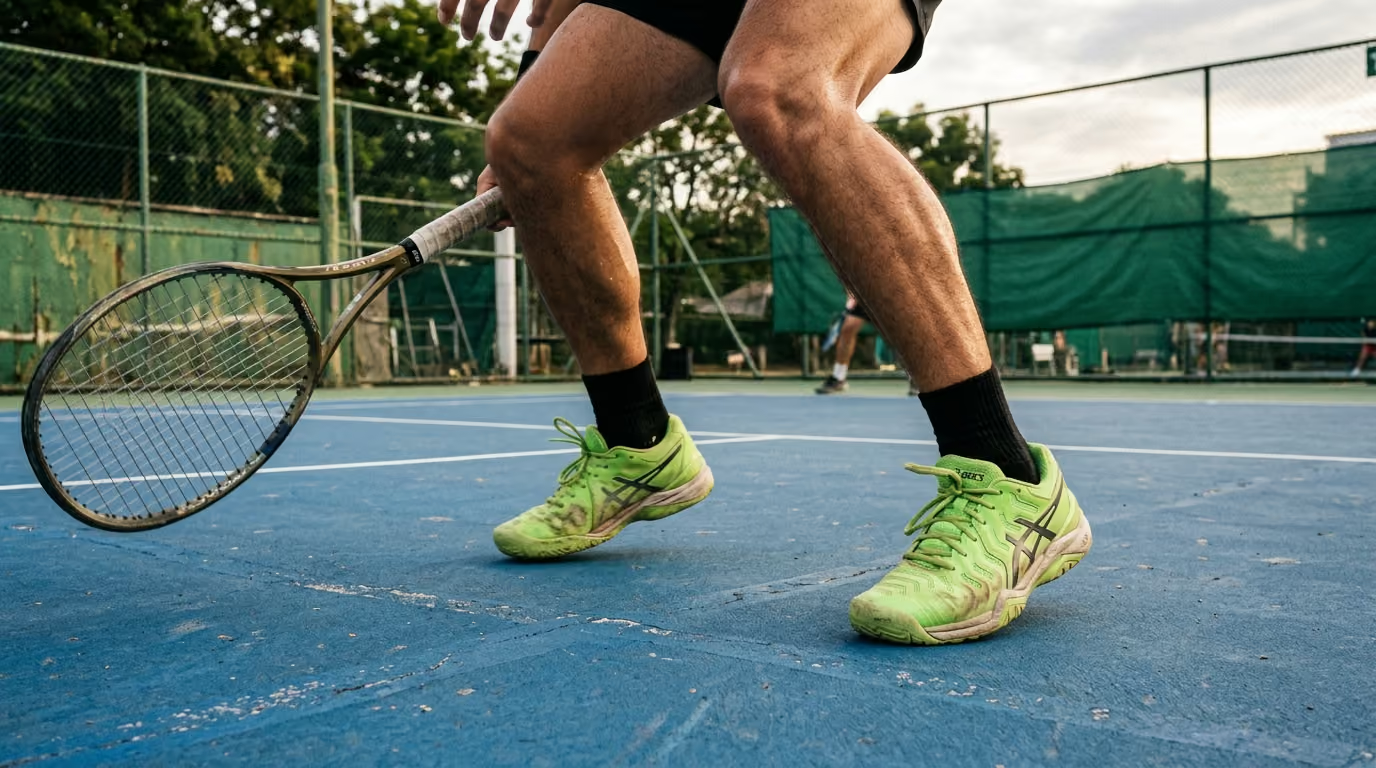

Over 88 percent of men's second serves in professional matches bounce above 1.22 meters, highlighting the critical role of contact height in racquet sports.




Contact height is the exact vertical point where your racket face meets the ball. It is not a fixed measurement, but rather a dynamic interaction shaped by your movement, court position, and swing technique. Understanding how to manage this point is essential for maintaining control and protecting your joints on the court.
Contact height is the vertical location of the ball relative to your body at the instant of impact. Striking the ball at the correct height ensures optimal power, control, and joint safety. Managing this variable requires a coordinated combination of footwork, body lowering, and swing adjustments.
Many players mistake bounce height for contact height. They believe that if a ball bounces high, they must hit it high. In reality, contact height is a variable you can control. By adjusting your movement, you can choose where to strike the ball.
There is a major difference between the vertical flight of the ball and where you make contact. Ball height is simply how high the ball is above the court surface. Contact height is the vertical point where your strings or paddle make impact. Contact location refers to whether the ball is hit in front of, beside, or behind your body. Contact timing describes whether you strike on the rise, at the peak, or on the descent.
To understand these differences, we use a three-zone framework:
These zones are not rigid rules. They change depending on your grip, court surface, and physical capabilities. If you want to move fluidly between these zones, it helps to incorporate focused mobility and movement training into your weekly routine.
Sports science provides clear data on how contact height affects your body and your shots. Biomechanical research shows that your contact height directly influences the forces acting on your joints. When you hit outside your ideal strike zone, your muscles must work harder to stabilize your body.
A study on tennis shoulder forces found that estimated maximal glenohumeral contact force during the forward swing reached 3,573 Newtons. This forward swing force averaged 1.25 times the follow-through force. It was also 5.8 times greater than the backswing force. This high load explains why hitting outside your optimal height zone can strain your shoulder.
Grip style also dictates your natural contact height. Research on tennis players shows that those with an Eastern grip prefer a lower contact. On hard courts, Eastern-grip players typically make contact four centimeters below hip height. Conversely, players with semi-Western or Western grips make contact at least six centimeters above hip height.
Spin and speed also dictate how high a ball will bounce. Research shows that heavy topspin and kick serves bounce significantly higher than flat shots. In professional matches, more than 88 percent of men's second serves bounced above 1.22 meters at a point three feet inside the baseline. In contrast, more than 80 percent of first serves stayed below that same height.
Timing studies also reveal how elite players manage contact. During Wimbledon qualifying practice, researchers noted that players predominantly made contact near the top of the bounce. This choice allowed them to strike the ball at a neutral, comfortable height. They used the vertical velocity of the ball after the bounce to time their forward swing.
To handle different ball heights, you must coordinate five distinct decisions on every shot. We call this the Height-Stance-Swing-Spin-Intent framework. It provides a repeatable mental checklist for practice and matches.
First, you must read the incoming ball to predict its height. Once you identify the zone, you must select the appropriate stance. A linear stance works well for low balls because it lets you get behind the ball. A semi-open stance is better for high balls because it allows you to rotate your torso while keeping the ball to your side.
Your swing shape must adjust to the contact height. We use the Path, Angle, and Speed model to describe this relationship. A low contact requires a steep, low-to-high path to lift the ball over the net. A neutral contact allows a flatter path for maximum drive. Spin is not just a wrist flick, but is a product of this overall racket path.
Your physical situation determines your tactical options. When hitting from a neutral contact height, you can attack, defend, or rally. From a low defensive position, your intent may shift to resetting the point. Matching your contact height to a realistic tactical goal prevents unforced errors.
A low ball is any contact that occurs at knee height or below. These shots are common when facing slice, low-bouncing court surfaces, or short balls. Successfully hitting a low ball requires excellent leg strength and precise spacing.
Spacing is the most critical element of low-ball mechanics. If you crowd the ball, your racket cannot travel freely from low to high. You must stay slightly farther away from the ball and get behind it. This position gives your arm room to swing without hitting your own body.
I remember finishing a tough two hour padel match on a cold Tuesday night and waking up the next morning feeling like my lower back was locked in concrete. For a long time, I just accepted this as the price of playing hard in my forties. But once I started spending just ten minutes on targeted hip mobility before heading to the club, the stiffness almost completely vanished. It taught me that we do not have to accept pain as a default state of aging.
To lower your contact point safely, you must bend from your hips and knees. Bending solely from the waist puts immense pressure on your lower back. Keeping your torso relatively upright allows your hips to rotate. This rotational force is what drives the ball forward, reducing the demand on your shoulder.
Your swing path must adapt to lift the ball safely over the net. To raise the ball's trajectory, you can open your racket face slightly. You should also increase the steepness of your low-to-high swing. This lift must come from your legs and body rotation rather than scooping with your wrist.
Other court sports offer helpful lessons for low contact. In squash, players routinely hit balls near their ankles. They use a highly structured, low stance to maintain balance. In racquetball, coaches instruct players to hit level through low balls rather than chopping downward.
The neutral strike zone is located between your hips and chest. This is the most forgiving area to hit a ball. In this zone, your body can produce maximum force with minimal effort. You do not need extreme leg flexion or overhead reaching to make solid contact.
When hitting in the neutral zone, your torso can rotate freely. Your feet can plant firmly on the ground to create a stable base. This stability allows you to contact the ball well in front of your body. Hitting in front is crucial for force production and directional control.
A biomechanical review of the forehand swing reveals how different joints contribute to racket speed. The shoulder contributes 15 percent of the velocity. Horizontal flexion of the upper arm adds 25 percent. Internal rotation of the shoulder contributes a massive 40 percent.
This data shows that internal rotation is your primary power source. To use this rotation safely, you must hit the ball in front of your body. A neutral contact height makes this forward contact point easy to find. It allows you to use your natural biomechanics without straining small muscles.
You should always try to move yourself into this neutral zone. If a ball is bouncing high, you can step back to let it drop. If a ball is landing short, you can run forward to catch it before it falls too low. Making the neutral zone your target will improve your consistency.
High balls present a unique physical and tactical challenge. A high contact is anything at shoulder height or above. These balls are often produced by heavy topspin or deep lobs. Handling them requires altered spacing and a more compact swing.
To hit a shoulder-high ball, you must adjust your position. You should move closer to the line of the ball and stand almost beside it. This lateral positioning is easiest to manage from a semi-open stance. It prevents you from having to reach backward, which can injure your shoulder.
The swing path for a high ball must be more level than a low-ball swing. Because the ball is already high, you do not need to lift it. Instead, you want to drive through the ball with a flatter racket path. Your racket face should remain vertical at impact to control the launch angle.
You must also shorten your backswing on high balls. A long, looping backswing takes too much time and is hard to control at shoulder height. A compact preparation allows you to time the ball better. It also helps you maintain a stable trunk during rotation.
If a high ball is too deep or fast, attacking it may be too risky. In these situations, the best tactical choice is to move backward. Allowing the ball to drop into your neutral zone is often safer. Protecting your long-term player health means knowing when to defend rather than forcing an awkward shot.
While the physics of contact height are similar, each racquet sport has its own unique demands. The court size, ball weight, and implement length change how you should approach each zone.
Tennis features the widest variation in contact height. High-bouncing topspin and low-skidding slices require constant physical adjustments. The long racket length increases the leverage on your joints. This makes proper spacing and contact location critical for avoiding tennis elbow and shoulder strain.
Pickleball is dominated by low contact heights, especially near the non-volley zone. Because the plastic ball does not bounce high, players spend a lot of time bent forward. The short paddle offers less reach than a tennis racket. To play well, you must master the art of lowering your entire body to keep the paddle below the ball.
Padel is characterized by low balls off the glass and high overheads. When the ball rebounds off the back wall, it often drops very low. Padel players must use extreme knee flexion to get under these balls. Conversely, the frequent use of the lob means you will hit many overheads. This requires a balanced transition from low defensive positions to high, controlled overhead strikes.
For all three sports, physical preparation is key. Engaging in structured strength and conditioning will help your body handle these sport-specific demands. Bending low in pickleball or hitting overheads in padel requires strong legs and a stable core.
To improve your control at different heights, you must train your body to adapt. You cannot rely on the same swing for every ball. This six-stage training progression will help you develop feel and consistency.
Start with simple self-feeds. Drop the ball and hit it at ankle, knee, hip, and shoulder height. Focus on how your body must adjust to each drop. Your goal is to identify the contact zone before you begin your forward swing.
Have a partner feed balls at alternating heights. Practice using a linear stance for low balls and a semi-open stance for high balls. Focus on changing your physical structure rather than just changing your arm path. This drill trains your feet to support your contact point.
Use the Path, Angle, and Speed model to hit three different trajectories from each height. From a low feed, practice hitting a high safety ball, a neutral rally ball, and an aggressive dip. Repeat this from neutral and high feeds to learn how racket face control changes at each height.
In this drill, your partner feeds balls randomly. You will receive short-low, deep-high, and neutral balls. You must decide whether to move forward, stand your ground, or retreat. This training improves your court positioning and timing.
Play practice points with strict rules. For example, you may only attack shoulder-high balls. You must neutralize all knee-height balls by hitting them deep and crosscourt. This teaches you to match your tactical intent to the physical reality of the ball.
Record a few games of your matches. Watch where you make contact relative to your body. Look for common errors, such as crowding low balls or reaching for high ones. Video feedback is a powerful tool for correcting hidden technique issues.
To ensure your training is safe, make sure to follow proactive injury prevention practices. Moving quickly to adjust your contact height requires stable joints and proper mechanics.
Recreational players often struggle with contact height because of bad habits. Recognizing these common errors is the first step toward correcting them.
This rigidity is a common mistake. Players will stand still and wait for the ball, even if it bounces to an awkward height. You must use your feet to bring the ball into your preferred zone. Do not be afraid to step back or move forward to secure a better contact point.
When faced with a low ball, many players keep their legs straight and flick their wrists. This scooping action produces a weak, slow ball. It also puts excessive strain on your wrist and elbow. You must bend your knees to lower your entire body, using your legs to lift the shot.
Just because a ball is high does not mean it is easy to attack. A deep, heavy topspin ball is very difficult to drive downward. Trying to attack this ball often results in hitting long or into the net. Instead, choose a defensive slice or retreat to regain control of the point.
On high balls, players often reach upward with a completely straight arm. This disconnects the arm from the torso. It forces the small shoulder muscles to handle all the impact forces. To protect your shoulder, keep your swing compact and stay beside the ball.
How you handle contact height has a massive impact on your recovery time. Striking the ball outside your optimal zone forces your body to compensate. Over a long match, these compensations lead to fatigue and muscle soreness.
Low contact points require significant eccentric strength in your quadriceps and glutes. Bending your knees to get under the ball acts as a natural shock absorber. If you do not have this leg strength, you will bend from your waist. This transfers the stress of the impact directly to your lower back.
High contact points place extreme demands on your rotator cuff. When you hit a ball above shoulder height, your shoulder joint is in an inherently unstable position. If your technique is poor, the impact forces can cause micro-tears in the tendon. This leads to chronic inflammation and rotator cuff tendonitis.
Managing your contact heights properly will preserve your energy. It ensures that large muscle groups, like your legs and hips, handle the heavy lifting. This protects your smaller joint structures, helping you maintain your athletic longevity.
While adjusting your technique can prevent many issues, some pain requires expert care. If you experience persistent joint pain after playing, you should consult a qualified healthcare provider.
You should seek professional medical advice if you experience any of the following warning signs:
A physical therapist can assess your movement patterns and identify strength deficits. They can design a customized program to improve your mobility and strength. This professional guidance will help you return to the court safely and keep playing for years to come.
Wind can cause the ball to drop faster or float longer than expected. To handle wind, you must use smaller adjustment steps. Prepare your racket early and do not commit to your stance too soon. Be ready to adjust your contact height at the last split second.
Changing your grip is a major technical adjustment that takes time. If you use an Eastern grip and struggle with high balls, focus on your footwork first. Try to take the ball early on the rise, or step back to let it drop. If you still struggle, consult a coach about a subtle grip adjustment.
A low backhand requires the same leg flexion as a forehand. You must lower your hips and keep your torso stable. For a two-handed backhand, ensure your dominant hand does not take over. For a one-handed backhand, use a compact slice to clear the net safely.
You are likely hitting low volleys with a vertical racket face. When the ball is below net height, your racket face must open to create lift. Focus on getting your racket hand lower than the ball. Use a short, compact punch with an open face to lift the volley over.
Follow Evercourts for practical insights on tennis, pickleball and padel performance, movement, recovery and healthy ageing. Stay connected for new articles, research-led guidance and ideas to help you play well and keep playing for years.


Read practical guidance for better movement, smarter preparation and a game that keeps working for you.
explore the Blog