
Core training for racquet sports involves five pillars of physical qualities, emphasizing stability, rotation, and power to improve performance and prevent injuries.




Imagine chasing a deep ball into the corner of the court. You stretch your racket arm, plant your outer foot, and swing hard. Instead of a smooth, balanced return, you feel a sharp pinch in your lower back and wobble out of balance.
Effective core training for racquet sports builds the trunk's ability to stabilize the spine and transfer force from the lower body to the arm. It teaches the muscles surrounding your spine to resist unwanted movement while permitting controlled rotation during your strokes. This approach protects your back while improving the power and accuracy of your shots.
Moving from static floor exercises to integrated, multi-planar movements is key to long-term court performance. Let us examine the mechanics of how the trunk functions during dynamic play.
Many players associate core training with abdominal crunches or long planks. However, static floor exercises do not fully prepare the body for the dynamic demands of racquet sports. In a sport like tennis, padel, or pickleball, the trunk acts as a vital bridge between the ground and the racquet.
According to pioneering research by Dr. Ben Kibler, core stability is the ability to control the position and motion of the trunk over the pelvis. This control allows force and motion to transfer effectively to the terminal segment of the body, which is the racquet hand. When you hit a groundstroke, your legs push against the court surface to create energy. This energy, known as ground reaction force, travels upward through your knees, hips, and pelvis.
The trunk muscles must stiffen at the exact moment of ball contact to transfer this force to the shoulder, arm, and ball. If the trunk is weak or lacks coordination, this energy escapes. Sports scientists call this an energy leak. To compensate for this lost energy, players often use excessive shoulder and arm effort, which increases the risk of rotator cuff issues or tennis elbow.
Biomechanical studies of the tennis serve demonstrate that pelvis and trunk rotation timing directly influences ball velocity. When your torso and pelvis rotate in a coordinated sequence, you generate high racquet-head speed with less stress on your shoulder joints. Conversely, a weak or poorly coordinated trunk forces the upper body to work twice as hard.
The trunk must also absorb and decelerate forces. When you finish a hard forehand, your muscles must work eccentrically to slow down the rotation of your torso. Without this braking system, the joints of your spine and shoulders would absorb the impact. This repetitive stress is a primary driver of back issues in court athletes.
Research shows that lower-limb injuries represent 48 to 56 percent of tennis injuries. Lumbar spine problems account for 12 to 39 percent of documented issues. This statistics emphasize why we must train the trunk as a whole-body kinetic system. To build a resilient trunk, you must integrate it into your general strength and conditioning programs.
To build a comprehensive training plan, we must look beyond basic core strength. A balanced program should target five distinct but overlapping physical qualities.
The first pillar is position. Before adding speed or heavy resistance, you must learn to control your pelvis and rib cage. Many players stand with an arched lower back and flared ribs, which places the trunk muscles at a mechanical disadvantage. Learning to maintain a neutral alignment during simple movements is the foundation of all advanced training.
The second pillar is stability. Stability is your ability to resist unwanted movement when an external force acts upon you. This quality is crucial when you run, stop, or change direction on the court. To train stability, you must perform exercises where your trunk remains completely still while your arms or legs move.
The third pillar is mobility. True core stability requires adequate joint mobility in the areas directly above and below the lumbar spine. If your hips and thoracic spine are stiff, your body will force your lower back to twist and bend beyond its safe limits. Combining targeted mobility work with stability exercises protects the lower back from excessive wear.
The fourth pillar is rotation. Racquet sports are inherently rotational. You must train your trunk to produce rotation, transfer rotation, and decelerate rotation. This training should progress from slow, controlled movements under load to rapid, expressive patterns.
The fifth pillar is power. Power is the ability to project force quickly. A player can have exceptional trunk endurance but still lack the explosive power needed for a hard overhead smash. Power training involves exercises like medicine ball throws and explosive cable chops, which teach your muscles to contract with maximum speed.
The primary role of the trunk during athletic movement is to resist unwanted motion. We train this capacity using anti-movement exercises. These movements fall into four categories based on the direction of the force you are resisting.
Anti-extension exercises train you to resist excessive arching of the lower back. This movement pattern is vital for court athletes during overhead smashes and serves. When you reach up for a high ball, your lower back naturally wants to arch, which can compress the spinal joints.
The dead bug is an excellent entry-level anti-extension exercise. To perform it, lie flat on your back with your arms pointing toward the ceiling. Bend your knees to 90 degrees and lift your feet off the floor. Slowly lower your right arm overhead while extending your left leg toward the floor. Keep your lower back pressed firmly against the ground throughout the movement. Return to the starting position and repeat on the opposite side.
For a more advanced challenge, try the stability-ball rollout. Kneel on the floor with your hands resting on top of a stability ball. Keep your hips extended so your body forms a straight line from your knees to your shoulders. Slowly roll the ball away from you by extending your arms. Contract your abdominals to prevent your lower back from sagging. Pull the ball back to the starting position using your core muscles.
Anti-rotation exercises train your body to resist twisting forces. This ability is essential when you hit a shot on the run and must maintain your balance against the pull of your racket.
The Pallof press is the standard exercise for anti-rotation training. Stand sideways to a cable machine or resistance band anchor point. Hold the handle with both hands at the center of your chest. Step away from the anchor to create tension on the band. Press the handle straight out in front of your chest. Hold this position for two seconds while resisting the urge to twist toward the anchor. Slowly return your hands to your chest and repeat.
You can progress this exercise by changing your stance. Performing the press in a split stance or a single-leg stance mimics the unstable positions you experience on the court.
Anti-lateral flexion exercises train you to resist bending sideways. This strength keeps your spine aligned when you reach low for a volley or slide sideways across the court.
The suitcase carry is a highly practical anti-lateral flexion movement. Hold a heavy kettlebell or dumbbell in one hand, keeping your arm straight at your side. Stand tall, pull your shoulders back, and look straight ahead. Walk slowly in a straight line for thirty meters. Keep your torso completely upright, resisting the pull of the weight to tip you sideways. Switch hands and repeat the walk.
The Copenhagen plank is another excellent variation. It targets the lateral trunk muscles and the adductors of the inner thigh. Lie on your side and place your top foot on a bench or chair. Lift your hips until your body forms a straight line. Hold this position while keeping your bottom leg off the ground.
Anti-flexion exercises train you to resist forward collapse. These movements are essential for picking up low-sitting balls in pickleball and padel, where you must bend deeply at the hips.
The front-loaded kettlebell squat is a great option. Hold two kettlebells at your chest in the front-rack position. Keep your chest upright and squat down deeply. The front placement of the weight forces your back extensors to work hard to keep you from falling forward. This movement builds the muscular endurance needed to stay low during long rallies.
Using these exercises regularly is a key component of injury prevention for court players. They build the structural tolerance required to handle sudden forces.
Once you have established solid anti-movement strength, you can begin training rotational power. This phase of training translates directly to your racquet head speed.
Rotational power training teaches your pelvis to rotate ahead of your upper body. This separation stretches the muscles of the trunk, creating elastic energy. This stretch-shortening cycle works like a rubber band. When you release this tension, your upper body snaps forward with immense velocity.
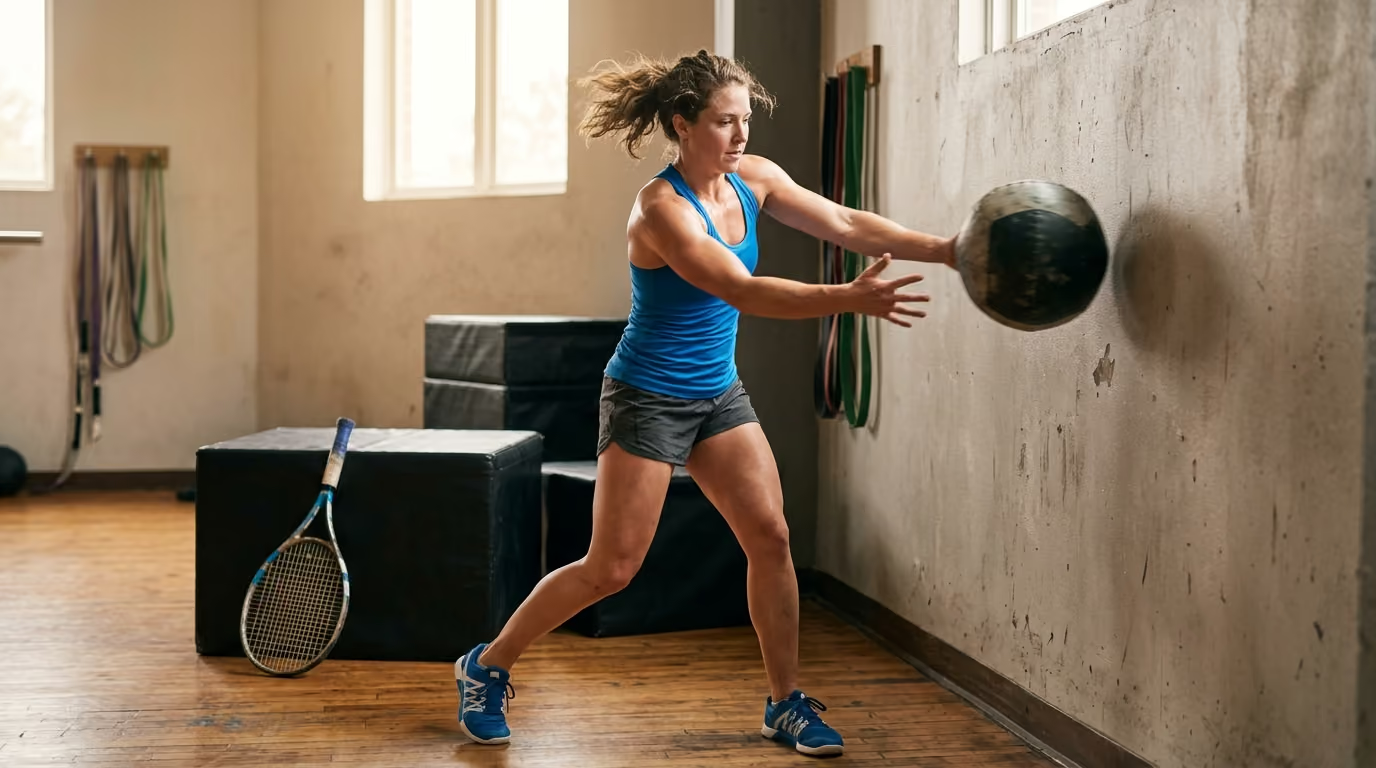
Medicine ball throws are the most effective tool for training this quality. The rotational scoop toss is a foundational power movement. Stand sideways to a solid wall, holding a light medicine ball at your hip. Step toward the wall with your front foot and throw the ball underhand against the wall. Focus on driving the movement from your back hip, using your core to transfer that energy to your arms. Catch the ball on the rebound and repeat immediately.
To make this movement more specific to racquet sports, perform the throw from an open stance. Stand facing the wall with a wide stance. Rotate your hips and torso away from the wall to load your back leg. Pivot and throw the ball forcefully, focusing on rapid pelvic rotation.
You must also train the body to slow down. Deceleration capacity is often the missing link in athletic training. If your nervous system senses that you cannot safely stop a high-speed movement, it will prevent you from generating maximum speed in the first place.
You can train deceleration using a partner-assisted reactive press. Stand in an athletic stance while holding a cable handle at your chest. Have a partner pull the cable randomly, forcing you to react and stabilize your body instantly. You can also practice high-speed rotational throws where you focus on catching the ball and stopping its momentum as fast as possible. This teaching helps your muscles absorb forces efficiently.
Your training should match your current physical preparation and court experience. Jumping into advanced plyometric throws without a foundation can lead to setbacks.
The goal for beginners is to build basic muscular endurance and learn proper movement patterns. In this phase, we use stable positions, low external weights, and short lever lengths.
A sample beginner core routine might look like this:
Beginners should perform these movements slowly. Focus on maintaining a normal breathing pattern rather than holding your breath to create stability.
Intermediate players should progress to standing movements that integrate the upper and lower body. We introduce asymmetrical loading and unilateral patterns to mimic court conditions.
A sample intermediate routine might look like this:
At this level, focus on maintaining alignment as you transition from one movement to the next.
Advanced training prepares the athlete for the chaotic demands of competition. We use high-velocity movements, reactive drills, and exercises that challenge the core under fatigue.
A sample advanced routine might look like this:
Using a systematic progression keeps your training safe and productive. This structured approach supports healthy aging and athletic longevity for competitive players.
While all racquet sports share some movement patterns, each sport places unique demands on the trunk. Tailoring your training to your specific sport can improve your performance.
Tennis requires explosive actions over a large court surface. Players must slide, sprint, and change direction constantly. The tennis serve is one of the most demanding movements in all of sports.
During a serve, the spine undergoes high-velocity extension, lateral flexion, and axial rotation. This combination of forces requires exceptional anti-extension strength and thoracic mobility. If a tennis player lacks upper back mobility, their body will force the lower back to arch excessively. To prepare for this demand, tennis players should prioritize overhead core stability, single-leg landing balance, and rotational deceleration.
The forehand and backhand also require significant rotational capacity. The two-handed backhand relies heavily on torso rotation, while the one-handed backhand demands lateral stability and shoulder control. Understanding these mechanics helps you choose the right exercises for your game.
Pickleball is played on a smaller court, but it requires rapid reaction times and constant bending. The kitchen line is the focal point of most rallies, requiring players to stay in a low squat for long periods.
This low position demands high isometric endurance of the back extensors to prevent forward trunk collapse. Pickleball players need exceptional anti-flexion and lateral stability to reach low for ball placements without losing their balance. Because the paddle and ball are light, pickleball does not require the same raw power as tennis. Instead, it demands rapid, repetitive adjustments and excellent balance.
Exercises like the front-loaded squat and short-range lateral shuffles with a band are ideal for pickleball. These movements build the specific endurance needed to play multiple matches in a day.
Padel combines elements of tennis and squash. The presence of glass walls requires players to rotate quickly to chase balls that bounce off the back of the court.
Overhead shots, such as the bandeja and the vibora, are central to padel strategy. These shots require players to strike the ball while moving backward or sideways. This movement pattern demands high-level lateral stability and rotational control. Padel players must also cope with sudden changes of direction as they respond to unpredictable ball bounces.
To prepare for padel, focus on exercises like the lateral bound to stick and the landmine rotation. These movements build the multi-directional stability needed to navigate the court confidently. For more detailed training strategies, you can explore the player health section.
Even well-intentioned players often make mistakes when training their core. Avoiding these common pitfalls can save you time and prevent unnecessary injuries.
The first mistake is chasing excessively long planks. Many players believe that holding a front plank for five minutes is a sign of a strong core. In reality, static holds of that duration offer diminishing returns for court athletes. Racquet sports require brief, intense bursts of stiffness followed by rapid relaxation. A better approach is to make the plank harder by adding limb movement or external resistance, rather than simply extending the duration.
The second mistake is treating all rotation as dangerous. Some fitness philosophies suggest that the spine should never twist. While uncontrolled twisting under heavy load can be risky, avoiding rotation entirely makes you stiff and fragile. Your body must be prepared to rotate, because rotation is a fundamental part of every racquet stroke. The key is to teach your hips to drive the rotation while your core muscles control the movement of your spine.
The third mistake is training only your dominant side. Because racquet sports are asymmetric, players naturally develop strength imbalances between their left and right sides. If you only perform rotational throws in your dominant direction, you will reinforce these imbalances. Training both sides symmetrically builds a balanced structural foundation. It also improves your non-dominant backhand and your ability to decelerate when moving in either direction.
Finally, some players use core training to compensate for a poor match schedule. If you double your playing hours without building up your tolerance, no amount of core exercises will protect you. Abrupt increases in playing volume are strong predictors of injury. Your training must be coordinated with your match schedule and recovery times.
Core fatigue is a hidden driver of technical breakdown during a match. As you get tired late in a set, your trunk muscles lose their ability to support your spine.
When these muscles fatigue, your body compensates by changing your stroke mechanics. You might begin to swing with your arm alone, or you may arch your lower back to reach high balls. These subtle changes increase the mechanical stress on your shoulder, elbow, and lumbar joints. Building core endurance delays the onset of this fatigue, allowing you to maintain your technique throughout a long match.
Fatigue also impairs your balance and reaction times. A tired core slows down your split-step and makes it harder to change direction quickly. This delay can prevent you from getting into a balanced position to hit your shots.
To manage this risk, monitor your weekly playing volume closely. If you plan to play a long tournament, reduce the intensity of your gym workouts in the preceding days. This tapering allows your muscles to recover fully, ensuring you have maximum stability on the court.
You should also prioritize sleep and nutrition. These foundational recovery habits are essential for tissue repair and joint health. No exercise program can overcome the effects of chronic sleep deprivation or poor nutrition.
While a structured core training program can improve your performance, it is not a cure for existing medical conditions. You must recognize when a problem requires professional attention.
If you experience sharp, radiating pain down your legs, this is a warning sign. This symptom, often called sciatica, can indicate nerve compression in your lower back. You should also watch out for numbness, tingling, or weakness in your legs or feet. These neurological signs require immediate evaluation by a doctor or physical therapist.
Persistent back discomfort that does not improve with rest also warrants a professional assessment. A qualified healthcare provider can identify the root cause of your pain and design a safe rehab plan. Do not try to exercise through severe or worsening pain.
A physical therapist can also perform a biomechanical analysis of your movement. They can identify specific mobility restrictions or muscle weaknesses that may be holding you back on the court. Working with a professional ensures your training is safe and targeted.
A balanced weekly schedule ensures you train all aspects of trunk function without overtraining.
This option is ideal for players who have dedicated gym time. It separates stability work from explosive power work to maximize energy levels.
If you have a busy schedule, you can perform short core sessions directly before or after your court practice. This keeps your training frequent and manageable.
Choose the option that best fits your lifestyle and commit to consistency over intensity.
Revisit this resource when you are preparing for a new competitive season, recovering from a seasonal break, or looking to adjust your current routine. Reviewing these principles regularly will help you stay focused on movement quality rather than simple repetition.
Building a stable, powerful trunk is a continuous process that ensures you can play the game you love for many years to come.
Follow Evercourts for practical insights on tennis, pickleball and padel performance, movement, recovery and healthy ageing. Stay connected for new articles, research-led guidance and ideas to help you play well and keep playing for years.


Read practical guidance for better movement, smarter preparation and a game that keeps working for you.
explore the Blog