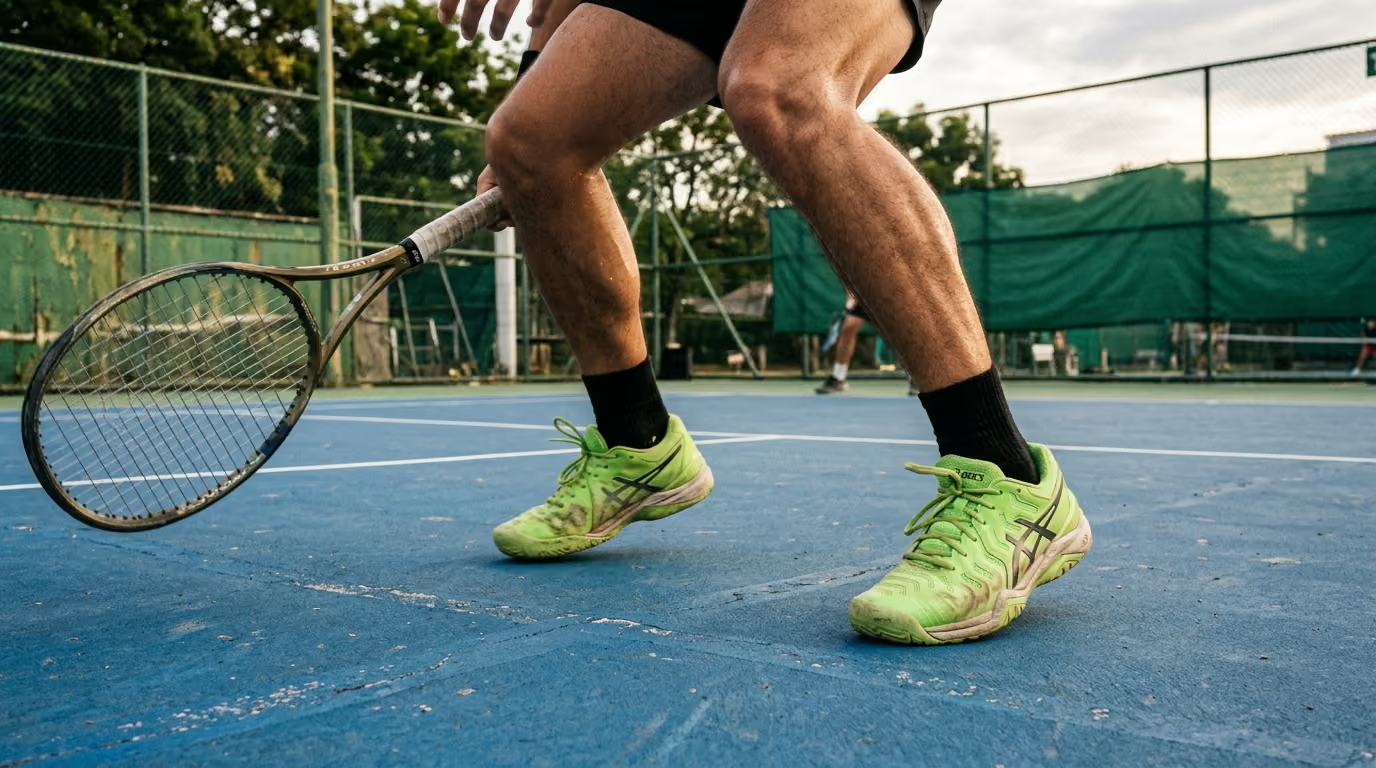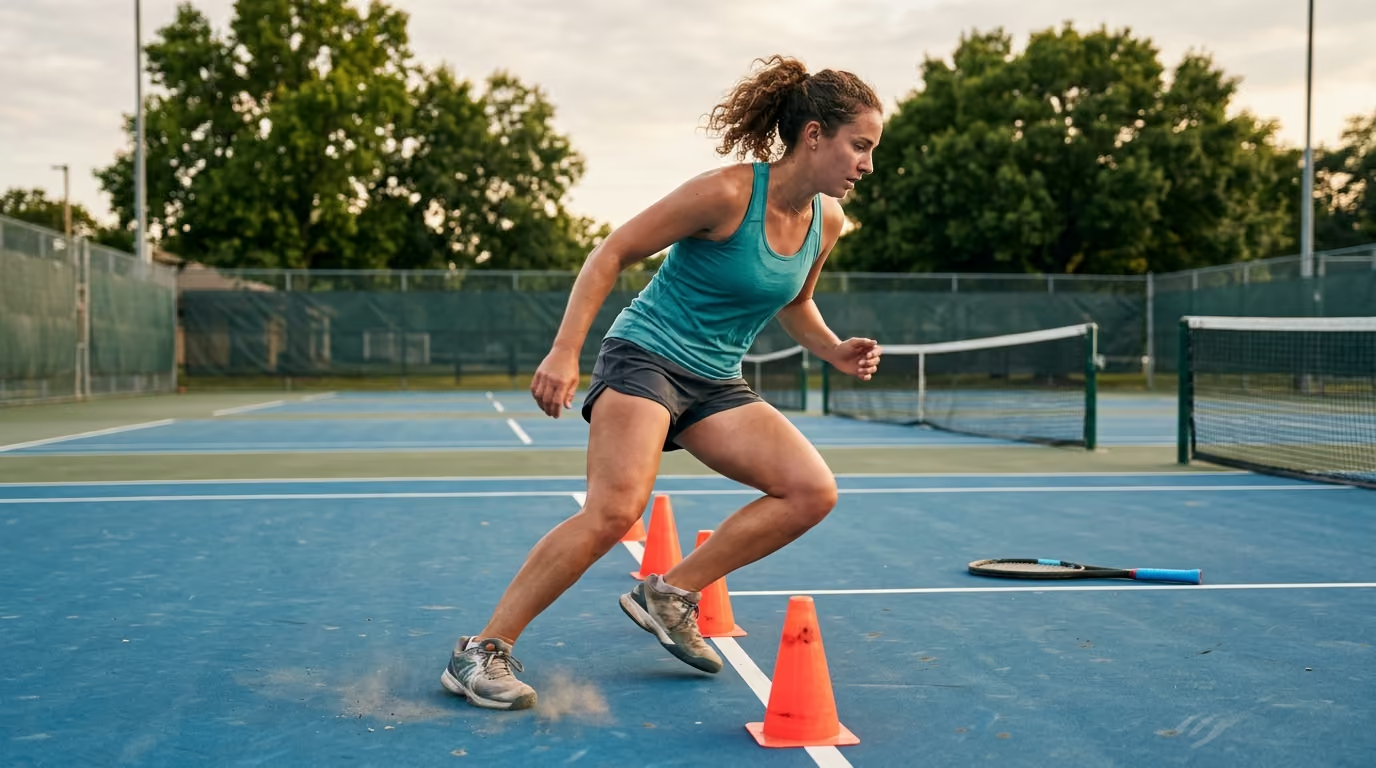

Court-based conditioning involves structured training within racquet court lines to build sport-specific endurance, refine footwork, and promote athletic longevity.




Court-based conditioning is the structured training of athletic movement within the lines of a racquet court. It is not continuous, long-distance jogging or generic treadmill running. Instead, it is the targeted practice of short accelerations, rapid deceleration, lateral shuffling, and repeated high-intensity efforts. This guide provides a detailed manual for using short, focused court sessions to build sport-specific endurance, refine footwork, and promote long-term athletic longevity on the court.
Many players believe that the only way to get in shape for their sport is to play more matches. While match play is valuable, it often combines extreme fatigue with random physical demands. This can lead to poor movement mechanics and an increased risk of injury.
By contrast, structured court drills isolate specific movement patterns. This allows you to build physical capacity without the chaotic stress of competitive play.
In this resource, we cover the exact science of court movement, sport-specific demands, and a library of practical drills. We also outline how to program these sessions without overworking your joints.
Court-based conditioning is a systematic method of training the physical qualities of racquet sports on the court itself. It improves acceleration, braking, and directional changes while keeping physical quality high. This approach helps players maintain performance and protect their joints during competitive matches.
Unlike general fitness training, court conditioning targets the precise distances and movement directions you use during play. It bridges the gap between general strength training and the chaotic demands of a live match.
To design effective conditioning, we must understand the physical demands of racquet sports. Current sports science research offers clear data on how players move during competitive play. These findings should guide how we structure our training sessions.
Tennis requires explosive horizontal movement, rapid deceleration, and efficient recovery steps. According to research published by the International Tennis Federation, tennis is characterized by short, high-intensity efforts.
During professional matches, players perform an average of 1.6 changes of direction per point. They cover approximately 4.8 meters per change of direction. These directional changes occur roughly every 2.7 seconds in men's matches and 3.1 seconds in women's matches.
The majority of these directional changes are of medium intensity. Sharp cutting maneuvers of less than 45 degrees are less frequent but require higher intensity. This indicates that tennis conditioning should emphasize frequent, moderate-to-high-intensity lateral shifts rather than endless maximum-effort sprints.
Padel is played on a smaller, enclosed court. The presence of walls changes the physical demands of the sport. A systematic review of padel movement describes the sport as an intermittent, whole-body exercise. It involves repeated accelerations, decelerations, and multi-directional changes of direction.
Research on elite padel players shows that 80 percent of recorded accelerations and decelerations occur within a distance of only 1 to 2 meters. This means that first-step explosiveness and rapid braking are far more critical than top-speed running. The study also highlights that players must frequently reorient their bodies to manage rebounds off the walls, which places unique demands on the trunk and hips.
Pickleball is played on a smaller court, but it still presents a meaningful cardiovascular and mechanical workload. A study comparing 30 minutes of doubles pickleball with 30 minutes of self-paced walking found that pickleball produced significantly higher physiological markers.
Doubles pickleball resulted in a 14 percent higher average heart rate and a 19 percent higher maximum heart rate than walking. It also produced a 36 percent greater caloric expenditure.
Another study focusing on middle-aged and older adults recorded an average match heart rate of 108.8 beats per minute. This represents approximately 50.9 percent of their heart-rate reserve.
These findings show that even doubles play requires a steady cardiovascular effort. The frequent, short adjustment steps around the kitchen line demand constant muscular engagement.
Effective court conditioning relies on four foundational physical pillars. Each pillar must be trained with specific distances, intensities, and recovery periods.
Acceleration on the court is the ability to reach high velocity in the first two or three steps. This occurs after a split step when chasing a short ball or moving to cover a wide shot. On-court acceleration is different from track sprinting.
Match analysis reveals that high-acceleration actions occur much more frequently than sprints longer than 5 meters. In tennis, researchers recorded approximately 51.7 high-acceleration actions per match. Training this quality requires short, explosive starts from a stationary or split-step position.
Deceleration is the ability to absorb force and stop horizontal momentum before hitting a ball or changing direction. It is a highly demanding eccentric action that places significant stress on the quadriceps, patellar tendons, and ankles.
Proper deceleration allows you to strike the ball from a stable, balanced posture. It also reduces the joint stress associated with abrupt, uncontrolled stops. Useful coaching cues for deceleration include lowering your center of mass and taking multiple small braking steps rather than one hard plant.
Change-of-direction speed refers to a pre-planned route where the player knows exactly where to run. Reactive agility involves changing direction in response to an unpredictable external stimulus, such as an opponent's shot or a coach's signal.
A study of collegiate tennis players compared fixed-route multidirectional sprint training with random-route reactive training. Both methods improved straight-line speed and planned change-of-direction performance.
However, the random-route training produced significantly greater improvements in reactive agility. This suggests that while planned drills are excellent for teaching mechanics, reactive drills are necessary to build true match-readiness.
Repeated-effort ability is the capacity to perform multiple high-intensity actions with minimal decline in speed or movement quality. It relies on both anaerobic power and aerobic recovery systems.
Research on high-intensity interval training, or HIIT, in racquet sports shows excellent benefits from structured repeated-effort sessions. Regular HIIT sessions over six to eight weeks can improve VO2max, repetitive-sprint performance, and hitting speed. The key is to manage the work-to-rest ratios so that movement quality does not deteriorate due to extreme fatigue.
To implement these scientific findings, coaches and players can use a simple, step-by-step framework to design effective conditioning drills. You can learn more about these training methods through our strength and conditioning resources.
Select one physical focus for your drill. Attempting to train maximum acceleration, extreme fatigue tolerance, and complex decision-making in a single drill reduces the effectiveness of each quality. Choose either acceleration, lateral movement, braking, reactive agility, or specific endurance.
Select a distance that matches the physical demands of your sport.
Tennis research suggests keeping sport-specific sprints under 20 meters to preserve movement specificity.
Incorporate the exact footwork patterns used in match play. This includes the split step, lateral shuffle, crossover step, diagonal sprint, or backpedal. Ensure that the movement ends with a simulated stroke or a balanced recovery step.
Match the duration of the drill to the energy systems used in play. Short efforts of 3 to 5 seconds target pure speed and power.
Work periods of 5 to 20 seconds simulate typical point lengths.
Efforts lasting 20 to 30 seconds build specific muscular endurance but should be performed at submaximal speeds to protect technique.
The rest period determines the physical adaptation of the drill.
Start with closed, pre-planned drills to teach proper movement mechanics, body control, and braking angles. Once you can execute these movements with excellent technique, progress to open, reactive formats. Introduce visual cues, coach commands, or partner-linked movements to challenge your reactive agility.
Monitor your movement quality closely during every repetition. Stop the drill immediately if you experience heavy, noisy foot strikes, an inability to brake under control, or a significant drop in speed. Training through extreme movement deterioration does not improve conditioning. It simply teaches your nervous system to move inefficiently.
While all racquet sports share common physical qualities, the size of the court and the rules of play dictate distinct movement demands. For more general movement advice, visit our mobility and movement resources.
Tennis features the largest court dimensions of the three sports. A singles court is 23.77 meters long and 8.23 meters wide. This larger space allows for greater acceleration distances and requires players to cover significant ground.
Tennis movement involves long lateral shuffles across the baseline and deep diagonal sprints to chase drop shots. It also requires explosive forward transitions to approach the net.
Deceleration demands are high because players must stop their momentum from high speeds to hit a stable groundstroke. Recovery steps are longer, often requiring multiple crossover steps to return to the center of the court.
A pickleball court measures 20 feet wide by 44 feet long. The presence of the 7-foot non-volley zone, or kitchen, concentrates the movement around the net. This smaller space shifts the physical demand away from long-distance sprinting.
Instead, pickleball requires rapid, low-amplitude lateral adjustments and quick forward-backward steps. Players must maintain a low, athletic stance for extended periods at the kitchen line.
First-step reaction speed is highly prized, as ball speeds are fast over short distances. Conditioning for pickleball should emphasize knee and hip stability during short, high-frequency movements rather than long-distance speed.
A standard padel court is 20 meters long by 10 m wide and is enclosed by glass and mesh walls. The presence of these walls creates a highly dynamic movement environment.
Padel players must move forward to volley, backward to defend lobbed balls, and diagonally to intercept wall rebounds. The short dimensions mean that accelerations are brief but frequent.
Deceleration is a constant requirement, and players must be able to turn their hips quickly to face the ball as it bounces off the glass. Padel conditioning must focus on spatial awareness, rapid body reorientation, and repeated low-distance acceleration.
The following nine drills are designed to target specific movement qualities. They can be adjusted to suit your physical capability and your specific sport.
A common mistake in court conditioning is turning every training session into a chaotic, exhausting match simulation. While playing matches is highly demanding, your conditioning sessions should be carefully structured to avoid joint overload. To read more about preserving your body, view our athletic longevity resources.
When you design a conditioning session, do not attempt to maximize every training variable at once. If your goal is to build maximum sprint speed, keep the duration short and provide full recovery.
If your goal is to build cardiovascular endurance, reduce your running speed to a submaximal level.
By isolating your physical objectives, you allow your body to adapt to one stressor at a time. This prevents the systemic exhaustion that often leads to injury.
Competitive games naturally encourage players to dive, lung, and make high-risk movements to win a point. While this is exciting during a match, it is counterproductive during a conditioning session.
Instead of awarding points for winning a rally, score your drills based on movement quality. For example, award a point if you brake inside a designated target zone with a balanced posture.
Score yourself on whether you returned to the center mark using the correct number of recovery steps. This shifts your focus from winning the point to mastering the movement mechanics.
While heart rate monitors are useful tools, they do not fully capture the mechanical stress of starting and stopping on a hard court. High-intensity braking places immense stress on your muscles and tendons, even if your heart rate remains moderate.
Use the Borg RPE scale from 1 to 10 to monitor your subjective effort. Keep most of your conditioning sessions at an RPE of 7 or 8.
Save maximum-effort, RPE 9 to 10 training for specific phases of your yearly calendar. This ensures you do not deplete your physical reserves.
Avoiding these common errors will help you maximize your training results while protecting your joints from unnecessary wear and tear.
Many players use long, straight-line shuttle runs because they are easy to measure. However, these drills do not replicate the brief, multi-directional nature of racquet sports. Sprints longer than 15 meters on a court are rare.
Relying on long sprints builds general linear endurance, but it does not prepare your joints for the rapid lateral cutting required during a match. Keep your drill distances short and focus on frequent changes of direction rather than long-distance running.
Many athletes believe that a workout is only successful if they leave the court completely exhausted. This mindset is highly damaging to your movement mechanics.
When you train under extreme fatigue, your nervous system coordinates movement inefficiently. You begin to drag your feet, lose your balance, and place excessive stress on your knees and lower back.
True conditioning success is defined by how well you maintain high movement quality across multiple repetitions. Prioritize precision and control over sheer exhaustion.
How you recover between court sessions is just as important as the drills themselves. High-intensity stopping and starting places a heavy load on your connective tissues. You can find more recovery strategies in our injury prevention resources.
Deceleration forces can be up to three times your body weight. Your patellar tendons, Achilles tendons, and plantar fascia absorb these forces during every sudden stop.
To allow these tissues to adapt, you must program adequate rest between conditioning sessions. Avoid scheduling high-intensity court drills on consecutive days.
Instead, allow 48 hours between intense sessions to let your tendons synthesize collagen and rebuild their structural strength. This practice is essential for maintaining your physical capabilities as you age.
A thorough, dynamic warm-up is non-negotiable before any court-conditioning session. Cold muscles and stiff joints cannot absorb the rapid forces generated during acceleration and braking.
Spend 8 to 10 minutes performing dynamic movements, including leg swings, glute bridges, lateral lunges, and light jogging. Gradually increase the speed of your movements until you are ready for maximum effort.
In our experience, proper preparation makes a profound difference in how your body handles the physical demands of racquet sports. Our team remembers finishing a tough, two-hour padel match on a cold Tuesday night and waking up the next morning feeling like our lower back was locked in concrete. For a long time, we just accepted this as the price of playing hard in our forties.
But once we started spending just ten minutes on targeted hip mobility before heading to the club, the morning stiffness almost completely vanished. It taught us that we do not have to accept pain as a default state of aging. Dedicated preparation and smart training design can keep you moving fluidly for decades.
While muscle soreness is a normal response to intense conditioning, you must learn to distinguish between healthy adaptation and potential injury. If you experience any warning signs, you should consult a qualified healthcare provider, physical therapist, or sports physician.
Do not ignore sharp, stabbing pain in your joints, particularly in your knees, ankles, hips, or shoulders. Persistent swelling that does not subside within 48 hours is a clear sign of tissue inflammation.
If you feel a sensation of instability, clicking, or giving way in a joint, seek a professional evaluation immediately. Additionally, if your morning stiffness worsens over several weeks despite proper warm-ups and recovery, a physical therapist can help you identify biomechanical imbalances before they develop into chronic injuries.
For more information about our research-led approach to player health, please read about Evercourts.
Yes, court-based conditioning is far more specific to the demands of racquet sports. Treadmills only allow for linear, continuous running on a moving belt, which does not train lateral movement, deceleration mechanics, or reactive agility. Court drills build the specific joint strength and coordination needed to move safely and efficiently during a match.
For most recreational and competitive players, one or two dedicated conditioning sessions per week are sufficient. These sessions should be performed on days when you are not playing intense matches to ensure your muscles and joints have adequate time to recover.
Perform high-quality speed and agility drills at the beginning of your session, immediately after your warm-up, when your nervous system is fresh. If you are training for specific endurance under fatigue, you can perform submaximal movement drills at the end of a hitting session, provided your technique does not break down.
As we age, our tendons become less elastic, and our recovery times increase. Older players should increase their work-to-rest ratios to 1:5 or 1:6 to allow for full recovery between repetitions. Additionally, reduce the total volume of your drills and place a greater emphasis on smooth deceleration and balanced movement rather than maximum-effort sprinting.
Follow Evercourts for practical insights on tennis, pickleball and padel performance, movement, recovery and healthy ageing. Stay connected for new articles, research-led guidance and ideas to help you play well and keep playing for years.


Read practical guidance for better movement, smarter preparation and a game that keeps working for you.
explore the Blog