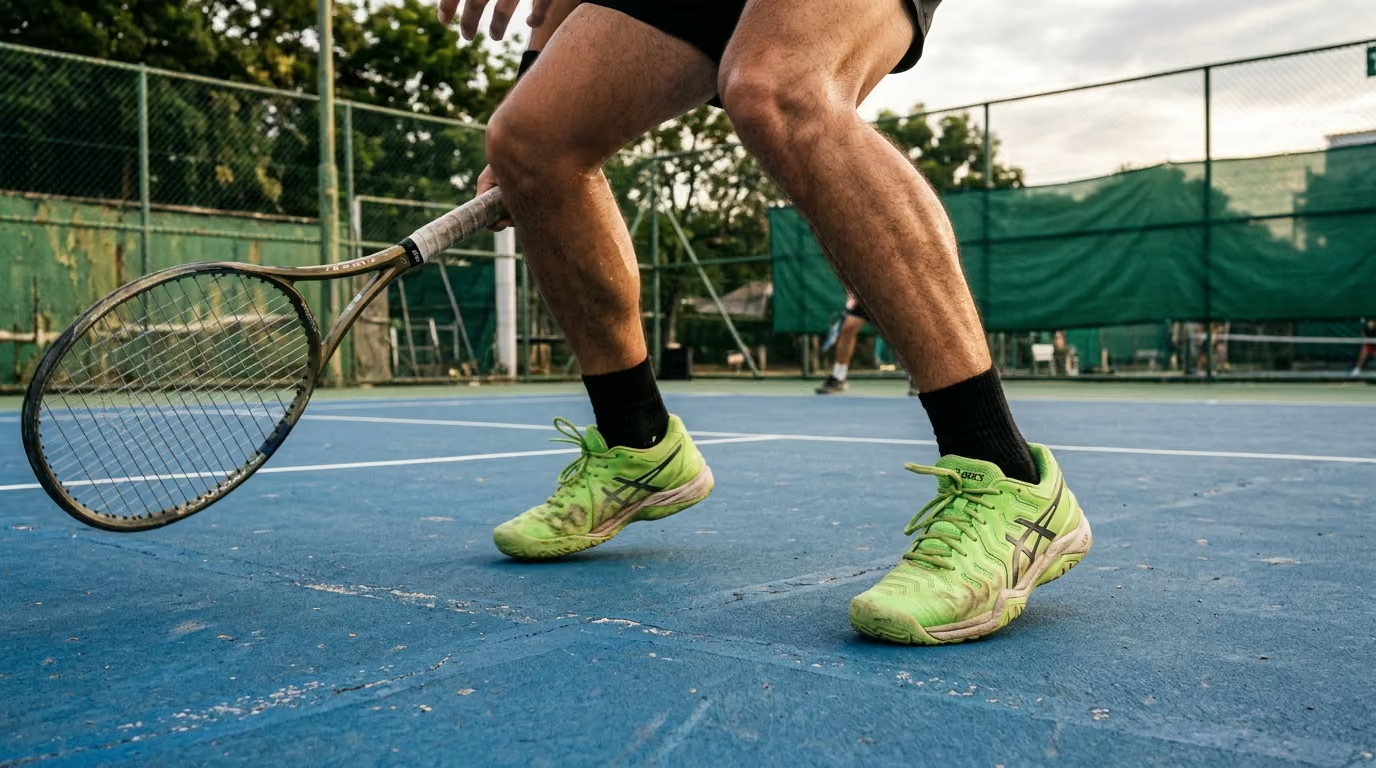
A 2024 study using Hawk-Eye data from the Australian Open revealed that about 80 percent of all between-shot movements required players to travel less than 2.5 meters.




Many training manuals tell players to run back to the exact middle of the baseline or court after hitting a shot. This standard piece of advice is actually a geometric error that leaves wide lanes open for your opponent to exploit. Effective positioning is not about memorizing a static home base on the court.
Dynamic positioning is the continuous adjustment of your court location based on the opponent's hitting angle, your shot quality, and the remaining reaction time. By positioning yourself along the center of your opponent's active hitting cone, you reduce their available target area and maintain balanced coverage. This approach ensures you move with the play rather than chasing it, supporting long-term performance and healthy aging on the court.
To master court movement, you must shift your perspective from running harder to positioning smarter. This guide provides a detailed breakdown of spatial geometry across tennis, pickleball, and padel. It translates current sports science into practical court strategies to help you maintain efficient movement, protect your joints, and keep playing the sports you love for years to come. By learning to read court space, you can get more out of your court performance resources and play with greater confidence.
Modern sports science offers valuable insights into how spatial awareness affects player performance. A 2024 study published in sports science literature examined Henri Cochet's classic "theory of angles" in tennis. The researchers found that expert players consistently utilize the angle-bisector concept to position themselves. Rather than standing in the geometric center of the court, these players stand on the line that divides the opponent's possible shot paths exactly in half. The study noted that more experienced players executed this geometric positioning with much higher precision than recreational players.
Positioning is not an isolated choice, but a relational dance between players. A 2013 study in the Journal of Sports Sciences analyzed baseline rallies using a positional-advantage index. This index measured lateral and longitudinal displacement between players during active play. The researchers discovered that point outcomes are highly predictable based on how this spatial balance shifts. When a player fails to recover relative to their opponent's hitting position, the spatial balance breaks down, leading to a high probability of losing the point.
Physical demands also highlight the importance of efficient positioning. A 2024 study using Hawk-Eye movement data from the Australian Open revealed detailed movement patterns on hard courts. The average movement-cycle distance was approximately 4.5 meters for men and 4.2 meters for women. Surprisingly, about 80 percent of all between-shot movements required players to travel less than 2.5 meters. Only 10 percent of movements required sprints of more than 4.5 meters.
This data shows that elite court movement is not built on wild, exhausting sprints across the entire court. Instead, it relies on small, well-timed adjustments and preventative positioning. A separate study on professional movement identified three distinct qualities of successful movers: raw speed, reading the play, and mechanical efficiency. While raw speed often declines with age, your ability to read the play and position yourself efficiently can improve over time, enhancing your mobility and movement resources as you mature.
To apply these scientific principles on the court, you must abandon guesswork. You should run through a rapid mental check before and immediately after every shot you hit. This model relies on four key questions that help you determine the optimal location on the court.
You must observe the opponent's exact physical location and balance. Are they pushed deep behind the baseline, or are they stepping inside the court? An opponent who is off-balance or forced to hit on the run has a limited selection of shots. If they are forced to hit from a closed stance, they will struggle to change the direction of the ball. You must adjust your position to cover their most likely physical escape route rather than covering the entire theoretical court.
The ball you just hit dictates what your opponent can do next. If you hit a deep, heavy shot that forces a low contact point, your opponent must hit upward. This defensive reply gives you the freedom to take a more aggressive recovery position. If you hit a short, sit-up ball, your opponent can hit downward with high pace. In this scenario, you must immediately retreat or shift to a highly defensive stance to protect the open lanes.
Time on the court is created by the ball's depth, height, and speed. A high, looping defensive lob gives you several seconds to run back and establish a stable position. A flat, hard drive leaves you with mere fractions of a second to prepare. You must evaluate how fast the ball will reach the opponent's racquet. Do not try to move to an advanced position if the speed of the ball does not allow you to complete your split-step before they strike.
You cannot cover every square inch of the court at the same time. Percentage positioning requires you to identify the opponent's highest-probability shot. Under pressure, most players will choose the cross-court option because the net is lower in the middle and the court is longer diagonally. Cover this high-percentage lane first, while keeping enough balance to react if they attempt a high-risk, down-the-line winner.
To make this model highly practical during a match, follow this step-by-step sequence on every single shot:
Tennis courts present a large physical area to cover, measuring 23.77 meters long and up to 10.97 meters wide. Because of these large dimensions, small positioning errors can quickly leave you out of reach of the ball.
In singles play, your baseline positioning should be treated as a flexible, three-part cycle. This cycle includes your contact position, your recovery position, and your defensive readiness position. After hitting a cross-court groundstroke, you should not run back to the exact center mark of the baseline.
If you hit a cross-court forehand from your right side, your opponent's available angles shift to your left. The bisector of their new hitting cone lies slightly to the right of the center mark. If you overrun to the absolute center, you leave the wide cross-court angle open. You must stop your recovery slightly to the right of the center line, perform your split-step, and prepare for the reply.
When you hit a down-the-line groundstroke, the geometry changes dramatically. The ball travels along the sideline, giving your opponent a direct line to hit a sharp cross-court reply. You must recover quickly across the court to cover this wide diagonal lane. Because the down-the-line shot leaves you with more court to cover, you must only use this shot when you have hit a high-quality ball that puts your opponent on the defensive.
You must also adjust your depth behind the baseline based on the pace and depth of the incoming ball. If your opponent hits a heavy, high-bouncing topspin shot, standing close to the baseline forces you to take the ball on the rise. This requires exceptional timing and coordination.
Moving two to three meters behind the baseline is a time-seeking defensive choice. This extra distance allows the ball to drop into a comfortable hitting zone, giving you more time to execute a controlled stroke. Conversely, if your opponent hits a short, weak ball, you must step inside the baseline. This space-denying choice cuts off the ball early, taking away your opponent's recovery time.
Doubles tennis is a shared geometry problem. The wider doubles court increases the importance of lateral coordination and team movement. The most common amateur error is playing as two individuals rather than a connected unit.
You and your partner must move together like they are connected by a tight rubber band. If your partner is pulled wide into the doubles alley to hit a ball, you must shift laterally toward the center line. This movement protects the middle gap, which is the most dangerous target on the court. If you remain fixed in your original half-court position, you leave a massive, uncontested lane right down the center of the court.
The server's partner should start near the center of the service box. From this position, you can threaten the returner and protect the net. Your job is to reduce the returner's target area and prepare to intercept any weak cross-court returns.
If the returner hits a high, floating ball, you must be ready to poach across the net. The returner's partner should start near the service line. This staggered position provides enough reaction time to handle a sharp first volley while allowing you to move forward quickly if the return is successful.
Pickleball is played on a compact court measuring 20 feet wide by 44 feet long. Despite the smaller dimensions, positioning is highly critical because of the speed of the rallies and the legal restrictions of the court.
The central positioning concept in pickleball is the battle to establish a balanced, legal position at the non-volley zone line, commonly called the kitchen line. The kitchen extends exactly seven feet from the net on both sides. Understanding the physical rules of this zone is essential for safe, effective play.
You cannot hit a volley while standing in the kitchen or touching the kitchen line. Furthermore, your physical momentum cannot carry you into the kitchen after you hit a volley, even if the ball is already dead. To position yourself correctly, you must stand approximately two inches behind the kitchen line. This tiny gap gives you enough physical space to execute volleys without risk of stepping on the line.
From this position, you can take volleys early, reduce the opponent's reaction time, and attack any balls that rise above net height. Standing any farther back creates a dangerous space at your feet that your opponents can easily target.
In singles pickleball, you must cover the entire 20-foot width of the court alone. Because there is no partner to share the load, you cannot blindly rush to the kitchen line on every shot.
If you hit a shallow, weak return, rushing forward will leave you highly vulnerable to a passing shot. You must remain deep and use a transition stroke, such as a third-shot drop, to land the ball softly in the opponent's kitchen. Only when you see the ball land safely in their kitchen should you advance to your own kitchen line. If your drop shot is too high, you must pause, split-step, and defend from the mid-court or baseline.
Doubles pickleball positioning requires both partners to reach the kitchen line together to form a solid defensive wall. A common failure occurs when one partner is stuck at the baseline while the other stands at the kitchen. This depth split creates a large diagonal gap that is easy for opponents to exploit.
To prevent this, you must advance through the transition zone, the area between the baseline and the kitchen, using controlled movement. Do not sprint blindly through this zone.
Instead, move forward as your partner hits soft, low resets. If the opponent hits a hard, downward shot, you must immediately stop, drop into a low athletic stance, and play a defensive reset. Once you hit a soft ball that lands in the kitchen, you can safely complete your journey to the line.
Padel is played on a 10-meter by 20-meter court enclosed by glass and wire mesh walls. This unique environment requires a completely different approach to positioning, as the walls alter the flight path and timing of the ball.
When defending at the back of the court, your positioning must account for the ball's rebound off the glass. Many players make the mistake of standing too close to the back wall. This position jams your physical swing, leaving you with no room to execute a proper stroke.
The standard defensive starting position is approximately one step behind the service line and one step away from the side glass. This location allows you to read the speed and spin of the incoming ball.
If the ball is hit deep and fast, you must let it pass you, bounce on the turf, and rebound off the glass. By remaining patient and waiting for the rebound, you can hit the ball as it moves forward away from the wall. This approach provides you with a much larger hitting window and better control over your defensive lob.
When your team holds the net, you should stand approximately two to three meters away from the net. This specific distance allows you to intercept low volleys and protect the middle of the court.
If you stand too close to the net, you become highly vulnerable to a basic lob. Your opponents can easily hit the ball over your head, forcing you to run backward and give up your offensive position.
If you stand too far back, you allow the ball to drop below net height before you can reach it. This forces you to hit upward, giving your opponents an opportunity to counter-attack. You must maintain this two-to-three-meter gap, shifting forward only when you see an opportunity to hit a decisive, downward volley.
In padel, partners must move as a parallel unit at a similar depth. The court is too small to support a staggered, one-up, one-back formation. If your partner is pushed back to defend a deep lob, you must also retreat toward the back of the court.
If you remain at the net while your partner is defending, you leave a massive diagonal gap in the center of the court. Your opponents can easily target this open space.
By retreating together, you preserve your team's defensive structure. Once your partner hits a high, deep lob that pushes the opponents back, both of you can advance to the net together to reclaim the offensive position.
Your physical position on the court should always match the quality of the shot you have just hit. Do not move forward simply because you want to attack. You must earn the right to move forward by hitting a high-quality ball that limits your opponent's options.
An attacking state is triggered when you hit a high-quality ball that puts your opponent under clear physical pressure. Examples of this include:
In these situations, you must immediately step forward to compress the court. By moving closer to the net or kitchen line, you reduce the opponent's available hitting angles and take away their reaction time. This aggressive positioning allows you to intercept their defensive reply and finish the point early.
A neutral state occurs when you hit a decent shot that keeps the rally stable but does not put your opponent under pressure. This is the most common state during baseline rallies. Examples include:
During a neutral state, your primary goal is to maintain a balanced, central recovery position. Do not rush forward, as you have not created enough difficulty to make forward movement safe. Instead, focus on recovering to the center of your opponent's active hitting cone and performing a balanced split-step.
A defensive state occurs when you hit a weak, short, or high ball that allows your opponent to attack. Examples include:
In a defensive state, you must immediately shift to a protective position. This often requires you to take a half-step back to buy more reaction time. Drop your hips, lower your center of gravity, and widen your stance. Focus on protecting the most direct, high-pace hitting lanes first, while accepting that you may have to concede the wider angles.
Even experienced players frequently fall into predictable positioning traps that waste energy and lead to lost points.
The absolute center of the court is rarely the correct recovery position. As shown by the Henri Cochet angle-bisector research, the correct recovery location is the center of your opponent's active hitting cone.
If your opponent is pulled wide to their right side, their available angles shift to that side. If you run all the way back to the mathematical center of the court, you leave the wide-angle lane completely open. You must learn to stop your recovery slightly short of the center to maintain proper geometric balance.
Many players run toward the net or kitchen line simply because they want to finish the point. Rushing forward after hitting a short, weak ball is a major tactical error.
Your opponent can easily target your feet or hit a high-pace passing shot before you can establish a balanced stance. You must only move forward when the quality of your shot has forced a defensive, upward contact from your opponent.
In doubles tennis, pickleball, and padel, players often allow themselves to become separated in depth. Having one player at the net while the other is stuck at the baseline creates a massive diagonal gap.
Opponents can easily place the ball between you, causing confusion and weak replies. You and your partner must communicate and move together, maintaining a consistent depth relationship throughout the rally.
Many recreational players hit a shot and immediately sprint back to the middle without watching the opponent's preparation. If the opponent hits a late, disguised shot behind you, your momentum makes it impossible to change directions.
You must complete your lateral recovery and perform a balanced split-step just before the opponent makes contact with the ball. This ensures you are perfectly balanced and ready to move in any direction.
Poor positioning does more than just cost you points; it also places unnecessary physical strain on your body. When you stand in the wrong position, you are forced to make sudden, desperate lunges to reach the ball. These emergency movements require rapid, high-impact braking forces that place heavy load on your joints, particularly during lateral movements.
When you make a sudden lateral stop from an incorrect starting position, your lower body must absorb massive eccentric forces. This sudden braking puts high stress on your patellar tendons, Achilles tendons, and lower back muscles. Over time, this repetitive eccentric overload can lead to chronic joint stiffness, micro-tears, and inflammatory conditions.
By contrast, proactive positioning allows you to utilize small, controlled adjustment steps. Because you are already standing in the correct geometric location, you do not need to make wild, high-impact lunges.
Instead, you can glide to the ball using balanced, low-impact footwork. This efficient movement distributes the landing forces evenly across your major muscle groups, sparing your joints from excessive wear and tear.
Maintaining proper positioning also reduces your overall cardiovascular fatigue. Taking small adjustment steps requires significantly less energy than executing full-court sprints to recover from poor positioning.
By conserving your physical energy, you can maintain high-quality movement late into a match, protecting your body from the fatigue-related form breakdowns that often lead to acute injuries. Integrating these movement concepts with your strength and conditioning resources will help you build a resilient, durable physical foundation for lifelong play.
While improving your spatial awareness can significantly reduce joint strain, physical limitations can sometimes prevent you from moving efficiently. If you have underlying mobility restrictions, you may find it difficult to execute the low, balanced stances required for proper court coverage.
If you experience sharp joint pain, swelling, or persistent lower-back stiffness during or after play, positioning adjustments alone will not resolve the issue. You should consult a qualified healthcare provider, such as a physical therapist or sports medicine specialist. These professionals can perform a comprehensive movement assessment to identify specific joint restrictions or muscle imbalances that may be holding you back.
You should seek immediate professional guidance if you notice any of the following red flags:
A physical therapist can design a customized program to address your specific mobility and strength deficits. By combining professional guidance with your injury prevention resources, you can resolve movement limitations before they become chronic issues. This proactive approach ensures you can continue moving freely and enjoying your time on the court for years to come.
Dynamic court positioning is the most effective tool you have to play smarter, run less, and extend your playing years across all racquet sports. By mastering court geometry and movement efficiency, you can protect your body from unnecessary wear and enjoy a higher level of play for a lifetime.
Follow Evercourts for practical insights on tennis, pickleball and padel performance, movement, recovery and healthy ageing. Stay connected for new articles, research-led guidance and ideas to help you play well and keep playing for years.


Read practical guidance for better movement, smarter preparation and a game that keeps working for you.
explore the Blog