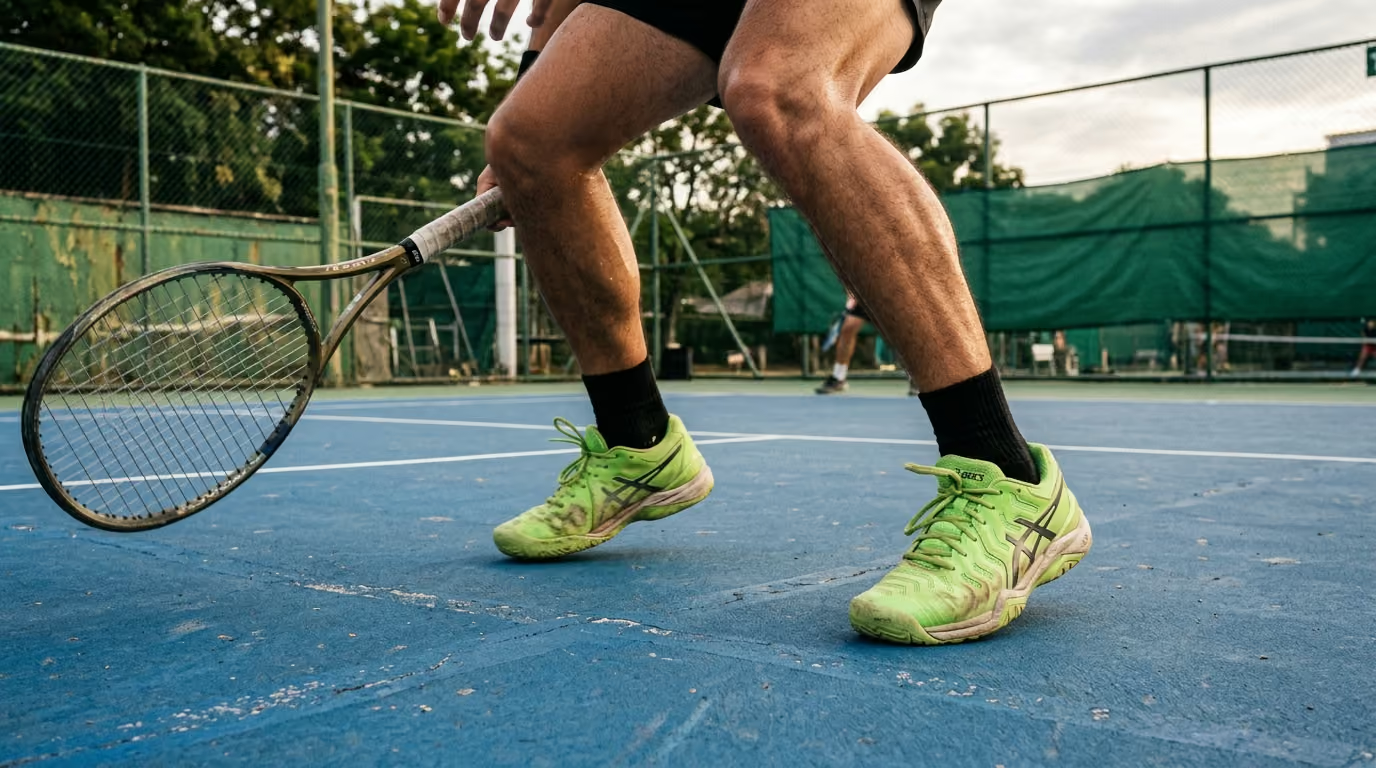
Court surface and movement strategies for different playing environments involve adapting traction, ball speed, bounce height, and surface compliance.




Adapting to a court surface requires a player to balance traction, ball speed, bounce height, and surface compliance. By modifying joint flexion, step length, and braking mechanics, players can maintain optimal positioning while protecting their joints. This strategy relies on reading the ball early and adjusting the transition from movement to the hitting base.
Understanding the court environment is not merely about changing your tennis shoes. It is a systematic shift in how your body handles force, manages timing, and recovers balance on different materials. This guide provides a comprehensive look at how to adjust your footwork, joint angles, and preparation across hard court, clay, grass, and indoor environments.
Every step on a court involves a complex exchange of force between your footwear and the ground. The court surface acts as a dynamic partner that dictates how quickly you can start, stop, and change direction. If you ignore these physical properties, you risk losing footing, wasting energy, or overloading your joints.
Traction is the usable force generated between the shoe and court. This force allows a player to accelerate, decelerate, change direction, or stabilize the body. It should not be treated as a simple rule where more grip is always better.
A player needs sufficient traction to push off, but excessive traction can prevent the foot from releasing during a slide. This can increase braking loads during abrupt stops. To understand traction, we must distinguish between its different forms:
Racquet sports movement is multidirectional and includes both linear and rotational components. A shoe can feel highly secure during a split step but behave differently during a lateral slide or pivot.
The International Tennis Federation, or ITF, measures court pace using the Court Pace Rating. This rating evaluates the ball’s velocity before and after it bounces on the surface. The system combines the effects of horizontal speed loss and bounce behavior rather than defining pace solely by the material name of the court.
The ITF classifications include five distinct categories:
These categories are important because two courts described informally as hard courts may have different playing characteristics. Rougher surfaces create more friction between the ball and court. This reduces horizontal ball speed and makes the court play slower.
Bounce should be considered separately from pace. A high, slow bounce may provide more preparation time but force the player to move farther backward. It can also force you to strike the ball at shoulder height.
Conversely, a low, fast bounce provides less time. It requires earlier preparation, lower body positioning, and highly efficient forward movement. We can break bounce behavior down into several factors:
These variables influence your movement before you even reach the ball. A player does not simply run to a location. You must arrive at the correct location and height relative to the incoming ball.
A court’s mechanical properties affect how much energy is absorbed during impact. They also dictate how much energy is returned to the player and the ball. A comparison of court properties shows lower shock absorption and vertical deformation on hard courts than on clay and artificial grass.
At the same time, energy restitution is higher on hard courts. This supports a practical distinction between different surfaces:
Surface compliance should not be interpreted as a simple injury ranking. Injury risk depends on playing volume, technique, footwear, physical capacity, court condition, and adaptation history.
The most important movement distinction between many courts is whether the player primarily brakes through the shoe-surface interface or dissipates momentum through a controlled slide. Research comparing clay with cushioned acrylic hard court found that players adapted their movement to the surface. Greater knee flexion contributed to braking on hard court, whereas less knee flexion facilitated sliding on clay.
Sliding is not simply losing traction. A skilled clay-court slide is a planned deceleration strategy involving several technical elements:
Research shows that players adapt their utilized friction to surface characteristics. Sliding is favored on lower-friction surfaces to protect the joints from sudden stopping forces.
While the physics of surface interaction remain constant, court dimensions and rules alter movement spacing. Players must adjust their mobility strategies based on the specific sport they are playing.
The standard singles tennis court is 23.77 meters long and 8.23 meters wide. The doubles court increases the width to 10.97 meters. The net stands 1.07 meters high at the posts and 0.914 meters high at the center.
These dimensions require tennis players to cover large distances, often demanding full-speed sprints followed by rapid deceleration. Because of the space involved, tennis players must use progressive braking steps to control their momentum on hard courts. On clay, they must rely on long, sliding approaches.
Preparing your joints for these massive deceleration forces is critical. Incorporating targeted training for joint mobility and movement control can help you develop the necessary movement capacity for these wide court transitions.
Pickleball courts are much smaller, measuring 13.41 meters long and 6.10 meters wide for both singles and doubles. The net is also lower, standing at 0.914 meters at the posts and 0.864 meters at the center. The presence of the 2.13-meter non-volley zone, commonly called the kitchen, prevents players from hitting volleys while standing inside it.
This geometry shifts the mobility challenge away from long-distance sprinting. Instead, pickleball demands exceptional short-range acceleration, rapid lateral shuffling, and deep knee flexion to play low balls near the kitchen line.
Because points are fast and movements are compact, players must maintain a low center of mass. This stance places high rotational and shearing forces on the knees and ankles. Using dedicated injury prevention resources for court sports is essential to protect these joints from the constant, repetitive micro-adjustments required on the pickleball court.
Padel is played on a 20-meter by 10-meter court enclosed by glass walls and metal mesh. The net is 0.88 meters high at the center and 0.92 meters high at the posts. The presence of the walls completely changes how a player must move and position themselves.
Instead of simply moving side to side, padel players must frequently run backward, turn, and track balls that rebound off the glass. This requires excellent thoracic rotation, hip mobility, and spatial awareness.
I remember finishing a tough two hour padel match on a cold Tuesday night and waking up the next morning feeling like my lower back was locked in concrete. For a long time, I just accepted this as the price of playing hard in my forties. But once I started spending just ten minutes on targeted hip mobility before heading to the club, the stiffness almost completely vanished. It taught me that we do not have to accept pain as a default state of aging.
Hard courts offer a highly predictable ball bounce but present a rigid, high-traction environment. This combination requires specific physical preparation and technical adjustments.
Most acrylic-coated surfaces fall within the ITF medium or medium-slow classifications. Hard courts are generally associated with consistent ball response and relatively firm support. They offer almost no opportunity for natural sliding compared to clay courts.
A comparison of court properties shows lower shock absorption and vertical deformation on hard courts than on clay. This stiffness means your muscles and joints must absorb the brunt of the impact when you stop or change direction.
Hard-court movement emphasizes several key technical requirements:
Players should not attempt to slide on a high-traction hard court unless they have highly specialized training and appropriate footwear. Instead, the objective is to arrive with enough time to brake progressively through several smaller steps.
A hard-court mobility warm-up should progressively prepare your body for high-impact forces. Focus on these physical priorities:
Coaches should use cues such as "lower your hips before you brake." This encourages players to bend at the knees and hips rather than staying upright and stabbing at the ball.
To handle a wide forehand on a firm hard court, use this step-by-step pattern:
This approach distributes the braking force across multiple steps and joints, reducing the strain on any single structure.
Hard courts should not automatically be labeled as dangerous. A large study of recreational players found no statistically significant difference in overall injury prevalence among players using hard courts, clay, or artificial grass.
However, the study did find a higher prevalence of lower-limb overuse injuries among hard-court players. It also noted that players who frequently switched between multiple surfaces had higher injury rates.
The appropriate conclusion is that hard courts require deliberate load management and specific braking preparation. They do not require fear, but they do require respect for the physical forces involved.
Clay courts offer a slower pace but introduce a low-friction environment. To move efficiently on clay, players must master the art of the controlled slide.
Most clay courts are classified by the ITF as slow, with Court Pace Ratings below 30. The frictional behavior of clay can vary significantly based on particle size, infill depth, moisture, and daily maintenance.
Reduced friction allows for controlled sliding, but clay is not always uniformly slippery. A study of artificial clay surfaces found that small, dry particles could produce traction comparable to hard courts under heavy load. Conversely, larger particles and moisture generally reduced traction.
Moving successfully on clay rewards a different set of physical skills:
Research shows that clay-court players utilize less initial knee flexion than hard-court players. This flatter joint profile helps initiate and maintain a smooth slide.
Sliding is a skill that should be taught progressively rather than at full speed. Use this step-by-step progression to develop your sliding technique:
During each step, pay attention to how your foot releases, how your body decelerates, and how you regain traction to move again.
On a clay court, you must initiate braking earlier because the slide itself consumes distance. If you wait until you reach the ball to stop, your slide will carry you far past the ideal hitting position.
This environment rewards anticipatory braking. You must read the shot early, start your movement smoothly, and begin your slide before entering the final contact zone. Keep your chest and pelvis organized over your hips, and let the slide continue while you control your swing.
Your physical preparation for clay courts should focus on the demands of sliding and recovering. Incorporate strength and conditioning guidelines for racquet sports to build a resilient lower body. Prioritize these movements:
Clay-court players must practice managing their movement during a loss of traction. Hard-court players, by contrast, must focus on managing high impact forces while retaining total traction.
Moisture and maintenance can rapidly change how a clay court behaves. A damp court or one with uneven sand distribution will have inconsistent traction.
Before every match or practice, perform a brief traction assessment. Test a controlled lateral step, practice a progressive stop, and try sliding on both legs. Reassess the court after it has been watered, swept, or exposed to heavy wind and sun.
Grass courts are the fastest surfaces in racquet sports, requiring exceptionally quick reflexes and low, compact movement.
The ITF classifies natural grass, artificial grass, and some carpet surfaces as fast Category 4 or Category 5 environments. Grass encourages low, skidding ball trajectories that give players very little time to prepare.
Traction on grass is highly sensitive to moisture, wear, and grass height. A dry, freshly mowed grass court offers excellent traction, while a damp or worn court can become incredibly slippery.
To move effectively on grass, you must adjust your physical approach:
Because the ball stays low and arrives quickly, you rarely have time for large crossover steps. Your movement must become highly economical.
Your warm-up on a grass court should prepare your body for rapid, low-amplitude movements. Include these exercises:
Avoid high, bouncy movements during your warm-up. A high split step wastes valuable time and can leave you unbalanced when a low ball skids off the turf.
Never assume that a low-bounce surface allows for aggressive, abrupt stopping. If the grass is damp or worn down to the soil, your traction will be highly inconsistent.
The safest strategy is to use shorter steps and avoid reaching top speed when you cannot trust the traction. Focus on balance and early preparation rather than relying on emergency slides or sudden stops.
Indoor courts offer shelter from the elements, but they present unique physical and spatial challenges that affect your mobility.
An indoor court is an environmental category rather than a single material type. Indoor facilities can feature acrylic, cushioned systems, carpet, or wood-based systems. You cannot assume an indoor court is fast or slow based on the building alone.
The ITF classifies some carpet surfaces across medium, medium-fast, and fast categories. Always test the specific court before playing rather than relying on general assumptions.
Indoor environments can significantly alter your perception and movement:
The ITF recommends a minimum free height of 9.0 meters above the net for international play. However, in smaller local clubs, you may have much less vertical and horizontal space.
Indoor environments reward compact, highly controlled movement:
If you are used to taking a long, looping path to recover after a wide ball, you must learn to brake earlier indoors. The physical constraint is not the painted court itself, but the safety margin beyond the lines.
Before playing indoors, use this structured sequence to prepare your body and assess the space:
Even experienced players make predictable mistakes when transitioning between different court surfaces and environments.
Many players who grow up on clay attempt to use the same sliding mechanics when they play on hard courts. Because hard courts offer high friction, the shoe can catch abruptly on the surface.
This sudden stop can cause severe ankle sprains, knee strain, or hip injuries. It also places immense stress on the patellar tendon.
On hard courts, you must use progressive braking. Focus on taking several smaller steps to dissipate your momentum rather than trying to glide into the shot.
Conversely, players who are used to hard courts often try to stop instantly on clay. If you plant your foot with a rigid leg on a loose clay surface, the particles will roll under your shoe.
This can cause your foot to slip out from under you, leading to groin strains or falls. On clay, you must learn to lower your center of mass and allow your foot to slide under control. Decelerate smoothly rather than trying to force an instant stop.
When playing on grass, low-bouncing hard courts, or near the pickleball kitchen, players often fail to lower their hips. Instead of bending their knees and hips, they bend forward from the waist.
This upright leg posture forces you to reach down with your back, placing immense strain on your lumbar spine. It also leaves you off-balance and slow to recover.
To protect your back and maintain mobility, you must prioritize healthy aging and athletic longevity guides that emphasize hip and knee flexion. Focus on dropping your seat to reach low balls rather than bending your spine.
The surface you play on directly influences the type of physical stress your body experiences, affecting how you recover between sessions.
Stiff surfaces like hard courts transmit high ground reaction forces through your bones and joints. This impact primarily loads your Achilles tendon, patellar tendon, and lower back. If you play frequently on hard courts, you need to dedicate extra time to managing tendon health and joint compression.
Clay courts and sand-filled turf offer more shock absorption, which reduces joint impact. However, the sliding and shifting nature of these surfaces increases the workload on your adductors, groin, and lateral hip stabilizers.
Understanding these differences is essential for planning your recovery. Utilizing recovery science principles for tennis and pickleball can help you tailor your post-match routine to the specific physical demands of the surface you just played on.
Research on recreational court athletes reveals important patterns regarding surface-related injuries. A large study of over 3,600 players found that 80% of reported injuries were overuse injuries, while only 20% were acute.
While overall injury rates were similar across different court types, hard-court players experienced a higher rate of lower-limb overuse issues. Interestingly, players who frequently switched between multiple surfaces also had a higher prevalence of overuse injuries.
This suggests that your body needs time to adapt to a specific surface. If you must switch environments, do so gradually to allow your tendons and muscles to adjust to the changing forces.
While some soreness is normal after a tough match, certain symptoms indicate a more serious issue that requires professional attention. Do not try to play through pain that alters how you move on the court.
Consult a qualified healthcare provider if you experience any of the following warning signs:
A physical therapist or sports medicine specialist can help identify movement compensations and design a targeted recovery plan to keep you playing safely.
It is highly recommended to use surface-specific shoes. Hard-court shoes feature durable outsoles with herringbone patterns designed to grip rigid surfaces and resist wear. Clay-court shoes have a full herringbone tread pattern that prevents clay from clogging the sole, allowing for controlled slides and reliable grip when pushing off. Using a hard-court shoe on clay can lead to slips, while using a clay shoe on hard court can cause excessive grip and increase injury risks.
Indoor carpet courts often provide high traction and rapid bounce behavior, which can increase the rotational and translational forces transmitted to your lower limbs. If the carpet is laid directly over concrete without a cushioned underlay, the lack of shock absorption increases the load on your joints. To manage this, focus on wearing highly cushioned shoes and incorporating progressive braking steps to avoid abrupt stops.
When playing in restricted spaces with limited run-off, you must adapt your tactical and physical approach. Avoid chasing deep balls at full speed if you cannot safely decelerate. Instead, practice playing closer to the baseline or taking the ball on the rise. If you must run back, use short, rapid steps to slow down early, and use your hands to guide your contact with the back wall or curtain if necessary.
Sand-filled artificial grass can have highly variable traction. The sand acts as a loose layer of tiny rollers between your shoe and the synthetic turf, which can cause unexpected slips if the sand is unevenly distributed or wet. To stay safe, perform a thorough traction test during your warm-up, focus on taking smaller adjustment steps, and avoid making maximum lateral cuts until you understand how the surface is responding.
Follow Evercourts for practical insights on tennis, pickleball and padel performance, movement, recovery and healthy ageing. Stay connected for new articles, research-led guidance and ideas to help you play well and keep playing for years.


Read practical guidance for better movement, smarter preparation and a game that keeps working for you.
explore the Blog