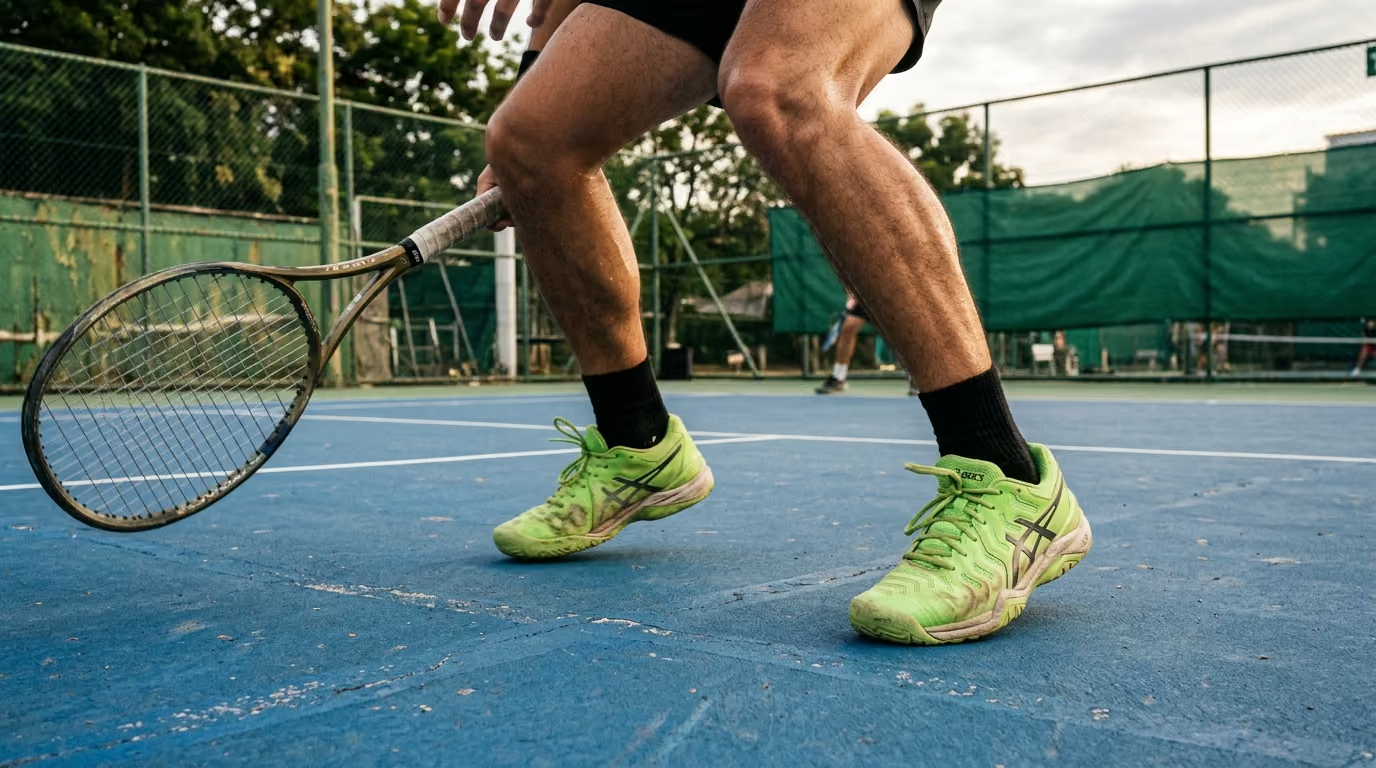
When playing on different court surfaces, the interaction between your body and the court involves a complex system of stiffness, shock absorption, and friction.




Court surface interaction is not merely a question of whether a playing floor feels hard or soft. It is a complex system involving surface stiffness, shock absorption, vertical deformation, energy restitution, and friction. This guide explains how different court environments alter the load on your body and outlines how to adapt your footwear, movement strategies, and training volume to stay on the court for years to come.
To protect your joints and maintain athletic longevity, you must understand that no single surface is universally safe or harmful. Managing impact is about how quickly and repeatedly load is applied to your tissues. By adapting your movement technique, choosing compatible footwear, and transitioning gradually between different courts, you can minimize sudden spikes in physical stress.
When we step onto a court, we often judge it solely by how our knees feel after a single hit. Biomechanical reality is much more complex. The interaction between your body and the court is a continuous loop.
This loop follows a specific path. First, the mechanical properties of the surface interact with your shoe. Next, this interaction shapes your movement strategy. That strategy dictates how load is distributed through your tissues. Finally, this tissue loading determines your recovery demand and your overall injury risk.
We must recognize that a court is part of an active system. A concrete base with a thin acrylic coating behaves differently than a suspended wood floor or a natural clay bed. Your muscles and joints act as the primary dampers in this system. If a surface does not deform under your weight, your body must bend more to absorb the energy.
This means a hard court is not a simple enemy. It is a predictable partner that requires specific movement adaptations. Conversely, a soft court is not a perfect shield. It presents its own challenges to your stability and muscle endurance. For those interested in sustainable training, reviewing our healthy aging and athletic longevity resources can provide deeper context on tissue capacity.
To make informed decisions about your play, you need to understand the basic physical properties of sports flooring. These terms are often used by court builders, but they have direct consequences for your daily recovery.
Stiffness describes how much a surface resists compression under a vertical load. A highly stiff court does not budge when you land from a jump or push off for a sprint. In a comparative study of tennis court materials, researchers measured stiffness values across different playing areas.
The test reported stiffness values of approximately 639 units for acrylic courts. Clay courts measured at 181 units. Natural grass courts showed a value of just 19 units.
These numbers reveal that acrylic is about three times stiffer than clay. It is roughly 33 times stiffer than grass. However, high stiffness does not automatically translate to injury. When you run on a stiff surface, your nervous system often compensates by increasing knee and hip flexion to damp the shock.
Shock absorption is the percentage of impact force a floor absorbs compared to a completely rigid reference point, like solid concrete. In controlled flooring experiments, researchers have tested surfaces ranging from 0 percent shock absorption up to 45 percent.
This property primarily influences the rate at which impact force rises. It does not necessarily guarantee a lower peak force. In the same controlled tests, the softest floors reduced the instantaneous loading rate but did not significantly alter the maximum vertical force during jump tasks.
Vertical deformation is the actual distance a court compresses downward under load. While deformation assists with shock absorption, too much of it can compromise your stability. If a surface deforms excessively, your stabilizing muscles must work harder to keep your ankles and hips aligned during quick lateral cuts.
Energy restitution is the amount of mechanical energy a surface returns to you after it deforms. A high-restitution surface feels bouncy and responsive, helping you run with less muscular effort.
In comparative testing, hard courts demonstrate greater energy restitution than clay or artificial grass. Artificial grass tend to offer higher shock absorption and vertical deformation but returns less energy to the player.
This means that while a softer, high-deformation court might feel gentle, it can actually cause your muscles to fatigue faster. Your body must work harder to push off and find stable footing on a surface that absorbs your energy instead of returning it.
Traction is the grip between your shoe outsole and the court surface. It is measured by the coefficient of friction, which represents the ratio of horizontal force to vertical force before a slide or slip occurs.
Traction presents a delicate balance for your joint health. Too little traction causes slipping, which can lead to falls or groin strains. Too much traction prevents your foot from releasing during pivot movements, which transfers high rotational forces directly to your ankles and knees.
Our goal as active players is not to find the stickiest shoe or the grippiest court. We want task-appropriate traction. This means having enough grip to accelerate confidently, but enough release to protect our joints when we need to change direction quickly. Our library of player health articles covers how these forces interact with common joint conditions.
Peak force is the maximum amount of stress your body experiences during a single footprint. Loading rate is the speed at which that force increases.
Imagine two different landings. Both produce a peak force of twice your body weight. In the first landing, that peak is reached in 10 milliseconds. In the second landing, it takes 50 milliseconds.
The second landing is much easier on your joints and tendons because your tissues have more time to distribute the energy. The sports flooring research shows that loading rates are highly sensitive to your shoe selection and the court surface. Managing this loading rate is crucial for preventing chronic issues like shin splints and tendon issues.
Acrylic hard courts are the most common surfaces in North America. They consist of a concrete or asphalt base covered with layers of acrylic resin, silica sand, and paint. Because of their construction, they are highly stiff and offer minimal vertical deformation.
A comparative tennis court study showed that acrylic produced a mean peak impact force of approximately 2.0 body weights. This was higher than the 1.8 body weights recorded on clay and the 1.7 body weights found on natural grass.
Interestingly, the same study showed that the mean loading rate on acrylic was 76.1 body weights per second. This was slightly lower than the 77.5 body weights per second recorded on grass. This proof shows that a softer surface does not always guarantee a lower loading rate.
The real challenge of hard courts is the high friction they generate. Because the surface does not slide, your feet stop instantly when you plant them. This abrupt braking requires significant eccentric strength from your quadriceps and calves.
A study tracking lower-limb muscle activation found greater gastrocnemius muscle activity on hard courts compared to clay during running stroke movements. This indicates that your calf muscles work harder to stabilize and brake on hard courts.
If you transition to hard courts after playing on softer surfaces, your calves and Achilles tendons will face a sudden increase in demand. To learn more about keeping your knees and ankles safe, read our injury prevention resources.
Clay courts, whether red or green, represent a fundamentally different movement environment. Because clay is made of crushed stone or shale, the loose top layer acts as a sliding medium.
This loose surface reduces the coefficient of friction. When you change direction on clay, your shoe slides across the top particles rather than catching instantly. Biomechanical studies show that players adapt to this lower friction by using different knee mechanics.
On clay, players use less knee flexion at the moment of impact and during the peak of their stroke. Instead of bending their knees deeply to brake, they allow their lower bodies to slide to a stop. This sliding technique helps dissipate horizontal momentum over a longer period of time.
However, sliding is not a passive action. It requires excellent core stability, timing, and hip strength. If you slide without control, you risk planting your foot prematurely while your upper body is still moving, which can strain your groin or hip flexors.
It is also worth noting that clay rallies tend to be longer. Because the ball bounces slower and higher, you will likely take more steps per point than you would on a hard court. This shifts the physical demand from acute joint impact to cardiorespiratory and muscular endurance.
Natural grass is rare in recreational play, but synthetic turf systems are increasingly common, especially in padel and certain multi-sport facilities. These surfaces behave differently than both hard courts and clay.
Natural grass offers the lowest material stiffness of all traditional court types. The grass and soil deform easily, resulting in a mean peak impact force of just 1.7 body weights.
However, because grass can be slick, the loading rate can be quite high, measuring 77.5 body weights per second. This occurs because players often experience micro-slips before their shoes find secure traction, causing rapid spikes in force when the foot finally grips.
Synthetic turf surfaces often use sand infill to stabilize the synthetic fibers. Research shows that sand-filled artificial grass can actually provide higher shock absorption and vertical deformation than clay and hard courts.
However, the slip resistance on synthetic turf can be unpredictable. If the sand is unevenly distributed, you may experience a mix of highly slippery spots and highly sticky patches. This variation requires constant, rapid micro-adjustments from your ankles and feet.
When playing on these grass-like surfaces, you cannot rely on the surface to provide a consistent slide. Your footwork must feature shorter, faster adjustment steps to maintain your balance. You must also inspect the court for dampness or worn areas before starting your match.
Indoor sports halls often feature synthetic floors made of polyurethane, vinyl, or point-elastic rubber. These floors are engineered to provide high shock absorption, often reaching up to 45 percent deformation under load.
In controlled laboratory experiments, these cushioned floors significantly reduced the vertical instantaneous loading rate during jump and landing tasks. However, the same studies revealed that these floors did not reduce peak vertical forces or change jump height.
This means that while the floor slows down the speed of the impact, your body still bears the same total weight during a hard landing. You cannot assume that a cushioned indoor floor permits you to skip proper movement mechanics.
Furthermore, indoor synthetic floors often have a high coefficient of friction. This "sticky" feel can lead to abrupt stops that strain the knees and hips.
If you are using shoes with dirty or worn outsoles on a dusty synthetic floor, you might experience sudden slips followed by sudden catches. Keeping your outsoles clean is vital for maintaining predictable traction on these surfaces. We have compiled several recovery science resources to help you structure your post-match routine.
The physical demands of court surfaces change depending on the specific racquet sport you play. Each sport features unique movement patterns, court dimensions, and tactical requirements.
Tennis involves long sprints, wide lateral slides, and sudden vertical jumps. Because of the large court size, players reach high speeds before they must decelerate.
On hard courts, this requires exceptional eccentric quadriceps strength to brake. On clay, it demands highly coordinated sliding mechanics. Because tennis rallies can be long, the cumulative impact of these movements builds up over several hours.
Pickleball is played on a much smaller court, which shifts the physical demand from high-speed running to rapid, short-distance lateral shuffling. Most of the action occurs near the non-volley zone line, requiring constant low-squatting postures.
If you play pickleball primarily, check out our dedicated pickleball articles section. The quick lateral steps at the kitchen line can be highly demanding on your ankles and knees, especially on unyielding concrete surfaces.
When I first started playing pickleball, I noticed how many people skipped warming up entirely. They would jump straight out of their cars and right up to the kitchen line. I tried doing that and immediately pulled a calf muscle. Pickleball requires just as much explosive lateral movement as tennis, just in a tighter space. Since then, I always spend five minutes doing dynamic lunges and ankle rolls. It changes everything about how confident I feel pushing off the baseline.
Padel is played on synthetic turf courts enclosed by glass and metal walls. The movement in padel is highly multidirectional, involving frequent rotations, backward running, and overhead reaching.
Because the synthetic turf contains sand, you will experience a moderate amount of slide. However, because you are constantly turning to play balls off the wall, your shoes must offer excellent torsional stability. The combination of turf traction and overhead jumping makes calf and Achilles tendon health a top priority for padel players.
Your shoes are the only interface between your body and the court. Choosing the right shoe is not just about fashion or brand preference. It is a critical component of managing your physical workload.
Using the wrong shoe outsole can quickly lead to joint strain or acute injury.
It is tempting to buy the softest, most cushioned shoe available to protect your joints. However, research suggests that excessive cushioning can have drawbacks.
A highly cushioned shoe raises your stack height, which is the distance between your foot and the court surface. This elevated position can reduce your proprioception, making it harder for your brain to sense your ankle position. This lack of feedback can increase your risk of rolling an ankle during a lateral cut.
Furthermore, extremely soft foam can feel unstable during rapid directional changes. Your foot may slide inside the shoe, causing your toes to jam or your arch to collapse. Look for shoes that combine responsive, moderate cushioning with stiff lateral support wraps to keep your foot secure.
When you purchase new shoes, or when you transition to a different court surface, do not jump straight into a competitive three-hour match. Your body needs time to adapt to the new frictional forces and loading rates.
Spend your first session doing light hitting and controlled movement drills at 50 percent intensity. In your second session, introduce faster lateral cuts but limit your total playing time to one hour.
By the third or fourth session, you can safely return to your normal playing volume. This progressive exposure allows your tendons and muscles to adapt without becoming overloaded.
A proper warm-up prepares your nervous system and muscles for the specific demands of your playing environment. You should tailor your preparation based on the court surface you are stepping onto today.
Because hard courts require sudden, high-force braking, your warm-up must focus on eccentric control and calf preparation.
A clay court warm-up should emphasize hip mobility and controlled sliding mechanics to prepare you for the loose surface.
Grass and turf require quick, precise footwork and excellent ankle stability to manage unpredictable traction.
Many recreational players base their training and recovery decisions on court myths. Clearing up these misconceptions can help you avoid unnecessary fatigue and injury.
While clay and turf courts have lower material stiffness, research does not show a significant difference in overall injury rates among recreational players on different surfaces.
An Amsterdam study tracking recreational tennis players over an entire season found that overall injury prevalence did not differ significantly between clay, hard courts, and artificial grass. Softer courts change where the stress is applied, shifting load from your bone-and-joint system to your muscle-and-tendon system, but they do not eliminate physical demand entirely.
Many players believe that the grippiest shoe on the stickiest court represents the safest environment. In reality, excessive traction is a major risk factor for acute lower-limb injuries.
If your shoe grips the court too aggressively during a lateral stop, the kinetic energy must be absorbed somewhere else in your body. This energy often travels up to your ankle or knee joint, leading to sprains or meniscus tears. Task-appropriate traction that allows for minor sliding or release is much safer for long-term play.
Assuming that every hard court or every clay court behaves identically is a mistake. A hard court in a humid, coastal environment can feel much slower and stickier than the same surface in an arid, high-altitude region.
Similarly, an older, poorly maintained clay court with thin top-dressing can behave exactly like a hard court, offering no slide but high stiffness. Always assess the actual court conditions on the day of your match rather than relying on the general category label.
When we look at sports injuries, we often find that a sudden change in surface is more dangerous than playing consistently on a single court type. Your body is highly adaptable, but it requires time to build the specific structural tolerance needed for different environments.
If you play exclusively on clay for six months, your calf muscles, Achilles tendons, and plantar fascia adapt to the lower-friction, lower-stiffness environment. When you suddenly switch to a hard court, the traction forces increase instantly.
Your calf muscles must contract harder to stabilize your foot, and your Achilles tendons must absorb higher loading rates. If you do not reduce your playing volume during this transition, this sudden spike in demand can lead to micro-tears and chronic tendinopathy.
Instead of waiting for actual pain to occur, you should monitor your body's functional responses to surface changes. Look out for these common warning signs during and after your sessions:
If you notice these signs, your tissues are telling you that the current combination of surface, footwear, and volume is exceeding their capacity to adapt.
While managing your workload can resolve many minor aches, you must know when to seek professional guidance. Some symptoms indicate structural issues that require clinical diagnosis and targeted rehabilitation.
You should consult a qualified healthcare provider, such as a physical therapist or sports medicine physician, if you experience any of the following red flags:
A professional can help identify the root cause of your symptoms. They can design a customized strengthening program to prepare your body for the unique demands of your preferred playing surface.
You should avoid using running shoes on court surfaces. Running shoes are designed for forward linear movement, featuring high stack heights, thick cushioning, and soft mesh uppers that offer very little lateral support.
When you make a sharp lateral cut in a running shoe, your foot can easily slide off the side of the sole, leading to an ankle sprain. Court-specific shoes have lower profiles, wider outsoles, and reinforced lateral wraps designed to keep your foot secure during sudden side-to-side movements.
The increased discomfort on hard courts is typically caused by a combination of high surface stiffness and abrupt traction forces. Because hard courts do not compress or slide, your body must absorb the kinetic energy of every stop and landing.
This requires deeper knee flexion and stronger muscle contractions, which places higher pressure on your patellofemoral joint and patellar tendon. On clay, the ability to slide extends the deceleration time, which reduces the immediate loading rate on your joints.
As a general rule, active players should replace their court shoes every 45 to 60 hours of play. Even if the upper part of the shoe looks brand new, the internal midsole foam degrades over time from the constant impact of jumping and lateral cutting.
Once the foam loses its resilience, its ability to damp loading rates decreases, transferring more stress to your feet, shins, and knees. Additionally, keep an eye on your outsole traction. If the tread pattern is worn smooth, you risk slipping and injuring yourself.
Follow Evercourts for practical insights on tennis, pickleball and padel performance, movement, recovery and healthy ageing. Stay connected for new articles, research-led guidance and ideas to help you play well and keep playing for years.


Read practical guidance for better movement, smarter preparation and a game that keeps working for you.
explore the Blog