
When preparing for a racquet sport match, selecting the right conditioning methods is crucial for building stamina and protecting your joints.




Many racquet athletes search online for ways to build stamina without aggravating their joints. The frequent question is whether running, cycling, swimming, or elliptical training is the best way to stay fit for the court.
The ideal approach is to treat cross-training as a strategic tool selection process. You should use low-impact non-court methods to build your general cardiorespiratory engine and use specific court-based drills to teach that engine how to move. This balance builds stamina while protecting your joints from repetitive impact.
Racquet sports are intermittent activities that combine short high-intensity movements, repeated accelerations, and incomplete recovery. You cannot prepare for these demands by simply building a single fitness quality. Your body relies on three distinct energy pathways during a match, and each plays a specific role in your performance.
The aerobic system supports sustained energy production and recovery during long matches. It contributes to your recovery between rallies, games, and training sessions, even when the play itself is highly explosive. A strong aerobic base helps you maintain your accuracy and speed during the third set or late in a tournament. Research has shown that squash and badminton generally present higher overall cardiovascular demands than tennis or table tennis.
The anaerobic alactic system supplies energy for very short, explosive actions. This includes your first-step acceleration, vertical jumps, rapid lunges, and powerful strokes. These actions usually last under ten seconds and rely on stored energy sources in the muscle.
The anaerobic glycolytic system becomes relevant during longer, intense rallies with incomplete recovery. This pathway produces lactic acid, which can lead to muscular fatigue and coordinate errors if your body is not trained to buffer it. By understanding these systems, you can select cross-training methods that target your specific physiological needs.
The principle of specificity dictates that your body adapts precisely to the demands you place on it. While general conditioning builds cardiorespiratory health, it does not teach your muscles how to move efficiently on the court. For racquet athletes, specific movement quality is just as important as general lung capacity.
General conditioning develops broad cardiovascular or muscular capacities through continuous activities like cycling or rowing. These methods can improve your aerobic base while reducing repetitive impact on your knees and ankles. They are highly useful for maintaining fitness, but their transfer to actual court performance is incomplete.
Specific conditioning reproduces the precise movement patterns, work-to-rest ratios, and muscle actions of your sport. On the court, you must constantly perform split steps, lateral shuffles, crossover steps, and sudden braking actions. You must also maintain trunk control during rotation and execute strokes under physical fatigue.
Adaptations in your heart and blood vessels transfer easily between different types of exercise. However, adaptations in your muscles, tendons, and nervous system are highly specific to how you train. To move well on the court, you must supplement off-court conditioning with targeted mobility and movement resources to maintain your agility.
Running is the most direct non-court method for developing weight-bearing fitness. It matches the upright, forward-moving nature of racquet sports and requires no specialized equipment. It is also highly measurable using distance, pace, or heart rate.
Running develops your running economy, aerobic capacity, and your feet's tolerance to repeated ground contact. According to a systematic review, short-term running-only and cycling-only programs show no significant differences in their impact on maximal oxygen uptake. Running remains highly effective for building the cardiorespiratory endurance needed to survive long matches.
However, running has clear limitations for racquet players. It is a linear, continuous activity that does not train lateral braking, diagonal recovery, or rotational trunk control. It also adds significant stress to your joints, which can be problematic if you already have a high volume of court play.
Running is most useful during your base-building phases or when your access to courts is limited. It should be programmed carefully, using easy aerobic runs for recovery or short intervals for high-intensity power. If you are returning from an injury, reintroduce running slowly to allow your joints to adapt to the impact.
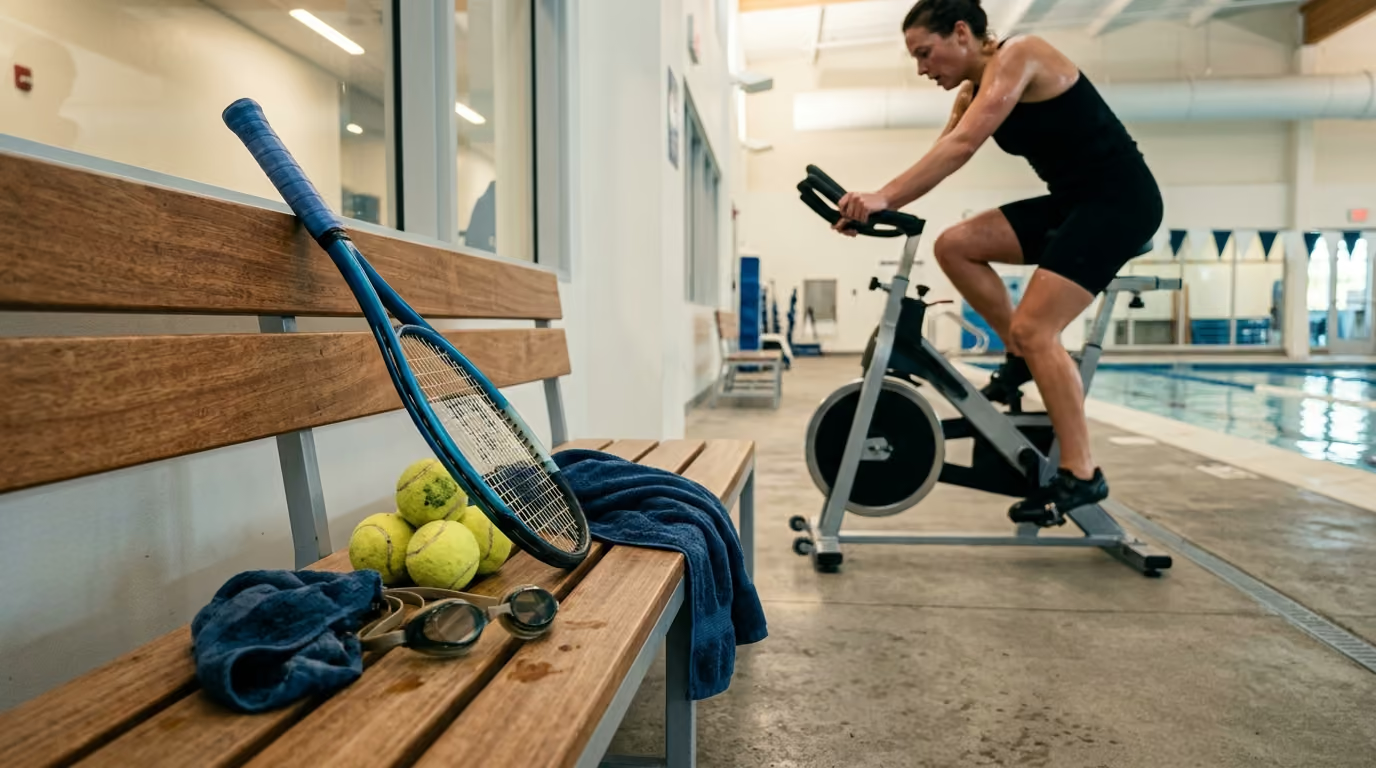
Cycling is an excellent low-impact option for developing cardiorespiratory fitness and lower-body muscular endurance. It is particularly valuable when you need to maintain your conditioning while giving your joints a break from impact.
Cycling allows you to perform long aerobic sessions or high-intensity intervals without repetitive ground reaction forces. Because cycling is non-weight-bearing, it reduces stress on your knees, ankles, and feet. This makes it an ideal choice for building a strong aerobic engine.
Despite these benefits, cycling has minimal movement specificity for racquet sports. The seated, linear nature of cycling does not prepare your feet to absorb impact or redirect force during lateral movements. It also does not challenge your balance, postural control, or upper-body mechanics.
Use cycling to supplement your court training during high-volume weeks or congested tournament schedules. It is also highly effective for active recovery sessions or for maintaining fitness during injury rehabilitation. To balance your training, combine cycling with standing strength and balance exercises.
Rowing is a rhythmic, low-impact exercise that engages both your upper and lower body. It offers a unique conditioning option that builds cardiovascular fitness while strengthening your posture.
Rowing targets several major muscle groups, including your legs, hips, trunk, and upper back. Research on experienced rowers shows that both low-intensity and mixed-intensity rowing programs improve maximal oxygen uptake over twelve weeks. The pulling action of rowing can help balance the repetitive pushing and rotational forces of racquet strokes.
The primary limitation of rowing is its high technical demand. Poor technique, such as excessive rounding of your lower back, can lead to back strain or hip discomfort. It is also a purely linear, sagittal-plane movement that does not prepare you for lateral court movement.
Rowing is best used for high-intensity intervals or moderate aerobic sessions. Ensure you maintain proper form throughout each session, keeping your trunk stable and using your legs to drive the movement. If you experience lower back stiffness, substitute rowing with a different low-impact method.
Swimming offers unique advantages because of the natural buoyancy of water. It provides a highly effective cardiovascular stimulus with virtually no impact on your joints.
A systematic review of swimming shows it can significantly reduce your risk of overuse injuries while keeping you active. Swimming unloads weight-bearing joints, making it highly useful for players recovering from lower-limb issues. It also promotes general muscle relaxation and can assist in overall physical recovery.
However, the transfer of swimming fitness to land-based sports is relatively low. Swimming lacks foot loading, impact tolerance, and the rapid deceleration demands of court play. Additionally, swimming relies heavily on upper-body endurance, which can fatigue your shoulders before you achieve a true cardiovascular challenge.
Use swimming primarily for active recovery, joint off-loading, or during the early stages of injury rehabilitation. It can be paired with recovery science resources to design a complete weekly rejuvenation plan. Keep swim sessions moderate to avoid overworking your hitting shoulder.
Elliptical exercise provides an upright, running-like movement pattern without the high impact of actual running. It serves as a practical bridge between non-impact training and weight-bearing court work.
The elliptical trainer allows you to work your legs and arms in an upright posture. Research indicates that vertical ground-reaction forces on an elliptical are less than half of those measured during treadmill running. This allows you to achieve a high cardiovascular workout while sparing your joints from harsh impacts.
The main limitation of the elliptical is the guided path of the foot pedals. Because your feet remain in constant contact with the pedals, you do not train ankle stabilization or impact absorption. This guided path can also create a false sense of physical readiness for the unpredictable movements of court play.
The elliptical is excellent for steady-state aerobic work or moderate-intensity intervals when your joints feel fatigued. It is also a useful tool for gradually transitioning back to running after a period of rest. Focus on keeping your posture upright and engaging your core during each session.
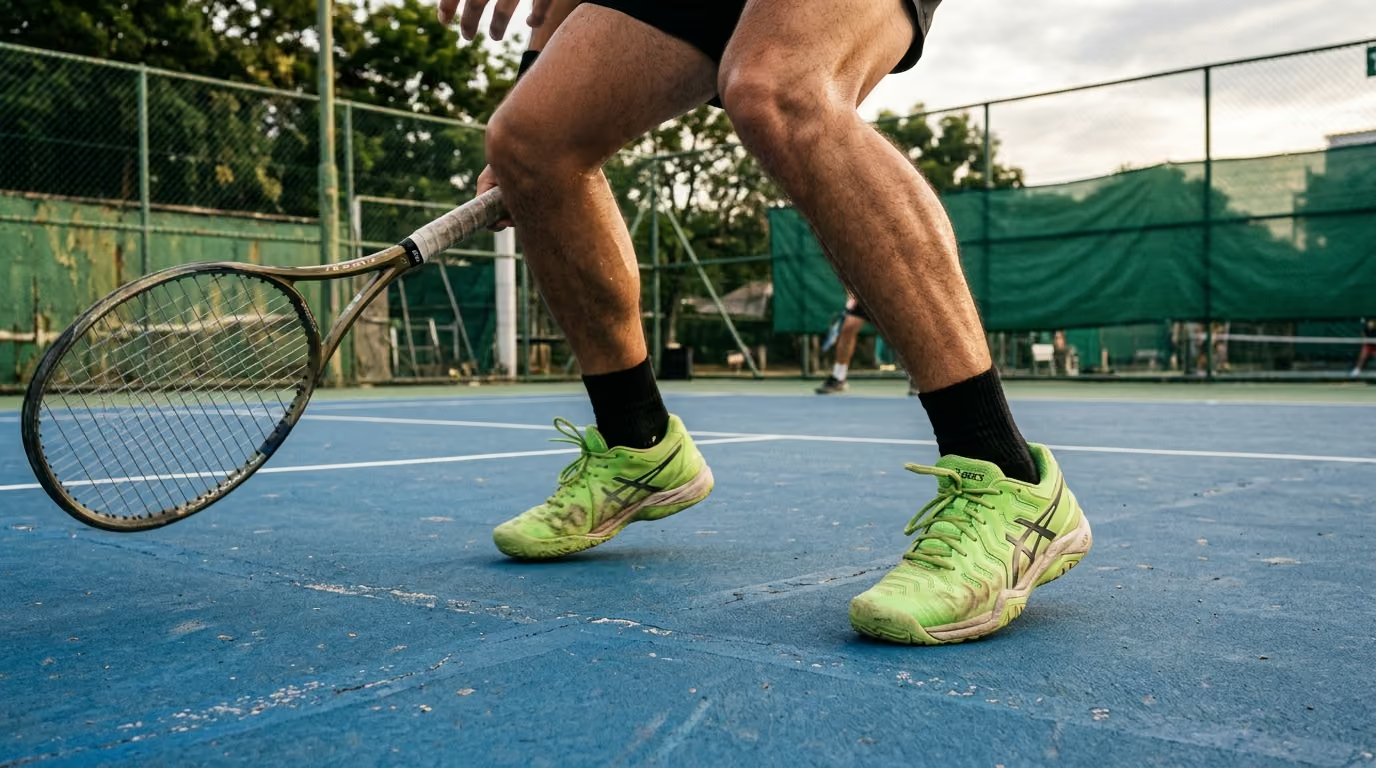
Court-based conditioning is the most specific way to prepare your body for the physical demands of play. It allows you to train your cardiovascular system while simultaneously developing your footwork and reaction speed.
This training style integrates acceleration, deceleration, lateral shuffling, and visual reaction. A tennis-focused review found that plyometric training has a moderate, significant effect on agility, with an effect size of 0.88. These specific drills help you maintain your movement efficiency and stroke accuracy during long matches.
To implement court conditioning, use structured drills like shadow swings, corner-to-corner shuffles, and shuttle runs. You can also perform repeated-sprint training, which has been shown to improve short sprint and change-of-direction performance. These drills should mimic the work-to-rest ratios of your specific sport.
Because court-based conditioning is highly demanding, it carries a high mechanical cost. It adds directly to the stress of your regular practice sessions and matches. To prevent overuse issues, carefully monitor your total court time and read injury prevention resources to manage your workload.
Selecting the right cross-training method depends on your personal goals, injury history, and current training volume. You should analyze your needs systematically to choose the most effective tool.
First, identify the specific physical quality you need to develop. If you need general aerobic endurance, cycling or elliptical training are highly efficient options. If you need to build explosive speed, short court-based sprints or plyometric drills are more appropriate.
Second, consider any physical limitations or joint sensitivities. If you have knee or ankle discomfort, avoid high-impact running and choose cycling or swimming instead. If you have lower back stiffness, choose the elliptical over rowing to keep your spine upright.
Finally, evaluate your overall weekly training volume. If you are playing several matches a week, your joints are already absorbing significant impact. In this scenario, choose low-impact cardiovascular methods to maintain your fitness without adding joint stress.
To help you apply these principles, here are five practical programming examples based on different player profiles.
This program is designed for players who want to build stamina while playing twice a week.
This structure balances general endurance with specific court movement.
This program is designed to maintain fitness during busy tournament blocks.
This plan minimizes unnecessary joint impact while keeping your cardiorespiratory system active.
This program helps you rebuild fitness without overloading recovering tissues.
Ensure you receive clinical clearance before progressing to faster movements.
This program focuses on the rapid recovery needed for fast-paced court movement.
This combination supports the high metabolic demands of badminton play.
This program helps you maintain movement quality under heavy fatigue.
This approach ensures your muscles can handle repeated lunging throughout a match. You can find more structured workouts in our strength and conditioning resources library.
Many athletes make simple errors when designing their cross-training programs. Recognizing these mistakes can save you time and protect you from unnecessary joint stress.
A common pitfall is assuming that any exercise that raises your heart rate is sport-specific. A high heart rate on a stationary bike does not train your ankles to stabilize during a sudden cut. Cardiovascular strain and movement-specific coordination are different qualities that require different training methods.
Another frequent mistake is assuming that cycling fitness translates directly to running readiness. While cycling keeps your heart and lungs fit, it does not prepare your tendons for the impact of sprinting. If you transition directly from cycling to hard court work, you risk developing tendon irritation.
Finally, avoid adding intensive court conditioning on top of a full playing schedule. If you are already playing several times a week, your body does not need more high-impact movement. In this case, choose low-impact off-court methods to support your athletic longevity instead.
While cross-training is highly beneficial, you must monitor your body's response to training. Progressing too quickly can lead to overuse issues and keep you off the court.
Always increase your training volume and intensity gradually. A sudden spike in your workout duration or the number of weekly sessions can overload your tissues. Keep track of your weekly training time and your daily physical recovery.
Pay close attention to persistent physical warning signs. Standard muscle soreness usually resolves within two days of a hard workout. However, sharp joint pain, localized swelling, or pain that worsens during movement require attention.
If you experience persistent joint discomfort, consult a qualified physical therapist or sports medicine specialist. They can identify movement compensations and help you design a safe progression plan. Protecting your joints ensures you can continue playing the sports you love for years to come.
To implement these cross-training methods, use this simple checklist over the next seven days.
Follow Evercourts for practical insights on tennis, pickleball and padel performance, movement, recovery and healthy ageing. Stay connected for new articles, research-led guidance and ideas to help you play well and keep playing for years.


Read practical guidance for better movement, smarter preparation and a game that keeps working for you.
explore the Blog