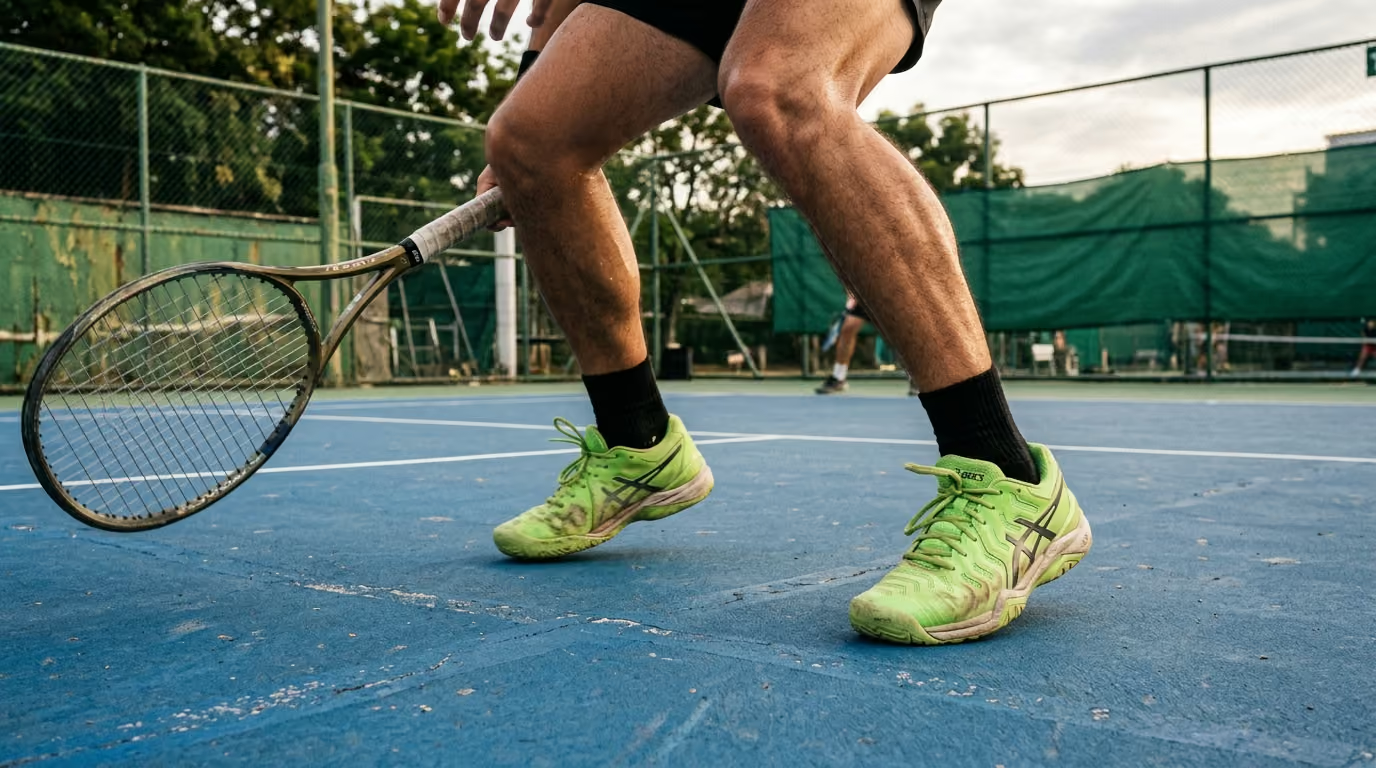
While many athletes prioritize speed, the ability to decelerate and brake effectively is actually the true measure of court performance in racquet sports.




Court movement is often measured by how fast an athlete can sprint toward the ball. However, the ability to stop and change direction is actually the true baseline of court performance. Deceleration is the controlled reduction of horizontal velocity before stopping, changing direction, lunging, or striking. It is not a sudden, jarring halt that rattles your joints, but rather a coordinated, planned absorption of momentum. This guide explains the physical science, mechanical sequences, and practical court drills to master this movement.
Efficient deceleration requires a player to distribute braking force across multiple steps, lower their center of mass, and engage the ankle, knee, and hip joints together. By using the penultimate step to absorb momentum, court players can protect their joints and transition smoothly into the next shot.
To move efficiently, you must understand the difference between stopping and changing direction. In racquet sports, players constantly transition between high-velocity sprints and balanced hitting postures. Braking force is the ground-reaction force directed opposite your current direction of travel. If you are running forward, you must push backward against the court surface to slow down.
This physical concept is described as braking impulse in sports science. Impulse is the product of force and the time over which you apply that force. To decrease your momentum, you can apply a very high force for a brief moment. Alternatively, you can apply a smaller, controlled force over a longer period. The second option is much gentler on your joints and muscles.
According to a systematic review of biomechanical determinants of change-of-direction performance, several key body adjustments are linked to faster, safer movement. Researchers analyzed thirteen studies involving 374 participants to identify these common movement traits. They found that faster performance is associated with a lower center of mass and greater trunk inclination. It is also linked to higher braking and propulsive forces, alongside strong contributions from the ankle, knee, and hip joints.
However, the sports science community still acknowledges certain limitations in this research. A systematic review of deceleration-specific training in adult court athletes concluded that general training programs do not always guarantee improvements in deceleration performance. This means your training must be highly specific to the actual movements you perform on the court. Simply running straight-line sprints will not teach your body how to brake during a lateral cut or a deep corner lunge.
By focusing on controlled compliance rather than joint rigidity, you can improve your mobility and movement resources to handle these sudden forces. This foundation of healthy athletic longevity allows you to play for years without chronic wear. It helps you preserve your cartilage and tendons by spreading forces throughout your entire kinetic chain.
An efficient brake is not a single movement. It is a highly coordinated sequence of six distinct phases. Understanding these phases allows you to analyze your own movement and correct common technical errors.
The first phase is approach and speed regulation. The faster you run toward the ball, the more braking force you must generate to stop. High-level players do not sprint at maximum speed to every ball. Instead, they regulate their approach speed based on the trajectory of the ball and their distance from the target. This early regulation reduces the absolute force required at the end of the run.
The second phase is preparatory deceleration. This phase begins before your final foot contact with the court. Your body starts to transition from travel mode to control mode. You lower your center of mass by bending your hips and knees. Your trunk remains relatively upright or slightly reclined to shift your weight backward.
The third phase is foot placement. To slow down, you must place your foot slightly ahead of your center of mass. This placement allows you to direct ground-reaction forces backward. However, reaching too far forward creates an excessively long lever. This mistake puts extreme stress on your knee and can cause your trunk to collapse forward.
Instead, you should distribute the load between the penultimate step and the final step. The penultimate step is the second-to-last step before you change direction. Research shows this step is the primary braking step in efficient movement. The final step is then used to stabilize and push off into the new direction.
The fourth phase is ankle contribution. The ankle is the first joint to accept the force of court contact. During braking, your ankle must undergo controlled dorsiflexion, which means your shin moves forward over your foot. Your calf muscles must work eccentrically to control this rate of movement. If your ankle is too stiff, the impact will travel directly up to your knee and lower back.
The fifth phase is knee and hip contribution. The knee and hip must flex in coordination with the ankle to absorb forces. This joint action is known as triple flexion. It increases the time available to dissipate energy, protecting your joints from sharp spikes in load. Peak braking forces often occur within the first 50 milliseconds of court contact, making this rapid absorption crucial.
The sixth phase is trunk control. Your torso acts as a stabilizer for your entire body during a brake. An upright or slightly reclined trunk helps keep your center of mass behind your lead foot. If your trunk collapses forward, your hamstrings are placed in a highly vulnerable, lengthened position. Maintaining core stability ensures you can swing your racquet from a balanced foundation.
Racquet sports are unpredictable, requiring multi-directional movement. You must brake in forward, lateral, diagonal, and rotational directions. Each pattern demands a unique technical solution.
Forward braking is common when you run toward the net to reach a drop shot. In this scenario, you must reduce forward momentum while preparing to reach and strike. You can use multiple short adjustment steps to distribute the force. This prevents your upper body from continuing to travel forward after your feet have stopped.
Lateral braking occurs when you shuffle side-to-side along the baseline. To stop your lateral momentum, you must place your braking foot outside your pelvic midline. Your trunk must resist swaying sideways over your planted leg. An efficient lateral brake requires strong hip abductors to control your pelvic position and prevent your knee from collapsing inward.
Diagonal braking combines elements of both forward and lateral movement. It is common when moving from the center of the court to a wide ball. You must decide whether to use a diagonal plant or a crossover step. The best choice depends on the speed of the ball and how far you have to travel.
Your choice of hitting stance also affects your deceleration mechanics. An open stance allows you to strike the ball while keeping your body facing the net. This stance makes it easier to recover quickly, but it demands excellent lateral control from your hips. A closed stance provides a traditional, stable hitting base, but it often requires extra adjustment steps to recover your court position.
In specialized movements like the badminton or squash forward lunge, the loading profiles differ based on the shot. Musculoskeletal modeling studies show that forehand and backhand lunges produce distinct kinematic patterns. Forehand lunges often show higher ankle compressive contact forces and greater horizontal deceleration of the body. Training should focus on progressive loading to prepare your tissues for these specific demands.
Many recreational players suffer from avoidable aches because of poor braking habits. Correcting these mistakes can quickly improve your movement efficiency.
The most frequent error is trying to perform all your braking on the final plant step. When you do this, your final step becomes a hard, jarring impact. This pattern places excessive stress on the lead knee and ankle. It also makes it very difficult to transition quickly into your next movement. Instead, you should use the penultimate step to absorb the majority of your momentum.
Another common mistake is landing with a completely straight, locked knee. A straight knee cannot absorb force through muscle contraction. Instead, the impact is transferred directly to your joint cartilage and bone. Always keep your landing knee soft and slightly bent to allow your muscles to do the work.
Many players also reach too far ahead with their lead foot. While they think this helps them reach the ball, it actually creates a weak mechanical position. The foot is too far from the pelvis, making it hard to push back. This long lever increases the risk of hamstring strains and hip strain.
Finally, players often let their trunk collapse forward during a hard stop. When your torso bends excessively at the waist, your center of mass shifts too far forward. This shift makes you unbalanced and forces your lower back to work too hard to pull you upright. Keeping your chest up and your core engaged will resolve this issue.
To improve your movement, you must practice deceleration as a distinct skill. You should start with simple, slow movements before adding speed and reactivity. These progressive drills will help you develop efficient habits.
On-court drills are only half of the equation. To handle high braking forces, your muscles must possess sufficient eccentric strength. Eccentric strength is the ability of a muscle to produce force while it is lengthening.
According to a meta-analysis of physical training, eccentric overload training shows highly positive effects for change-of-direction speed. The researchers found that athletes who used eccentric overload training completed directional changes significantly faster than those who did not. This demonstrates the performance benefits of targeted strength work.
You can build this capacity by incorporating specific exercises into your routine. Focus on movements that challenge your lower-body joints through a full range of motion.
Step into a lunge position, then lower your back knee toward the floor over a slow, five-second count. Push back up quickly to the starting position. This slow lowering phase forces your quadriceps and glutes to work eccentrically, mimicking the landing phase of a brake. Perform 3 sets of 6 to 8 repetitions per leg.
Place one foot behind you on a bench or step, and perform a single-leg squat on your front leg. This exercise isolates each leg, correcting any strength imbalances between your left and right sides. Keep your torso slightly inclined forward to engage your glutes. Perform 3 sets of 8 repetitions per leg.
Stand on a small box or step, then slowly lower one foot to touch the floor before stepping back up. Keep your knee aligned over your second toe during the entire movement. Do not let your knee collapse inward. Perform 3 sets of 10 slow repetitions.
Hold a weight in your hands, stand on one leg, and hinge at your hips while keeping your back flat. This movement builds the eccentric hamstring strength needed to control your trunk during forward braking. It also improves single-leg balance. Perform 3 sets of 8 repetitions per leg.
Perform both straight-leg and bent-knee calf raises. Your calf muscles control your shin angle during a brake. Strengthening them protects your Achilles tendon and ankle joint from excessive strain. Perform 3 sets of 12 to 15 slow, controlled repetitions.
Stand in an athletic stance while a partner throws a medicine ball toward your chest or hips. Catch the ball and stabilize your body instantly without letting your torso sway. This builds the dynamic trunk stability needed for on-court deceleration. Perform 3 sets of 10 catches.
By combining these strength exercises, you prepare your muscles for the high forces of match play. You can find more structured advice in our strength and conditioning resources.
Every time you brake on the court, your muscles undergo eccentric contractions. These contractions are highly efficient for stopping your body, but they also cause microscopic tears in your muscle fibers. This tissue damage is the primary cause of delayed onset muscle soreness, or DOMS.
If you play a high-intensity match without adequate preparation, you may experience severe muscle soreness the next day. This soreness can limit your mobility and reduce your performance in subsequent sessions. Spreading the braking force across multiple steps reduces the peak damage done to any single muscle group.
Braking also places a high structural demand on your tendons and joint cartilage. Your patellar tendon, which connects your kneecap to your shin, must absorb massive loads during a deep lunge. Your Achilles tendon must also absorb and store energy during every foot plant.
If your muscles are too weak to absorb these forces, the load is transferred directly to your passive structures. Over time, this repetitive stress can lead to tendinopathy or joint wear. Incorporating proper recovery protocols is essential for maintaining your athletic longevity.
To support your tissue health, allow adequate rest between heavy playing sessions. Focus on active recovery, hydration, and gentle mobility work to promote blood flow to your muscles. You can read more about managing post-match fatigue in our recovery science resources.
While the physics of deceleration remain constant, the specific demands of each racquet sport vary. Understanding these differences allows you to tailor your training to your specific sport.
Tennis players operate on a large court, which allows them to reach much higher sprinting speeds. Consequently, tennis requires high-velocity braking over longer distances. Players must often slide to absorb force, particularly on clay courts. On hard courts, they must tolerate high peak impact forces, which demands exceptional eccentric strength. For more tennis-specific movement tips, you can explore our tennis articles.
In contrast, pickleball is played on a much smaller court. Players rarely reach the high sprinting speeds seen in tennis. Instead, pickleball demands rapid, low-amplitude deceleration steps near the non-volley zone line. Players must constantly perform small split-steps and lateral adjustments to react to fast volleys.
Padel occupies a middle ground, combining a moderate-sized court with glass walls. Padel players must frequently transition from forward sprints to rapid back-pedaling. They must also learn to brake and turn near the walls, which requires unique spatial awareness and footwork. Regardless of your sport, the fundamental mechanics of triple flexion and trunk control remain the same.
While some muscle soreness is normal after a hard match, persistent pain is a warning sign. You should never ignore pain that alters how you move on the court.
If you experience sharp joint pain during or after deceleration, you should consult a professional. Localized swelling around your knee, ankle, or Achilles tendon is another clear sign that something is wrong. Pain that worsens specifically when you try to stop or change direction indicates that your tissues are overloaded.
An inability to bear weight on one leg or a feeling of joint instability requires immediate medical attention. These symptoms could indicate a ligament sprain or a tendon tear. A qualified physiotherapist or sports specialist can perform a detailed movement assessment. They can help identify mechanical errors and design a safe rehabilitation program.
To learn more about keeping your joints healthy, visit our injury prevention resources. Taking a proactive approach to your physical health ensures you can enjoy your sport for many years to come.
Is sliding on hard courts safe for my joints?
Sliding on hard courts can actually reduce peak joint loading by extending the time it takes to stop. However, it requires highly specialized footwear, excellent ankle stability, and precise timing. If you do not have the proper physical preparation, attempting to slide can increase your risk of ankle sprains.
Should I land on my heels or my toes when trying to stop?
During high-speed forward braking, an initial heel contact often occurs naturally. This heel-to-toe roll helps absorb and distribute horizontal forces. For lateral cuts and short adjustment steps, a midfoot or forefoot landing is more common to allow for rapid redirection.
How often should I perform deceleration drills?
You can integrate low-intensity deceleration drills into your warm-up routine before every match. Dedicate ten to fifteen minutes twice a week to focused, high-speed braking and reactive agility drills. Always perform these drills when you are fresh to maintain high movement quality.
Can wearing different court shoes improve my braking?
Yes, your shoes play a crucial role in traction and force transmission. Shoes with worn-out outsoles can cause you to slip, while shoes with too much grip might cause a jarring stop. Choose shoes designed specifically for your court surface to ensure optimal traction and support.
Follow Evercourts for practical insights on tennis, pickleball and padel performance, movement, recovery and healthy ageing. Stay connected for new articles, research-led guidance and ideas to help you play well and keep playing for years.


Read practical guidance for better movement, smarter preparation and a game that keeps working for you.
explore the Blog