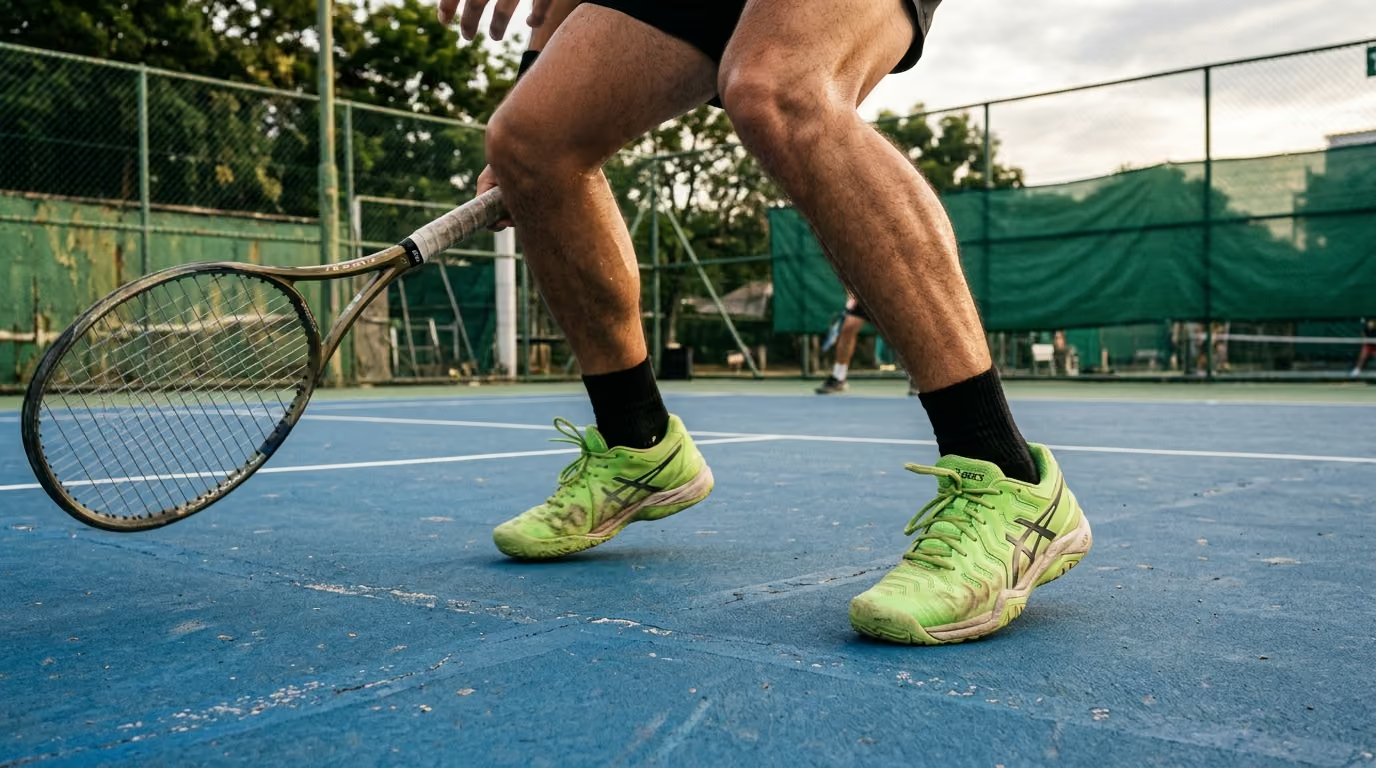

While many court players believe harder workouts are always better, the most effective strength program for racquet athletes involves the minimum effective dose.




Many court players believe that a harder workout is always a better workout. They spend hours in the gym trying to exhaust themselves, hoping it will improve their performance. This intense approach often leads to heavy legs, sore shoulders, and poor court performance. In reality, the most effective strength program for a racquet athlete is the minimum effective dose. You want to build physical capacity while keeping your body fresh for your next match.
A thorough program should focus on athletic longevity rather than temporary fitness peaks. This guide provides a repeatable method to design your own strength plan. It is built around your playing schedule, injury history, equipment access, age, and goals. By treating training as a decision process rather than a fixed list of exercises, you can play the sports you love for years to come.
A sustainable strength program for racquet sports is not a rigid list of exercises, but a dynamic decision-making system. It balances your playing schedule, physical capacity, and recovery to keep you performing on the court. The ultimate goal is to build movement resilience with the minimum effective training dose.
To build a sustainable program, you must view your body as a single system. Racquet sports are highly demanding, intermittent, and acyclic. You constantly alternate between explosive sprints and brief moments of rest. Research from a systematic review in Frontiers in Psychology shows that tennis matches can range from 60 to 90 minutes. Padel matches average around 35 to 36 minutes of continuous play.
These sports require your body to manage multiple physical demands at once. A proper framework must account for your total workload, which is divided into five distinct areas. First, your court workload includes drills, matches, and casual games. Second, your mechanical workload includes the physical impact of serving, lunging, and braking.
Third, your neuromuscular workload covers high-velocity movements and quick reactions. Fourth, your strength-training workload consists of your sets, repetitions, and weights in the gym. Finally, your life workload includes sleep quality, travel stress, and work demands. If you ignore how these factors interact, you risk overtraining and potential injuries.
A systematic review on training load published in the British Journal of Sports Medicine found moderate evidence linking applied training loads to injury or illness. You cannot separate what you do in the gym from what you do on the court. When your court volume increases, your strength training must adjust. This relationship forms the core operating rule of our framework.
To keep your body healthy, you must prioritize your physical needs. Your first goal is to preserve your ability to play on the court. Your second goal is to reduce avoidable injury risks. Your third goal is to build general strength and tissue capacity. Only when these baselines are met should you focus on sport-specific power and speed.
Before picking up a dumbbell, you need to understand your current starting point. This begins with determining your training age. Your training age is the number of years you have spent performing structured resistance training. It is completely different from your chronological age. A fifty-year-old player might have a training age of zero, while a twenty-year-old might have a training age of five.
For a novice player, the focus must remain on basic movement patterns. You need to learn how to hinge, squat, push, pull, and carry safely. The American College of Sports Medicine, or ACSM, recommends that beginners use lighter loads. Specifically, novices should use weights they can lift for eight to twelve repetitions. This builds structural tolerance without overloading your joints.
For advanced players, the programming needs to be more precise. You can use a wider range of loads, spanning from one to twelve repetitions. Advanced players require planned variation to continue making progress. You can access specialized guides on these topics through our strength and conditioning resources. These resources help you tailor your plan to your training history.
Your assessment must also look closely at your previous injuries. A systematic review on badminton injuries in 2025 noted that previous injury is a supported risk factor. If you have a history of ankle sprains, your current tissues may be more vulnerable. You must classify your current physical state before training. Identify if you are pain-free, managing mild symptoms, or recovering from an acute injury.
To build an accurate profile, ask yourself these assessment questions:
Your answers will help you determine how much training stress you can tolerate. A player returning from a knee injury needs a completely different program than a healthy competitor. By answering these questions honestly, you avoid the trap of using a generic online workout. You can find more tailored advice on preserving your joints in our athletic longevity resources.
Tennis, pickleball, and padel are often grouped together, but they place very different demands on your body. Understanding these differences allows you to train the specific qualities you need. It also keeps you from wasting energy on movements that do not transfer to your game. Let us examine the unique characteristics of each sport.
Tennis combines prolonged match play with sudden, explosive movements. The tennis serve requires extreme power and a high contribution of the ATP-PC energy system. Research shows that tennis players maintain average heart rates between 128 and 154 beats per minute. To support this, your program needs lower-body strength for braking and rotational trunk control. You also need targeted shoulder work to handle the repeated impact of serving.
Padel demands rapid lateral movements and constant overhead strokes. Studies show that padel movements are roughly 52 percent lateral and 42 percent frontal. Padel players experience average heart rates between 126 and 159 beats per minute. Because you play on a smaller court, you must constantly accelerate and decelerate. This means your program should prioritize lateral lunges, hip abductor strength, and rotational power.
Pickleball involves lower impact but requires deep, sustained split steps. You spend a large portion of the game in a low, loaded squat position near the kitchen. This places a high demand on your quadriceps, patellar tendons, and calves. The paddle is light, but the reactions must be exceptionally fast. To perform well, you need eccentric lower-body strength and excellent ankle stability. Our mobility and movement resources can help you develop the range of motion needed for these low positions.
By understanding these sport-specific demands, you can choose exercises that offer the highest return on investment. A tennis player should not train exactly like a pickleball player. Your gym time should directly support the movement patterns you use on the court. This targeted approach saves energy and keeps your training efficient.
A great strength program is useless if it leaves you too sore to play. You must organize your training based on your weekly court volume. This requires classifying each week into one of four categories. Once you identify your current week, you can choose the correct training dose.
A low court-load week is ideal for building capacity. During these weeks, you have few matches and plenty of time for recovery. You can safely increase your strength-training volume and intensity. This is the perfect time to challenge your muscles and push for progress.
A moderate court-load week requires a balanced approach. You might have a couple of hitting sessions and one competitive match. Your strength sessions should focus on maintaining your baseline. Keep the intensity high but reduce the total number of sets.
A high court-load week occurs during tournament play or heavy match schedules. During this time, your main goal is physical preservation. You should perform a minimal training dose to keep your joints moving. Avoid training to failure and stay away from highly fatiguing exercises.
A transition week is necessary when returning from an illness or a long vacation. You should not try to resume your previous workloads immediately. Instead, use light weights and focus on movement quality. This gradual return protects your tendons and muscles from sudden overload. You can learn more about managing these periods in our injury prevention resources.
Let us look at how to structure a typical moderate court-load week. If you play tennis or padel on Tuesday and Thursday, your strength sessions should sit on Monday and Friday. This schedule gives your muscles time to recover before you hit the court. It also prevents you from playing with heavy, fatigued legs.
If you are a competitive player with four court sessions, you must be even more careful. You might perform your strength training on the same day as your lighter hitting sessions. This approach clusters your high-fatigue activities together, leaving other days completely free for rest. Protecting your rest days is essential for long-term progress.
To maximize your time in the gym, structure your workouts into six organized blocks. This sequence ensures you perform the most demanding exercises when your central nervous system is fresh. It also helps you warm up progressively and reduce training stress.
This block should increase your body temperature and improve joint mobility. Perform dynamic movements like leg swings, lunges, and light footwork. An older review of racquet-sport injuries suggested that poor warm-up routines are a common factor in court injuries. Spend five to ten minutes preparing your body before lifting heavy weights.
You must perform these movements when you are completely fresh. The ACSM recommends using light loads for power training, such as zero to sixty percent of your maximum. Perform medicine ball rotational throws or low-volume jump variations. Keep your repetitions low, usually between three and five per set. Take long rest periods of three to five minutes to allow full recovery.
This is where you perform compound movements that recruit large muscle groups. ACSM recommends sequencing multi-joint exercises like squats or deadlifts before single-joint movements. Perform three to five sets of four to eight repetitions. Focus on controlled movement and maintain perfect posture throughout each set.
Racquet sports require you to push off one leg and change directions quickly. Exercises like split squats, lateral lunges, and single-leg calf raises are essential here. Perform two to three sets of eight to twelve repetitions on each side. This block builds the specific tissue capacity needed for court movement.
You need a stable core to transfer power from your legs to your racket. Include exercises like suitcase carries, side planks, and external shoulder rotations. These movements do not need to be extremely heavy. Focus on quality, control, and endurance to support your joints.
Only add this block if your court play does not provide enough cardiovascular stress. For tennis players, use longer intermittent intervals that mimic rally times. For padel players, focus on repeated lateral shuttles with short rest periods. If you are already playing several times a week, you can skip this block entirely.
You cannot perform the same workout forever and expect to improve. To see continuous progress, you must apply systematic progression rules. These rules prevent you from adding too much weight too quickly. They also ensure your tendons and muscles adapt safely over time.
The first rule is load progression. Increase your training weight only when you can complete your target repetitions with perfect technique. The ACSM recommends a load increase of two to ten percent. This small step ensures you do not overload your tissues.
The second rule is repetition progression. If you are not ready to add weight, add repetitions instead. Keep the load fixed and try to perform one more repetition per set. Once you reach the top of your target repetition range, you can increase the weight.
The third rule is set progression. You can increase your total training volume by adding an extra set. Only do this if you are recovering well from your current routine. If you feel constantly sore or fatigued on court, do not add sets.
The fourth rule is range-of-motion progression. Always master a partial movement before trying to go deeper. For example, master a shallow split squat before trying to touch your back knee to the floor. Only load ranges of motion that you can control without pain.
You must also have clear options for different training environments. Whether you train in a fully equipped commercial gym or at home, you can find suitable exercises.
For a primary squat pattern, you can use a barbell back squat in a gym. At home, you can substitute a dumbbell goblet squat or a bodyweight split squat.
For a hinge pattern, use a Romanian deadlift with a barbell or heavy dumbbells. At home, you can perform a single-leg hinge using a resistance band or a light kettlebell.
For a horizontal push, use a bench press in the gym or a classic push-up at home. For a vertical pull, use a lat pulldown machine or a band-resisted pull at home.
These equipment substitutions ensure you never miss a workout. You do not need expensive machines to build court-worthy strength. A pair of dumbbells and a resistance band can provide an excellent training stimulus at home.
Your body does not care about your perfect paper program. It only responds to the stress you actually experience. To stay healthy, you must learn to adjust your training based on your daily readiness. This process is called autoregulation.
Start by tracking your session rating of perceived exertion, or RPE. After every strength workout, rate the difficulty on a scale of one to ten. A score of ten represents maximum, exhausting effort. Most of your strength training should fall between a score of six and eight. If you consistently score your sessions as nines or tens, you are training too hard.
You should also keep a simple log of your court play. Record your playing duration, match intensity, and any next-day soreness. This helps you see if your gym work is impacting your court performance. If you notice your legs feel heavy during matches, it is time to reduce your gym volume.
Use a simple traffic-light system before every workout to check your readiness.
Green means you feel normal, have stable joints, and slept well. You can proceed with your planned training session. This is the time to push for progression or add a small amount of weight.
Yellow means you have moderate fatigue, mild muscle soreness, or poor sleep. Reduce your total sets by one or two per exercise. You can also skip your power training and focus only on moderate strength work.
Red means you have sharp pain, joint stiffness, or extreme exhaustion. Do not try to push through a red day. Instead, perform gentle mobility exercises or take a complete rest day. This simple system is essential for maintaining your athletic longevity. You can learn more about managing your body's energy in our recovery science resources.
Autoregulation protects you from training when your body is vulnerable. It acknowledges that poor sleep or work stress reduces your recovery capacity. By adjusting your weights to match your daily energy, you make consistent progress without burning out.
Many athletes make simple mistakes that ruin their progress. By identifying these pitfalls early, you can save yourself months of frustration. Let us look at the most common errors racquet players make in the gym.
The first pitfall is treating all racquet sports as identical. As we discussed, tennis, padel, and pickleball have very different movement demands. A tennis player needs maximum serve power and long-court endurance. A pickleball player needs quick hands and deep, low-stance isometric strength. Your gym work must reflect the specific demands of your chosen sport.
The second pitfall is training only your hitting muscles. Many players spend too much time on chest presses and bicep curls. They ignore their back, hips, and calves. Your body is a kinetic chain that transfers force from the ground up. If you have weak hips, your shoulder has to work much harder to swing the racket.
The third pitfall is chasing extreme muscle soreness. Some players believe a workout is only good if they cannot walk the next day. In reality, severe soreness is a sign of excessive muscle damage. It ruins your court movement and increases your risk of injury. Your goal in the gym is to stimulate your muscles, not destroy them.
The fourth pitfall is relying on minor exercises instead of proper load management. Doing a few band exercises for your rotator cuff will not save your shoulder if you suddenly double your playing time. A 2025 tennis review highlighted that rapid increases in your acute-to-chronic workload ratio are linked to injury. No single exercise can replace a smart, gradual increase in your playing and training volume.
The fifth pitfall is using fixed weight percentages without context. Prescribing an exact percentage of your maximum lift can be dangerous if you are exhausted. If you had poor sleep or traveled for a tournament, that weight will feel much heavier. Always use your daily readiness to guide your loading decisions.
While a smart strength program can build resilience, it is not a replacement for medical care. You must know when to stop training and seek professional help. Ignoring warning signs can turn a minor strain into a chronic issue.
You should consult a qualified healthcare provider if you experience sharp, localized pain. This is especially true if the pain occurs inside a joint, like your knee or shoulder. Normal muscle soreness feels dull and spread out across the muscle belly. Sharp, stabbing pain during a specific movement is a clear warning sign.
You should also seek help if you experience neurological symptoms. These include numbness, tingling, or shooting pain down your arms or legs. These symptoms often point to nerve irritation that requires careful clinical diagnosis. Do not attempt to stretch or strengthen your way out of these issues.
Another warning sign is swelling or heat around a joint. If your knee swells up after a match, your joint is under significant stress. A physiotherapist can identify the root cause of the swelling and guide your recovery. They can help you modify your strength program to keep you active while your tissues heal. If you need to contact us for general guidance, please visit our contact page.
Remember that pain is a signal from your nervous system. It tells you that your current workload has exceeded your tissue tolerance. A qualified professional can help you find the right balance between rest and loaded movement.
Let us look at how this framework works in real life. These case patterns show how to adjust the program for different players.
This player plays twice a week and has access to dumbbells at home. First, we temporarily reduce his heavy overhead pressing in the gym. We replace it with dumbbell chest presses and single-arm rows. We add external shoulder rotations and side planks to support his kinetic chain. He continues to serve on court, but he limits his total serve volume to twenty per session. We progress his overhead movements only when he is completely pain-free the next morning.
This player has a history of ankle sprains and is rapidly increasing her weekly training hours. Our first priority is restoring her ankle stability and calf strength. We include single-leg calf raises, balance work, and lateral lunges. We introduce low-volume landing drills before allowing her to perform explosive jumps. Her weekly schedule includes one mandatory rest day to allow her tissues to adapt. This structured approach protects her during this critical growth phase.
This player has no current injuries but has never done structured strength training. We do not start with complex, high-velocity power exercises. Instead, we spend six weeks building a foundation of general strength. We use goblet squats, Romanian deadlifts, and dumbbell rows. Once he can perform these movements with excellent control, we add lateral lunges and medicine ball throws. This systematic progression ensures he builds usable power without irritating his joints.
Because of his age and the long break, his tendons need a gradual reintroduction to load. We begin with two short, full-body strength sessions per week. We focus on slow, controlled tempos for his squats and calf raises. On court, he starts with solo hitting drills rather than competitive matches. He limits his first court sessions to thirty minutes and takes two rest days between games. This careful plan protects his Achilles and patellar tendons from sudden overload.
This player travels frequently and only has thirty minutes for gym sessions. We design a minimum-effective-dose routine that hits every major movement pattern. She performs a brief warm-up followed by three sets of medicine ball throws. Next, she completes three sets of dumbbell split squats and three sets of Romanian deadlifts. She finishes with three sets of rows and two sets of suitcase carries. This simple workout takes exactly twenty-five minutes and keeps her strong during a long season. For more practical advice on managing your court life, visit the Evercourts blog.
To get the most out of this framework, you must think long-term. Your body adapts to the demands you place on it over months, not days. By planning your training in phases, you can build lasting strength and athletic longevity. This long-term approach ensures you can enjoy your favorite racquet sports for years to come.
Start by focusing on consistency rather than intensity. It is far better to perform two short, moderate strength sessions every week than one massive workout that leaves you sore for days. Keep your log updated and listen to your body's readiness signals. This simple habit is the true foundation of successful physical preparation.
As your strength improves, you will notice your court movement becomes more effortless. You will recover faster from long matches and feel more stable during dynamic shots. This is the power of a well-designed strength framework. It does not replace your court skills, but it gives you the physical foundation to express them fully.
By applying these principles consistently, you can build a resilient body that supports your passion for racquet sports.
Follow Evercourts for practical insights on tennis, pickleball and padel performance, movement, recovery and healthy ageing. Stay connected for new articles, research-led guidance and ideas to help you play well and keep playing for years.


Read practical guidance for better movement, smarter preparation and a game that keeps working for you.
explore the Blog