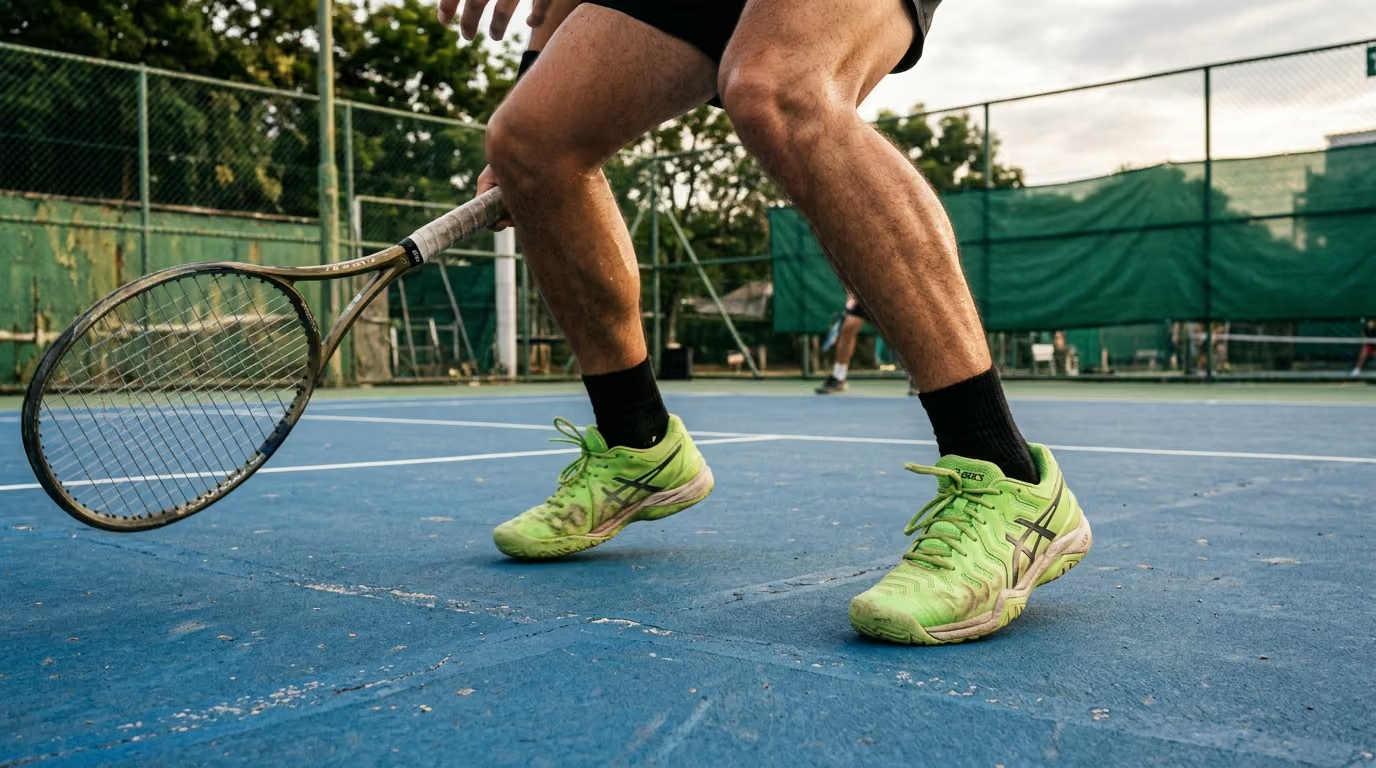

When a simple lob lands between partners or a collision occurs on a middle ball, a structured communication system transforms two players into a cohesive unit.




Have you ever collided with your partner on a middle ball, or watched a simple lob land between you because both of you hesitated? This common frustration occurs when teams rely on vague instincts instead of a structured communication system.
A reliable doubles system uses pre-agreed hand signals, immediate verbal calls, and joint movement patterns to eliminate court confusion. By coordinating your intentions before the point and executing them together, you transform two individual players into a single cohesive unit. This practical guide provides the exact playbooks, signals, and drills you need to establish a highly functional partnership.
Many players assume that successful doubles partnerships are built purely on individual skill or social chemistry. However, sports science research reveals that structured communication is the actual differentiator between winning and losing teams. When we study high-level court dynamics, we find that the quantity, quality, and structure of partner interactions directly predict competitive outcomes.
Research conducted on NCAA Division I women’s tennis doubles teams demonstrated a stark contrast in communication habits. Winning teams exchanged roughly twice as many messages as losing teams during a match. Furthermore, these successful pairings utilized highly homogeneous communication patterns. This consistency made their messages significantly easier to interpret under intense time pressure. The same study revealed that more than half of the recorded communications were emotional statements, while over one-quarter were action-oriented instructions.
A parallel study on NCAA Division I men’s tennis teams supported these findings. Winning male players utilized a high volume of emotional, action, encouragement, and planning statements. Conversely, losing teams engaged in more non-task-related communication, which often distracted them from the match strategy. This indicates that communication must remain focused on court events and emotional stabilization to be effective.
To understand how this works, we must look at how experienced partners use their voice and body language on the court. A phenomenological study of established doubles partners identified four primary functions of team communication:
These functions contribute directly to team cohesion. In sports psychology, a meta-analysis on team dynamics revealed a significant, moderate-to-large relationship between overall cohesion and athletic performance. When researchers looked closer, they found that task cohesion has a much stronger relationship with winning than social cohesion. Task cohesion represents a team's shared commitment to tactical roles, systems, and objectives. You do not need to be best friends to win, but you must agree on who covers the middle.
A 2025 scoping review of elite sports doubles players identified five core collaborative practices: performance evaluation, frequent structured practice, ongoing coach feedback, a shared team culture, and partner familiarity. These findings prove that team coordination is not an innate gift. It is a highly trainable skill that must be practiced, reviewed, and refined just like a serve or a volley.
To implement these scientific insights, a team must treat communication as a closed-loop system. This model prevents misunderstandings by ensuring that every message is received and confirmed. The loop consists of five distinct stages:
Within this closed-loop system, your communication must be divided into four categories. Pre-point communication focuses on strategy and positioning. In-point communication coordinates ball ownership and recovery. Post-point communication evaluates the tactical outcome. Emotional communication maintains partner confidence and focus.
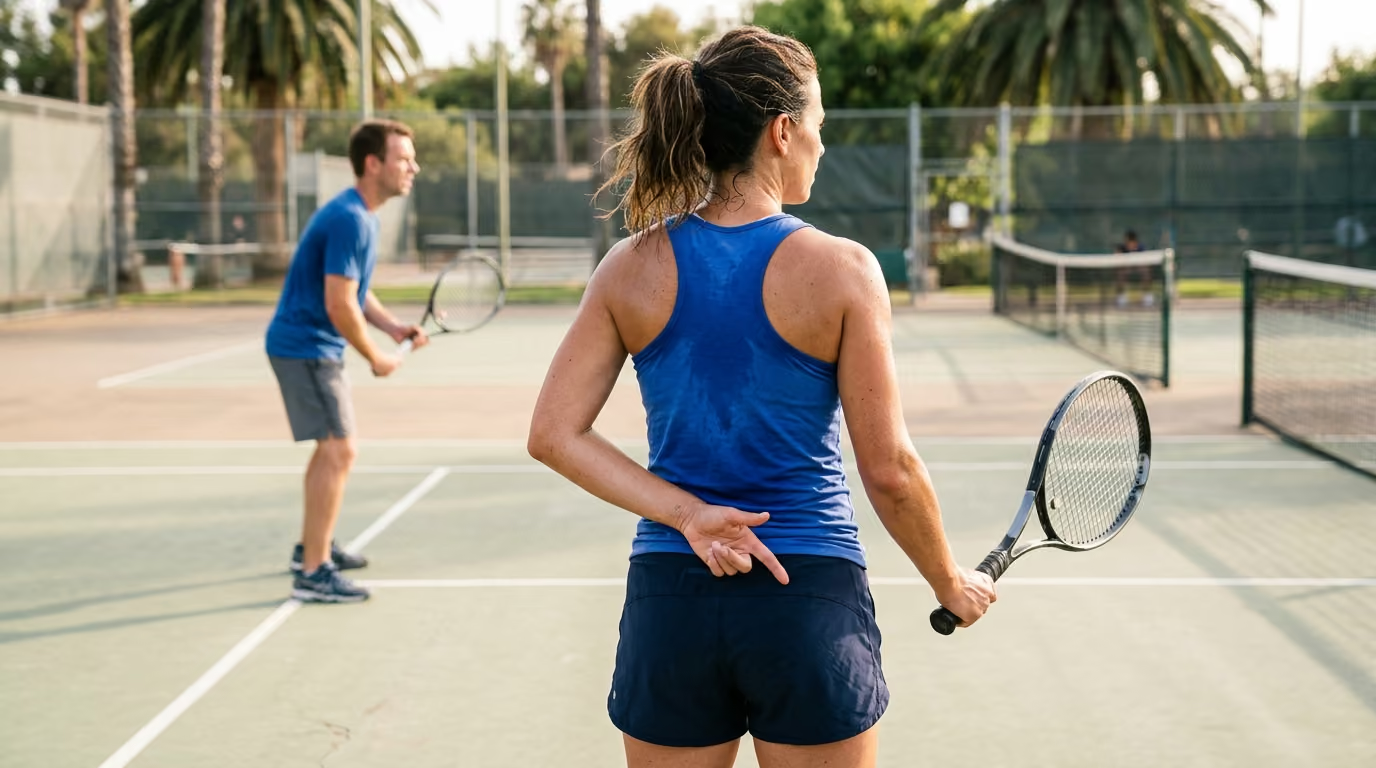
A successful team relies on both verbal and nonverbal cues to move through these stages. Nonverbal communication is highly efficient because it does not alert your opponents to your plans. Behind-the-back hand signals, eye contact, racket taps, and deliberate body orientation are excellent tools for quiet coordination. Research shows that winning players tend to score higher on measures of sensitivity to nonverbal cues than losing players.
However, hand signals are not universal. A fist, an open hand, or a wiggling finger can mean entirely different things to different players. You must explicitly define your team's vocabulary before you step onto the court. Here is a reliable, standard vocabulary system you can establish with your partner:
To keep these calls effective, apply the one-message rule. This rule dictates that one player gives one clear call, and the partner immediately acts without hesitation or debate. Conflicting or late calls cause catastrophic hesitation on the court.
To communicate effectively, partners must share an identical understanding of the court’s geometry. You cannot coordinate your movements if "the line" or "the middle" means different things to each player.
Every player must master the core location vocabulary. The "line" refers to the alley or sideline channel. The "middle" represents the central seam between both partners. "Crosscourt" defines the diagonal angle across the court, while "down the line" refers to a straight-line target parallel to the sideline. "Inside" means moving toward the center service line, whereas "outside" indicates moving toward the outer single boundaries.
To navigate this geometry under pressure, use the ball-player-space model. This model requires you to answer three questions before every movement:
If your partner is pulled wide into the alley, they cannot protect the center. You must immediately shift toward the middle to cover the open space. This collective movement is called the accordion model. When the ball moves left, both players shift left. When the ball moves right, both players shift right. If one player retreats, the other adjusts to cover the open court.
Managing the middle corridor is the most common positional challenge in doubles. You should never improvise middle-ball responsibility during a fast rally. Instead, establish a clear default rule before the match.
The most common default is that the player with their forehand in the center takes the middle ball. For two right-handed players, the player on the ad court (left side) always has their forehand in the middle. For a right-handed and left-handed pairing, you may have both forehands or both backhands in the middle, which requires an explicit agreement.
While "forehand takes the middle" is an excellent default, it can fail in several predictable situations:
The serve is your team's greatest opportunity to control the point from the very first shot. However, a great serve is wasted if the net player does not know where the ball is going. To solve this, the server and net player must use a pre-serve planning system.
Before the serve, the net player stands at the net with their hand behind their back. They show a signal to the server to establish the play. A common system uses two consecutive signals. The first signal designates the serve direction:
The second signal designates the net player's movement:
If the server agrees with the plan, they nod. If they want to change the target, they shake their head and the net player offers a different signal.
This coordination can be organized into a strategic planning matrix. When serving wide, the returner is pulled off the court, creating a crosscourt return angle. The net player can poach toward the middle, while the server covers the line or the short alley.
When serving into the body, the returner is jammed, which often produces a floating, weak return. The net player should hold their position or fake, preparing to smash any loose ball in the center. When serving down the T, the returner’s angle is highly restricted. The net player can poach aggressively or hold, while the server covers the open side.
The communication demands change based on your starting formation. In a traditional formation, the server is at the baseline, and the partner is at the net on the opposite side. This requires only a simple serve target and a stay or poach decision.
In the I formation, both players align near the center line. This creates intense visual pressure on the returner. The net player must signal which direction they will move after the serve, and the server must run to cover the opposite side. If you use the Australian formation, both players start on the same half of the court. You must explicitly agree on who will cover the open side if the returner hits down the line.
The return team faces a different challenge. The non-returner must stand in a position that allows them to help their partner without leaving the court wide open. Before the serve, the return team should agree on:
For detailed tactical frameworks across different court setups, you can explore our resources on the Evercourts platform to refine your team’s competitive approach.
A doubles partnership can easily unravel after a few missed shots. When tension rises, players often stop talking, which leads to more mistakes and deeper frustration. To prevent this destructive cycle, you must separate tactical accountability from personal blame.
An unproductive post-point interaction focuses on personal failure. For example, saying, "You never take anything in the middle," attacks your partner's competence. A productive interaction uses the fact, decision, and adjustment framework.
Start with the objective fact: "The return went straight through the middle." Follow with the decision: "We both hesitated because we did not call it." End with the actionable adjustment: "You take all forehand middles next time; I will call yours if you are pulled wide." This keeps the conversation constructive and focused on the next point.
To maintain this focus, use ownership language. Each player must take immediate responsibility for their own mistakes. Saying, "My call was late," or "I should have stayed," defuses tension instantly. It shows your partner that you are aware of your role in the error, which eliminates their need to point it out.
When partners disagree about court tactics, do not hold a long debate on the baseline. Implement a strict disagreement protocol:
This protocol prevents constant tactical changes after every single lost point. You cannot evaluate a strategy if you do not give it enough repetitions to succeed.
Finally, you must actively manage emotional contagion. Your body language and facial expressions have a profound impact on your partner’s confidence. If you roll your eyes, sigh heavily, or look away after their mistake, you increase their performance anxiety.
Instead, establish a consistent physical and verbal reset routine. Meet in the middle of the court for a quick racket or paddle tap after every point, regardless of the outcome. Use a pre-agreed reset phrase like "Next ball," "We are good," or "Same plan." This simple ritual breaks the momentum of a bad mistake and re-anchors your team in the present moment.
While the core principles of communication apply to all racquet sports, the court size, rules, and equipment create unique demands for tennis, pickleball, and padel.
In tennis, the court is large, and the ball travels at very high speeds. This means physical signals must be highly visible, and verbal calls must be delivered extremely early.
Under the official rules of tennis, you may communicate with your partner while the ball is traveling toward your side of the court. For example, you can call "yours" or "switch" to coordinate positioning. However, you are legally prohibited from talking or making loud noises while the ball is traveling toward your opponents. Doing so can result in a hindrance call, which awards the point to your opponents.
Tennis also permits a wide range of starting formations, such as the I formation and the Australian formation. This is because the server’s partner has complete freedom to stand anywhere on their side of the net. However, the server must obey strict legal requirements. They must alternate serving from the deuce and ad courts, and they must keep their feet behind the baseline within the center and side extensions.
For more strategic guides on mastering the tennis court, you can read our specialized tennis articles to elevate your doubles play.
Pickleball is played on a much smaller court, which alters the timing and vocabulary of your communication. The presence of the non-volley zone (the kitchen) means that matches are won or lost at the net.
Under USA Pickleball rules, your starting positions are determined strictly by the score. The starting server must serve from the right side when their team's score is even, and from the left when it is odd. Because of this, teams often use stacking, a system where players swap sides immediately after the serve or return to preserve their preferred lateral positions. Stacking requires constant verbal confirmation before every serve to ensure no one commits a service positioning error.
In pickleball, the "up" call is the most important instruction on the court. Because the serving team must allow the return to bounce before hitting it (the double-bounce rule), they start at a disadvantage. The return team is already at the kitchen line. The serving team must communicate when it is safe to move "up" together, usually after hitting a successful third-shot drop.
To learn more about positioning and tactical coordination on the short court, check out our pickleball guides.
Padel introduces a three-dimensional challenge because of the glass walls and metal mesh enclosing the court. The game is highly dynamic, with a very high frequency of lobs and ball rebounds.
In padel, you must communicate constantly while the ball is in play. Because players must often run backward to defend against lobs, the net player acts as the "eyes" of the team. While your partner is running backward to hit a smash or a bandeja, you must look at the opponents and call out their positions.
Common padel calls include:
Padel partners must move like they are connected by a short rope. If your partner is pulled wide to play a ball off the side glass, you must instantly slide to cover the center glass. This constant lateral shifting requires continuous, high-volume verbal encouragement and positioning cues.
Even experienced players fall into predictable communication traps that damage their performance and strain their partnership.
This error occurs when a ball is hit directly down the center seam, and both players remain completely silent. Either both players swing at the same time, leading to a clashed racket or paddle, or both players step back, letting the ball land untouched.
This mistake is caused by a failure to establish a default middle-ball rule. To fix this, agree on a baseline rule before the match begins, such as "forehand takes the middle." If a ball enters this zone and no one calls it, the forehand player must hit it.
A late "switch" call is highly dangerous and tactically useless. If your partner calls "switch" after the ball has already flown past them, you are forced to make a sudden, desperate turn to chase the ball. This often results in a weak defensive shot or a physical collision.
A switch call must be delivered the instant the ball is struck over your partner's head. If you cannot call it early, do not call it at all. Instead, the net player should simply recover to the best defensive position possible on their own side.
There is nothing more frustrating than receiving a detailed technical analysis of your swing from your partner immediately after you miss a volley. Saying, "You dropped your wrist on that shot," does not help your partner. It only increases their self-consciousness and frustration.
Keep your post-point communication strictly focused on tactics and positioning, not mechanics. If your partner misses a shot, offer a quick physical tap and say, "Good aggressive swing, keep going." Save the technical discussions for the practice court.
Establishing a clear communication system does more than just win points; it protects your physical health. When a team does not communicate, players are forced to make sudden, uncoordinated movements to cover for their partner's hesitation.
These emergency physical adjustments are highly taxing on the body. They require abrupt deceleration, awkward lunging, and violent twisting of the torso. These erratic movements significantly increase the shear forces on your knees, ankles, and lower back, raising your risk of acute muscle strains or joint sprains.
I remember finishing a tough two hour padel match on a cold Tuesday night and waking up the next morning feeling like my lower back was locked in concrete. For a long time, I just accepted this as the price of playing hard in my forties. But once I started spending just ten minutes on targeted hip mobility before heading to the club, the stiffness almost completely vanished. It taught me that we do not have to accept pain as a default state of aging.
By communicating early and moving as a coordinated unit, you drastically reduce the need for these desperate, high-risk physical recoveries. When you know exactly who is covering the middle and when to switch, your movement becomes smooth, predictable, and proactive. You glide into position early, which allows you to hit from a balanced stance. This preserves your energy, reduces overall physical fatigue, and protects your joints from repetitive wear and tear.
To learn more about maintaining your physical capability and preventing chronic joint stiffness, explore our player health resources.
To make your communication system automatic under pressure, you must practice it during your training sessions. Here are six highly effective partner drills designed to build your team's coordination.
Stand in your standard starting positions on the court with your partner. Have a coach or a third player call out randomized scenarios, such as "Lob over the net player," "Server pulled wide," or "Fast ball down the center seam."
You and your partner must instantly yell out the correct verbal call and move to the appropriate defensive positions. This drill builds muscle memory for your vocal cords and your feet, ensuring you do not freeze during a real match.
Position yourself and your partner at the net. Have a coach or a ball machine feed rapid volleys directly down the center line at unpredictable heights and speeds.
The players must call "mine" or "yours" before the ball crosses the net. If a player calls "mine," they must execute the volley while the partner steps back slightly to cover the angle. If neither player calls the ball, you lose a point. This drill trains early decision-making and establishes the dominance of the verbal call.
The server stands at the baseline, and the net player stands in their serving position. Before every serve, the net player must use hand signals to communicate the serve target and their intended movement (stay, poach, or fake).
The server must execute the serve to the requested target. A returner then hits a crosscourt return. The net player must execute their signaled movement, and the server must move to cover the open court. Play the point out, focusing on smooth recovery positioning.
Play a series of practice tiebreaks where you and your partner are strictly forbidden from speaking during the rally. You may only use hand signals before the serve, eye contact, and body positioning cues to coordinate your movements.
This constraint forces you to pay intense attention to your partner's physical posture and racket preparation. It dramatically improves your nonverbal sensitivity, which is a key trait of winning doubles teams.
During a standard practice set, implement a strict five-second rule after every single point. No matter how the point ended, you and your partner must meet in the middle of the court within five seconds.
You must deliver one objective tactical acknowledgment, one adjustment for the next point, and one positive physical cue (like a paddle tap). This drill builds the habit of rapid emotional recovery, preventing negative momentum from building after consecutive errors.
Play a practice match to eleven points using specific scoring constraints that reward communication. For example, award two points for every successful poach that was signaled before the serve.
Conversely, deduct one point every time partners collide or fail to call a ball in the middle. These constraints force you to prioritize team coordination over individual play, making your communication system a habit.
For comprehensive workout routines and movement drills that support your court agility, explore our mobility and movement resources.
While structured communication is a tactical asset, it is also a vital safety measure. On a crowded doubles court, uncoordinated movements can lead to high-velocity physical collisions.
If you or your partner experience a collision that results in a joint sprain, muscle tear, or a blow to the head, stop playing immediately. Do not attempt to push through acute pain or dizziness to finish a match.
You should consult a qualified healthcare provider or physical therapist if you experience any of the following warning signs:
Prioritizing your physical health ensures you can continue playing the sports you love for years to come.
To transform your doubles partnership this week, follow this simple implementation checklist:
Follow Evercourts for practical insights on tennis, pickleball and padel performance, movement, recovery and healthy ageing. Stay connected for new articles, research-led guidance and ideas to help you play well and keep playing for years.


Read practical guidance for better movement, smarter preparation and a game that keeps working for you.
explore the Blog