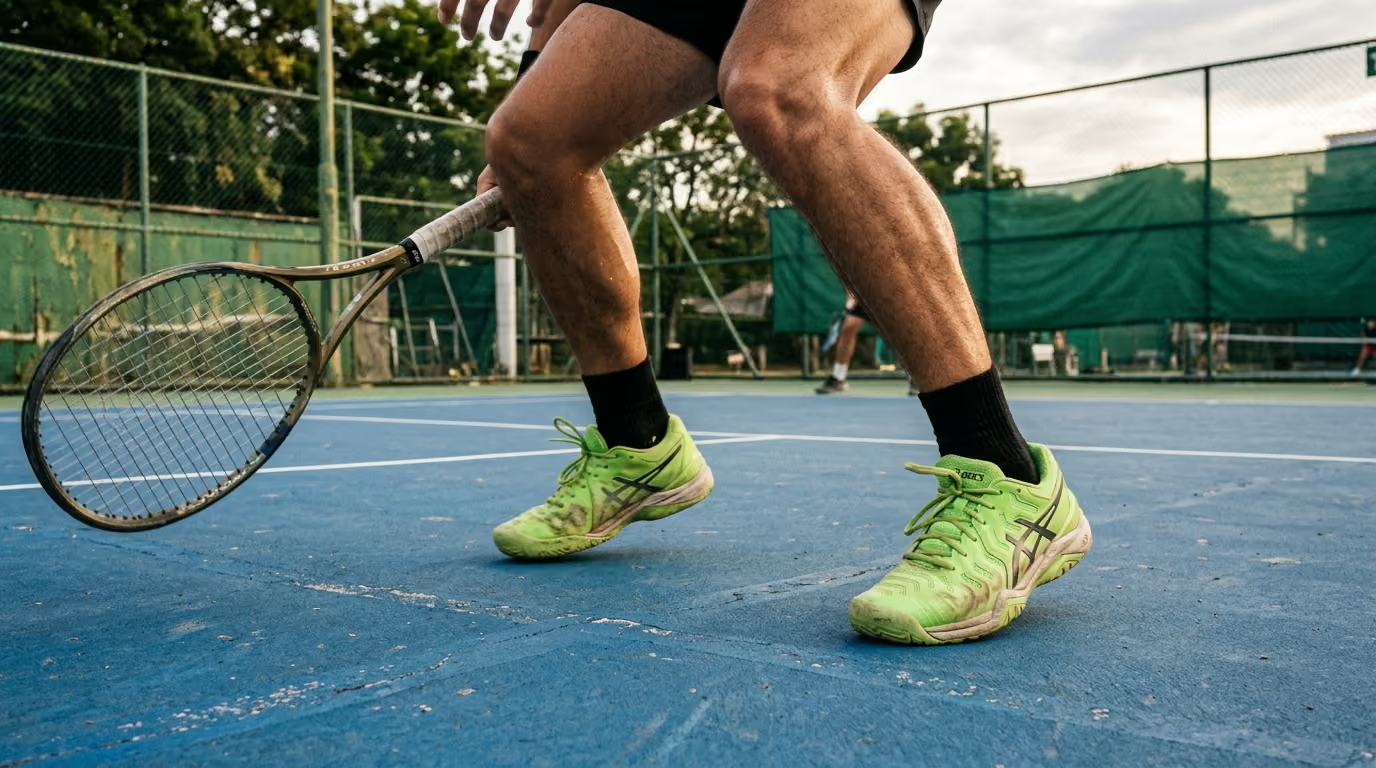
This comprehensive guide details 15 essential principles of doubles court coverage, including movement, formation, and communication strategies for racquet sports.




A high, floating ball drifts directly down the center line. Both you and your partner hesitate for a fraction of a second, watching the ball land untouched between you. You both turn to each other, palms up, and say, "I thought you had it." This scenario is familiar to anyone who plays racquet sports, whether on a tennis court, a pickleball court, or inside a padel cage.
Coordinated doubles court coverage requires partners to move as a single connected unit, managing space, time, and shot probability together rather than simply defending separate halves of the court. By establishing clear rules for ball ownership, shifting dynamically in the direction of the ball, and communicating before and during the point, players can close defensive gaps and create better offensive opportunities.
To build a reliable partnership, we must understand the spatial, physical, and tactical rules that govern how two players share a court. This guide outlines the essential principles of movement, formation, and communication for all three major racquet sports.
Doubles play is often misunderstood as two separate individuals playing singles on the same side of the net. In reality, effective court coverage is an active exercise in geometry. The main objective is to reduce the angles available to the opponent while positioning yourself to strike the ball cleanly.
Static coverage refers to where you and your partner stand before a point begins. This is your baseline formation, which is designed to cover the most common shots. Dynamic coverage, however, is where you move as the ball travels through the air.
As soon as a ball is struck, the geometry of the court changes. A static player remains in their starting spot and leaves vast lanes open. A dynamic player shifts in relation to the ball’s trajectory, constantly closing down the opponent’s highest-percentage targets.
Many successful doubles partnerships describe their movement using the metaphor of a rope. Imagine a ten-foot rope connecting you and your partner. If you slide three feet to the left, your partner must also slide three feet to the left to keep the rope taut.
If you remain stationary while your partner moves, the rope stretches, creating a massive gap in the middle of the court. Conversely, if you crowd your partner, the rope slackens, leaving the outer lines completely exposed. Keeping this connection tight ensures that you cover lateral space efficiently.
A foundational rule of lateral movement is that both players must shift toward the direction of their own shot. If you hit a ball deep into the opponent’s left corner, both you and your partner must slide toward that left side.
This movement closes down the straight-down-the-line passing shot and the sharp cross-court angle. The player closest to the ball covers the line, while the cross-court partner narrows the middle. When the ball is redirected to the other side, both partners reverse their movement in unison.
Lateral spacing must be wide enough to defend the outer boundaries but narrow enough to prevent easy shots through the middle. The ideal distance between partners fluctuates based on the tactical phase of the rally.
To build your understanding of these tactical movements, you can review our court performance resources, which offer practical guides on positioning.
Understanding the physical demands of doubles movement helps players prepare their bodies for competition. Different racquet sports place distinct physical stresses on the body, which can be measured through movement rates, speed, and distance.
A 2025 study published in the Journal of Science and Medicine in Sport compared simulated doubles tennis and padel sessions. The research involved eight national-level male players and measured several movement variables over 40 minutes of play.
The study found that tennis players moved at a higher overall rate. Tennis players covered a distance rate of 43.92 plus or minus 3.93 meters per minute. Padel players covered 34.79 plus or minus 6.60 meters per minute.
Average speeds also differed. Tennis players averaged 2.63 plus or minus 0.25 kilometers per hour, while padel players averaged 2.10 plus or minus 0.40 kilometers per hour.
The same study tracked high-intensity efforts. Tennis players recorded approximately 15.63 total sprints per session. Padel players performed an average of 9.67 sprints.
Over the 40-minute simulated sessions, tennis players covered approximately 1,706.83 meters. Padel players covered approximately 1,392.96 meters.
It is important to note that this study used a small sample of highly competitive players. While the exact numbers may differ for recreational athletes, the data clearly shows that doubles tennis requires more continuous high-speed running over larger areas.
A systematic review of padel match play offers broader data on how players move in that sport. Advanced padel players cover approximately 3,000 meters over the course of a full match.
Roughly 50.8% of this total distance is covered while the ball is actively in play. The average distance covered per point is approximately 11 meters.
Interestingly, about 40% of all padel points involve individual movement distances shorter than 8 meters. This points to a game characterized by shorter, highly repetitive lateral adjustments rather than long-distance sprints.
Tennis performance research has consistently associated winning points with offensive court positioning. Players who win points tend to spend more time in offensive zones and force their opponents to cover greater distances at higher speeds.
This highlights the value of proactive court coverage. By moving early and taking up aggressive positions, you reduce your own running distance while forcing your opponents to sprint.
Formations are the starting arrangements that teams use to organize their coverage. Selecting the right formation helps establish clear roles and minimizes confusion during the point.
The "both up" formation puts both players near the net or the non-volley line. This is the most offensive position in doubles.
By standing close to the net, you cut off the opponent's angles and reduce their reaction time. However, this formation leaves the back of the court vulnerable to lobs. Partners must be prepared to retreat together if a high ball is played over their heads.
In the "both back" formation, both partners stand near the baseline. This is primarily a defensive setup.
It is useful when your team is under heavy pressure or when facing hard-hitting opponents. While it offers excellent coverage against deep drives and lobs, it leaves a massive gap short in the court. This makes it difficult to win the point outright.
The staggered formation is the most common starting position in traditional tennis doubles. One player stands at the net to look for volleys, while the other covers the baseline.
This formation provides balanced coverage for both short and deep balls. However, it also creates a diagonal gap between the players. Opponents can exploit this gap by hitting soft, low angled shots between the partners.
Stacking is a specialized formation where partners start on non-traditional sides of the court. It is commonly used when one partner has a dominant forehand or when a left-handed and right-handed pair want their forehands in the middle.
Switching occurs during a rally when partners exchange sides of the court. This usually happens after a poach or when one player is pulled completely out of position. The player who crosses must stay on the new side, and their partner must slide over to cover the vacated space.
Without communication, even the most athletic players will struggle to cover the court. An effective communication system uses simple, pre-determined calls to eliminate hesitation.
Before the ball is served, partners should agree on a basic plan. This is especially important for the serving team.
Using simple hand signals or brief verbal cues behind the baseline can coordinate your movement. Common pre-point plans include:
Once the rally begins, calls must be short, loud, and immediate. Late calls are often worse than no calls at all, as they cause both players to freeze.
The most common live-action calls are:
Between rallies, take five seconds to discuss spatial adjustments. Avoid long, technical lectures about strokes.
Instead, focus on simple, actionable tactical notes. For example, you might say, "They are attacking the alley, so I will stand closer to the line," or "Let's shift toward the middle on the next return." This keeps both players focused on spatial coordination.
Tennis doubles uses a large court with wide alleys. Players must understand the specific responsibilities of all four positions on the court.
The server must not view their job as finished once the ball is struck. Their serve choice directly influences how their partner can move at the net.
If the server hits a wide serve, the opponent’s return will likely travel wide. The server’s partner must protect the alley. If the server hits a serve down the "T", the return is more likely to travel down the middle, which allows the net player to poach.
After serving, the server must quickly recover. If they are playing a serve-and-volley style, they must sprint forward to the service line and split-step. If they are staying back, they must shift laterally to cover the open baseline lane.
The server’s partner starts at the net and acts as the primary pressure player. Their job is to distract the returner and look for weak, floating returns to volley.
The net player must perform a split-step exactly as the returner makes contact with the ball. They should protect their alley while looking for opportunities to move laterally into the middle.
Using a "fake-and-hold" technique can be highly effective. The net player takes a quick step toward the center just before the returner hits, then freezes and pushes back to cover the line. This movement forces the returner to think twice about their target.
The returner’s primary objective is to hit a low, controlled ball that prevents the net player from poaching. A high, floating return is an invitation for the net player to finish the point.
Cross-court returns offer the highest margin of safety because the net is lowest in the center. Returning down the line is a high-risk play that should be used sparingly, as the net player is waiting to intercept it.
Immediately after hitting the return, the returner must recover. If they hit a deep, heavy return, they can transition forward. If the return is weak, they must prepare to play defensively from behind the baseline.
The returner’s partner starts in a challenging, transitional position, usually near the service line. They must watch the server’s partner closely.
If the server’s partner poaches and intercepts the return, the returner’s partner must prepare for a hard volley coming their way. If the return safely bypasses the net player, the returner’s partner should immediately move forward to the net.
If you want to read more about tactical movement and general court safety, you can explore the Evercourts blog for regular updates and coaching insights.
Pickleball is played on a smaller court, but its unique rules, such as the non-volley zone, create specific movement demands.
In pickleball, the serving team starts with both players behind the baseline. The receiving team has one player deep to receive the serve and one player already established at the kitchen line.
This asymmetry means the serving team must work to earn their way forward. They do this by hitting a "third-shot drop," which is a soft, arc-like shot that lands gently inside the opponent's kitchen.
Both serving players must transition forward together behind this shot. If one player runs forward while the other remains deep, they create a staggered gap that is easily targeted. They should advance in stages, stopping and split-stepping whenever the opponent is about to strike the ball.
Once all four players are at the kitchen line, the game becomes a tactical battle of dinks and speed-ups. Players must stand just an inch behind the non-volley line without stepping on it.
At the kitchen line, your primary responsibility is to keep your dinks low. If a dink is hit too high, the opponent can hit a hard downward volley.
Partners must shift laterally together as the ball is dinked back and forth. If the ball is dinked wide to the left, both players must slide left. The player directly opposite the ball covers the straight shot, while their partner slides over to protect the middle.
Stacking is incredibly common in competitive pickleball. It allows teams to keep a left-handed player on the right side and a right-handed player on the left side, keeping both forehands in the middle.
During the serve or return, players will stand out of bounds or in non-traditional spots. As soon as the ball is struck, they slide into their preferred sides.
This requires precise coordination. If you stack, make sure you practice the transition extensively so you do not collide with your partner or leave half the court completely empty.
Poaching in pickleball is highly effective when an opponent hits a weak, high dink or a slow speed-up. The player on the off-ball side can slide across the kitchen line to execute a downward volley.
To poach safely, the poaching player must strike the ball cleanly out in front of their body. Their partner must immediately slide into the vacated space behind them to cover the open court.
For those interested in exploring the health aspects of these quick lateral movements, our player health articles cover the physical preparation required for court sports.
Padel is played on a 10-meter by 20-meter court surrounded by glass walls and metal fencing. The presence of these walls completely alters how players cover the court.
In padel, the team that controls the net wins the majority of the points. However, you cannot stand close to the net indefinitely because opponents will use the lob to push you back.
The net players must position themselves about three meters back from the net. This allows them to hit volleys while still being able to retreat for a "bandeja" or "vibora," which are specialized overhead shots used to maintain net position.
If a lob is hit exceptionally deep, the net players must retreat to the back of the court. They should run backward diagonally, keeping their eyes on the ball, rather than turning their backs to the net.
When playing from the baseline in padel, you must learn to use the glass walls to your advantage. Beginners often try to hit the ball before it reaches the back glass, which can force them into awkward, unbalanced positions.
Experienced players let the ball pass them, read the rebound off the glass, and play it after it bounces off the wall. This approach buys you extra time and allows you to hit the ball from a stable, balanced stance.
When your partner is playing a ball off the back glass, you must shift toward the middle of the court. Do not stand still; your job is to cover the center of the court while your partner is out of position in the corner.
When a padel player is pulled wide to play a ball off the side wall, they leave a massive gap in the center of the court. Their partner must perform a movement known as "closing the gate."
The partner must slide horizontally toward the center line, blocking the opponent's direct path to the open court. Once the wide player hits the ball, they must sprint back to their half, allowing the partner to return to their normal spacing.
At advanced levels of padel, players are permitted to run out of the court through the side doors to retrieve balls that have bounced over the wall. This requires extreme coordination.
If one player exits the court to save a ball, the remaining player must stand directly in the center of the net. They must try to cover the entire court alone until their partner can run back inside the cage.
Poaching is one of the most effective ways to break up a repetitive cross-court rally and force an error. However, a poorly timed poach can leave your partner completely stranded.
You should poach when specific tactical triggers are met. These "green-light" conditions include:
When these conditions are met, make a decisive move. Do not hesitate; commit to the cross-court sprint and strike the ball with downward force.
You should avoid poaching when the risks outweigh the potential rewards. These "red-light" conditions include:
If you decide to poach and do not win the point immediately, you must not try to run backward to your original side. Running backward while the ball is in play ruins your balance and leaves you vulnerable.
Instead, continue moving forward and take up a position on the new side. Your partner must slide across to cover the side you just left. This simple rotation preserves your team's formation and balance.
Analyzing specific scenarios helps players visualize how these movement and communication rules work during actual play.
The server hits a wide serve into the deuce court, pulling the returner outside the singles sideline. The returner is off-balance and hits a slow, cross-court return.
The server's partner reads the returner's open body position and sprints across the net to intercept the ball. They call "switch" loudly as they move.
The server, seeing their partner cross, runs diagonally forward to cover the open ad court. The server's partner hits a winning volley into the open court, ending the point.
The server hits a serve down the "T". The server’s partner takes a sharp lateral step toward the center line just as the returner begins their swing.
The returner sees this movement out of the corner of their eye and hesitates, trying to redirect the ball down the line. Because they changed their mind mid-swing, the returner hits the ball into the net.
The server’s partner, having successfully faked, immediately pushed back to cover their alley. Even though they did not touch the ball, their movement forced the error.
The receiving team hits a deep, heavy return to the server's feet. The server hits a controlled, soft third-shot drop that lands deep in the opponent's kitchen.
Seeing the quality of the drop, both the server and their partner advance forward together. They do not sprint wildly; they take three controlled steps and split-step as the opponent prepares to hit.
The opponent is forced to hit a soft, defensive dink. Both serving players arrive at the kitchen line balanced, having successfully transitioned from defense to offense.
A soft dink lands directly on the center line between two players at the kitchen. The left-side player has their forehand in the middle, but is currently leaning toward the left line to cover a wide angle.
The right-side player is balanced and standing directly next to the center line. Recognizing their partner is stretched, the right-side player calls "mine" loudly and hits a controlled cross-court dink.
The left-side player holds their position on the left, preventing the opponent from hitting a straight passing shot. The clear call prevented a collision and kept both players in position.
An opponent hits a dink that pops up three feet above net height near the middle of the kitchen. The left-side player, who has a forehand in the middle, reads the high bounce and steps across to hit a hard downward volley.
As they step, they call "switch." Their partner immediately slides to the left side of the court, preparing to play if the opponent somehow returns the smash.
The volley is too fast to return, and the point ends. The aggressive move was safe because the partner covered the open space.
The net players are standing three meters back from the net when the opponent hits a deep lob. The ball rises high and is headed toward the back right corner.
The right-side player runs backward diagonally, tracking the ball's flight. They realize they cannot hit a comfortable overhead, so they call "wall" to let the ball rebound off the back glass.
Their partner, seeing the retreat, slides backward to the service line to protect the middle. The right-side player plays a controlled lob off the back glass, allowing both players to reset their defensive positions.
An opponent hits a sharp, angled shot that is headed toward the side wall in the left corner. The left-side player runs toward the corner but calls "leave" to let the ball hit the side wall and then the back wall.
Their partner does not run into the corner with them. Instead, the partner shifts toward the center of the court to cover the net area.
The left-side player plays a clean boast off the back wall, keeping the rally alive. The team maintained their defensive spacing because only one player entered the corner.
Many recreational players rely on outdated advice or simplified rules that can actually hurt their court coverage.
While having a dominant forehand in the middle is a great asset, treating this as an absolute rule is a mistake. Ball ownership should depend on reach, balance, and movement direction.
If the forehand player is running backward or is pulled wide, they are not in a good position to take a middle ball. A balanced player hitting a backhand volley from a stable position will often produce a much better shot. Always prioritize balance and positioning over hand preference.
Many players believe that after they poach, they must immediately run back to their starting side. This is highly dangerous.
If you try to run backward while your partner is also trying to recover, you will likely collide or leave the entire court wide open. Once you commit to a poach, stay on that side. Trust your partner to slide over and cover the space you left behind.
In tennis, you must strike the ball before it bounces twice, which requires immediate, aggressive running. In padel, however, the walls act as a second chance.
Chasing a ball too early can force you to hit from unbalanced positions near the glass. Letting the ball hit the wall and playing the rebound is often the more stable, controlled choice. Learn to slow down and let the geometry of the court work for you.
Coordinated court coverage requires constant lateral shuffling, explosive split-steps, and sudden changes of direction. These movements place unique stresses on the lower body, particularly the hips, knees, and lower back.
I remember finishing a tough two hour padel match on a cold Tuesday night and waking up the next morning feeling like my lower back was locked in concrete. For a long time, I just accepted this as the price of playing hard in my forties. But once I started spending just ten minutes on targeted hip mobility before heading to the club, the stiffness almost completely vanished. It taught me that we do not have to accept pain as a default state of healthy aging.
To keep playing for years to come, players must prioritize joint mobility and tissue health. Dynamic stretching before play prepares your muscles for explosive lateral movements, while static stretching afterward helps restore tissue length.
Focusing on hip internal and external rotation is particularly helpful for racquet sports players. When your hips are tight, your lower back is forced to compensate during deep lunges and low volleys, which can lead to chronic stiffness and fatigue.
For targeted routines to improve your movement and flexibility on the court, explore our mobility and movement resources.
While mild muscle soreness is a normal part of playing competitive sports, you should never ignore persistent joint discomfort or sharp pains. Knowing when to see a professional can prevent minor issues from becoming chronic conditions.
Consult a qualified healthcare provider, such as a physical therapist or sports medicine physician, if you experience any of the following warning signs:
To learn more about our commitment to providing research-led, practical advice for court athletes, you can read about Evercourts or browse our extensive library of resources for court athletes.
Revisit this guide before starting a league season, when partnering with a new player, or if you find your team constantly colliding and hesitating during matches.
By turning these geometric, scientific, and physical principles into consistent habits, you and your partner can move with confidence, defend the court efficiently, and enjoy racquet sports for years to come.
Follow Evercourts for practical insights on tennis, pickleball and padel performance, movement, recovery and healthy ageing. Stay connected for new articles, research-led guidance and ideas to help you play well and keep playing for years.


Read practical guidance for better movement, smarter preparation and a game that keeps working for you.
explore the Blog