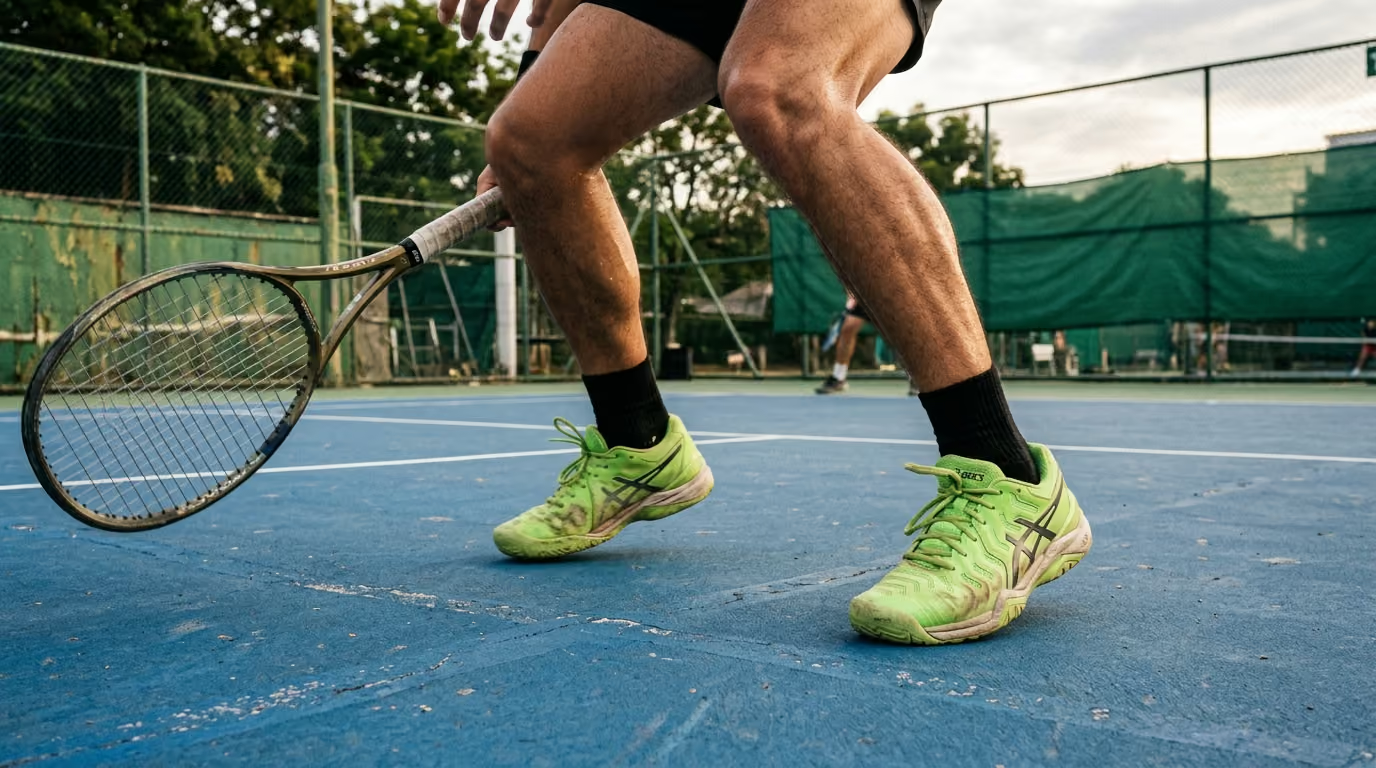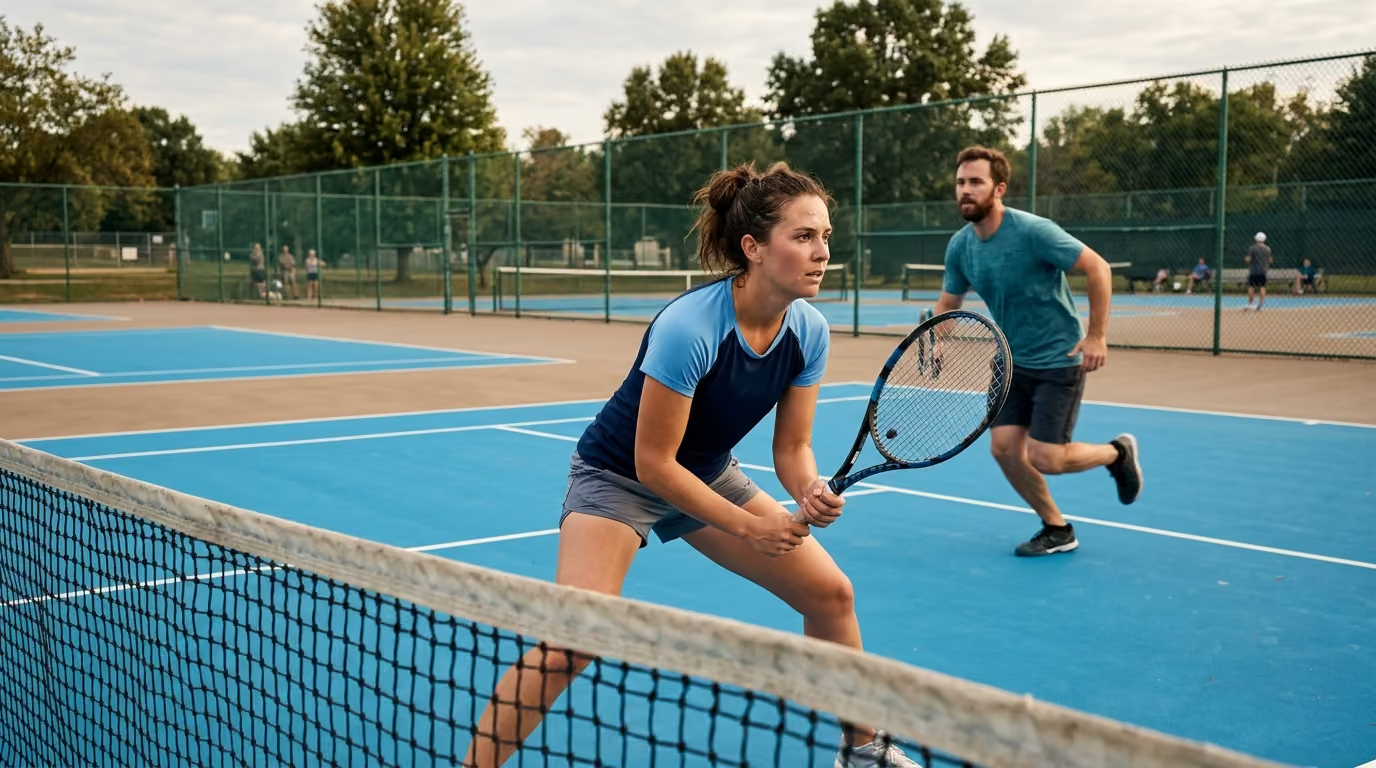

Doubles court movement involves the coordinated management of space, time, and physical responsibility by two teammates to cover the shared court effectively.




You stand at the net, watching your partner serve a deep ball into the opponent's backhand corner. You prepare to react, but your partner's serve is slightly short. The returner strikes a sharp crosscourt angle that flies past your partner, while you stand frozen, unsure whether to cover the alley or pinch toward the center. This moment of hesitation is a common challenge in doubles racquet sports, where two players must coordinate their physical movement to cover a shared court.
Effective doubles movement is the coordinated management of space, time, and physical responsibility by two teammates. To move well as a pair, players must prioritize compact spacing, protect the high-probability lanes, and execute synchronized changes of position. The ball determines your immediate movement, but your partnership determines your recovery position.
Developing this spatial awareness allows you to cover more court with less effort. For players seeking to maintain their court coverage over years of play, focusing on mobility and movement resources is a fundamental step. This guide covers the physical mechanics, geometry, and team dynamics required to master doubles positioning.
To move efficiently, you must understand the spatial realities of the court. The official doubles court is 36 feet wide, which is 10.97 meters, according to the International Tennis Federation. This is significantly wider than the 27-foot singles court, which measures 8.23 meters. The addition of the doubles alleys adds approximately 1.372 meters of space outside each singles sideline.
This extra width creates a larger playing area that requires precise lateral coordination. According to technical specifications, the full-court diagonal on a doubles court is approximately 26.184 meters. This distance explains why moving diagonally is almost always more efficient than moving in straight lateral lines. Diagonal recovery angles allow you to cover the court while maintaining momentum and preserving balance.
The most critical spatial concept in doubles is the middle-first principle. When you and your partner are uncertain about who should cover a ball, you must prioritize closing the central gap. The middle of the court represents the shortest route between opponents, offers a large target, and easily causes confusion. Protecting the middle does not mean ignoring the alleys. Instead, you should protect the highest-probability next shot rather than the geometric center at all costs.
When your opponent is pulled wide off the court, their ability to hit an extreme angle down your alley decreases. This change in geometry allows you and your partner to shift together toward the ball. If you remain glued to your respective sidelines, you leave a massive central seam open. By understanding these angles, you can take fewer steps, reduce physical strain, and cover more court with minimal effort.
Dynamic spacing is the foundation of a resilient doubles team. Teammates should not remain at a fixed distance from each other throughout a rally. Instead, your lateral and depth spacing must adapt to the quality, direction, and height of every shot. We can break this spacing down into four distinct categories:
When your team hits a deep, challenging ball, your functional spacing improves. This allows both of you to move forward and compress the court. Conversely, a weak defensive shot limits your functional spacing. This scenario requires you to stagger your positions or retreat to buy reaction time.
Your ability to execute these rapid changes in spacing depends on the mechanics of your split-step. Biomechanical research on the poaching split-step shows that the crouching phase of the movement lasts longer than the push-off phase. This prolonged crouch allows your muscles and tendons to store elastic energy. When you push off, your body uses this stored energy to initiate explosive movement.
The calf muscles opposite your intended direction of movement generate the primary force for this lateral push. If you want to move quickly to your left, your right calf must produce a powerful push-off force. This requires a wide, balanced base and a low center of gravity. If you stand too tall or keep your knees straight, you cannot load these muscles effectively, which slows your reaction time.
To coordinate your movement, your team must utilize specific formations based on the tactical situation. Each formation requires unique physical shifts and recovery patterns.
In the side-by-side formation, both partners occupy comparable depth on the court and divide the lateral space. This formation is primarily defensive or neutralizing. It is highly useful when both players are forced to the baseline, or when defending against a strong net attack.
The primary movement principle here is mirroring. When your partner is pulled wide to chase a ball, you must shift in the same direction to close the central gap. If your partner moves to the left sideline, you must move toward the center line. This prevents the opponents from hitting an easy winner through the middle. You must move as a connected unit, maintaining a consistent lateral distance of about 10 to 12 feet.
The traditional one-up, one-back formation places one player near the net and the other near the baseline. This setup combines the aggressive pressure of a net player with the defensive depth of a baseline player. However, it creates a significant vertical gap between partners.
To manage this gap, players should use the triangle concept. The ball, the net player, and the baseline player should form a triangle that limits open angles. If the baseline player hits a weak ball, the net player must slightly retreat or pinch toward the middle to protect against an aggressive counter-attack. The baseline player must also look for opportunities to move forward, rather than accepting a permanent defensive position.
Positioning both players at the net is an aggressive formation designed to take away the opponents' reaction time. However, this is a pressure state rather than a permanent destination. Research shows that while this formation is highly effective, simply standing at the net does not guarantee success.
This formation is strongest when your team has hit a deep, low ball that forces the opponent to hit upward. Both net players must split-step together as the opponent contacts the ball. You must maintain tight lateral spacing, leaving only the most difficult, low-probability passing shots open. If your approach shot is weak, staying at the net leaves you highly vulnerable to lobs and fast body shots.
Having both players at the baseline is a defensive or transitional setup. It is used to absorb heavy pressure, neutralize strong net players, and create an opportunity to rebuild the point. From this position, your goal is to hit deep, high shots that keep your opponents back.
Once you force a short or weak reply, you and your partner must advance together. This recovery sequence requires synchronized forward movement, culminating in a balanced split-step before your opponent makes contact. Remaining passive at the baseline allows your opponents to control the angles and wear down your defense.
Against high-quality returners, standard formations can become predictable. Advanced serving formations introduce uncertainty and force the receiving team to make difficult, hurried decisions.
In the I-formation, the net player crouches low directly over the center service line before the serve. The server stands close to the center mark on the baseline. This alignment disguises the net player's intended movement, making it difficult for the returner to spot an open target.
Executing this formation requires a clear pre-point agreement. The net player must decide whether to cross to the left, cross to the right, or stay in the middle. The server must then cover the opposite side of the court. The net player must remain low to avoid blocking the server's view, then push off explosively as the returner begins their swing. If the net player hesitates, the formation collapses, leaving half of the court completely exposed.
The Australian formation places both the server and the net player on the same side of the court before the serve. For example, if the server is serving from the deuce court, the net player also stands on the deuce side of the net. This setup is designed to protect against an opponent who has an exceptionally strong crosscourt return.
By clogging the crosscourt lane, you force the returner to attempt a difficult down-the-line shot over the highest part of the net. The server must be prepared to move laterally to cover the open half of the court. This formation simplifies lateral coverage on one side but demands high physical mobility from the server, who must sprint to cover the vacant line immediately after serving.
Poaching occurs when the net player deliberately crosses the center line to intercept a ball that would normally be played by the baseline partner. Poaching is not just about lateral speed. It is a highly calculated movement skill that relies on anticipation and precise timing.
The most common error in poaching is moving straight across the court parallel to the net. Instead, you must move along a diagonal path that goes across and forward. This diagonal path allows you to cut off the crosscourt angle and intercept the ball at a higher point. It also keeps your physical momentum moving toward the target, which increases the power of your volley.
To execute a successful poach, follow this physical sequence:
The timing of your poach must adapt to the speed of the serve. If you move too early, the returner will see your movement and easily pass you down the line. If you move too late, you will not reach the ball in time to make clean contact.
To keep opponents guessing, you should vary your net play. You can use a pinch, where you shift toward the middle without fully committing. You can also use a fake poach, where you take one loud step toward the center before returning to your original position. These variations create mental pressure without requiring you to sprint across the court on every point.
A switch occurs when you and your partner exchange sides of the court during a live point. This is a defensive recovery mechanism designed to restore court coverage when one player has been pulled completely out of position.
The basic switch pattern begins when Player A crosses the court to chase a wide ball or execute an aggressive poach. As Player A commits to the move, Player B must run behind them to cover the vacated side. Player A must call "switch" loudly and early enough to guide Player B's movement. Once the switch is complete, both players must establish a new, balanced spacing.
A switch is not always necessary or helpful. If Player A can easily recover to their original side after hitting the ball, you should not switch. Switching unnecessarily can cause confusion, leave both players in the same zone, or expose a massive gap.
To prevent these errors, your team must use precise verbal communication. You must distinguish between "switch," "mine," and "yours." The call of "switch" strictly means you are exchanging court responsibilities. "Mine" claims the incoming ball, while "yours" assigns the shot to your partner. Clear, early calls eliminate hesitation and prevent dangerous on-court collisions.
When your opponents hit a deep lob or an aggressive overhead, your team must transition from attack to defense. Retreating is a highly coordinated team movement that requires both players to maintain spatial awareness while moving backward.
If a lob goes over the net player's head, both partners must react instantly. The net player should not try to run straight backward while looking up at the ball. This movement is slow and increases your risk of falling. Instead, the net player must turn their hips, run diagonally backward toward the baseline, and keep their eyes on the ball over their shoulder.
Meanwhile, the baseline partner must move diagonally across to cover the ball if it is out of the net player's reach. As you retreat, both players must strive to establish a side-by-side defensive formation. If one player retreats while the other remains glued to the net, you create a massive gap that the opponents can easily exploit.
Your defensive recovery target depends on the quality of your defensive reply. If you hit a high, deep defensive lob, you buy enough time to recover your court positions. If your defensive shot is short and weak, you must remain cautious and defend from a deeper position. Once the immediate danger passes, you can begin to move forward together to reclaim the net.
Many recreational players wait until a ball is flying between them to start communicating. At that point, it is usually too late to coordinate an effective response. Successful doubles teams communicate continuously across three distinct phases.
Before the ball is put into play, you and your partner should agree on a basic strategy. This includes serve placement, poaching intentions, and defensive responsibilities. Many teams use hand signals behind their back to communicate these plans secretly.
A closed fist can signal that the net player will stay on their side, while an open hand indicates an active poach. These signals remove confusion and ensure that both players are moving toward their correct positions the moment the serve is struck.
During a fast-paced rally, your verbal calls must be short, loud, and direct. Use single-word instructions such as "mine," "yours," "switch," "stay," or "out." These simple calls help your partner react instantly without having to process complex sentences. Your calls must focus entirely on assigning responsibility rather than expressing frustration or emotion.
Between points, take a few seconds to briefly discuss what worked and what needs adjustment. This is the time to identify your opponents' movement tendencies or physical limitations. Keep these conversations positive and constructive. Developing structural resilience is key to maintaining this mental focus, and you can learn more about this in our injury prevention resources section.
While the core principles of spacing and communication apply to all doubles racquet sports, the specific physical demands vary significantly depending on the court size and game dynamics.
Tennis is played on a large court that demands long diagonal runs, explosive split-steps, and high-velocity lateral shifts. Players must cover a wider area, which requires high cardiovascular endurance and powerful leg drive.
Slide steps and crossover steps are essential for covering the wide alleys. Because the ball travels at extreme speeds, anticipation and early movement preparation are vital for survival at the net.
Pickleball is played on a much smaller court measuring 20 by 44 feet. This tight space compresses reaction times and emphasizes rapid lateral sliding along the non-volley zone line, also known as the kitchen.
Long, explosive runs are rare. Instead, pickleball doubles demands exceptional short-range agility, precise footwork, and fast hand-eye coordination. Players must move in perfect unison, sliding left and right along the kitchen line like they are connected by a short rope.
Padel is played within an enclosed glass court, which introduces unique movement patterns. Players must defend against balls that rebound off the back and side glass walls. This requires you to let the ball pass you, turn your body, and run toward the glass to play the rebound.
Padel movement is highly rotational, requiring excellent hip mobility and spatial orientation. Teammates must maintain a tight side-by-side formation at the net or at the back of the court, continuously shifting to cover the rebound angles off the walls.
Even experienced players frequently fall into movement traps that leave their team vulnerable. Avoiding these common mistakes will instantly improve your court coverage.
Many recreational players are terrified of being passed down their alley. As a result, they stand too close to the sideline, leaving the entire middle of the court wide open.
Your alley is a small, high-risk target for your opponents. You should only prioritize the alley when your partner has hit a weak shot, or when your opponent is balanced and has a clear down-the-line look. Otherwise, pinch toward the center to protect the high-probability middle lanes.
While establishing a dual-net position is highly aggressive, it is not a guaranteed path to victory. If your approach shot is short and sits up high, rushing to the net is highly risky.
Your opponents can easily strike a fast ball at your body or hit a deep lob over your head. You must evaluate the quality of your shot before committing to forward movement. If your shot is weak, hold your ground or take a defensive step back to buy reaction time.
Many net players wait until the returner contacts the ball, then run straight sideways across the court. This lateral path makes it very difficult to reach the ball before it passes you.
It also forces you to hit the volley from a low, defensive position. You must move diagonally forward and across. This path cuts off the angle early, allows you to contact the ball above net height, and keeps your physical momentum moving into your shot.
Executing repetitive split-steps, rapid lateral cuts, and explosive sprints puts significant physical stress on your body. If your joints lack adequate range of motion, your muscles must work much harder to absorb these forces. Over time, this leads to muscle fatigue, joint wear, and an increased risk of soft-tissue strains.
I remember finishing a tough two hour padel match on a cold Tuesday night and waking up the next morning feeling like my lower back was locked in concrete. For a long time, I just accepted this as the price of playing hard in my forties. But once I started spending just ten minutes on targeted hip mobility before heading to the club, the stiffness almost completely vanished. It taught me that we do not have to accept pain as a default state of aging.
This approach is essential for healthy aging and athletic longevity, keeping you on the court without interruption. To protect your body, prioritize a dynamic warm-up that focuses on hip, ankle, and thoracic spine mobility.
After your match, focus on active recovery to help your muscles shed metabolic waste and restore normal resting length. Understanding how post-match stiffness behaves can guide your strategies in recovery science to bounce back faster.
While minor muscle soreness and mild fatigue are normal parts of training, you must be able to recognize the signs of a more serious structural issue. If you experience any of the following symptoms, stop playing and consult a qualified healthcare professional, such as a sports physiotherapist or orthopedic physician:
A clinical professional can diagnose the root cause of your symptoms, provide targeted rehabilitation exercises, and ensure you can return to the court safely without risking long-term joint damage.
To build these movement patterns into your muscle memory, integrate these progressive drills into your weekly practice sessions.
Start with you and your partner standing side-by-side near the service line, facing the net. A coach or third player stands on the opposite baseline, holding a racket. The coach points their racket to the left, and both players must slide laterally to the left while maintaining their 10-foot spacing.
The coach then points to the right, and both players must slide to the right. To progress this drill, the coach can feed live balls to different areas, forcing you to adjust your spacing and split-step in response to actual ball flight.
This drill refines your anticipation and decision-making at the net. The net player starts in a standard doubles position. A player on the opposite baseline hits returns from a basket of balls.
The net player must choose one of three actions on every shot: stay in position, pinch toward the center, or execute a full diagonal poach. Evaluate your decisions based on the height and quality of the incoming ball. If the ball is low and fast, staying or pinching is correct. If the ball is high and slow, commit to a decisive, diagonal poach.
The coach feeds a deep, wide ball that forces the net player to run completely across the court to make a defensive play. As the net player crosses, the baseline partner must sprint behind them to cover the open court.
The net player must call "switch" loudly. After hitting the ball, both players must establish a new, balanced side-by-side defensive formation. Repeat this drill with live rallies, focusing on recovering your positioning after the initial switch is completed.
Start with one player at the net and one player at the baseline. The coach feeds a high lob over the net player's head. The net player must turn their hips, run diagonally backward, and communicate with their partner.
The baseline partner must move to cover the ball if necessary, while both players work to establish a side-by-side defensive position at the baseline. Once you hit a successful defensive shot, both players must advance forward together to reclaim the net, split-stepping before the coach's next feed.
This drill focuses on the biomechanics of your push-off movement. Stand in an active ready position. On a whistle or visual cue, drop into a deep, balanced crouch, loading your hips and calves.
Immediately push off your right leg to sprint diagonally forward and to your left, simulating a poaching move. Focus on keeping your center of gravity low and generating power from your calf muscles. Perform 3 sets of 6 repetitions on each side, ensuring high movement quality and dynamic balance.
Revisit this guide at the start of every competitive season, or whenever you find your doubles team struggling with spacing, leaving the middle open, or experiencing unnecessary on-court collisions.
Mastering these synchronized movements and maintaining your joint mobility will keep you playing efficient, pain-free doubles for years to come.
Follow Evercourts for practical insights on tennis, pickleball and padel performance, movement, recovery and healthy ageing. Stay connected for new articles, research-led guidance and ideas to help you play well and keep playing for years.


Read practical guidance for better movement, smarter preparation and a game that keeps working for you.
explore the Blog