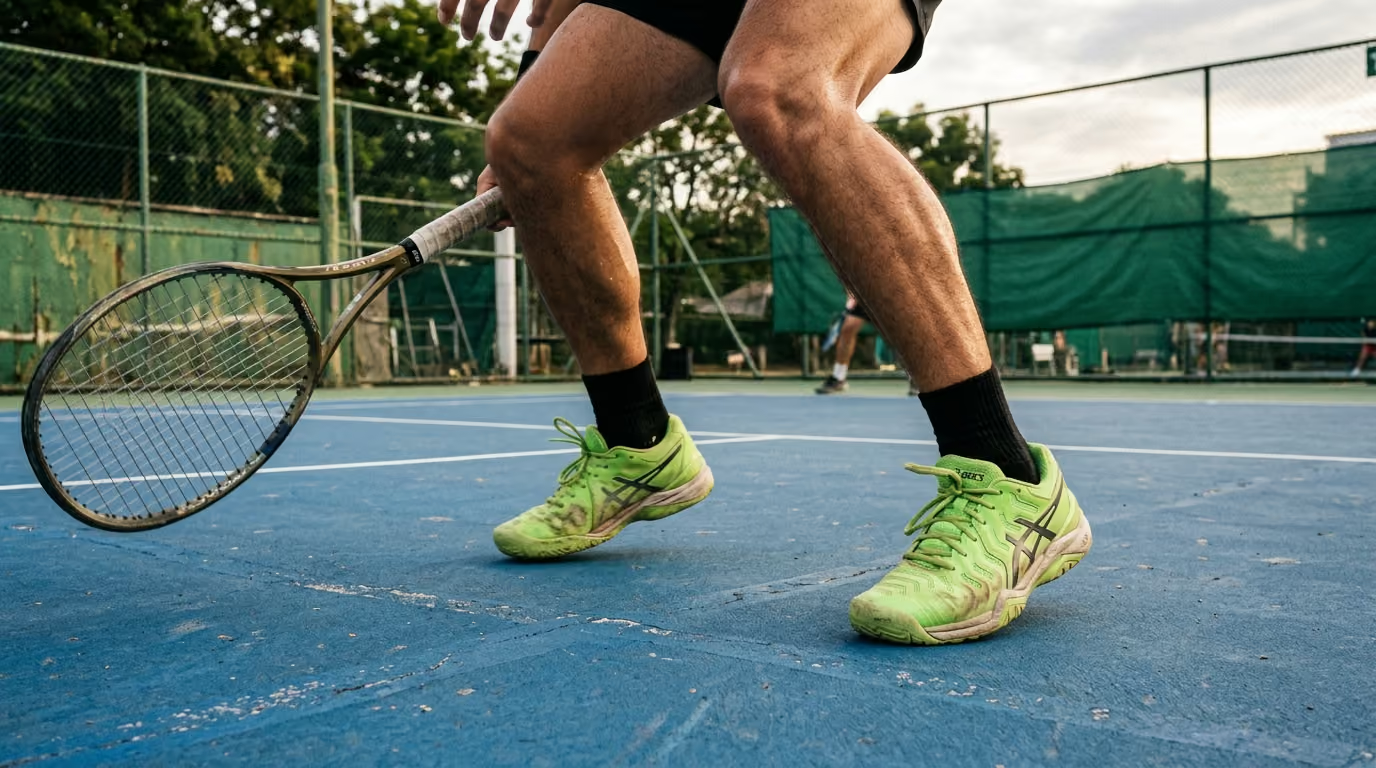
Playing doubles in racquet sports presents unique injury risks from close proximity, sudden movements, and partner interactions, requiring specific prevention strategies.




Many players view doubles as a retirement home for court athletes. They assume that dividing the court in half slashes physical demands and eliminates injury risk. This assumption is a mistake that often leads to avoidable trips to the clinic.
While doubles reduces the total running distance compared to singles, it introduces unique physical challenges. Teams must navigate close spacing, sudden directional changes, and high-speed balls in the middle. Safe team play relies on structured partner communication, predictable movement systems, and joint-specific physical preparation. By removing the guesswork of who covers the court, players can avoid collisions, falls, and acute joint strains.
Understanding your risk is the first step toward lasting health on the court. In racquet sports, injury data shows that doubles play carries distinct patterns of physical stress. These patterns vary significantly between tennis, pickleball, and padel. However, they all share a common thread of high-velocity movement in a restricted space.
According to a systematic review published in 2025, badminton injury rates generally range between one and four injuries per 1,000 hours of play. Elite players tend to occupy the higher end of this spectrum due to faster match speeds and greater training volume. This exposure-based model is highly useful for recreational athletes. It demonstrates that injury risk is a function of time spent on the court under physical stress.
The data on acute impact injuries in doubles is particularly revealing. A clinical review of badminton injuries examined eighty-five ocular injuries. Remarkably, seventy-three of these occurred during doubles matches. Fifty-two of those cases were directly partner-involved, where a player was struck by their own teammate's racket or the shuttlecock. This highlights that your partner is not just a teammate, but also a moving physical hazard.
In pickleball, epidemiologic analyses using the United States National Electronic Injury Surveillance System show a different risk profile. A study spanning 2013 through 2022 estimated over forty-three thousand weighted emergency department cases. Falls were the single most common mechanism of injury, accounting for more than sixty-five percent of all cases. This study also noted that being hit by a paddle was highly common among youth players, while ankle sprains and inversions dominated the young adult category.
For older adults, the stakes are even higher. Research analyzing pickleball injuries from 2012 through 2021 found that slips, trips, falls, and tumbling efforts represented over sixty-four percent of injury mechanisms. In this population, players aged sixty to seventy-nine accounted for eighty-three percent of the injuries. This group was nearly three times more likely to sustain fractures than younger participants. This suggests that balance, deceleration control, and fall-mitigation strategies must be prioritized to support healthy aging and athletic longevity.
Overuse injuries present another major category of risk. Repeated overhead loading, sudden lunges, and constant grip pressure wear down joint tissues over time. This gradual wear affects the shoulder, elbow, knee, and Achilles tendon. Unlike acute sprains, these symptoms creep up over weeks or months. They often stem from poor movement mechanics, inadequate recovery, or a sudden increase in play volume.
By viewing doubles safety through a systematic lens, we can identify these problems before they cause tissue damage. This requires evaluating how you move, how you communicate, and how you prepare. Safe play is not about holding back or playing with fear. It is about building the capacity to handle the specific forces of your sport.
Communication is your primary safety system on a doubles court. When two players chase the same ball in silence, a collision is almost inevitable. To prevent this, teams should adopt a strict communication hierarchy during every match.
The first level of this hierarchy is the pre-point agreement. Before the server releases the ball, both partners must agree on basic positioning and responsibilities. This includes confirming who will cover the middle, whether you are playing a standard or Australian formation, and who handles the initial return. A simple verbal confirmation or hand signal behind the back prevents early confusion.
The second level is the pre-shot cue, which occurs just as the opponent prepares to strike. If you notice a high ball that will land short, you can signal your partner to advance. This proactive information allows your teammate to adjust their footing before the ball is in play. It reduces the need for emergency braking maneuvers that strain the knees and ankles.
The third and most critical level is the active rally call. Use short, high-volume monosyllabic words like "mine," "yours," "leave," or "switch." These calls must be made early, ideally before the ball crosses the net. A late call is often worse than no call at all. If your partner has already committed their body weight to a shot, a sudden yell to "leave it" can cause them to brake awkwardly.
Nonverbal communication is also highly valuable but should remain secondary during fast exchanges. Hand signals are excellent for planned movements, such as a net player poaching during a serve. However, during a rapid scramble, your partner cannot look at your hands while tracking the ball. In these moments, clear vocal volume is the only reliable option.
Teams frequently suffer from predictable communication failures. The most common is the silent middle ball, where both players hesitate and then make a late, panicked run. Another common error is the contradictory call, where one partner shouts "mine" while the other is already swinging. To eliminate these patterns, practice calling balls during warm-up sessions. This builds a shared vocabulary and trains your brain to prioritize vocal cues under physical stress.
Finally, establish a constructive post-point reset routine. If a near miss or a minor collision occurs, do not ignore it or assign blame. Take five seconds to clarify who should have taken that ball. This brief discussion updates your team strategy for the next point and reinforces your safety habits. You can find more practical advice on building team coordination on the Evercourts blog.
Moving as a cohesive unit is essential for covering the court safely. Many recreational players move independently of their partner, which creates massive gaps and invites collisions. A highly effective way to conceptualize team movement is the invisible string metaphor.
Imagine a ten-foot piece of elastic string tied between your waist and your partner's waist. When your partner is pulled wide to the left alley, the string should pull you toward the center. This movement keeps the distance between you consistent and covers the most vulnerable areas of the court. It prevents situations where both players end up in the same alley, leaving the opposite side completely exposed.
Maintaining this relationship requires default responsibility zones. For example, the player standing diagonal to the ball generally has a better angle to cover deep lobs. The player closest to the net should focus on rapid, short-range volleys. When a ball lands directly down the centerline, the default rule should favor the player with their forehand in the middle. Having these pre-set rules reduces hesitation and the need for dangerous, last-second lunges.
Switching sides is another maneuver that requires precise coordination. A chaotic switch often leads to partners running into each other or stepping on each other's feet. When a switch is called, both players should move along diagonal paths rather than straight lines. The player crossing to the new side must keep their racket close to their chest to avoid striking their teammate.
Backpedaling is one of the most dangerous movements on a racquet court. When you run backward while facing the net, your center of gravity shifts too far behind your heels. This position makes you highly susceptible to tripping, falling, and landing hard on your wrists or head. It is a common cause of severe injuries in older athletic populations.
Instead of backpedaling, learn to turn your hips and run diagonally or use side-shuffle recovery steps. This technique allows you to keep your eyes on the ball and your partner while maintaining a stable base of support. Before hitting a high overhead, always use quick, lateral adjustment steps to establish balance. This ensures that when you land, your feet are wide and your knees can absorb the impact safely.
While doubles principles apply across all racquet sports, each discipline places unique physical demands on your body. Understanding these differences allows you to tailor your training and injury prevention strategies effectively.
Tennis doubles is characterized by explosive, long-range movements and heavy overhead loading. Because the court is large, players must cover significant ground during wide angles or deep lobs. This requires rapid acceleration followed by intense eccentric braking to stop and change directions.
The shoulder joint faces high stress in tennis doubles due to the frequency of serves and overhead volleys. The rotator cuff muscles must work hard to decelerate the racket after every high-velocity swing. To protect these tissues, tennis players need to focus on thoracic spine mobility and scapular stability. This ensures that the forces of the swing are distributed through the upper back rather than overloading the shoulder.
Pickleball is played on a much smaller court, which dramatically increases the speed of play at the net. Rallies at the non-volley zone, or kitchen line, involve rapid-fire exchanges that require lightning-fast reflexes. The primary physical challenge here is lateral lunging and quick hand-eye coordination.
Because pickleball attracts many older adults, fall prevention is a major priority. The sudden forward and lateral lunges required to reach low dinks can easily compromise balance. Players often reach far beyond their base of support, leading to slips and fractures. Training should focus heavily on ankle mobility, calf strength, and balance control to keep your feet firmly underneath your torso.
Padel is unique because it is played within an enclosed glass and mesh cage. Rallies are often long and require players to track ball rebounds off the walls. This creates a high demand for 360-degree rotational awareness and constant spatial adjustments.
I remember finishing a tough two hour padel match on a cold Tuesday night and waking up the next morning feeling like my lower back was locked in concrete. For a long time, I just accepted this as the price of playing hard in my forties. But once I started spending just ten minutes on targeted hip mobility before heading to the club, the stiffness almost completely vanished. It taught me that we do not have to accept pain as a default state of aging.
Padel players frequently experience lower back strain from twisting to play balls off the back glass. To prevent this, players must focus on hip rotation and core endurance. When you can rotate through your hips, you relieve your lumbar spine of excessive twisting forces. This protects your spinal discs and keeps your lower back feeling loose and healthy.
A proper warm-up does much more than simply raise your body temperature. It primes your nervous system to coordinate complex movements, stabilize your joints, and react to fast visual cues. Relying on a few static stretches before a match is a common mistake that does little to protect your tissues.
Instead, implement a progressive neuromuscular warm-up routine before every session. This sequence should take ten to fifteen minutes and require no special equipment. It is designed to prepare your body for the specific lateral, rotational, and overhead demands of doubles play.
Begin with five minutes of light, multi-directional movement to increase circulation. This can include light jogging, gentle side-shuffling, and high-knee walking. The goal is to break a light sweat and prepare your cardiovascular system for work.
Next, perform dynamic mobility exercises for your major joints. Focus on hip openers, gentle trunk rotations, and arm circles. These movements lubricate your joints with synovial fluid, which reduces friction and improves your range of motion. Avoid holding static stretches, as research shows they can temporarily reduce muscle power and do not prevent acute injuries.
Follow this with activation exercises for your core and lower body stabilizers. Single-leg balance holds are excellent for waking up the tiny muscles in your feet and ankles. Perform ten bodyweight squats and ten lateral lunges on each side to prime your glutes, quadriceps, and hamstrings. This step is crucial for preparing your legs to handle the forces of rapid court movement.
Finally, transition into sport-specific coordination drills. Practice your split-step timing by jumping lightly and landing with a wide, stable base. Perform a few low-intensity lateral hops, focusing on keeping your knee aligned over your second toe when you land. This movement pattern is key for safe braking during lateral scrambles. You can explore a variety of functional movement drills in our mobility and movement resources.
To withstand the physical stresses of doubles play, your body needs a foundation of strength. Strong muscles act as shock absorbers, protecting your joints and tendons from the high impacts of court sports. Your training should focus on the lower limbs, the core, and the upper body.
Your feet and ankles are your only points of contact with the court. Calf strength and ankle stability are vital for preventing inversions and supporting rapid changes of direction. Perform regular calf raises with a slow, controlled lowering phase to build tendon resilience.
The muscles surrounding your knees, particularly your quadriceps and hamstrings, must be balanced. Strong hamstrings help protect the anterior cruciate ligament, or ACL, during sudden stops. Incorporate single-leg exercises like Bulgarian split squats and Romanian deadlifts into your routine. These movements build unilateral strength, correcting imbalances between your left and right legs.
Your hip abductors and external rotators are responsible for controlling lateral movement. When these muscles are weak, your knees can collapse inward during a lunge, increasing injury risk. Lateral band walks and single-leg squats are highly effective for building hip stability. They ensure that your pelvis remains level when you cut and change directions on the court.
Because court sports require constant twisting, core stability is essential. Your core muscles must be strong enough to produce and absorb rotational forces safely. Focus on anti-rotation exercises like the Pallof press, where you resist a lateral pulling force. This trains your torso to remain stable, protecting your lower back during powerful swings.
For your upper body, prioritize rotator cuff endurance and scapular control. The small muscles around your shoulder blades are responsible for keeping your shoulder joint stable during overheads. Perform face pulls and external rotations with a resistance band to keep these tissues strong. This prevents shoulder impingement and keeps your throwing motion smooth and powerful.
Additionally, do not neglect wrist and forearm strength. Repetitive gripping and off-center ball impacts can strain the tendons in your elbow, leading to tennis or pickleball elbow. Exercises like wrist curls, reverse curls, and forearm extensions build endurance in these muscles. This helps absorb the vibrations of the ball hitting your racket or paddle, keeping your elbows healthy. Discover structured workout routines designed for court athletes in our strength and conditioning resources.
Recreational players frequently fall into predictable movement traps that elevate their risk of injury. Recognizing these errors allows you to correct them before they lead to a painful strain or fall.
The most common mistake is assuming that because doubles involves less running, you do not need to prepare. Many players arrive at the court, skip their warm-up, and immediately start hitting hard serves. This practice is a recipe for muscle strains and tendon tears, as cold tissues are far less elastic. Treat every doubles match with the same physical respect as a singles match.
Another frequent error is allowing the most vocal or aggressive partner to claim every middle ball. While communication is key, physical position and angle of approach should dictate who hits the shot. When an aggressive player cuts across their partner's path to reach a ball, they often leave their own side exposed and force their partner into an awkward, last-second recovery step. This movement pattern frequently results in groin or hip flexor strains.
Many recreational players feel pressured to chase every ball, even those that are mathematically unreachable. Lunging at an extreme angle while off-balance often leads to severe slips and falls. It is far safer to concede a point than to risk a wrist fracture or knee ligament tear. Learn to recognize when a ball is lost and focus on resetting for the next point.
Stretching cold muscles before a match does not prevent injuries and can actually reduce your power on the court. Your warm-up should be dynamic and active, focused on movement quality rather than static flexibility. Save your static stretches for after the match, when your muscles are warm and receptive to lengthening.
Fatigue is a major contributor to injuries on the doubles court. When your muscles tire, your reaction times slow down, your footwork degrades, and your decision-making suffers. This degradation increases the likelihood of clumsy steps, poor landings, and avoidable collisions.
Systemic fatigue also affects your spatial awareness. You become less conscious of where your partner is and less able to track fast balls. To manage this, pay close attention to your body during long matches. If you notice your split-steps becoming sluggish or your partner making late calls, it is time to adjust your pace. Take longer breaks between games, hydrate properly, and focus on clean, efficient movement rather than raw speed.
Managing your training load over weeks and months is equally important for healthy player health. If you are returning to play after a period of inactivity, do not immediately sign up for multiple high-intensity matches. Gradually build your playing time to allow your tendons and muscles to adapt to the stress.
Adequate recovery between sessions is crucial for tissue repair and adaptation. Focus on quality sleep, proper nutrition, and active recovery strategies like light walking or swimming. If you feel persistent soreness that does not resolve within forty-eight hours, your body is telling you to rest. For more science-backed tips on optimization, check out our recovery science resources.
To help you visualize how these principles apply in real-time, let us examine several common doubles scenarios. These case patterns illustrate how communication, movement mechanics, and positioning work together to prevent injuries.
During a fast exchange, the opponent hits a soft ball directly down the center line. Both partners see the opening and sprint inward without saying a word. At the last second, they realize they are on a collision course. One player tries to brake suddenly, twisting their ankle, while the other swings and strikes their partner's racket.
To prevent this, establish a clear centerline rule before the match. The player with their forehand in the middle should have default priority. Crucially, the non-hitting player must call "yours" early, allowing them to stop safely and maintain their defensive position. This early call removes all ambiguity and allows the hitter to swing with confidence.
The opponents hit a deep lob over the net player's head. The net player starts backpedaling blindly, keeping their eyes glued to the sky. Meanwhile, the baseline partner runs forward to cover the shot. The two players collide, resulting in a hard fall onto the court surface.
The solution is two-fold. First, the net player must turn their hips and run forward toward the back of the court rather than backpedaling. Second, the baseline partner must call "mine" or "I've got it" immediately. Once the call is made, the net player should stop, clear the path, and shift to cover the open space.
In an attempt to surprise the opponents, the net player suddenly jumps across the center line to volley a ball. They do not warn their partner beforehand. The baseline partner, who was already moving forward to hit the ball, is forced to make an emergency stop, straining their groin muscle.
Before attempting a poach, always communicate your intention. Use a simple hand signal behind your back before the serve to let your partner know you plan to cross. This signal allows your partner to anticipate the move and shift diagonally to cover the space you vacate. It ensures that the team remains balanced and prevents sudden, frantic adjustments.
A player is pulled wide by a sharp, angled shot. Determined to save the point, they sprint toward the sideline, sliding on a surface that does not support sliding. Their foot catches on the court, resulting in a severe ankle inversion.
Avoid high-risk scrambles when you are completely out of position. Learn to recognize when a shot is too good and concede the point. When you must run wide, focus on controlled deceleration steps rather than trying to slide. Keep your center of gravity low and land on a wide, stable base to absorb the force safely.
While structured training and smart court habits go a long way, some injuries require professional attention. It is vital to recognize when a physical issue cannot be resolved with rest and self-care. Ignoring warning signs can turn a minor strain into a chronic, long-term problem that keeps you off the court for months.
Seek immediate medical attention if you experience any of the following red flags:
If you experience these symptoms, consult a qualified physical therapist, sports medicine physician, or orthopedic specialist. These professionals can provide an accurate diagnosis and design a targeted rehabilitation plan. They can also analyze your movement patterns to identify the underlying cause of your injury. To learn more about our editorial mission and find additional health guides, visit our about page. If you have questions or need support, feel free to contact us.
Investing a small amount of time into proper communication, movement mechanics, and conditioning will pay massive dividends for your athletic longevity. By playing smart and preparing your body, you can continue to enjoy the competition and camaraderie of doubles play for years to come.
Follow Evercourts for practical insights on tennis, pickleball and padel performance, movement, recovery and healthy ageing. Stay connected for new articles, research-led guidance and ideas to help you play well and keep playing for years.


Read practical guidance for better movement, smarter preparation and a game that keeps working for you.
explore the Blog