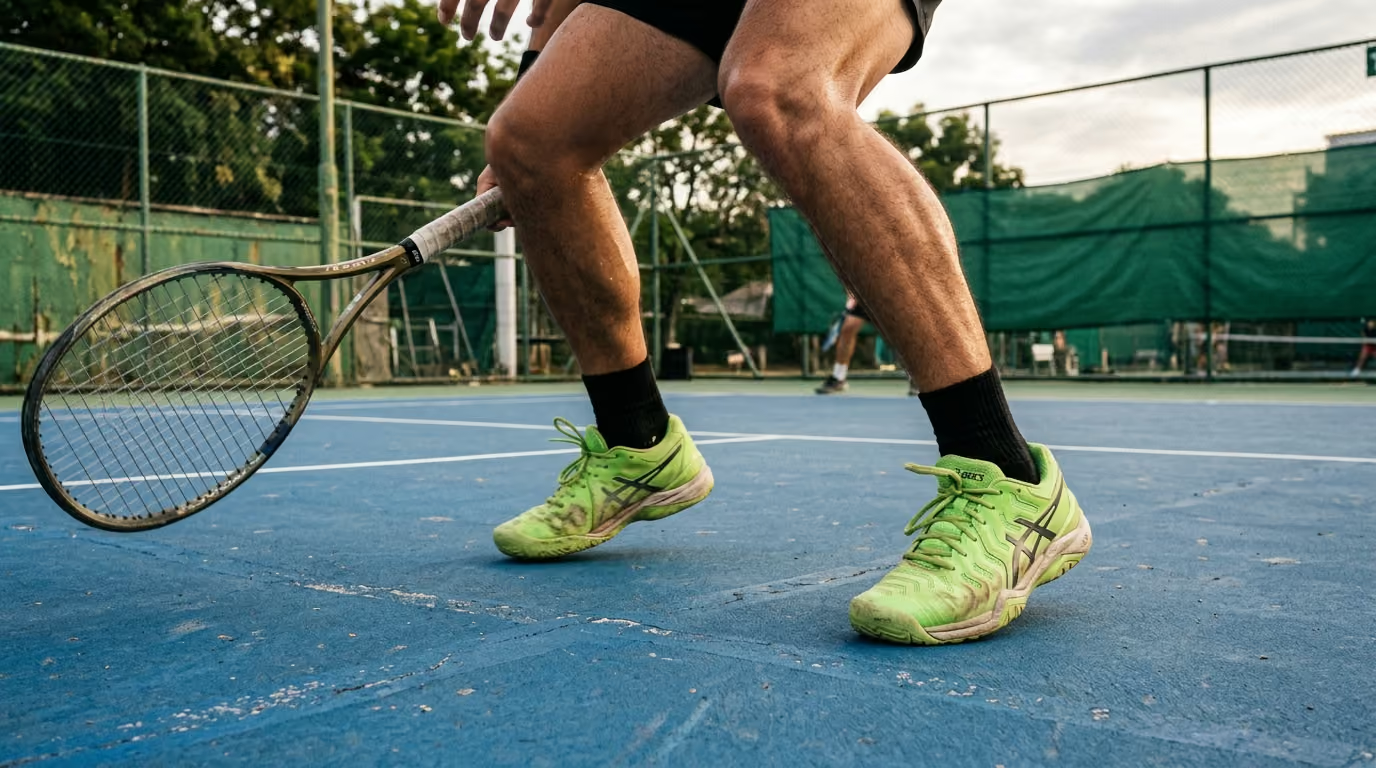
Over 200,000 competitive racquet players face environmental factors like heat, cold, and altitude that significantly impact physiological demands and performance.




Many competitive racquet players believe that their toughest opponent is always the person standing across the net. In reality, the environment in which you play often exerts a far greater physiological demand than your opponent's best shots. Trying to play through intense heat, freezing wind, or high altitude without adjusting your strategy is a recipe for physical decline.
Environmental conditions act as an additional physical load on your body during court play. To maintain long-term performance, you must manage these conditions as a total physiological stressor rather than a simple hydration issue. Adjusting your pacing, clothing, and recovery protocols based on the specific climate protects your physical health and preserves your joint function.
Understanding these external variables helps you make smarter decisions on the court. It also ensures you can continue playing the sports you love for decades to come.
To protect your body over a lifetime of play, you must change how you view environmental challenges. Many players view hot weather simply as a reason to drink more water, and cold weather as a reason to wear a jacket. In sports science, however, weather conditions are treated as a significant load-management challenge. When you step onto the court, your body experiences two distinct types of stress.
The first is your external load, which consists of everything you can physically measure on the court. This includes your total playing time, the number of rallies you play, your total running distance, and the number of explosive sprints you make. Under ideal conditions, such as a mild and dry afternoon, your body handles this external workload with a predictable level of effort.
The second type of stress is your internal load, which represents the physiological cost of completing that physical work. This internal load is measured by your heart rate, your rate of perceived exertion, your core body temperature, and your respiratory strain. When the weather changes, your internal load can skyrocket even if your external load remains exactly the same.
This means that playing a two-hour match in high humidity or at high altitude demands far more from your cardiovascular and thermoregulatory systems than the same match played in mild weather. In hot conditions, your body must work twice as hard to pump blood to your working muscles while simultaneously directing blood to your skin to release heat. This phenomenon leads to cardiovascular drift, where your heart rate rises progressively even though your running speed remains constant.
By framing weather conditions as an internal load issue, you can plan your matches and practice sessions more realistically. You will understand why a standard drill session feels exhausting on some days and effortless on others. To learn more about managing these physical stresses to support athletic longevity, you can read our specialized Recovery Science Resources.
Relying on standard air temperature to judge outdoor safety is a common mistake among recreational players. A thermometer only measures ambient air temperature, which does not account for how your body actually experiences heat on the court. To make accurate decisions about your playing schedule, you should look at the Wet-Bulb Globe Temperature, commonly known as WBGT.
This environmental index combines multiple factors to provide a realistic assessment of heat stress. It calculates risk by measuring ambient air temperature, relative humidity, radiant heat from the sun, and the cooling effect of wind. Because racquet sports are often played on hard courts that absorb and radiate solar energy, the ground temperature can be much higher than the air temperature.
The Japanese Ministry of the Environment publishes clear risk-management thresholds based on WBGT readings. These guidelines offer a practical framework for players of all ages.
These categories serve as valuable risk-management tools, but they do not guarantee safety for everyone. Unacclimatized players, older adults, and those returning from a break are highly vulnerable to heat illness even in lower risk categories. True safety requires you to combine these environmental measurements with a careful assessment of your own physical condition on that day.
When you play in hot and humid conditions, your sweat cannot evaporate effectively. Sweat must evaporate from your skin to cool you down, but high humidity blocks this natural cooling process. When the air is saturated with water vapor, sweat simply pools on your skin and drips away without lowering your core temperature.
To combat this thermal strain, you must adopt effort-based pacing. Attempting to maintain your usual aggressive playing style in high heat will lead to rapid physical exhaustion. Instead, focus on controlling your physical output between points and during changeovers.
First, deliberately slow down your movement between points. Avoid rushing to collect balls or walking quickly back to the baseline. Use every second of your permitted rest time to lower your heart rate.
Second, adjust your tactical choices to reduce unnecessary running. Play higher-margin shots that keep you in the point without requiring extreme physical lunges. If you can control the center of the court, you can force your opponent to do the running while you conserve your energy.
Finally, use physical cooling strategies during every changeover. Sit in the shade, use portable fans, and place ice towels around your neck to cool the blood flowing to your brain. This deliberate pacing keeps your core temperature within a safe range, allowing you to sustain your performance over a long match.
Generic advice telling athletes to drink a specific volume of water per hour is highly inefficient. Every player has a unique sweat rate that is determined by body size, fitness level, genetics, and how well they have adapted to the heat. To protect your performance and avoid health complications, you should calculate your individual sweat loss.
You can easily calculate your sweat rate with a simple scale before and after a practice session.
For every 0.5 kilograms of body mass you lose, your body has lost approximately 500 milliliters of fluid. Add the volume of fluid you drank during the hour to this number to find your hourly sweat rate. This calculated number gives you a highly accurate target for your future hot-weather matches.
Your primary goal is to avoid losing more than two percent of your pre-exercise body mass during a match. Losing more than this threshold impairs your physical coordination, slows your reaction times, and increases cardiovascular strain. However, you must also avoid the dangerous practice of overdrinking.
Drinking excessive amounts of plain water during long matches can dilute the sodium levels in your blood. This condition, known as exercise-associated hyponatremia, is highly dangerous and can lead to confusion, muscle weakness, and collapse. To prevent this, always include electrolytes in your fluids when playing in hot weather for more than one hour. After your match, the American College of Sports Medicine recommends drinking 450 to 675 milliliters of fluid for every 0.5 kilograms of weight lost to restore your fluid balance.
Playing in cold weather presents a very different set of challenges for court athletes. Cold ambient temperatures cause your blood vessels to constrict, which reduces blood flow to your extremities. This natural defense mechanism keeps your core warm, but it leaves your muscles, tendons, and joints cold and stiff.
Cold muscles are far less efficient at absorbing impact, which increases the stress placed on your joints and connective tissues. In our experience, ignoring this cold transition can lead to severe muscle stiffness that lasts for days.
I remember finishing a tough two hour padel match on a cold Tuesday night and waking up the next morning feeling like my lower back was locked in concrete. For a long time, I just accepted this as the price of playing hard in my forties. But once I started spending just ten minutes on targeted hip mobility before heading to the club, the stiffness almost completely vanished. It taught me that we do not have to accept pain as a default state of aging.
To protect your mobility in cold weather, you must redesign your pre-match warm-up. You can find comprehensive routines designed for racquet athletes in our Mobility & Movement Resources.
Cold air is also naturally dry, which can trigger cold-induced bronchoconstriction in some players. This condition causes your airways to narrow, making it difficult to breathe during high-intensity rallies. To minimize this risk, focus on breathing through your nose to warm and humidify the air before it reaches your lungs.
Playing at high altitude changes both your physical performance and the physics of the game itself. As you ascend, the barometric pressure of the air decreases, which means there are fewer oxygen molecules in every breath you take. This condition, known as hypoxia, makes it much harder for your body to deliver oxygen to your working muscles.
At the same time, the thinner air offers less aerodynamic resistance to the ball. Tennis balls, pickleballs, and padel balls all travel through the air faster and bounce higher at altitude than they do at sea level. This combination of physical and physiological changes can be highly disorienting for players who are unprepared.
To succeed at altitude, you must modify your court tactics and your physical pacing.
Because the ball travels faster through the thin air, you will have less time to prepare your swings. Use a slightly shorter backswing to ensure you make clean contact with the ball. Apply more topspin to your shots to pull the ball down and keep it within the court boundaries.
Your cardiorespiratory system must work much harder to support your movement at altitude. You will notice that you feel winded after short rallies that would normally feel easy at sea level. Do not panic when this happens; it is a normal physiological response to the lower oxygen levels.
The Centers for Disease Control and Prevention recommends keeping physical activity mild during your first 48 hours at high altitude. If you are traveling to an altitude venue for a tournament, arrive at least two days early if possible. Use these first two days for light, technical hitting sessions rather than intense matches.
You lose water much faster at high altitude through increased breathing and dry air. This water loss is often silent because your sweat evaporates almost instantly. Drink water and electrolyte solutions consistently throughout the day, even when you do not feel thirsty.
While heat, cold, and altitude affect all athletes, the specific physical demands of each racquet sport alter how these environmental stresses impact your body. To learn more about maintaining healthy movement across these distinct sports, check out our Player Health Articles.
Tennis is characterized by massive court dimensions, explosive lateral sprints, and long match durations. These factors combine to create a high physical load, which is magnified on outdoor hard courts. The dark asphalt or concrete of a tennis court absorbs radiant heat from the sun and acts like an oven.
On a day when the air temperature is 30°C (86°F), the temperature on the court surface can easily exceed 43°C (110°F). This intense radiant heat increases your thermal strain and accelerates dehydration. Tennis players must utilize deep court positioning to give themselves more time to react, reducing the need for desperate, energy-sapping sprints.
Pickleball is played on a much smaller court, which reduces the total running distance compared to tennis. However, the sport requires rapid-fire reflexes and constant, repetitive bending at the waist. Because pickleball matches are often played in rapid succession during day-long tournaments, players face prolonged sun exposure.
This continuous exposure to direct sunlight increases the risk of sunburn, which actually impairs your body's ability to regulate its temperature. Pickleball players must wear high-quality sun protection, use wide-brimmed hats, and seek shade between games. Additionally, the constant bending in pickleball can lead to severe lower back stiffness in cold weather if you fail to keep your core warm.
Padel is played in a semi-enclosed court with glass walls, which creates a highly specific microclimate. In hot and humid conditions, these glass walls can trap heat and humidity, turning the court into a sauna. This environment accelerates sweating and increases your rate of perceived exertion.
Conversely, in cold and damp conditions, condensation can form on the glass walls. This moisture changes how the ball bounces off the glass, making its path highly unpredictable. Padel players must adjust their positioning, stay low to the ground, and use shorter strokes to handle these unusual bounces. To explore specific strategies for court safety and injury prevention across all three sports, visit our Injury Prevention Resources.
When playing in extreme environments, minor oversights can quickly escalate into serious health issues. To protect your athletic longevity, you must avoid common recovery mistakes and know when to seek professional help.
While mild fatigue and muscle soreness are normal parts of training, certain symptoms require immediate professional care. If you or your playing partner experience any of the following warning signs, stop playing immediately and seek medical assistance.
Adjusting your court strategy to match your environment is not a sign of weakness. It is a sign of a smart, durable player who values their physical longevity. By respecting the climate and preparing your body properly, you can continue to compete safely and enjoy racquet sports for many years to come.
Follow Evercourts for practical insights on tennis, pickleball and padel performance, movement, recovery and healthy ageing. Stay connected for new articles, research-led guidance and ideas to help you play well and keep playing for years.


Read practical guidance for better movement, smarter preparation and a game that keeps working for you.
explore the Blog