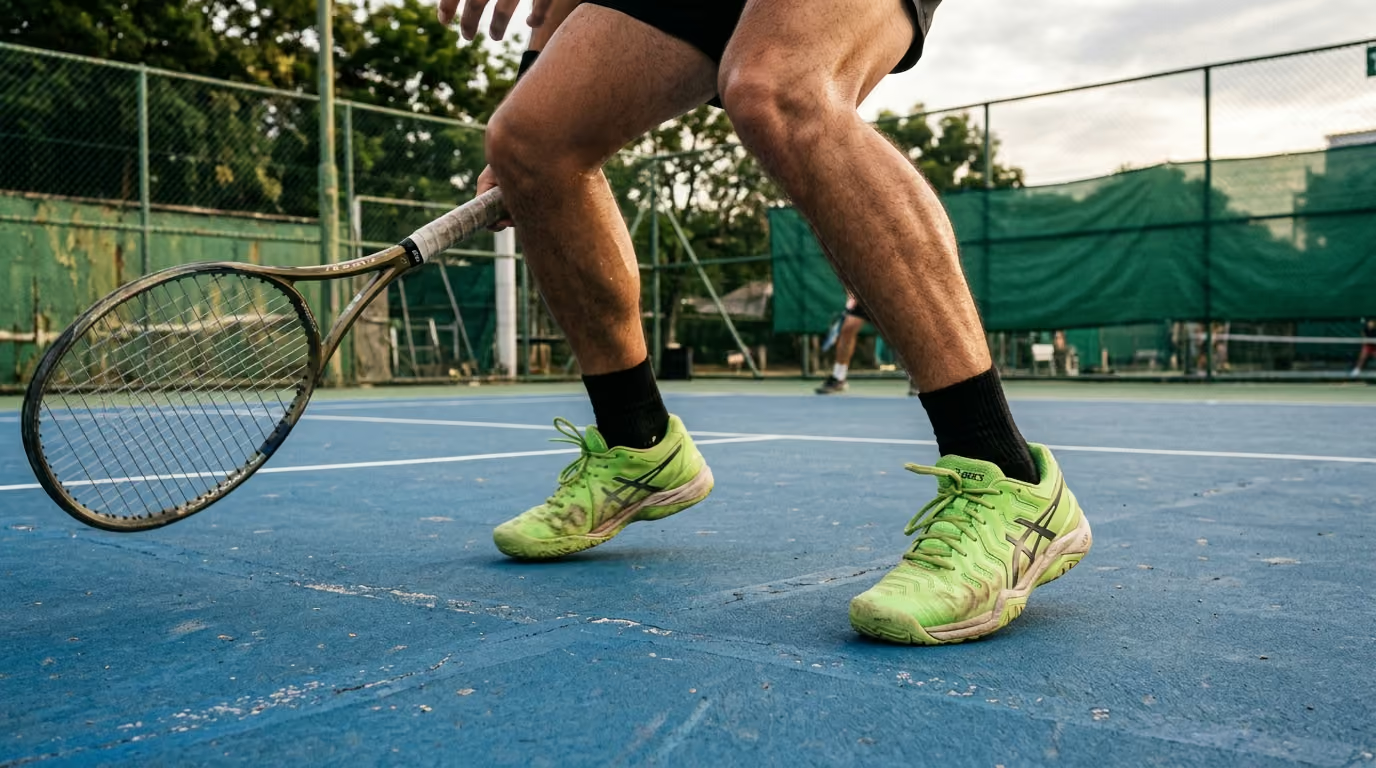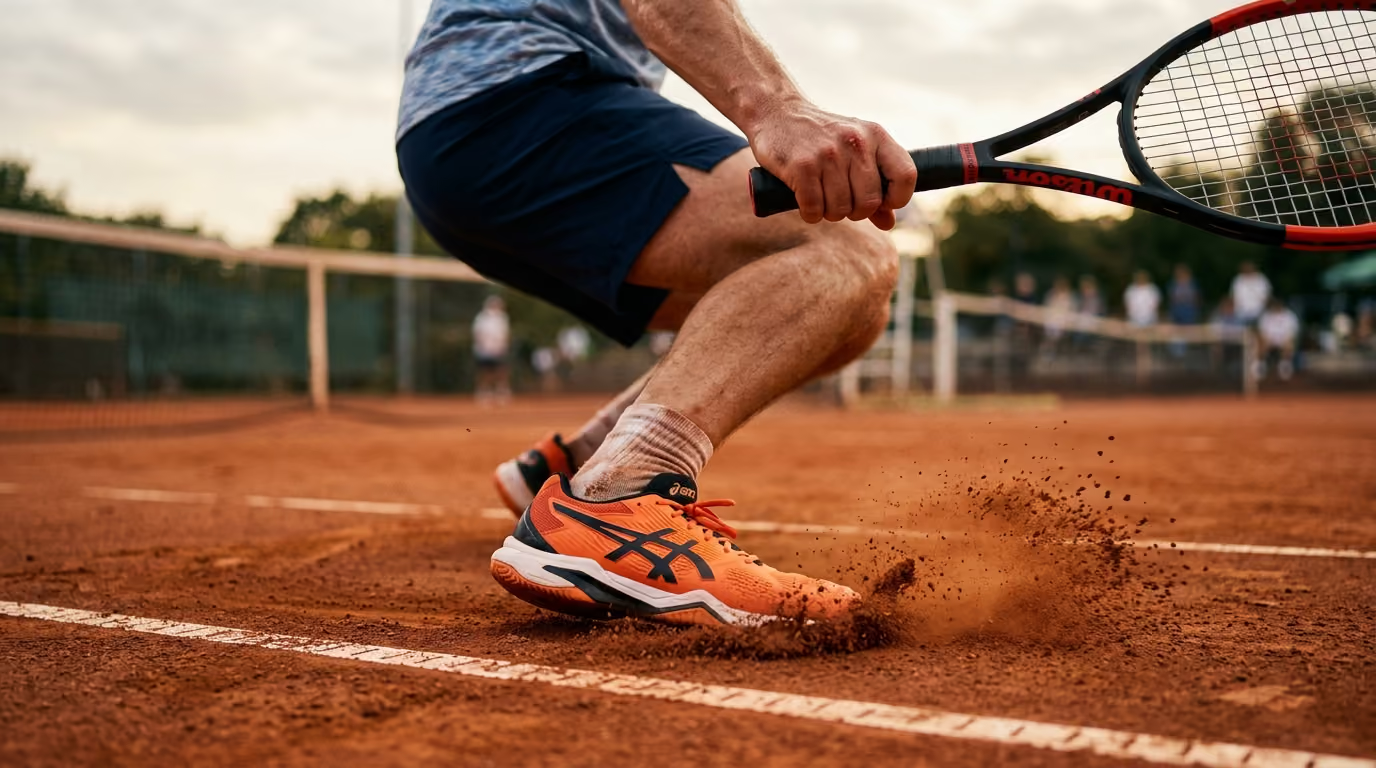

Racquet sports movement is significantly influenced by equipment choices, which dictate how athletes accelerate, brake, pivot, and transfer force during play.




Most court athletes assume mobility is a physical quality belonging entirely to their muscles and joints. We spend hours stretching our hips and practicing lateral lunges, yet we overlook the physical interface between our bodies and the court. Your shoes, racquet, and clothing are not passive accessories. They actively dictate how your joints load, how your feet grip, and how your muscles produce force.
Your choice of equipment determines how you accelerate, brake, pivot, and transfer force through your body during play. Selecting gear that balances traction, weight, and ergonomic fit allows you to move naturally without placing excessive stress on your musculoskeletal system. This systemic approach helps protect your joints and supports long-term athletic longevity on the court.
We often look at a racquet or a pair of shoes as isolated consumer products. Biomechanical research suggests a different reality. According to a comprehensive review of sports equipment from Heriot-Watt University, movement on the court is a complex transactional system. Lower-extremity loading is primarily driven by the interaction between your shoe and the court surface. Meanwhile, upper-extremity loading is influenced by the interaction among your stroke technique, racquet properties, strings, and ball weight.
To understand court mobility, you must analyze it as a five-part system. The first element is the athlete, which includes your body size, strength, fatigue level, and injury history. The second element is your equipment, which covers everything from footwear to racquet swingweight.
The third element is your environment. This includes the court surface, moisture, temperature, and cleanliness. The fourth element is the specific task you are performing on the court. This task could be a lateral shuffle, a deep lunge, or a sudden overhead reach.
The final element is adaptation. This describes how you change your technique in response to your gear and the court. If your shoes feel slippery, you will naturally shorten your strides to avoid falling. If your racquet is too heavy, you will likely delay your preparation.
Every step you take on the court sends ground reaction forces up through your feet, ankles, knees, and hips. When your shoe grips the court, the friction developed at the outsole determines how quickly you stop. If this friction is too high, the foot stops instantly while your momentum carries your knee forward. This mismatch increases torsional and shear loading in the joints.
The same principle applies to the upper body. When a ball hits your strings, the racquet frame vibrates and bends. A stiff frame transfers more shock to your hand, wrist, and elbow. If you compensate by gripping the handle tighter, you increase muscular tension throughout your forearm. Over time, these mechanical interactions can lead to chronic joint stress and movement limitations.
There is no single piece of gear that is universally perfect for every player. A shoe that feels incredibly stable on a dry hard court might feel slippery on a dusty indoor surface. A lightweight racquet that feels easy to swing in the store might twist in your hand when you face heavy pace on the court.
To make smart equipment decisions, stop asking which product is the absolute best. Instead, ask which equipment, surface, and athlete combination allows for natural movement with an acceptable safety margin. This perspective shifts your focus from marketing hype to practical biomechanical reality.
Friction is the physical resistance to relative motion between two surfaces. Traction is the usable portion of that resistance that allows you to push off, brake, or change direction. In racquet sports, maximum traction is not always the safest option.
Learning how to control these forces is a key part of court safety. For more details on physical preparation, you can read our guide on how to design a sport-specific mobility program for court athletes.
A useful model to evaluate traction includes three distinct zones. Too little traction causes your foot to slip during explosive push-offs or sudden braking. This leads to performance loss and increases the risk of a fall.
Functional traction allows you to accelerate, decelerate, and slide predictably. Too much traction stops your shoe abruptly, which transmits high twisting forces to your lower extremity. The ideal shoe and surface combination is the one that permits predictable force production across the entire movement cycle.
We must distinguish between static and dynamic traction. Static traction measures the resistance before your shoe begins to slide. Dynamic traction measures the forces acting while the shoe is moving across the court.
Research on tennis shoe tread elements highlights this difference. Scientists found that sliding movements produced higher dynamic friction than simple stepping movements. They also noted that the orientation of the tread pattern affected sliding friction differently from static friction. This means a shoe that feels completely secure when you take a step might behave differently during an emergency stop.
The utilized coefficient of friction describes how much of the available court grip you actually use. This is not a fixed number because players actively change their movement based on what they feel underfoot. Research shows that tennis players use a greater peak utilized coefficient of friction on clay courts than on cushioned acrylic hard courts.
The same study showed that players adapted their body positioning to the surface. On clay, players used less knee flexion to facilitate a controlled slide. On hard courts, they used greater knee flexion to brake and stop. If you switch surfaces without adjusting your movement, you may overload your muscles and joints.
Surface-specific footwear exists because the mechanical demands of each court are unique. Hard courts require durable outsoles with modified tread patterns to handle high friction and impact. These shoes often feature reinforced toe guards and lateral stabilizers to prevent the foot from rolling.
Clay courts require a full herringbone tread pattern. This design prevents loose clay from packing into the sole, which maintains consistent grip. On grass courts, players need small rubber studs to prevent slipping on moisture. Using a hard-court shoe on clay or grass can cause unpredictable movement and joint strain.
Racquet mass is the total weight of the frame. Balance describes where that mass is distributed along the length of the racquet. Swingweight measures how heavy the racquet feels when you actually swing it. A racquet with a high swingweight can produce excellent ball speed, but it requires more muscular effort to accelerate and decelerate.
To protect your upper body from chronic strain, check out our resources on injury prevention for active players.
Biomechanical research shows that different racquet setups alter joint power and muscle activity. A study examining different racquets during the flat serve found significant variations in shoulder joint power. It also noted changes in peak internal and external rotation moments.
This means two racquets of the same static weight can place very different demands on your rotator cuff. If a racquet is too head-heavy, it may drag during your swing, causing you to hit the ball late. If it is too light, it may not absorb enough shock, leaving your arm to handle the impact force.
Grip size dictates how hard your hand must squeeze the racquet handle during play. If your grip is too small, your fingers must curl tightly to prevent the frame from twisting. If your grip is too large, your hand cannot wrap securely around the handle. Both scenarios lead to excessive forearm tension.
Research on grip size and tennis elbow assessed grip force and wrist joint moments across different handle sizes. The study reported that an optimal individual grip diameter is associated with reduced grip force during strokes. This optimal size remains consistent even when the player experiences physical fatigue. Choosing the right size helps prevent overworking the forearm muscles.
String tension and material directly influence how much shock travels up your arm upon impact. According to research published in the Journal of Sports Sciences, string tension is a principal variable affecting the force experienced at the racquet. Lower string tension allows the string bed to deflect more, which acts as a cushion.
Stiffer strings, such as polyester, require high swing speeds to yield performance benefits. If you do not swing fast enough, these strings can feel harsh and transfer excessive vibration to your elbow. Combining a stiff string with high tension can quickly lead to tendon irritation. Finding the right balance requires matching string properties to your personal physical capabilities.
A racquet that feels manageable during a short warm-up can feel heavy after two hours of play. As your shoulder and forearm muscles tire, your swing mechanics will naturally change. You may begin to prepare late, contact the ball behind your body, or rely entirely on your arm.
This late contact shifts the impact load from your trunk to your smaller arm joints. To prevent this, consider using a slightly lighter setup if you regularly play long matches. Monitoring your physical sensations late in a session will tell you if your current setup matches your endurance.
We rarely think of apparel as a mechanical restriction, but tight fabric can limit your movement. When you serve, your shoulder must go through extreme external rotation and elevation. If your shirt is tight across the chest or shoulders, the fabric will resist this motion.
Similarly, your shorts or skirt must allow for deep hip abduction during lateral lunges. If the material lacks stretch, you may struggle to reach wide balls. This subtle resistance forces your muscles to work harder to achieve the same positions.
Over a match, this extra work leads to unnecessary energy expenditure. The goal is to choose apparel that feels completely unrestrictive during extreme ranges of motion. Look for fabrics with multi-directional stretch and gusseted seams that align with human anatomy.
Do not wait for a competitive match to find out if your clothes restrict your movement. You can run through a quick dynamic checklist in your locker room. Perform an overhead arm reach to see if your shirt hem pulls up excessively.
Next, drop into a deep split squat to check for tightness in the hips. Follow this with a rapid lateral shuffle and a crossover step. If you feel any binding or pulling, that garment is restricting your natural mobility. Test your playing gear with the exact socks and undergarments you plan to use on the court.
Heat stress is a well-documented risk factor in court sports. Heavy, saturated fabrics do not just feel uncomfortable, they also add physical weight to your body. As sweat accumulates, cotton shirts can become heavy and cling to your skin.
This damp fabric can cause skin irritation and increase your core temperature by preventing evaporation. Choosing high-quality synthetic blends or lightweight merino wool supports temperature regulation. When your body stays cool, your coordination and movement quality remain sharp.
To make equipment selection practical, we can organize our decisions around the F.A.S.T.E.R. framework. This structure guides you through six essential questions to evaluate your current setup. It helps you look at your gear as a complete, functional system rather than a collection of individual items.
Every piece of equipment should allow your joints to move through their full ranges. If a wrist brace, a tight sleeve, or rigid clothing limits your swing, your body will compensate elsewhere. Ensure your clothing, shoes, and supports allow for fluid, unrestricted paths of motion. If you feel restricted during a warm-up, adjust your gear before playing.
Look at your shoe and court as a unified system. Your goal is to find appropriate traction, not maximum grip. If you play on clay, choose a shoe that allows you to slide smoothly into your shots. If you play on a hard court, select a shoe that lets you decelerate without jarring stops.
Your equipment must remain stable when you apply maximum force. This means your shoe should not roll or twist when you change direction quickly. Your racquet should not wobble when you hit an off-center volley. Stability under load gives you the confidence to move aggressively without hesitation.
Always match your equipment to the specific court surface and playing style. A shoe designed for grass will not perform well on a hard court. A heavy baseline racquet might hinder your performance if you play fast doubles at the net. Tailoring your gear to the task improves both your movement efficiency and your court safety.
Ergonomic fit means your gear matches your unique anatomy. Try on court shoes in the afternoon when your feet are slightly larger. Ensure your racquet grip fits your hand, and your socks do not bunch inside your shoes. A secure, personalized fit prevents minor distractions from turning into movement compensations.
Your setup must perform consistently from the first point to the last. If your overgrip becomes slippery when wet, your repeatability drops. If your shoes lose their lateral support after a few months, your movement quality will decline. Regular maintenance ensures your gear supports you throughout entire matches.
Managing these systemic demands is essential for long-term health. Discover more about post-match care in our recovery science section.
While the physics of movement remain constant, the specific demands of each racquet sport differ. Each sport places unique loads on your body and requires a tailored approach to equipment selection. Understanding these differences helps you optimize your movement patterns.
Whether you focus on tennis or prefer the rapid exchanges of padel, your movement patterns dictate your gear choices.
Tennis is characterized by long, explosive sprints and heavy lateral loading. Players must cover a large court, which requires wide strides and deep lunges. Because of these demands, tennis footwear must feature robust lateral support and durable outsoles.
Tennis racquets are also heavier and longer than paddles used in other sports. This increased mass demands excellent trunk rotation and shoulder strength. Tennis players must also adapt to major surface changes, such as moving from high-traction hard courts to low-traction clay courts.
Pickleball is played on a much smaller court, which changes your movement patterns. Instead of long sprints, you perform rapid lateral shuffles, quick split steps, and frequent short lunges near the kitchen line. The paddle is lightweight, which allows for fast, wrist-dominant reactions.
Because the game is played on hard surfaces, pickleball shoes must provide excellent pivot control and low-profile cushioning. High-profile running shoes are particularly risky here, as the frequent small steps require close contact with the court. For those playing on smaller courts, our dedicated resources on pickleball offer tailored advice for paddle selection and footwork.
Padel combines elements of tennis and squash within an enclosed court. You must react to ball rebounds off the glass walls, which requires constant turning and backwards movement. The court surface is typically artificial turf covered with a layer of fine sand.
This sandy surface means padel shoes must have specialized outsoles. The tread must grip the turf while allowing for controlled slides. Padel paddles are thick, solid, and stringless, which creates unique impact vibrations. Players must use the safety lanyard on the wrist to prevent the paddle from slipping during fast swings.
Many active court athletes unknowingly make critical errors when managing their gear. These mistakes can lead to restricted movement, poor performance, and unnecessary physical discomfort. Identifying and correcting these habits is key to maintaining joint health.
Many players look for the grippiest shoes possible, believing this will prevent injuries. In reality, too much traction can be highly dangerous. If your shoe grips the court too aggressively during a lateral stop, the sudden deceleration can overload your knee or ankle.
Your ligaments and tendons must absorb the kinetic energy that would normally be dissipated through a slight slide. This is why clay-court players slide into their shots, reducing the peak braking force on their joints. Aim for predictable, controllable traction that matches your playing surface.
Cushioning feels comfortable when you stand or walk, but it can impair your court movement. Extremely soft midsoles reduce your ability to feel the court surface, which is known as proprioception. This sensory feedback is critical for rapid balance adjustments.
Furthermore, high stack heights raise your center of mass, making your ankles more vulnerable to rolling. An exploratory study of older female players showed that running shoes, which emphasize forward cushioning, can increase ankle inversion risks during lateral movements. Choose court-specific shoes with a lower, firmer profile.
It is easy to overlook the slow degradation of your gear. An outsole that has lost its tread will behave inconsistently, causing unexpected slips. A racquet string that has lost its tension will require you to swing harder and squeeze tighter to control the ball.
Similarly, a worn overgrip will force you to use excessive hand pressure to keep the racquet stable. According to the United States Tennis Association, replacing worn grips regularly is a simple way to prevent blisters and hand strain. Establish a regular maintenance schedule for all your gear.
When your equipment does not fit your movement demands, your body has to work harder. A heavy racquet forces your shoulder muscles to work overtime to generate swing speed. A shoe with poor traction requires your calves and feet to brace constantly to maintain stability.
This extra muscular effort burns through your energy reserves quickly. As fatigue sets in, your movement quality degrades, your reaction time slows, and your risk of injury increases. This is why choosing efficient, well-matched gear is a cornerstone of promoting athletic longevity for court players.
When you play with optimized equipment, your muscles do not have to work as hard to maintain control. This leads to less physical strain during your matches and a lower overall recovery burden afterward. It allows you to return to the court sooner with less residual soreness.
Your kinetic chain is the coordinated effort of your entire body to produce and absorb force. A stiff racquet or an inappropriate shoe breaks this chain. If your ankle cannot move freely because of a rigid shoe, the force of a jump landing travels directly to your knee.
If your shoulder must bear the entire load of a serve because of a heavy racquet, your rotator cuff will tire quickly. Protecting your kinetic chain means ensuring each piece of gear supports natural joint alignment. By distributing forces evenly, you reduce localized tissue strain and enjoy more years on the court.
While adjusting your equipment can resolve many movement issues, it is not a substitute for professional medical care. If you experience persistent joint pain, swelling, or numbness, you should stop playing immediately. These symptoms suggest a structural issue that gear changes cannot fix.
Consult a qualified physical therapist, sports physician, or orthopedic specialist if your discomfort does not resolve with rest. A professional can help identify underlying strength deficits, mobility restrictions, or technical errors. They can also offer personalized advice on matching your gear to your rehabilitation needs.
Do not ignore recurring aches in your elbow, shoulder, knee, or ankle. Early intervention from a medical provider can prevent a minor irritation from turning into a chronic condition. Use their expertise alongside proper equipment fitting to stay healthy and active on the court.
Choosing the right equipment is a highly individual process that supports your natural movement patterns and protects your athletic longevity on the court.
Follow Evercourts for practical insights on tennis, pickleball and padel performance, movement, recovery and healthy ageing. Stay connected for new articles, research-led guidance and ideas to help you play well and keep playing for years.


Read practical guidance for better movement, smarter preparation and a game that keeps working for you.
explore the Blog