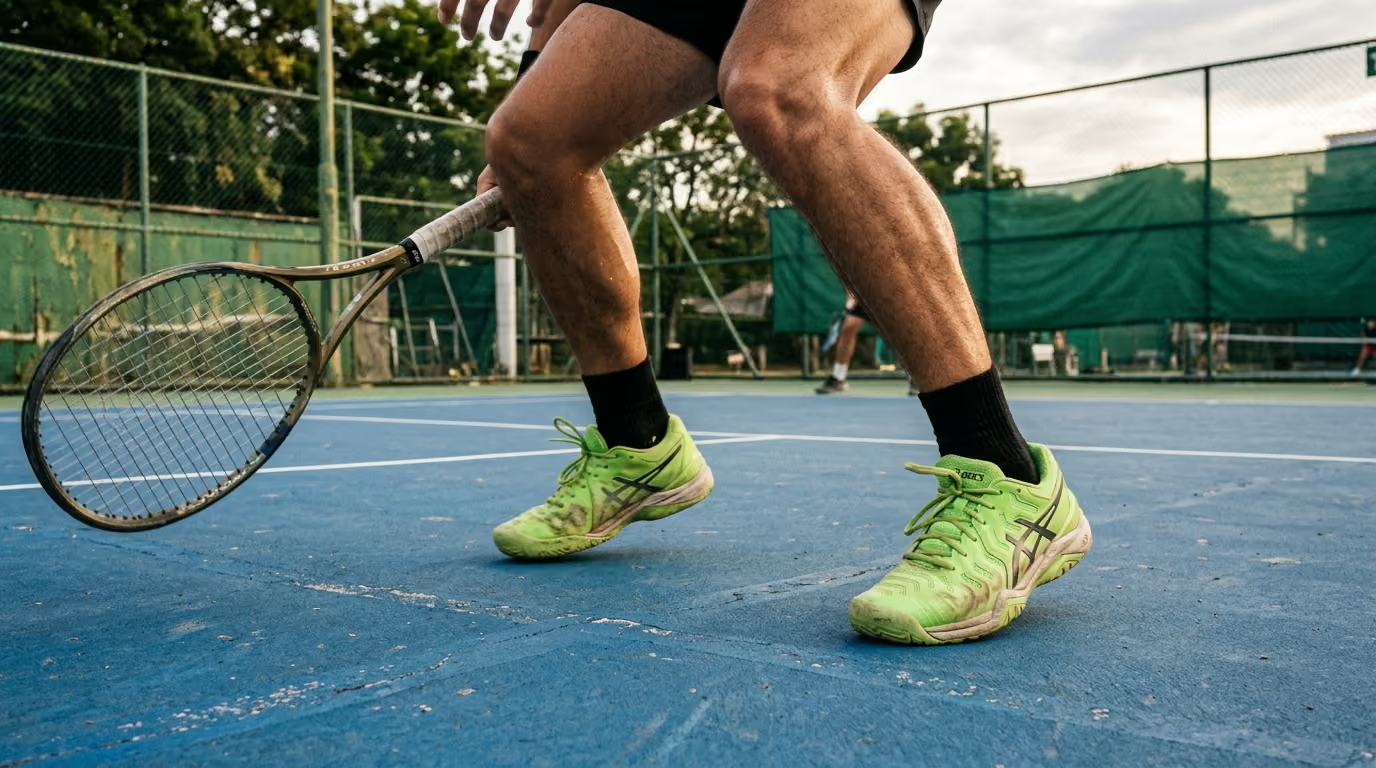
Five physical capacities shape lower arm performance and help racquet athletes build durable grip endurance, wrist stability, and long-term joint health.




Many racquet athletes believe that a tighter grip is the easiest way to generate more power and control the ball. They spend hours squeezing heavy spring-grippers or wrapping their handles with extra overgrips to prevent the frame from twisting. In reality, over-gripping is one of the fastest ways to exhaust your forearm muscles and disrupt your timing.
To build a reliable grip, you must look beyond absolute crushing power. True racquet control requires a balance of wrist stability, rotational power, and muscular endurance. A well-rounded grip routine helps your forearm absorb the shock of repeated impacts without transferring excessive stress to your elbow. This guide outlines how to build a resilient lower arm that keeps you playing comfortably for years.
Most standard gym tests measure grip strength with a simple hand dynamometer. The athlete squeezes the device as hard as possible for a few seconds, and the screen displays a score in kilograms or pounds. While this test is easy to run, it does not represent what happens during a long match. On the court, you rarely need to squeeze the handle with maximum force. Instead, you must regulate your grip pressure dynamically as you transition from delicate volleys to high-speed serves.
Research shows that absolute grip strength is not a perfect indicator of court performance. A study on youth tennis players found that body mass was the strongest predictor of grip strength, explaining 67 to 80 percent of the variation. Once researchers adjusted for age and physical maturity, higher grip strength did not predict a higher competitive ranking. This means that having a massive squeeze does not automatically make you a better player.
To improve your performance, you must treat grip strength as a multidimensional system. This system relies on five key physical capacities:
For comprehensive athletic longevity, players should integrate specific forearm training into their broader structured strength and conditioning routines. Building these five areas ensures that your wrist can handle the high-speed vibrations of racquet contact. This is especially important as you age, as healthy tendon adaptation requires systematic, progressive physical loading.
To train your lower arm effectively, you need to understand the muscles that control your wrist and hand. Your forearm contains dozens of small muscles that work in groups to position your racquet.
The wrist flexors run along the palm side of your forearm. This group includes the flexor carpi radialis, the flexor carpi ulnaris, the palmaris longus, and the deep finger flexors. Together, these muscles pull your hand forward and allow your fingers to wrap tightly around the handle.
In racquet sports, the flexors provide baseline grip stability. They also help snap the wrist forward during serves or overheads. You can train these muscles using controlled dumbbell wrist curls, cable flexions, or loaded carries.
The wrist extensors are located on the back of your forearm. This group includes the extensor carpi radialis longus, the extensor carpi radialis brevis, and the extensor carpi ulnaris. These muscles pull the back of your hand toward your elbow.
The extensors work hard during backhand strokes and whenever you need to stabilize your wrist against a fast-moving ball. A modeling study on the tennis forehand showed that the wrist extensors experience remarkably high forces during contact. Because these muscles cross both the wrist and the elbow, they are highly susceptible to overuse injuries like lateral epicondylopathy, commonly known as tennis elbow.
Pronation and supination are the movements that rotate your forearm. Pronation turns your palm downward, while supination turns your palm upward.
Pronation is a critical contributor to racquet-head speed during the serve and the overhead. Supination helps you shape the ball on spin shots and transition between different grip styles. You can train these rotation patterns by holding a weighted lever bar or a hammer and rotating your wrist from side to side under control.
Radial deviation tilts your wrist toward your thumb. Ulnar deviation tilts your wrist toward your pinky finger.
These lateral movements are essential for angling your shots and adjusting to low bounces. Because the muscles that control deviation are small, they can become irritated by sudden increases in training volume. When training deviation, always use light resistance and focus on smooth, stable movement through a pain-free range of motion.
Your wrist and hand form the final link in the kinetic chain. This means they are responsible for transmitting all the power generated by your legs, hips, and trunk into the racquet. When this kinetic chain is broken, players often try to compensate by squeezing the racquet harder, which places immense stress on the forearm.
A review of wrist injuries in tennis players emphasizes that single-stroke loads rarely cause structural damage. Instead, injuries typically stem from cumulative load over time. We can think about this risk using a simple conceptual framework:
$$\text{Total Load} \approx \text{Force per stroke} \times \text{Stroke repetition} \times \text{Frequency} \times \text{Recovery deficit}$$
This model reminds us that injury prevention requires managing multiple variables. You cannot simply strengthen a muscle to protect it; you must also monitor your weekly playing volume and ensure you get adequate rest.
Forearm muscle activation is also highly sensitive to shot speed. Research indicates that muscle forces in the forearm increase significantly as you hit the ball harder. Interestingly, the same study showed up to a threefold difference in wrist-extensor forces between different players hitting at the same speed. This suggests that clean technique, smooth joint coordination, and proper grip selection can dramatically reduce the physical stress on your arm.
Your choice of equipment also plays a role in how hard your forearm muscles have to work. A study of racquet grip sizes showed that changing your handle diameter alters the firing patterns of your forearm muscles. While minor differences of a few millimeters may not cause immediate issues, a handle that is far too small or far too large can force your muscles to over-work. An optimal grip diameter reduces the amount of squeeze required to keep the racquet from twisting, especially when your muscles begin to fatigue.
To build lasting capacity in your lower arms, you must follow a systematic, step-by-step training progression. Jumping directly into heavy, high-volume forearm exercises can irritate your tendons and disrupt your on-court practice.
The goal of the first phase is to establish comfortable, pain-free movement. This phase is highly beneficial if you are returning from a period of inactivity or experiencing mild stiffness. Focus on low resistance, slow tempos, and perfect control.
Begin with unloaded wrist circles to improve local circulation and joint lubrication. Perform light, assisted pronation and supination movements using a light wooden dowel or an unweighted racquet. Introduce gentle isometric holds, where you hold a neutral wrist position against light resistance for 15 to 30 seconds. Perform these movements three to four times per week to build baseline joint capacity.
Once your joints move comfortably without irritation, you can begin building local muscular strength. This phase focuses on traditional resistance training to increase the load-bearing capacity of your forearm muscles.
Incorporate dumbbell wrist curls and reverse wrist curls to target the flexors and extensors. Use a light hammer or a weighted lever bar to perform resisted pronation and supination. Focus on moderate-repetition sets, aiming for 3 sets of 10 to 15 controlled repetitions. Perform these strength exercises two days per week, ideally after your on-court sessions so your grip remains fresh for play.
Racquet sports require you to maintain grip precision across hours of play. In this phase, you will transition toward longer sets, shorter rest periods, and exercises that challenge your muscular endurance.
Replace some of your isolated strength work with loaded carries, such as the farmer's walk. Hold a pair of moderately heavy dumbbells and walk slowly for 30 to 60 seconds while keeping your wrists perfectly neutral. You can also perform timed submaximal grip holds, squeezing a spring-gripper or a tennis ball at 50 percent of your maximum force for extended periods. This teaches your nervous system to maintain steady, submaximal tension without locking up your wrist.
The final phase connects your gym-based strength to the actual demands of your sport. Here, you will practice regulating your grip pressure during dynamic movements and controlled impacts.
Perform shadow swings with your racquet while focusing on relaxing your hand between strokes. Squeeze the handle firmly just before the simulated impact, then immediately soften your grip during the follow-through. You can also incorporate medicine ball catches or wall-rebound drills, which force your wrist to react and stabilize against sudden, external forces. This phase bridges the gap between general physical preparation and the reactive nature of competitive play.
To keep your body moving efficiently across all phases of training, consider incorporating joint mobility and movement mechanics exercises into your weekly routine. Balancing local forearm strength with full-body mobility ensures that your kinetic chain remains fluid and functional.
To ensure your training is working, you should regularly test and monitor your forearm capacity. Tracking your progress allows you to adjust your workout volume and spot potential issues before they turn into nagging injuries.
If you have access to a hand dynamometer, you can use it to establish a baseline of maximal grip force. To get accurate results, you must standardize your testing posture. Stand with your feet shoulder-width apart, keep your elbow tucked at a 90-degree angle, and hold the device with your wrist in a neutral position.
Perform three maximum-effort squeezes on each hand, resting for 60 seconds between trials. Record the highest score for each hand and use these values to track your seasonal trends. Remember that a high score is only useful if you can maintain that strength throughout a long match.
In racquet sports, it is normal for your dominant arm to be stronger and more developed than your non-dominant arm. Research shows that dominant-hand grip strength is consistently higher in competitive tennis players. Because of this natural adaptation, you do not need to make both arms perfectly symmetrical.
Instead, watch for sudden or unusual changes in your strength balance. If your dominant arm experiences a rapid drop in strength, or if you feel pain during testing, it may indicate localized fatigue or tendon strain. Compare your weekly scores against your own historical baseline rather than comparing yourself to other players.
To test your muscular endurance, select a dumbbell that represents roughly 30 to 40 percent of your maximum grip capacity. Hold the dumbbell in a neutral position at your side and time how long you can maintain your grip before your fingers start to open.
A well-conditioned court athlete should be able to hold this weight for at least 45 to 60 seconds without significant shaking or wrist deviation. If your grip fails early, prioritize submaximal holds and high-repetition endurance exercises in your gym sessions.
The most practical monitoring tool is your body's daily feedback. Keep a simple training log to track how your forearms, wrists, and elbows feel during and after play. Rate any stiffness or soreness on a scale of 0 to 10.
Pay close attention to how your arms feel the morning after a tough match or a heavy workout. If you wake up with noticeable stiffness that takes more than 15 minutes to clear, your training volume may be outpacing your recovery capacity. Use this feedback to scale back your hitting time or reduce the weight in your strength sessions until your body adapts.
Many dedicated players sabotage their progress by falling into common training traps. Recognizing these mistakes can save you months of frustration and protect your joints from unnecessary wear and tear.
Many athletes assume that the best way to build grip strength is to squeeze heavy spring-grippers as hard as possible. While this builds maximal force, it does not prepare your wrist for the complex demands of a match. Racquet sports require rotational control and steady, low-level muscle endurance. If you only train maximal crushing force, you may develop stiff, hyper-tonic muscles that actually increase the stress on your elbow tendons.
When players get nervous or tired, they often clamp down on their handle. Keeping your hand clenched between points prevents your forearm muscles from receiving oxygen-rich blood, leading to premature fatigue. Watch professional players on television; you will notice they constantly spin their racquet or switch it to their non-dominant hand between points. This simple habit allows the dominant forearm to relax and recover for the next rally.
If your wrist or elbow begins to ache, it can be tempting to strap on a compression band or a brace and keep playing. While these supports can reduce temporary discomfort, they do not solve the underlying problem. Braces distribute forces away from the painful area, but they also allow you to continue overloading an already irritated tendon. Use braces sparingly and focus on building genuine physical capacity through progressive loading.
When players experience forearm pain, they often blame their equipment immediately. While using the wrong grip size can alter your muscle firing patterns, research suggests that minor variations are rarely the sole cause of injury. Often, the real culprit is a sudden increase in playing hours, poor stroke mechanics, or a lack of physical conditioning. Ensure your equipment is comfortable, but focus your energy on managing your workload and building physical strength.
While tennis, pickleball, and padel all require forearm endurance, each sport places distinct physical demands on your hand and wrist. Understanding these differences allows you to tailor your training to the specific sport you play.
Tennis involves a long racquet, a heavy ball, and high swing speeds. When the ball hits your strings, it creates a massive torque that tries to twist the racquet in your hand. This is especially true when defending against heavy topspin or dealing with off-center hits.
To handle these demands, tennis players must prioritize wrist-extensor strength and rotational control. Your training should emphasize eccentric forearm work to absorb the shock of high-velocity impacts. Tennis players also benefit from practicing grip-force modulation, as they must transition from a relaxed grip during the backswing to a firm, stable grip at the moment of contact.
Pickleball is played on a smaller court with a lightweight paddle and a plastic ball. Because the distances are shorter, the game requires lightning-fast hand speed and rapid volley exchanges at the kitchen line. The impact forces are much lower than in tennis, but the frequency of actions is incredibly high.
For pickleball, your training should focus on finger dexterity, reaction speed, and submaximal endurance. You do not need massive crushing strength; instead, you need the ability to make micro-adjustments to your paddle face under pressure. Incorporate light pinch-grip exercises and rapid pronation-supination drills into your routine to keep your hands quick and responsive.
Padel is played in an enclosed glass court using a thick, solid paddle. Because the paddle has no strings, it does not absorb impact vibrations as efficiently as a tennis racquet. Furthermore, padel involves a high volume of overhead strokes, such as the bandeja and vibora, which require continuous forearm rotation.
Padel players must build exceptional strength in their wrist flexors and pronators to power through repetitive overheads. Because the solid paddle transmits intense vibrations directly to your hand, your training should also emphasize tendon load tolerance. Incorporate isometric wrist holds and high-repetition eccentric exercises to prepare your forearm tendons for the stiff, solid feel of padel paddle impacts.
To help visualize these different sport demands, we can compare their primary physical requirements:
No matter which sport you play, implementing proactive injury prevention protocols is essential. Tailoring your strength training to the unique mechanical demands of your preferred sport will keep you on the court and performing at your best.
Building a strong grip is not just about what you do in the gym; it is also about how well you recover between sessions. Because the tendons in your wrist and elbow have a limited blood supply, they take longer to adapt and heal than your muscles.
To support long-term tissue health, you must give your forearm tendons adequate time to rest. Avoid scheduling intense grip-strength workouts on the same days as long, grueling matches. If you play several times a week, keep your gym-based forearm training short and focused. Two 15-minute sessions per week are usually enough to build capacity without pushing your tendons into a state of chronic fatigue.
You can also use simple self-massage techniques to manage muscle tension. Use your opposite thumb or a small massage ball to apply gentle pressure to the fleshy parts of your forearm. Avoid pressing directly on the bony points of your elbow, as this can irritate the attachment sites of your tendons. Spend two to three minutes rolling out your flexors and extensors after playing to promote relaxation and blood flow.
Finally, remember that lifestyle factors play a massive role in tissue recovery. Getting quality sleep, staying hydrated, and consuming adequate protein are essential for tendon repair. If you are constantly sleep-deprived or highly stressed, your body will struggle to adapt to your training, increasing your risk of developing chronic overuse issues.
For more insights on managing post-match soreness and optimizing your downtime, explore our long-term player health strategies. Prioritizing systematic recovery ensures that your body can repair itself effectively, allowing you to return to the court feeling refreshed and ready to perform.
To help you get started, here are three practical programming templates designed for different player profiles. Choose the template that matches your current physical status and goals.
This program is designed for active players who want to build a resilient lower arm and prevent future injuries. Perform these exercises twice a week after your court sessions or on non-playing days.
This template is for players who are recovering from lateral elbow soreness or stiffness. Focus entirely on pain-free movement, and stop immediately if you feel any sharp discomfort.
This program is tailored for competitive tournament players who experience a loss of racquet control and grip power during long, multi-set matches.
While progressive strength training is highly effective for building court resilience, you must know when to step back and seek professional help. Pushing through severe pain or ignoring neurological symptoms can lead to chronic damage that requires long periods of complete rest.
Consult a qualified healthcare provider, such as a physical therapist or sports physician, if you experience any of the following warning signs:
If you are unsure whether your symptoms require medical attention, err on the side of caution. A professional evaluation can help you identify the root cause of your discomfort, whether it stems from poor biomechanics, equipment issues, or a specific tendon injury. Getting an accurate diagnosis early allows you to modify your training safely and return to the court without unnecessary delays.
Building a strong, resilient grip is a gradual process that requires patience and consistency. By shifting your focus from absolute crushing power to smart, progressive training, you can protect your joints and enjoy your favorite racquet sports for decades to come.
Follow Evercourts for practical insights on tennis, pickleball and padel performance, movement, recovery and healthy ageing. Stay connected for new articles, research-led guidance and ideas to help you play well and keep playing for years.


Read practical guidance for better movement, smarter preparation and a game that keeps working for you.
explore the Blog