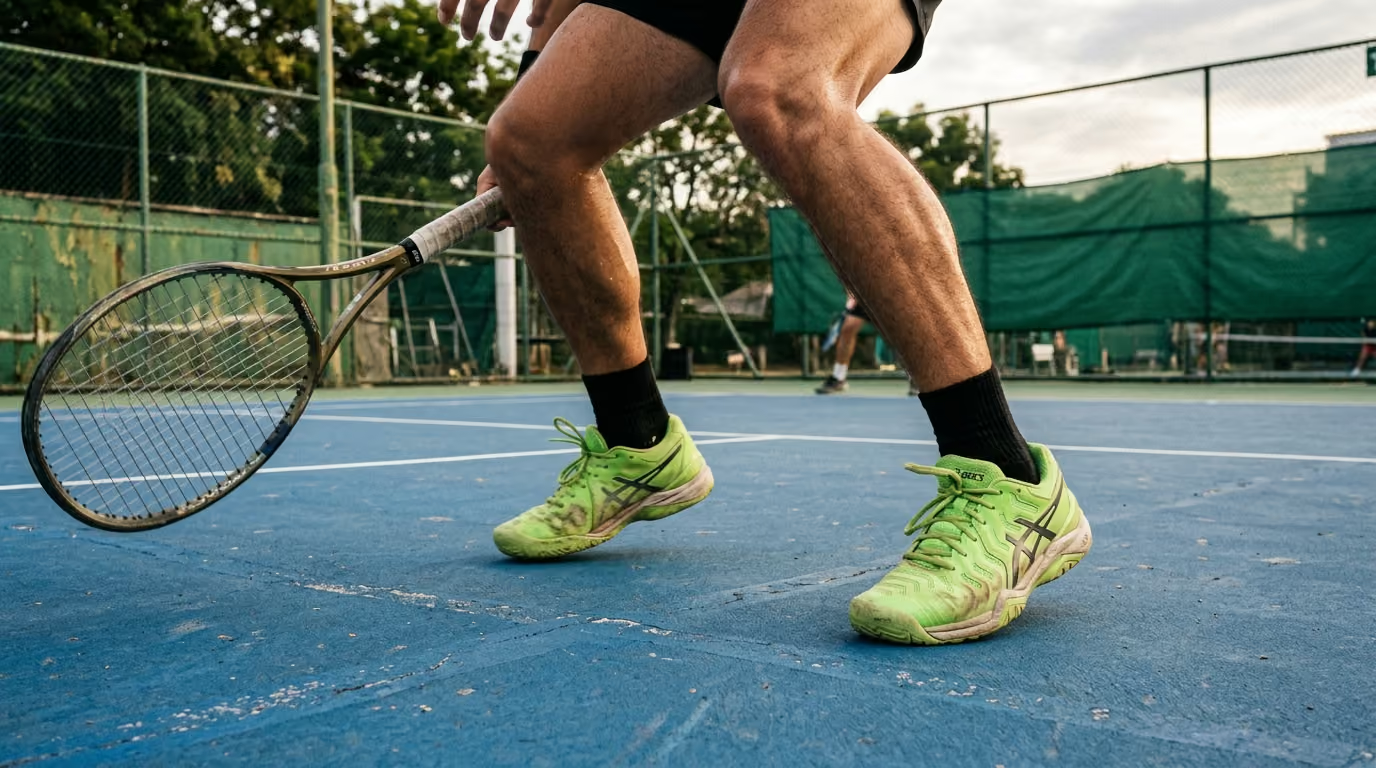
Converting static joint range into usable strength, balance, and coordination is essential for racquet sports players to improve court movement.




Many racquet sports players spend hours stretching on the floor to improve their flexibility. They hold static positions, reach for their toes, and try to loosen tight muscles before a match. Yet, when they step onto the court, they still struggle to bend for low balls, rotate fully on their groundstrokes, or recover quickly after a wide sprint.
This guide explains why passive flexibility often fails to show up during dynamic play. It presents a systematic framework for converting static joint range into usable strength, balance, and coordination. By learning how to load and control your joints, you can transform empty flexibility into efficient court athleticism.
To move efficiently on court, you must understand that flexibility is simply the passive length of your muscles, while mobility is your ability to actively control and stabilize that range of motion during play. True court movement requires converting passive range into usable strength, balance, and coordination. Without this active control, increased flexibility will not translate into faster footwork or better stroke production.
Flexibility is principally about the amount of motion available, particularly passive motion, while mobility includes active control and coordination through that motion. This distinction is vital for players of all ages. If you can passively pull your knee to your chest while lying down, you have hip flexibility. However, if you cannot maintain a deep, stable split-stance while reaching for a low volley, you lack hip mobility. You can find more practical movement strategies in our mobility and movement resources.
This gap between passive and active range is highly relevant to performance. A systematic review published in the Journal of Sports Sciences highlights that mobility is a complex performance quality combining joint range, tissue tolerance, muscle strength, motor control, and balance. A player must produce and absorb force at challenging joint angles, not merely reach those angles during a relaxed stretch.
Furthermore, resistance training through a full range of motion produces greater adaptations in strength and lower-limb muscle growth than training with a partial range of motion. A systematic review and meta-analysis on training ranges of motion confirms that loading a joint through its entire movement arc is superior for functional performance. Stretching alone does not build the strength required to deceleration, change direction, or launch into a sprint.
The primary reason flexibility does not automatically transfer to the court is a lack of neuromuscular control. Your nervous system is highly protective. If your brain senses that you cannot control or stabilize a specific joint angle, it will restrict your access to that range during fast, unpredictable movements.
This protective tension often feels like physical tightness, but it is actually a neurological brake. When you run to hit a ball, your body prioritizes balance and joint safety over maximum range. If you have not trained your muscles to produce force at the end of your joint range, your brain will simply prevent you from reaching that position during a match. This lack of control increases your vulnerability to sudden strains and joint issues. For detailed strategies on protecting your joints, refer to our injury prevention resources.
To bypass this protective brake, we must bridge the gap between passive joint range and athletic movement. We use a progressive five-stage framework to ensure that every millimeter of new flexibility becomes useful on the court.
Turning an isolated physical capacity into an integrated court movement requires a step-by-step approach. You cannot jump directly from a static calf stretch to an explosive split-step landing without intermediate training steps.
We begin by making the joint physically capable of moving further. Static stretching is a reliable tool for this initial step. A 2025 meta-analysis reported that chronic static stretching has a large positive effect on passive flexibility. The researchers found that flexibility gains were maximized at approximately four minutes of cumulative stretching per session acutely, and ten minutes per week chronically.
At this stage, you are simply preparing the tissues. You can perform these longer, passive holds after your matches or during dedicated recovery sessions.
Once you have accessed the range, you must teach your nervous system how to use it. This involves active mobility exercises where your own muscles drive the movement. For example, instead of using your hands to pull your leg into hip internal rotation, you use your hip rotators to turn the joint actively.
You should perform these movements slowly and deliberately. The goal is to reach your end range, pause, breathe, and return without losing your alignment or balance.
Next, we add resistance to the newly accessible joint angles. This step is crucial because court movement requires you to absorb your own bodyweight under gravity. We use exercises like deep split squats, lateral lunges, and controlled step-downs.
By loading the joints at their outer limits, you build muscle tissue tolerance and joint stability. This strength training also helps prevent common court issues by training the body to manage high-force positions. To build a stronger foundation for your movement, you can explore our strength and conditioning resources.
Court play does not happen at a slow, controlled tempo. You must be able to access your mobility in a fraction of a second. Here, we transition to dynamic, fast movements.
We use pogo hops, rapid snap-downs, and lateral push-offs to train the stretch-shortening cycle of your tendons. Dynamic stretching research indicates that moving actively through a range of motion immediately before high-speed activity improves explosive performance, whereas long, static holds can temporarily reduce your power output.
The final stage connects your physical capacity to the actual game. We add visual cues, a ball to track, an opponent to watch, and a racquet to swing.
For instance, you might perform a drill where you split-step, react to a wide ball, slide or lung into position using your full hip range, strike the ball, and recover to the center. This step is essential because real court movement is a perception-action loop. You must read the environment and execute the movement simultaneously.
To make this practical, let us look at the four major joint complexes used in racquet sports. Each region requires a specific progression to turn raw flexibility into functional court performance.
The hips are the primary engine for lateral movement, deceleration, and rotational power. If your hips are tight or weak, your body will transfer the stress of your movements to your lower back and knees.
I remember finishing a tough two hour padel match on a cold Tuesday night and waking up the next morning feeling like my lower back was locked in concrete. For a long time, I just accepted this as the price of playing hard in my forties. But once I started spending just ten minutes on targeted hip mobility before heading to the club, the stiffness almost completely vanished. It taught me that we do not have to accept pain as a default state of aging. You can read more about maintaining your physical capabilities as you age in our healthy aging and athletic longevity resources.
To build functional hip mobility, we use the following progression:
Ankle dorsiflexion is the ability to bend your foot upward toward your shin. This motion is essential for a deep split-step landing and for lowering your center of mass to chase low balls.
The serve and overhead smash require excellent shoulder mobility. However, chasing passive shoulder flexibility without stability can lead to impingement or rotator cuff issues.
A systematic review of tennis-serve kinematics shows that elite players achieve an average of 130 degrees of shoulder lateral rotation at the lowest point of their racquet drop. This impressive range requires a coordinated effort from the shoulder joint, scapula, and thoracic spine.
Your thoracic spine is your upper and middle back. It is designed to rotate, allowing you to coil your shoulders during stroke preparation while keeping your pelvis relatively stable.
While all racquet sports require mobility, the specific physical demands of each game shape how you should apply your training.
Tennis is characterized by large sprint distances, high-velocity deceleration, and extreme open-stance hip loading. Players must often slide or sprint wide, absorbing massive forces on a single leg before recovering to the center.
Because of these demands, tennis players need to focus heavily on eccentric hip and ankle strength. You must be able to control your joint range while moving at high speeds. Additionally, the tennis serve requires exceptional shoulder external rotation and thoracic extension to achieve a high contact point without straining the lower back.
Pickleball is played on a much smaller court, meaning sprint distances are shorter, but the action is incredibly fast. The game is won or lost at the non-volley zone line, where players must maintain a low, athletic stance for extended periods.
For pickleball, ankle dorsiflexion and deep hip flexion are paramount. You must be able to sink your hips low to the ground to play dinks and low volleys. If your ankles or hips are tight, you will be forced to bend at your waist, which compromises your balance and puts excessive strain on your lower back.
Padel combines a smaller, enclosed court with a high volume of overhead shots, such as the bandeja and the vibora. Players must also turn and rotate constantly to read balls rebounding off the glass walls.
This means padel players require excellent thoracic rotation and shoulder stability. You must be able to turn your upper body quickly to face the glass and then rotate back to strike the ball. The frequent overheads also mean your shoulder blades must move freely along your ribcage to prevent overuse injuries in the shoulder joint.
When trying to improve on-court movement, players often fall into several predictable traps. Recognizing these mistakes can save you time and prevent unnecessary physical setbacks.
Many players assume that if some flexibility is good, more must be better. They spend hours trying to achieve extreme positions, like a full split, that have no relevance to their sport.
This is a mistake because a joint that is highly flexible but lacks strength is inherently unstable. If you cannot control a specific joint angle, your nervous system will not allow you to use it during a fast match. You are much better off having a moderate range of motion that you can load and control completely.
Static stretching is an effective way to increase passive muscle length over time, but it is poorly suited for your pre-match warm-up. Research shows that holding static stretches for longer than 60 seconds immediately before explosive activity can reduce your power, speed, and agility.
Instead, your pre-match warm-up should focus on dynamic mobility. Save your long, passive stretches for after your matches or for a dedicated evening routine when your body is already warm and ready to relax.
It is common to see players performing complex mobility drills on a foam mat, only to stand up and move with the same stiff footwork as before. Floor-based drills are excellent for accessing new range, but they do not automatically teach your brain how to use that range on your feet.
You must bridge the gap by transitioning from the floor to standing, then to loaded movements, and finally to sport-specific drills. If you do not practice moving your joints under the influence of gravity and momentum, your floor gains will remain on the floor.
Racquet sports are inherently asymmetrical. You swing with one arm, rotate predominantly in one direction, and often land more heavily on one leg.
Trying to make both sides of your body perfectly symmetrical is often unrealistic and unnecessary. Instead of chasing a single numerical target on both sides, focus on whether you have sufficient range on each side to execute your strokes comfortably and without pain.
When you improve your movement control, you do not just play better, you also recover faster. When a joint cannot access its proper range of motion, your body is forced to compensate by moving other areas excessively.
For example, if your ankles are stiff, your knees and lower back must absorb the shock of every split-step landing. This concentrated stress leads to localized fatigue, muscle soreness, and eventual wear and tear on your joints.
By distributing the forces of movement across multiple joints, you reduce the focal load on any single structure. Your hips, knees, and ankles work together to absorb and produce force, which minimizes overall muscle fatigue and helps you wake up feeling fresher the day after a tough match.
While a progressive mobility program can help most players move more freely, it is important to recognize when self-directed exercise is not appropriate. You should consult a qualified healthcare professional, such as a physical therapist or sports doctor, if you experience any of the following:
These symptoms often indicate an underlying structural issue, such as a joint sprain, muscle tear, or nerve irritation, that requires clinical assessment rather than simple stretching.
To help you put these principles into action, here is a practical six-week template. This program is designed to fit alongside your regular play and can be adjusted based on your schedule.
In the first two weeks, our focus is on assessing your current limitations and teaching your brain how to control your joints.
Now that you have accessed and controlled your movement, we begin adding resistance to teach your muscles how to handle force in these positions.
In the final two weeks, we transition to fast, dynamic movements that mimic the chaotic nature of actual court play.
If you are naturally hypermobile, you do not need more flexibility. Your focus should be entirely on stability, strength, and motor control. Instead of stretching, spend your time on isometric holds, controlled strength training, and landing mechanics. This will help you stabilize your joints and protect them from excessive movement during play.
While you may feel looser immediately after a single stretching session, lasting changes in joint mobility require consistency. It typically takes 4 to 6 weeks of regular active mobility and strength training for your nervous system to accept and maintain your new range of motion. Think of it as a gradual process of building tissue tolerance and movement confidence.
Yes, post-match is the perfect time to use static stretching. Your muscles are warm, and your nervous system is in a highly stimulated state. Performing slow, static stretches with 30 to 60 second holds can help lower your heart rate, relax your nervous system, and restore resting length to tired tissues.
While some asymmetry is completely normal in racquet sports, large differences in movement or strength can be problematic. A good rule of thumb is to check if one side of your body feels significantly tighter, weaker, or less stable than the other during play. If you find a major discrepancy, spend a little extra time on the limited side during your warm-up and strength sessions.
Follow Evercourts for practical insights on tennis, pickleball and padel performance, movement, recovery and healthy ageing. Stay connected for new articles, research-led guidance and ideas to help you play well and keep playing for years.


Read practical guidance for better movement, smarter preparation and a game that keeps working for you.
explore the Blog