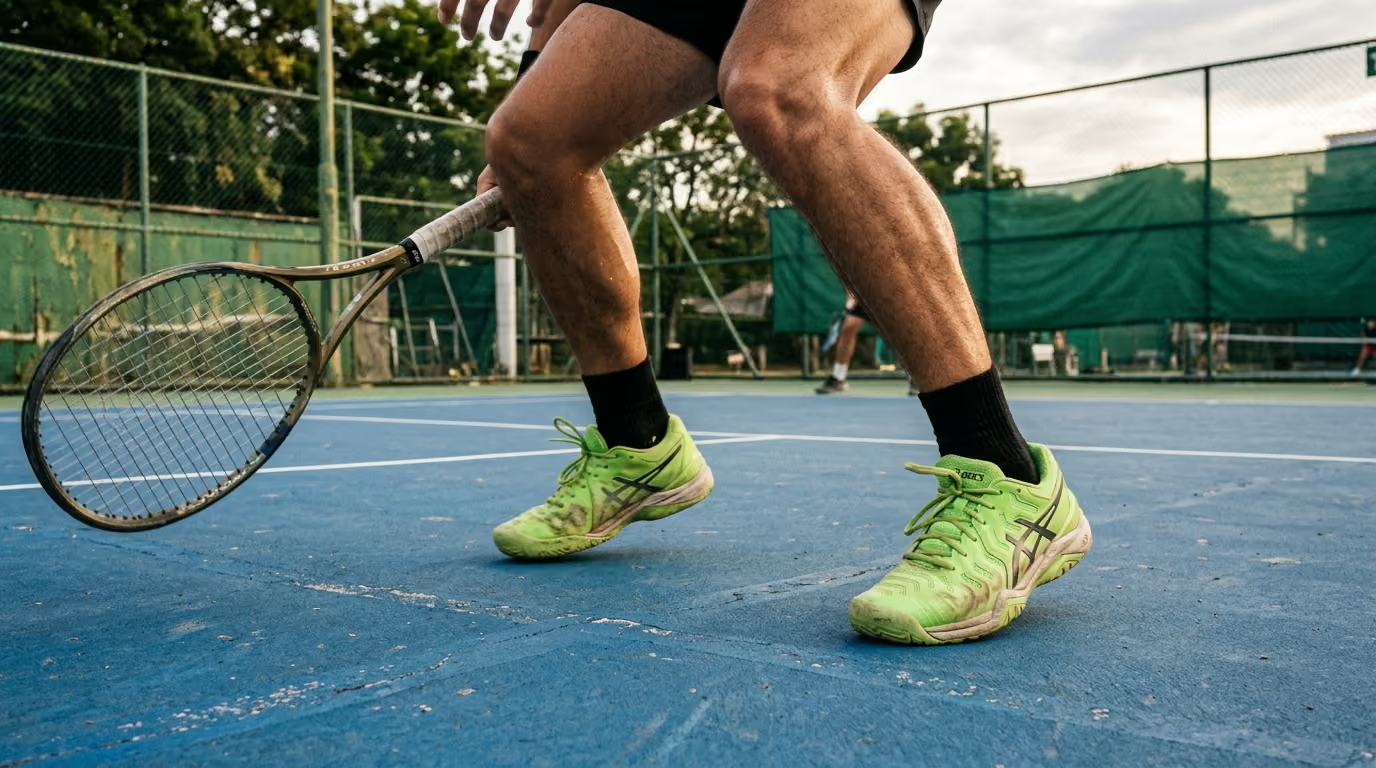
You will learn how to diagnose your racquet sports performance issues and create a personalized practice plan to achieve lasting improvement on the court.




What is an improvement framework? It is not a collection of generic tips or a list of standard drill sequences. Instead, it is a systematic diagnostic path designed to identify the true cause of a missed shot or a tactical collapse.
To turn a recurring match weakness into a productive practice session, a player must first separate the observable match outcome from its underlying cause. By testing whether a mistake stems from a technical, tactical, physical, perceptual, or emotional constraint, you can design highly targeted court drills that directly translate back to competitive matches. This structured framework shifts your practice from repetitive hitting to deliberate, high-yield improvement.
By establishing a clear diagnostic pathway, court athletes can avoid wasting hours on the wrong practice activities. This comprehensive guide details how to analyze your match play, identify your primary performance barriers, and build a progression-based training plan designed for lasting court success.
Many court athletes struggle to improve because they try to fix symptoms rather than the root mechanism. When you miss a crucial shot, it is easy to assume your technical form is broken. However, a missed ball is simply an outcome.
To address the issue effectively, you must understand where the breakdown occurred. We use a simple diagnostic hierarchy to separate these layers.
The outcome is the final result visible in the match score, statistics, or point log. It tells you what happened, but it does not tell you why.
Common examples of negative outcomes include losing three consecutive service games. Another example is failing to win points when drawn into a net rally.
The symptom is the specific, recurring event that happens during play. It is the visible physical error that occurs right before the point is lost.
For example, a player might hit short returns on every first serve. Another player might experience late contact on wide backhands.
The mechanism is the underlying process that produced the symptom. This is where your diagnostic investigation begins.
The mechanism might be physical, such as a player lacking the lateral braking strength to stop and recover. It could be perceptual, meaning the player reads the serve direction too late.
The intervention is the targeted practice task designed to alter the mechanism. It is the specific drill or game constraint you use during training.
If the mechanism is perceptual, the intervention must train visual scanning. If the mechanism is physical, the intervention must build strength or deceleration capacity.
To find the correct mechanism, you must look across five distinct areas of performance. These domains do not exist in isolation, as they constantly interact during a live rally.
The Technical domain concerns your body movement, racket path, and contact point. A true technical issue means you cannot reliably organize the movement, even when you have plenty of time.
The Tactical domain involves your decision-making, shot selection, and court positioning. You might possess a perfect stroke, but you struggle because you select the wrong target from a defensive position.
The Physical domain covers your speed, strength, mobility, and endurance. Fatigue or restricted joint movement can prevent you from reaching the ball in balance.
The Perceptual-Cognitive domain represents how quickly you process visual information. This includes reading your opponent's body language, tracking ball spin, and anticipating the direction of the shot.
The Emotional and Attentional domain governs your focus, arousal level, and psychological response to pressure. Frustration after a mistake can disrupt your decision-making on the subsequent point.
To build an effective training plan, we must look at the real physical demands of racquet sports. Sports science research reveals that court play is highly demanding, characterized by intermittent, high-intensity efforts.
According to a systematic review and meta-analysis of elite tennis, the average rally lasts approximately 5.5 seconds for male players. For female players, the average rally is around 6.4 seconds.
The same review showed that the average running distance per point is 9.6 meters for men. Women cover approximately 8.2 meters per point.
Crucially, the effective playing time in tennis matches is remarkably low. It sits at approximately 18.6 percent for men and 20 percent for women. This means the ability to recover between points is just as vital as the ability to sprint during a rally.
These demands are highly dependent on the playing surface. Research shows that clay-court rallies are about 22 percent longer than hard-court rallies. Clay play leads to higher heart rates, increased blood lactate, and greater ratings of perceived exertion.
When matches extend past the two-hour mark, physiological fatigue alters performance. A comprehensive review published in the British Journal of Sports Medicine documented these changes in detail.
Prolonged tennis match play causes a 10 to 13 percent reduction in quadriceps maximal voluntary strength. It also significantly reduces leg stiffness, which degrades your lateral braking ability.
When your legs lose their stiffness, you cannot change direction quickly. This physical decline often looks like a technical error. A player might start framing their groundstrokes, but the real issue is that their tired legs cannot position them correctly behind the ball.
Furthermore, match analysis reveals subtle set-to-set changes in elite play. As matches progress, there is a measurable decline in serve speed, net approaches, and running intensity.
Players often adjust to this fatigue by adopting a more conservative pacing strategy. If your performance drops late in a match, you must determine if you lack aerobic fitness or if your tactical choices are wasting valuable energy.
Psychological pressure has a direct, measurable impact on movement execution. A study of semi-professional tennis players examined how anxiety affects the serve.
Researchers divided players into an anxious group and a neutral group. The anxious group demonstrated significantly lower serve accuracy, but the breakdown was not caused by a sudden loss of motor skill.
Instead, the relationship was fully mediated by self-reported distraction. The pressure distracted the players, pulling their focus away from the court target and toward internal worries.
In a massive analysis of over 650,000 points from Grand Slam tournaments, researchers studied how errors compound. They found that committing an error on the preceding point significantly increases the probability of making another error.
This compounding effect is much stronger when situational pressure is high, such as during break points or tiebreakers. This scientific evidence shows that we must train the sequence after an error. Managing your attention between points is a physical and psychological skill that requires deliberate practice.
Applying this framework requires a systematic approach. You must move from raw court observation to a highly structured practice session.
Begin by replacing vague complaints with precise, observable descriptions. Do not say, "My backhand is terrible."
Instead, describe the situation, the trigger, the action, and the failure. A better description is, "When I receive a deep, heavy topspin ball to my backhand, I contact the ball late, and my return lands short."
This precise statement gives you a clear target for training. It identifies the exact environment, the incoming ball characteristics, and the physical failure.
Do not look at a match as one continuous event. Break your play down into specific phases to see where the system breaks down.
Analyze your performance during serve and return situations. Look at how you handle neutral rally exchanges versus defensive emergencies.
Examine if your errors happen early in the set or only after forty-five minutes of play. Track whether your performance dips during pressure scores, such as game points or tiebreaks.
To measure progress, you need a starting point. Use match statistics, video recordings, or a simple court notebook.
In our experience, relying solely on subjective memory after a match is highly unreliable. We tend to remember the spectacular winners or the frustrating misses, which distorts our perception of how we actually played.
For example, players often complain about making too many unforced errors. However, sports science notation systems often avoid the term "unforced error" because it is highly subjective. Instead, record the specific court zone where your errors occur, and note whether the opponent's shot put you under defensive pressure.
For every recurring error, write down at least three potential causes. If you are missing short balls into the net, do not immediately assume your swing is too low.
Your technical swing might be fine, but you may be recognizing the short ball late. Alternatively, you might lack the acceleration to reach the ball in balance.
By writing down multiple hypotheses, you prevent yourself from applying the wrong fix. You remain open to what the movement data actually reveals.
To find the dominant constraint, run simple, isolating tests on the court. These tests help you rule out different performance domains.
First, run a technical isolation test by having a partner feed predictable, comfortable balls. If you can hit ten perfect shots in a row, your basic movement mechanics are stable, and you do not need to rebuild your stroke.
Next, run a movement test by keeping the shot pattern predictable but adding wide lateral movement. If your accuracy drops significantly, your issue is likely related to balance, braking, or physical conditioning.
Run a decision test where your partner feeds variable balls, and you must choose between a cross-court or down-the-line shot. If your technique remains clean but you choose targets that land wide, your primary issue is tactical selection.
Analyze your test results to find the most pressing barrier. Prioritize the constraint that is costing you the most points and is highly controllable in training.
Your selected priority must be narrow enough to train but broad enough to transfer back to real play. Do not set a goal to "improve movement."
A better training priority is, "Maintain a balanced, low athletic stance when braking on wide court balls, allowing for a clean recovery step." This gives you a clear, physical focus for your next session.
Never jump straight from a diagnosed problem into a high-pressure match. You must guide your body and mind through a structured learning progression.
Start with simple, predictable feeds to clarify the physical action. Once you feel comfortable, introduce movement, requiring yourself to recover to the proper court position after every shot.
Next, add perceptual variables, forcing yourself to read the incoming ball's depth and speed. Finally, transition to representative rally play with competitive scoring and pressure constraints.
To find structured training templates and movement resources, you can explore our comprehensive collection of court performance resources.
To help you diagnose your court struggles, we have outlined the most common match symptoms below. For each symptom, we list competing hypotheses across the five performance domains. Use this guide to generate training ideas for your next practice session.
To see how this framework functions in practice, let us examine four common player profiles. These real-world scenarios show how proper diagnosis leads to very different practice designs.
Consider a player who consistently plays well in flat cross-court rallies but misses frequently when facing an opponent who hits high, looping topspin to the backhand. The player's immediate reaction is to book a lesson to fix their backhand swing mechanics.
However, a systematic diagnosis reveals that when the player is fed predictable high balls from a stationary basket, their technique is perfectly fine. The breakdown only occurs when the depth of the topspin ball varies randomly.
The true mechanism is perceptual and physical. The player struggles to judge the high bounce early, and they lack the footwork to step back or move forward to take the ball at a comfortable height.
The resulting practice plan must target positioning and early detection. The player practices recognizing the high bounce the moment the ball leaves the opponent's racket.
The court drills use a variable feed where the player must decide within a split second to take a step back and let the ball drop, or step forward to hit it on the rise. This approach solves the match problem without altering the player's natural swing mechanics.
A player struggles to return fast first serves, frequently blocking the ball short or missing wide. They assume they need to practice hitting their return harder to match the incoming pace.
During diagnostic testing, we find that the player uses a very long, traditional groundstroke backswing on their return. While this long swing works well during baseline rallies, they simply do not have enough time to execute it against a fast serve.
The mechanism here is a mixture of technical preparation and tactical understanding. The player needs to shorten their stroke and aim for high-margin, deep targets rather than looking for a winning return.
The practice plan begins by shortening the player's preparation. The coach feeds fast balls from the service line, forcing the player to use a compact, half-volley style block.
Next, we add visual cues, requiring the player to read the server's body stance to anticipate the serve direction. The final phase involves competitive play where the returner is rewarded with a point simply by landing the return deep in the center of the court.
A competitive player often wins their first set comfortably but experiences a massive drop in performance during the third set, leading to frustrating losses. They assume they need to start a intense long-distance running program to build their endurance.
A deeper look at the match data and physical tracking reveals a different story. The player's physical sprint times remain relatively stable, but their tactical choices change dramatically.
When they feel slightly tired, they stop building points patiently. Instead, they begin attempting low-percentage, high-risk winners early in the rally to avoid long running exchanges.
The true mechanism is tactical pacing and emotional discipline under fatigue. The player's fitness is actually sufficient, but they do not know how to play efficient, high-margin tennis when their energy drops.
The training plan focuses on simulated third-set scenarios. The player performs controlled, high-intensity court movement drills to induce a moderate state of fatigue.
Immediately following these drills, they play scored points where they are restricted to high, heavy, cross-court shots. This teaches them to construct points efficiently and remain disciplined when they are physically tired.
A player dominates practice sessions and easily defeats friends in casual play. However, during official league matches, they double-fault at break points and hit tentative, short balls whenever they have a lead.
They assume they need to find a way to stop feeling nervous. However, sports science shows that trying to suppress anxiety is rarely successful. The real mechanism is attentional distraction, where the player's focus shifts from the court target to the consequences of losing.
The practice plan introduces consequence-based training environments. We play games where points are scored normally, but if the server double-faults on a game point, they lose all the points they accumulated in that game.
We also build a strict, physical pre-serve routine. The player must bounce the ball three times, take a deep breath, and state their physical target out loud before starting their motion.
By focusing their attention on a physical checklist, they prevent their mind from wandering to the score. This approach helps the player perform effectively, even when they feel intense pressure.
While the diagnostic framework is universal, you must tailor your training to the unique physical, tactical, and spatial demands of your specific sport.
Tennis is played on a very large court, which imposes immense movement demands on the body. As we noted from the scientific literature, players must cover significant lateral distances and execute heavy braking forces on every single point.
In tennis, tactical success depends heavily on court depth, ball spin, and baseline recovery. Because of the large playing area, technical errors are often caused by poor movement or late positioning.
If you are looking to improve your baseline play or serve consistency, check out our comprehensive tennis performance articles for specialized guidance.
Pickleball is played on a much smaller court, which dramatically reduces the running distance but increases the speed of play. Points are dominated by rapid reflex exchanges and precise paddle control at the non-volley line.
In pickleball, perceptual-cognitive processing speed is incredibly important. You have very little time to react to a fast drive or a soft dink.
Furthermore, tactical patience is a major differentiator. To explore how to develop your non-volley zone strategies and reduce unforced errors, read our curated pickleball training guides.
Padel is played in an enclosed glass court, which introduces complex spatial and physical calculations. Players must read the ball's bounce off the glass walls, which requires constant multi-directional footwork.
I remember finishing a tough two hour padel match on a cold Tuesday night and waking up the next morning feeling like my lower back was locked in concrete. For a long time, I just accepted this as the price of playing hard in my forties. But once I started spending just ten minutes on targeted hip mobility before heading to the club, the stiffness almost completely vanished. It taught me that we do not have to accept pain as a default state of aging.
In padel, the work-to-rest ratio is highly demanding, and points are characterized by constant transitions from defense to attack. To master court positioning and rebound mechanics, read our in-depth padel training articles.
Even with a structured framework, court athletes often fall into common training traps that limit their long-term improvement.
This is the most common and costly mistake in racquet sports. Players spend years rebuilding their swings, searching for a perfect technique that does not exist.
Most errors are actually caused by poor positioning, late visual recognition, or tactical panic. If you try to fix a perceptual problem by changing your backswing, you will only create more confusion and frustration.
Blocked drills, such as hitting fifty consecutive forehands fed directly to your pocket, are excellent for learning a brand-new movement pattern. However, they do not transfer well to competitive matches.
A real match requires you to move, read unpredictable ball flight, make rapid tactical decisions, and handle intense pressure. If your practice is always predictable, your brain never learns how to coordinate these skills under match conditions.
To build lasting court skills, explore our resources on healthy aging and athletic longevity.
To maintain your physical capabilities and play racquet sports for many years, you must balance your training intensity with proper recovery.
An apparent drop in performance is often not a technical or tactical issue at all. Instead, it is a sign of chronic fatigue or poor load management.
According to the International Olympic Committee consensus statement on athlete load and injury risk, you should monitor your training, competition, psychological load, and overall well-being. Relying on a single measure of fatigue is highly unreliable.
For recreational and competitive players, we recommend tracking your Session Rating of Perceived Exertion. After every match or practice, rate the intensity of the session on a scale of one to ten, and multiply that number by the total duration of the session in minutes.
This simple calculation gives you a clear load score. If your weekly load score spikes too quickly, you are at a significantly higher risk of developing overuse injuries.
Furthermore, tennis-specific monitoring guidelines recommend recording court practice separately from strength and physical conditioning. This separation allows you to identify if a decline in your movement is caused by excessive training volume or a genuine physical limitation.
To learn more about tracking your training load and protecting your joints, visit our injury prevention resources.
While physical conditioning and structured practice can resolve many movement issues, you must know when to step off the court and seek professional medical guidance.
Do not ignore recurring physical pain or try to play through joint stiffness. Consult a qualified healthcare professional, such as a physical therapist or sports physician, if you experience any of the following warning signs:
Addressing minor physical limitations early can prevent them from turning into chronic injuries that keep you off the court for months.
This common issue usually means your practice environment is too comfortable and predictable. In practice, you often receive clean, rhythmic feeds, and there are no negative consequences for missing a shot.
To bridge this gap, you must introduce match-like uncertainty, rapid decision-making, and competitive scoring into your training sessions.
Yes, blocked practice is highly valuable when you are trying to learn a brand-new skill or change a specific mechanical movement. It allows you to build comfort and confidence without the distraction of court movement or tactical decisions.
However, once you can execute the movement consistently in a closed setting, you must quickly transition to variable, representative drills to ensure the skill transfers to your matches.
To find the answer, record your match play or have a partner take notes during your third set. If your sprint times, lateral recovery, and baseline court positioning remain fast but you are choosing risky, low-margin targets, your issue is tactical discipline.
If your decision-making remains smart and patient but your feet are physically slow and your contact point is consistently late, you need to focus on building your aerobic recovery and lower-body strength.
Absolutely. You can gather valuable diagnostic data by simply keeping a court journal.
Immediately after your matches, write down a behavioral description of your errors, the score context, and how you felt physically. This simple habit will help you spot recurring performance patterns and design smarter, more purposeful practice plans.
Follow Evercourts for practical insights on tennis, pickleball and padel performance, movement, recovery and healthy ageing. Stay connected for new articles, research-led guidance and ideas to help you play well and keep playing for years.


Read practical guidance for better movement, smarter preparation and a game that keeps working for you.
explore the Blog