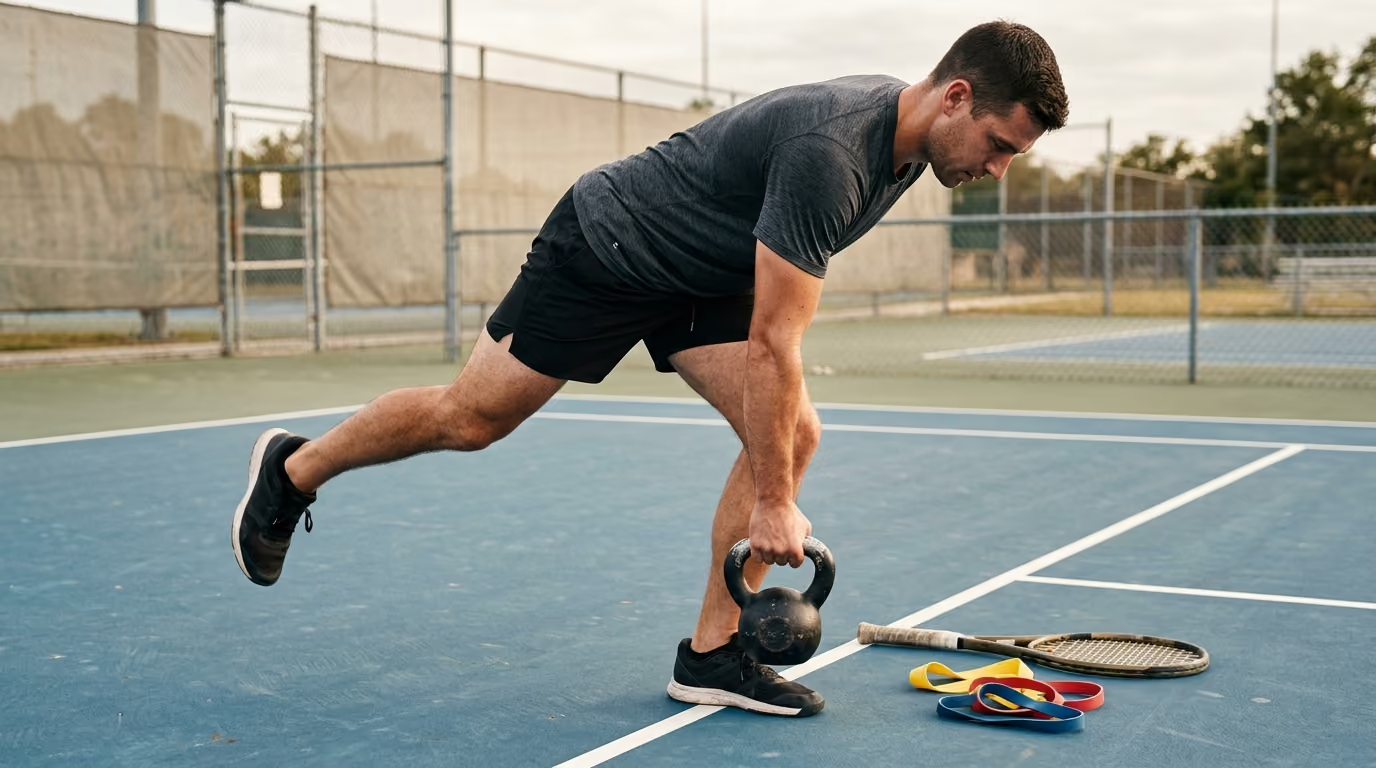

Hamstring injury prevention for court sports involves building tissue capacity through progressive eccentric strength training and high-speed movement exposure.




Imagine sprinting for a short drop shot on a hard court. You take two rapid acceleration steps, lunge forward at full stretch, and feel a sudden warning pull in the back of your thigh. This scenario is all too common for court athletes who rely on explosive movements.
Safely protecting your hamstrings on the court requires building your tissue capacity to handle high forces while the muscle is fully stretched. Traditional stretching alone is insufficient to prevent strains. Players must instead combine progressive eccentric strength training with structured, high-speed movement exposure to prepare the muscles for the chaotic demands of match play.
By understanding how these muscles function during dynamic court movements, you can construct a training plan that protects your lower limbs. Focusing on smart injury prevention resources is essential for anyone who wants to enjoy racquet sports for years to come. This guide breaks down the science, the movements, and the exact training steps required to build resilient hamstrings.
To protect the hamstrings, we must first understand what they do. The hamstring group consists of three distinct muscles. These are the biceps femoris, the semitendinosus, and the semimembranosus.
Unlike single-joint muscles, the hamstrings cross both the hip and the knee joints. This dual-joint architecture means they have complex responsibilities during court movement. They help extend your hip when you push off the ground to sprint. They also flex your knee when you pull your leg back during the running cycle.
On the court, these muscles must transition between producing force and absorbing force in a fraction of a second. When you sprint forward, your hamstrings work to control your lower leg just before your foot hits the ground. They act as brakes to slow down your swinging limb. If your hamstrings lack the strength to absorb this braking force, the muscle fibers can experience micro-tears.
Furthermore, the hamstrings do not work in isolation. Their loading patterns are heavily influenced by the position of your pelvis and trunk. If you lose control of your core stability, your pelvis may tilt forward. This tilt places the hamstrings under a constant, mechanical pre-stretch. When you add a sudden sprint or lunge to this already stretched position, the risk of injury rises.
Most hamstring strains occur when the muscle is forced to produce high tension while it is in a lengthened position. In sports science, this is known as the long and fast problem. This mechanical vulnerability is especially pronounced during two distinct phases of running and court movement.
The first phase is the terminal swing phase of running. This occurs right before your foot contacts the court surface. Your hip is flexed, your knee is almost fully straight, and the hamstrings are stretched to their limit while working hard to decelerate the leg. The second phase is the early stance phase, where the foot makes contact and the muscle must rapidly transition to pulling your body forward.
Court sports add unique mechanical demands that differ from straight-line track running. A deep forward lunge requires you to flex your hip deeply while extending your knee to reach a low ball. This action mimics the terminal swing phase but with added body weight and decelerating forces.
A wide lateral reach can also put immense strain on the medial hamstrings. This occurs as you brake your sideways momentum and prepare to push back toward the center of the court. A rapid split step requires your muscles to experience pre-tension followed by an immediate, explosive acceleration. If your muscles are not trained to produce force in these elongated states, they are more likely to fail.
The scientific literature on hamstring injuries has shifted dramatically over the last two decades. Researchers now view hamstring injury prevention as a multifactorial problem rather than a simple flexibility issue. The most critical risk factor identified in the research is a history of previous hamstring injury.
A systematic review published in the British Journal of Sports Medicine analyzed risk factors across thousands of athletes. The researchers found that athletes with a history of hamstring strain were 2.7 times more likely to suffer a future injury. If the injury was recent, that risk multiplier rose to 4.8. This high recurrence rate highlights the importance of thorough rehabilitation and long-term maintenance.
Fortunately, research also shows that targeted exercise programs are highly effective. The Nordic hamstring exercise is one of the most thoroughly researched movements in sports science. A comprehensive meta-analysis of fifteen studies showed that injury-prevention programs including the Nordic hamstring exercise reduced hamstring injury risk by up to 51 percent.
Another study in the American Journal of Sports Medicine reported that eccentric strength training reduced hamstring injury rates by approximately 56 to 70 percent. This eccentric training improves the muscle's ability to produce force while lengthening. It also increases the length of the muscle fascicles, which helps the tissue tolerate long-length positions.
While much of this research comes from field sports like football, the physiological adaptations apply directly to court athletes. Building eccentric strength is a fundamental requirement for anyone pursuing healthy aging and athletic longevity on the court.
To protect your hamstrings effectively, you need a balanced approach. Relying on a single exercise or stretching routine is rarely successful. A complete training program should be built around four distinct pillars.
The first pillar is Capacity. This means building raw eccentric and concentric strength in the hamstrings, glutes, and deep core muscles. You want to ensure the muscles can produce high levels of force. This foundational strength protects the muscle fibers from tearing under sudden, high-load demands.
The second pillar is Specific Exposure. You must progressively expose your hamstrings to high-speed movements, rapid accelerations, and sharp decelerations during practice. Gym work builds the foundation, but your nervous system must learn to coordinate these forces at real game speeds.
The third pillar is Mobility and Movement Options. This involves maintaining sufficient active range of motion in your hips, knees, and ankles. If your joints cannot move freely, your body will compensate by placing excessive stress on your hamstrings.
The fourth pillar is Load and Fatigue Management. You must avoid sudden, drastic spikes in your training volume or match play. If you transition too quickly from a period of rest to a heavy tournament schedule, your muscles will fatigue. Tired muscles lose their coordination and their ability to absorb impact, which opens the door to injury.
To manage your injury risk, it helps to view your training through the capacity versus exposure model. Your capacity is the maximum amount of work, force, and stretching your muscles can safely handle. Your exposure is the actual physical demand placed on those muscles during a match or practice session.
Injury risk rises when your exposure exceeds your current capacity. For example, if you have only been doing slow weight lifting, your capacity for high-speed braking is low. If you then play a highly competitive three-set singles match, your high-speed exposure will be very high. This mismatch creates a high-risk scenario.
To build athletic longevity, your goal is to keep your capacity safely ahead of your expected court exposure. You do this by gradually increasing the difficulty of your training sessions. You must also ensure your training matches the specific movement patterns of your sport.
Tracking your recent training volume is a simple way to manage this balance. If you plan to play a long tournament next month, you should gradually increase your on-court sprinting and lunging during the preceding weeks. This progressive preparation ensures your muscles are not shocked by the sudden physical demands of competition.
Building hamstring capacity requires integrating progressive strength and conditioning resources into your weekly routine. You should use a mix of bilateral, unilateral, and eccentric-focused movements. Here is a menu of effective exercises to include in your program.
The Romanian Deadlift is an excellent foundation for building hamstring strength at the hip joint. Stand with your feet hip-width apart while holding a barbell or two dumbbells in front of your thighs. Keep a slight bend in your knees, push your hips backward, and lower the weight along your shins.
Focus on keeping your spine neutral and your core engaged throughout the movement. Lower the weight until you feel a moderate stretch in your hamstrings, then squeeze your glutes to return to a standing position. Perform three sets of 8 to 10 repetitions with a controlled tempo.
This variation is highly specific to court sports because it targets one leg at a time. Stand on your right leg while holding a dumbbell in your left hand. Hinge forward at your hip, extending your left leg straight behind you for balance.
Keep your hips square to the floor and avoid letting your standing knee collapse inward. Lower the dumbbell toward the floor until your torso is parallel to the ground, then drive through your right heel to stand. Complete three sets of 6 to 8 repetitions on each leg to build balance and unilateral strength.
Slider leg curls are an exceptional intermediate exercise for targeting knee flexion strength. Lie on your back on a smooth floor with your heels placed on two sliding discs or a towel. Lift your hips into a bridge position, keeping your glutes squeezed and your torso straight.
Slowly slide your feet away from your body, taking three to four seconds to fully extend your legs. Once your legs are straight, lower your hips to the floor, pull your heels back to the starting position, and repeat. Perform three sets of 6 to 8 repetitions, focusing entirely on the slow, lowering phase.
This advanced movement is the gold standard for building eccentric knee flexion strength. Kneel on a soft mat and have a partner hold your ankles firmly, or anchor your feet securely under a heavy bar. Keep your torso straight and your hips fully extended so your body forms a straight line from your knees to your shoulders.
Slowly lower your chest toward the floor by bracing your hamstrings to resist the downward pull of gravity. Lower yourself as far as possible under control, then use your hands to catch yourself in a push-up position. Push yourself back up to the start and perform three sets of 3 to 5 repetitions.
While gym-based strength training is essential, it cannot completely prepare your muscles for high-speed movement. Your hamstrings must experience real sprinting to build the coordination required for match play. You should introduce this running preparation progressively to avoid overloading the tissues.
Start by performing simple marching and skipping drills during your warm-up. These exercises teach your hips to transition rapidly between flexion and extension. They also help build ankle stiffness, which reduces the amount of ground contact time during acceleration.
Once you can perform skipping drills comfortably, transition to low-speed accelerations. Stand at the baseline of the court and accelerate at 50 percent of your maximum speed over 10 yards, then decelerate slowly. Perform three to four repetitions, focusing on smooth movement and a relaxed running posture.
Gradually increase the intensity over several weeks until you are performing near-maximal sprints. Run at 90 to 95 percent of your top speed over 15 to 20 yards, allowing for a full minute of rest between each effort. This exposure teaches your hamstrings to manage high contraction velocities in a controlled environment.
Finally, integrate reactive acceleration drills into your training. Start in a split-step position, wait for a visual cue, and immediately sprint to the left or right. These drills train the nervous system to coordinate rapid force production without warning, which is exactly what happens during a point.
The mechanical demands on your hamstrings differ slightly depending on whether you play tennis, pickleball, or padel. Understanding these differences allows you to tailor your injury-prevention efforts.
Tennis is characterized by long sprint distances, high-impact decelerations, and extreme lateral lunges. Because tennis matches can last for several hours, your hamstrings must have excellent endurance.
The hard court surface provides high traction, which increases the braking forces transmitted through your lower limbs. Tennis players must focus heavily on eccentric strength and long-stride deceleration drills. On clay courts, players must also train the hamstrings to control the body during sliding movements.
Pickleball is played on a much smaller court, which reduces the need for long-distance sprinting. However, the game requires constant, rapid lateral shifts and deep, low-crouching postures near the kitchen line.
When I first started playing pickleball, I noticed how many people skipped warming up entirely. They would jump straight out of their cars and right up to the kitchen line. I tried doing that and immediately pulled a calf muscle. Pickleball requires just as much explosive lateral movement as tennis, just in a tighter space. Since then, I always spend five minutes doing dynamic lunges and ankle rolls. It changes everything about how confident I feel pushing off the baseline.
To protect your hamstrings in pickleball, focus on low-stance mobility and rapid, short-step accelerations. You must ensure your muscles can produce force while your hips are deeply flexed.
Padel combines the short-court explosive nature of pickleball with the added complexity of glass walls. Players must frequently transition from retreating to chase a lob to advancing rapidly to the net.
These constant transitions require rapid rotational movements and frequent overhead reaches. The hamstrings must work hard to stabilize the pelvis during these multi-directional turns. Padel players should incorporate rotational core training and multi-directional lunge variations into their preparation.
Many well-meaning athletes make mistakes in their training that actually increase their risk of injury. Recognizing these errors is the first step toward building a safer routine.
The most common mistake is relying entirely on static stretching to protect the hamstrings. Stretching can increase your passive range of motion, but it does not build the strength required to control that range. If you have flexible but weak hamstrings, your risk of injury remains high. You must combine any flexibility work with active strengthening exercises.
Another frequent error is introducing high-volume eccentric training immediately before a competitive match or tournament. Exercises like the Nordic hamstring exercise cause significant muscle soreness and temporary fatigue. If you perform these movements the day before a match, your muscles will be tired and less responsive. Schedule your heavy strength sessions at least 48 to 72 hours before intense competitive play.
Some players also make the mistake of avoiding all fast running in an effort to stay safe. They believe that by never sprinting in practice, they are protecting their muscles from strain. However, this strategy leaves the hamstrings completely unprepared for the inevitable emergency sprint during a match. Progressive sprint exposure is a highly protective form of preparation.
Finally, do not copy the high-volume training programs of professional athletes. Elite players have years of physical preparation and dedicated recovery support. Attempting to match their training volume without a gradual build-up will quickly lead to overuse injuries.
It is important to understand the difference between passive stretching and active mobility. Passive stretching involves holding a position with the help of gravity or an external force, such as a strap. Active mobility is the ability to move a joint through its full range of motion using your own muscular strength.
While passive stretching can feel pleasant, it does not prepare your nervous system for the demands of court movement. When you lunge for a ball, your hamstrings must actively contract while they are fully lengthened. This requires high levels of active mobility and long-length strength.
To enhance active mobility, focus on dynamic exercises that require control. Integrating progressive mobility and movement resources can help you develop this functional range of motion.
An excellent dynamic mobility exercise is the hand-walk or inchworm. Stand tall, bend at your hips, and place your hands on the floor. Slowly walk your hands forward into a push-up position, keeping your legs as straight as possible. Then, walk your feet forward toward your hands using small, controlled steps. This movement stretches the hamstrings while requiring them to support your body weight.
Another effective option is the active straight leg raise. Lie on your back and slowly lift one leg as high as possible while keeping both knees straight. Squeeze your quadriceps at the top of the movement, hold for two seconds, and lower under control. This exercise trains your nervous system to coordinate hip flexion on one side and hip extension on the other.
Fatigue is a major contributor to hamstring strains. When your muscles tire, their ability to absorb impact and coordinate complex movements declines. Managing fatigue is critical for protecting your tissues during dense competitive schedules.
During long matches or multi-day tournaments, your running mechanics naturally begin to change. You may start taking longer, heavier strides to compensate for a loss of explosive power. You might also find yourself braking later and harder, which increases the eccentric load on your hamstrings.
To monitor your readiness, pay close attention to daily physical indicators. Subjective hamstring soreness, a feeling of persistent tightness, or a loss of confidence during rapid accelerations are clear signs of fatigue. If you experience these symptoms, it is wise to reduce your court volume and focus on active recovery.
Understanding the latest recovery science resources is key to designing an effective post-match routine. Prioritize high-quality sleep, proper hydration, and balanced nutrition to support tissue repair.
Between matches, engage in low-intensity movement like gentle walking or stationary cycling. This light activity promotes blood flow to the muscles, which helps clear metabolic waste and reduce muscle stiffness. Avoid aggressive, deep static stretching when your muscles are already highly fatigued from a long match.
To implement these concepts safely, you must structure your training week logically. Here are two template options designed to balance court play, strength training, and recovery.
This structure is ideal for active players who participate in matches twice a week and want to maintain their physical capacity.
This structure is designed for weeks when you have multiple matches scheduled over a short period. The focus shifts entirely to recovery and maintenance.
Analyzing common physical profiles can help you identify your own training needs and adjust your program accordingly.
This player spends the winter months lifting weights in the gym but does very little running. When the spring season begins, they immediately jump into competitive singles matches. After two matches, they feel a persistent tightness in their hamstrings.
The issue here is a clear mismatch between gym capacity and high-speed court exposure. While their muscles are strong at slow speeds, their nervous system is not prepared for the rapid contraction velocities of match play.
The correct response is to gradually introduce short accelerations, deceleration steps, and reactive footwork drills over three to four weeks before the competitive season starts. This progressive transition allows the muscles to adapt to high-speed forces safely.
This player suffered a mild hamstring strain six months ago. They rested until the pain disappeared and returned to play, but they still feel apprehensive when lunging out wide on their injured side.
The problem is that pain-free jogging does not equal full functional recovery. The athlete returned to play with residual eccentric strength deficits, altered coordination, and a lack of movement confidence.
The training response should focus on progressive, single-leg eccentric strength training to address side-to-side imbalances. They must also perform graded lunging and reaching drills under controlled conditions to rebuild their nervous system's confidence in long-length positions.
This player has exceptional flexibility and can easily touch their toes. They spend 20 minutes stretching their hamstrings before every match, yet they still experience frequent, minor strains when sprinting for short balls.
The issue is that their passive flexibility exceeds their active force-control capacity. They can reach deep positions, but their muscles lack the eccentric strength to decelerate their body weight safely at those long lengths.
The training response should shift the focus away from passive stretching and toward long-lever isometric and eccentric strength training. Exercises like long-lever bridges and slow Romanian Deadlifts will help them build active control over their extensive range of motion.
While progressive training can significantly reduce your injury risk, some situations require professional medical guidance. Recognizing the warning signs of a serious injury is essential for protecting your long-term physical health.
If you experience a sudden, sharp pain in the back of your thigh accompanied by an audible pop or snap, stop playing immediately. These symptoms often indicate an acute, higher-grade muscle tear. Other clear warning signs include immediate, visible bruising, significant swelling, or a complete inability to walk without a limp.
You should also seek professional guidance if you experience persistent, localized pain near your sit bone. This discomfort may indicate a hamstring tendinopathy, which is an overuse injury of the proximal tendon. Tendon issues require highly specialized, progressive loading programs that differ from standard muscle strain recovery.
A qualified sports physiotherapist can perform a comprehensive physical assessment to identify specific strength asymmetries, pelvic instability, or joint restrictions. They can also design a personalized rehabilitation pathway that safely guides you from acute recovery back to full competitive play. Never attempt to push through sharp or worsening pain in the back of your thigh.
You should return to this guide at the start of every new training season, or whenever you are recovering from an injury. Re-reading these principles before a dense tournament schedule will help you structure your weekly recovery plan and avoid common training mistakes.
Building resilient hamstrings is a gradual process that requires patience, consistency, and a smart training design. By prioritizing eccentric strength, progressive speed exposure, and active mobility, you can confidently protect your lower limbs and continue enjoying your favorite court sports for many years to come.
Follow Evercourts for practical insights on tennis, pickleball and padel performance, movement, recovery and healthy ageing. Stay connected for new articles, research-led guidance and ideas to help you play well and keep playing for years.


Read practical guidance for better movement, smarter preparation and a game that keeps working for you.
explore the Blog