
Court disputes in racquet sports can be resolved quickly and fairly by treating them as procedural problems rather than personal attacks.




Every racquet sports player has experienced the sudden shift in atmosphere when a close ball lands near a line. One moment you are enjoying a competitive, flowing rally, and the next you are locked in an uncomfortable standoff over a split-second visual judgment. If these moments are handled poorly, they can quickly ruin an entire match, raise your blood pressure, and create lasting tension between players who should be enjoying their time on the court.
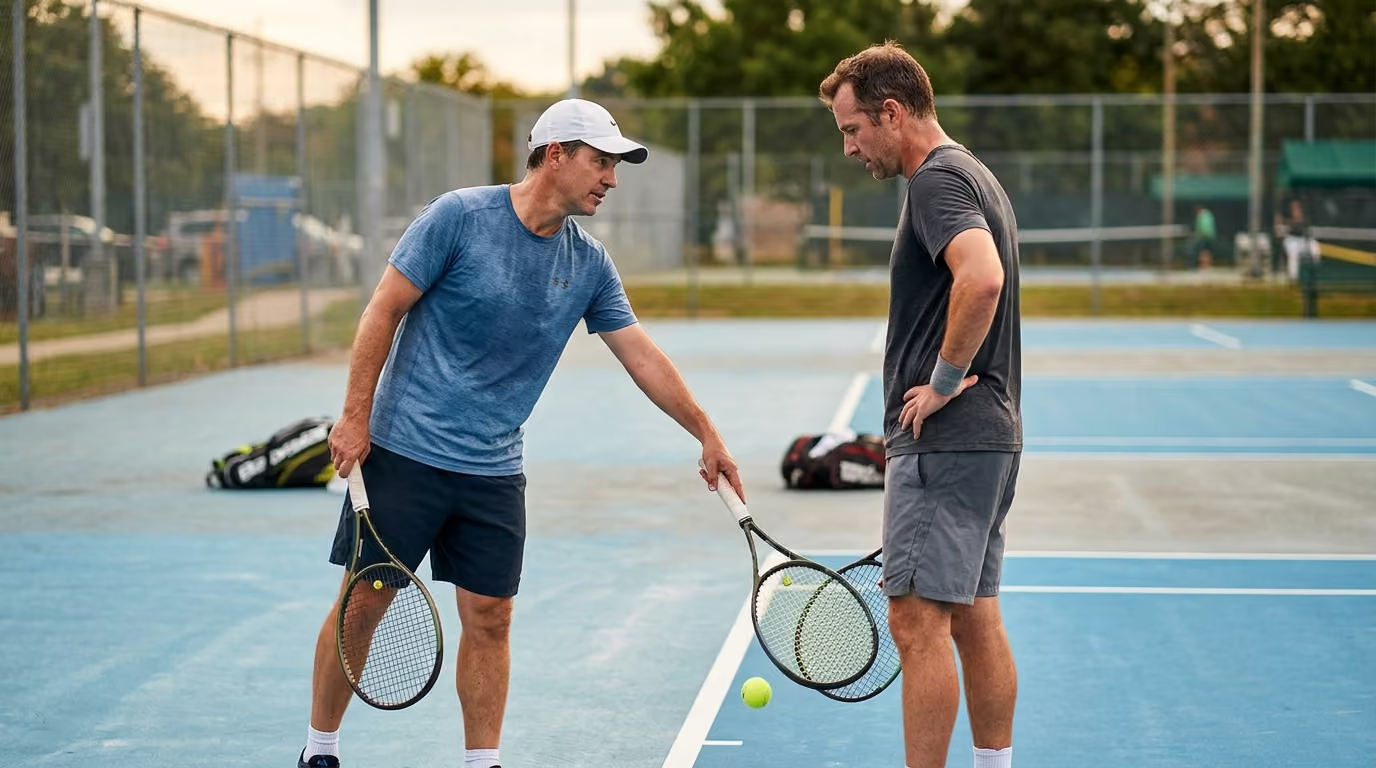
Handling on-court disagreements does not require you to be passive, nor does it require you to engage in an exhausting verbal battle. By treating every dispute as a procedural problem rather than a personal attack, you can resolve conflicts quickly and fairly while maintaining your focus on the game. This guide provides a practical, step-by-step framework to manage disagreements over line calls, scoring, rules interpretations, and sportsmanship across tennis, pickleball, and padel.
A court dispute is not simply an argument about who is right or who has better eyesight. It is a practical problem that involves four distinct questions that players must address systematically. First, you must determine what physically happened on the court, such as where a ball landed. Second, you must identify what specific rule applies to that physical event. Third, you must establish who has the proper authority to make the final decision. Finally, you must determine what action must happen next to resume play.
Disagreements are entirely natural in both self-officiated and formally refereed matches. The primary objective is not to prevent disagreements from occurring at all. Instead, the goal is to make every disagreement brief, highly specific, respectful, and procedurally final. When you separate these four questions, you stop treating your opponent as an adversary and begin treating the dispute as a shared puzzle to be solved.
We often see players complicate these situations by mixing factual questions with personal character judgments. For example, arguing that an opponent made a poor line call because they are dishonest is a personal attack. Pointing out that the ball kicked up clay or court dust is a factual observation. To keep your matches enjoyable, you must learn to focus exclusively on facts and established procedures.
To resolve a conflict efficiently, you must first identify exactly what type of issue you are facing. On-court disagreements generally fall into four distinct categories, each requiring a different approach.
A fact dispute concerns what physically occurred during a point. These are the most common arguments in racquet sports. Examples include whether a ball landed in or out, whether a ball bounced twice before being struck, or whether a player touched the net.
In self-officiated matches, players must rely on visual honesty and established local customs to resolve these issues. When an official is present, fact disputes are handled by the person with the best vantage point. Research from sports officiating manuals indicates that trying to argue against a physical fact is almost always unsuccessful because human perception is highly subjective.
A rules dispute is not about what happened, but rather about how the laws of the game apply to what happened. For instance, you might agree that a ball hit a player's body, but disagree on whether that results in a lost point or a replay.
To resolve a rules dispute, you do not need to debate your opponent's intentions. Instead, you need to consult the official rulebook or call for a tournament director to clarify the rule. Learning the fundamental rules of your sport is one of the best ways to protect your performance and build confidence. You can read more about building your physical and mental preparation by checking our resources for court athletes.
A procedure dispute concerns the steps required to resume play after a disruption. This includes questions about whether a player appealed a call quickly enough or whether a disputed point should be replayed.
Most governing bodies have strict timelines for when you can challenge a call or ask for a referee. If you wait too long to raise an issue, you may lose your right to do so under the rules. Resolving these disputes requires a quick look at the event's tournament regulations rather than a prolonged discussion between players.
A conduct dispute arises when a player's behavior violates the standards of sportsmanship. This includes shouting, using offensive language, throwing paddles or racquets, or deliberately delaying the match to disrupt your rhythm.
Conduct issues must be addressed immediately because they can quickly ruin the safety and enjoyment of the match. While players can agree to disagree on a close line call, they should never tolerate abusive or threatening behavior on the court.
When a dispute arises, having a structured routine prevents emotions from taking over. We recommend using a simple four-step protocol to keep exchanges productive and brief.
The moment a disagreement occurs, you must immediately pause play before the next point begins. Do not try to play another point while still harboring frustration about a previous call. If you continue playing, you legally accept whatever occurred, making it much harder to address the issue later.
Use a neutral signal to pause the action. You can hold up a hand and say, "Let's pause for a second to confirm the score," or "I would like to clarify that last call before we serve." Avoid aggressive gestures or shouting, which immediately put your opponent on the defensive.
Once play has stopped, state your perspective in a single, clear sentence without using accusatory language. Focus entirely on what you saw or what you believe the rule to be.
Good examples of neutral statements include:
Avoid any statements that speculate on your opponent's motives, such as accusing them of cheating or trying to steal the game.
After both sides have stated their perspectives, move directly to finding a solution. Ask a direct question that points toward the appropriate decision-maker or rulebook.
You can ask, "Can we consult the court supervisor?" or "What is the official procedure when we disagree on the score?" If you are playing a friendly match without an official, apply the standard convention of giving the benefit of the doubt to your opponent. Do not let the discussion turn into an ongoing debate that stalls the match.
Once a decision is reached, you must transition back to the game immediately. Confirm the final score, identify who is serving, and return to your position without any lingering remarks.
A great closing phrase to signal this transition is, "Understood, the score is 15 to 30, let's play." This clear verbal boundary helps you let go of the frustration and refocus your mind on the very next point.
Academic research on sports psychology and officiating offers valuable insights into why court disputes can feel so intense. Understanding the science behind these interactions can help you stay calm when tension rises.
According to a study on sports officials' interactions published in Qualitative Research in Sport, Exercise and Health, conflict resolution is highly dependent on protecting the dignity of everyone involved. The researchers found that effective communicators use strategies that allow players to save face, rather than humiliating them publicly. When you tell an opponent, "You are completely wrong," you invite an angry, defensive reaction. However, when you say, "I understand you saw it differently, but the rule requires us to replay the point," you resolve the issue while keeping the relationship intact.
Furthermore, research published in Communication & Sport highlights that athletes often communicate strategically during matches. Some players may use complaining or prolonged questioning to disrupt their opponent's momentum, alter the tempo of the game, or influence future line calls. Recognizing this behavior allows you to remain detached. If you realize an opponent's complaints are a tactical attempt to distract you, you can use our four-step protocol to keep the interaction as brief as possible, denying them the psychological advantage they are seeking.
It is also important to recognize that environmental factors can heighten stress on the court. Studies on sports referees show that nearby spectators, supportive teammates, and adjacent courts often amplify competitive pressure, making minor disagreements feel much larger than they are. In our experience, realizing that this pressure is a natural part of the environment, rather than a personal issue with your opponent, can help you maintain your composure.
I remember finishing a tough two hour padel match on a cold Tuesday night and waking up the next morning feeling like my lower back was locked in concrete. For a long time, I just accepted this as the price of playing hard in my forties. But once I started spending just ten minutes on targeted hip mobility before heading to the club, the stiffness almost completely vanished. It taught me that we do not have to accept pain as a default state of aging. Similarly, we do not have to accept emotional exhaustion and anger as the default state of competitive play. By understanding the social and physical dynamics of the court, you can protect both your body and your peace of mind.
Line calls are the most frequent source of friction in racquet sports. In self-officiated matches, you must adhere to a strict set of principles to keep play fair and enjoyable.
The most important rule of self-officiation is that you should only call an opponent's shot out if you are absolutely certain of what you saw. Under the guidelines established by major organizations like USA Pickleball, if you have any doubt about a call, you must resolve that uncertainty in favor of your opponent.
Never make an out call based on where you think the ball was going to land, or because you were surprised by its bounce. If you did not clearly see a gap between the ball and the line, the ball is considered good. Adhering to this high standard of visual proof prevents you from making defensive calls during crucial moments of the match.
In almost all racquet sports, players are responsible for making all line calls on their own side of the net. This is known as the ownership principle.
You must respect your opponents' right to make calls on their end of the court, even if you disagree with their perspective. Shouting a counter-call across the net is a major breach of etiquette. If you genuinely believe an opponent is making consistently poor calls, the correct response is to request an official or supervisor, rather than arguing from your side of the net.
If you make a line call and immediately realize you made an error, you must correct it instantly. The same rule applies in doubles play. If your partner calls a ball out, but you clearly saw that it touched the line, you must speak up and award the point to your opponents.
Honesty and clear communication with your partner are essential for maintaining sportsmanship. Promptly correcting an error shows your opponents that you value a fair contest over winning a single point at all costs.
Disagreements over the score can be incredibly disruptive because they affect every subsequent point in the match. The best way to prevent these issues is to announce the score clearly before every single serve. When a dispute does occur, you should use a systematic approach to reconstruct the score.
If you and your opponent disagree on the score, stop play immediately and use the ledger method to find a resolution.
First, ask each player or team to state what they believe the score is, along with their reasoning. Second, look back through the game and identify the last score that both sides agree on. For example, you might both agree that the score was 15 to 15 earlier in the game.
Once you have established that common ground, reconstruct the subsequent points one by one. Recount who won each point, how the rally ended, and which side of the court the server stood on. In many cases, this simple walk-through will jog someone's memory and resolve the confusion.
If you reconstruct the points and still cannot reach an agreement, you must consult the tournament rules. The United States Tennis Association officiating guidelines suggest that if players agree on some points but disagree on others, they should count all the mutually agreed-upon points and replay only the disputed points.
If you cannot agree on which court a disputed point started on, you can use a neutral method, such as a coin toss, to make a final determination. Never allow the player with the loudest voice or the most confidence to dictate the score without a clear, logical reconstruction.
While general principles of sportsmanship apply to all racquet sports, tennis, pickleball, and padel each have unique rules and court dynamics that influence how disputes should be handled.
Tennis is played on a large court where balls travel at very high speeds, making precise visual tracking difficult. Fact disputes often center on whether a ball touched the outer edge of a line.
According to the International Tennis Federation, a ball is only out if it lands entirely outside the boundary lines. Because of the court's size, players often experience parallax errors, which are visual distortions caused by viewing a ball from an angle. To help manage these challenges, tennis players can learn more about physical conditioning and joint health by reading about our injury prevention resources.
Under tennis rules, if you disagree with a chair umpire's interpretation of a rule, you have the right to call the tournament referee to the court. However, you cannot appeal a chair umpire's factual decision, such as whether a ball was in or out. Understanding this distinction between rules and facts can save you a lot of time and energy during a competitive match.
Pickleball is played on a much smaller court, which brings players closer together and can sometimes increase emotional intensity. The fast pace of play at the kitchen line means that disputes often center on non-volley zone infractions or foot faults.
The USA Pickleball rulebook emphasizes that players should resolve all close calls in favor of their opponents. Because the ball is solid plastic and makes a distinct sound, players sometimes try to use the sound of a bounce to determine if a ball was in or out. However, USA Pickleball advises that sound is not a reliable indicator of a ball's physical location, and players must rely strictly on visual evidence.
In doubles play, if you and your partner disagree on a line call, the ball is automatically considered good. This rule encourages teams to communicate clearly and give the benefit of the doubt to their opponents.
Padel is a unique sport because the court is enclosed by glass walls and metal mesh panels. This structure introduces a variety of unique disputes, such as whether a ball hit the glass wall directly or bounced on the turf first.
Under the International Padel Federation rules, if a ball hits the glass wall or metal fence before bouncing on the ground, it is an out ball. However, if the ball bounces on the turf and then hits the glass, it remains in play. These quick transitions require immense focus and can lead to honest disagreements about the sequence of events.
Because padel is almost always played as a doubles game, clear communication with your partner is vital. If a ball hits the metal mesh on your opponent's side, you must decide together whether the bounce was natural or if it took an illegal hop. If you want to learn more about the specific strategies and movement patterns of this fast-growing sport, you can browse our padel articles.
Disagreements often arise when players use different tempos or experience unexpected distractions during a match. Knowing how the rules define these situations can help you handle them without escalation.
All major racquet sports have rules requiring play to be continuous. This means players must serve and receive within a reasonable timeframe, typically between 20 and 25 seconds after the previous point ends.
Some players may deliberately delay the game by taking frequent towel breaks, adjusting their equipment, or walking slowly between points to disrupt your rhythm. If you feel your opponent is playing too slowly, avoid making sarcastic remarks. Instead, use neutral language to encourage a faster pace, such as, "Let's try to keep our intervals within the standard limits so we can finish our match on time." If the delay persists, you can ask a court supervisor to monitor the match.
A hindrance occurs when an event outside of your control interferes with your ability to play a point. This could be a ball rolling onto your court from an adjacent game, a sudden loud noise, or a distraction caused by your opponent.
Under tennis and pickleball rules, if a distraction is unintentional, the point should be replayed as a let. However, if an opponent deliberately tries to distract you, such as by shouting mid-stroke or waving their arms, they lose the point.
It is important to note that you cannot claim a hindrance for a minor distraction that did not actually affect your stroke. The USA Pickleball sportsmanship guide states that a replay should only be claimed if the distraction materially impacted your ability to make a play on the ball. This rule prevents players from using every minor noise as an excuse to erase a poor shot.
Even experienced players can fall into bad habits when resolving on-court tension. Avoiding these common mistakes will help you stay focused and protect your athletic longevity.
One of the most common mistakes is believing that the player who speaks with the most confidence or volume must be correct. Human memory and perception are highly fallible, and a loud voice does not make a poor line call any more accurate. Always rely on systematic procedures, such as reconstructing the score or consulting a supervisor, rather than giving in to aggressive communication.
Many players wait until several points or games have passed before bringing up a concern about an opponent's behavior or a disputed call. By then, it is usually too late to take any official action under tournament rules. If you have an issue, you must address it immediately before the next serve is delivered.
It is incredibly easy to let a single bad call or a brief argument ruin your focus for the rest of the game. When you spend your energy replaying old disagreements in your mind, your performance will inevitably suffer. Using a clear protocol to resolve disputes quickly allows you to leave the conflict behind and keep your attention on the court. To explore more about maintaining your physical and mental energy, you can read our guide on recovery science resources.
While on-court disputes are often viewed as purely mental challenges, they also have a direct impact on your physical well-being. When you experience anger or frustration during a match, your body enters a fight-or-flight state, releasing stress hormones like adrenaline and cortisol.
This sudden chemical spike causes your muscles to tighten, shortens your breathing, and increases your heart rate. Over the course of a long match, this constant state of physical tension can lead to premature fatigue and increase your risk of minor strains or joint stiffness. Managing conflicts calmly is not just about being polite. It is a vital strategy for protecting your body and supporting your healthy aging and athletic longevity.
Furthermore, the mental fatigue caused by constant arguing can impair your decision-making and slow your reaction times. By keeping your interactions brief and professional, you conserve the cognitive energy you need to execute complex shots and move efficiently around the court. Prioritizing clear communication is one of the easiest ways to improve your performance and ensure you can continue playing the sports you love for years to come.
While most court disagreements can be resolved with a polite conversation, there are times when you must involve tournament officials, club management, or security. Knowing where to draw the line is essential for your safety and peace of mind.
You should immediately stop play and seek professional assistance if your opponent engages in any of the following behaviors:
When these boundaries are crossed, your priority must shift from winning the match to protecting your safety. Walk off the court immediately and report the behavior to the appropriate club staff or tournament director. To learn more about our commitment to research-led guidance for court sports, you can visit our about Evercourts page.
The best way to handle court disputes is to prevent them from happening in the first place. Taking a few moments to clarify a few basic procedures with your opponents before the first serve can save you a lot of headache later.
Before you begin your next match, take a minute to discuss these quick questions:
Spending just a moment on these simple agreements helps set a positive, professional tone for the entire match. It ensures that everyone on the court is aligned on the rules, allowing you to focus on playing your best and enjoying the competitive spirit of the game.
Follow Evercourts for practical insights on tennis, pickleball and padel performance, movement, recovery and healthy ageing. Stay connected for new articles, research-led guidance and ideas to help you play well and keep playing for years.


Read practical guidance for better movement, smarter preparation and a game that keeps working for you.
explore the Blog