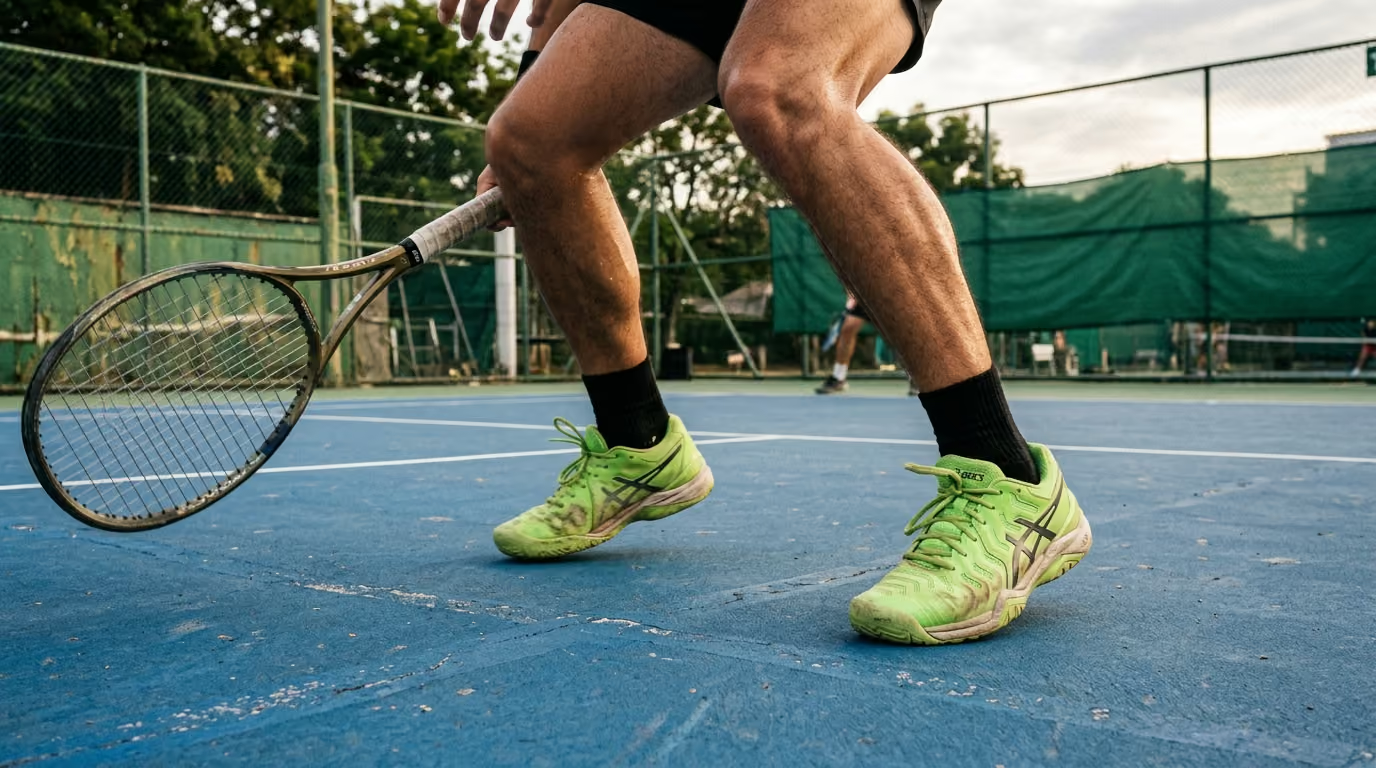
A systematic approach to managing physical capacity allows racquet players to remain active on the court for years, avoiding chronic irritation and severe muscle fatigue.




Remaining active on the court as the years pass requires a deliberate shift in how we view physical preparation. Healthy aging for racquet players is not a matter of trying to move like a teenager. It is a systematic approach to managing your physical capacity.
To play your best and avoid long layoffs, you must maintain enough joint motion, strength, coordination, and tissue tolerance to meet the demands of your sport. This guide provides a practical, research-supported framework to help you move well, recover faster, and stay on the court for years to come.
Healthy athletic longevity is the ability to enjoy racquet sports without constantly fighting chronic joint irritation or severe muscle fatigue. It means having the physical tolerance to play a competitive match and wake up the next morning feeling ready for daily life.
Rather than chasing extreme flexibility, our focus must be on maintaining a usable range of motion and building strength through that range. We also need to preserve muscle power and train our balance under sport-specific conditions. By managing our physical training with patience, we can continue playing the sports we love with confidence.
Many players use the terms mobility and flexibility as if they mean the exact same thing. Understanding the difference between them is the first step toward building a more resilient body.
Flexibility is simply the passive range of motion available at a joint. It is measured when an external force, such as a partner or a stretching strap, moves your limb through an arc.
Mobility is your ability to actively control and use your range of motion during dynamic movement. A tennis player might have the passive flexibility to lie on their back and pull their knee to their chest. However, they may lack the active mobility to stabilize their hip and trunk while hitting a low, running forehand.
For many years, players were told that stretching before a match was the best way to prevent injury. Modern sports science paints a much more nuanced picture.
According to a systematic review of flexibility interventions published in the Journal of Physical Therapy Science, stretching can improve measured joint range. Yet, the evidence linking static stretching to improved functional performance remains conflicting.
Stretching alone does not teach your muscles how to absorb the impact of a hard landing. It does not help you decelerate when chasing a drop shot. For court athletes, passive range is only useful if you have the strength to control it. You can explore more target-specific ideas in our mobility and movement resources.
Rather than trying to stretch every muscle in your body, you should focus on the joints that take the most stress during play.
To maintain your court speed and protect your joints, you need to understand two key physiological factors: muscle power and tendon health.
Muscle strength is the maximum force your muscles can produce. Muscle power is your ability to produce that force very quickly.
As we age, our muscle power tends to decline at a faster rate than our absolute strength. This change directly affects your first-step quickness, your split-step reaction, and your ability to brake before a wide ball.
A systematic review published in the Journal of Aging and Physical Research analyzed forty-four studies on muscle power. The researchers found that muscle power was a better predictor of physical function and performance in older adults than strength alone.
This means that a long-term mobility program should not consist solely of slow, heavy lifting. It must also include safe, controlled, and fast movements.
Your tendons are the thick bands of tissue that connect your muscles to your bones. They act like springs, storing and releasing energy every time you run, jump, or change direction.
As we age, our tendons naturally become less elastic. However, research shows that we can positively influence this process.
A systematic review on human tendon adaptation in the British Journal of Sports Medicine reported that progressive resistance training can increase the stiffness of both the Achilles and patellar tendons in older adults. Another study published in the Scandinavian Journal of Medicine and Science in Sports monitored older adults performing cyclic strain exercises. The researchers found that the Achilles tendon adapted over a fourteen-week period, though the adaptation process was nonlinear.
The takeaway for racquet players is clear. Your tendons do not need to be babied, but they do require consistent, progressive load to stay healthy. Sudden spikes in playing volume are highly risky, while steady, weekly training builds stronger, more resilient tissue. You can find more structured strategies in our strength and conditioning resources.
You do not need to spend hours in the gym to protect your health and performance. Even small amounts of activity can make a significant difference.
A comprehensive meta-analysis in the International Journal of Epidemiology examined physical activity in older adults. The researchers found that even a low dose of moderate-to-vigorous physical activity was associated with a twenty-two percent reduction in mortality risk.
For a busy racquet player, this is encouraging news. If you cannot fit in a full hour of strength work, a twenty-minute session of targeted exercises still provides major benefits for your athletic longevity.
To organize your training, we recommend a simple, five-pillar framework. This structure ensures you address all the physical qualities needed for comfortable court movement.
Your mobility program should focus on the movements you actually use during a match. If you play doubles and rarely run to the net, you have different physical needs than a singles player who covers the entire court.
Start by identifying which movements feel restricted or cause you to arrive late to the ball. Do you struggle to turn your shoulders on your backhand? Do you find it hard to get low for a short drop shot?
Once you know your specific limitations, you can select exercises to address them. This target-specific approach is much more effective than following a generic, full-body stretching routine.
Having a large range of motion is only helpful if you are strong at the outer limits of that range. This is where many traditional stretching programs fall short.
To build strength at your joint endpoints, you should perform controlled resistance exercises through a full, pain-free range.
By strengthening these outer limits, you create a buffer against injury when you are forced into extreme positions during a match. You can read more about protective exercise selection in our injury prevention resources.
You can preserve your fast-twitch muscle fibers without doing high-impact plyometrics that irritate your joints. The key is to focus on moving lighter loads as quickly as possible.
Keep your repetitions low, usually between five and eight per set. Stop the exercise as soon as you feel your movement speed begin to slow down.
Good balance on the court is not about standing still on a foam pad. It is the ability to control your center of mass while your feet are moving and your body is rotating.
Start with simple exercises and progress slowly. You might begin with a tandem stance, placing one foot directly in front of the other.
Once that feels easy, progress to single-leg balance with dynamic reaches. Stand on one leg and slowly reach your other foot forward, backward, and to the side, tapping the floor lightly.
This trains your hip and ankle stabilizers to maintain control when you reach for a wide ball.
Your physical mobility is closely tied to how well you recover from your sessions. When your muscles are chronically fatigued, they naturally tighten up to protect your joints.
We must pay close attention to how our bodies feel in the twenty-four hours after a match. If you wake up with stiff knees or a sore back, your playing volume may be exceeding your current tissue tolerance.
Active recovery can help restore your mobility. An easy walk, some light cycling, or gentle movement drills can encourage blood flow and reduce muscle tension without adding further stress to your joints.
To design an effective program, you need a simple way to measure your movement quality and track your progress over time.
You can perform these simple tests at home to check your baseline mobility and balance.
These drills help you evaluate how well you move under sport-specific conditions.
Use this simple three-tier system to monitor your physical state before every session.
This sample schedule shows how a recreational player can integrate strength, power, and mobility work into their week. It is designed to support, not replace, your court time.
While all racquet sports share common movement patterns, each game places unique physical demands on your body. Understanding these differences allows you to tailor your mobility work to your specific sport.
Tennis is played on a much larger court, which means players must cover greater distances. The sport requires repeated, high-speed sprints followed by sudden, high-force deceleration.
Because tennis players hit with longer swings, they experience significant rotational forces through their trunk and hips. The serving motion also puts a high demand on shoulder external rotation and thoracic extension.
To prepare for these demands, tennis players should focus on building robust eccentric strength in their lower body. This helps their muscles absorb the impact of running and sliding on hard courts. They also need to maintain generous thoracic spine mobility to power their groundstrokes without overloading their lower back.
Pickleball is played on a smaller court, which reduces the need for long-distance sprinting. However, the game requires constant, rapid reactions and frequent lateral adjustments.
Because the ball bounces low, pickleball players must spend a lot of time in a deep squat position, especially near the non-volley zone line. This constant crouching places a heavy demand on ankle dorsiflexion and hip flexion.
To move comfortably on a pickleball court, players should focus on building strength in deep ankle and knee angles. Exercises like step-downs and calf raises through a full range of motion are highly valuable. They should also train their reactive balance to handle the fast-paced volleys at the kitchen line.
Padel is played in an enclosed court, which creates a highly dynamic environment with many changes of direction. The presence of glass walls means players must rotate their bodies frequently to track the ball after it bounces off the back or side walls.
Padel also involves a very high volume of overhead strokes, such as the bandeja and gancho. This constant overhead activity can easily irritate the rotator cuff tendons if the shoulder lacks proper support.
I remember finishing a tough two hour padel match on a cold Tuesday night and waking up the next morning feeling like my lower back was locked in concrete. For a long time, I just accepted this as the price of playing hard in my thirties and forties.
But once our team started spending just ten minutes on targeted hip mobility before heading to the club, that morning stiffness almost completely vanished. It taught us that we do not have to accept chronic discomfort as a default state of aging.
Padel players must prioritize shoulder stability and thoracic rotation in their training. Keeping the middle back mobile allows the shoulders to reach overhead without pinching, which helps protect the rotator cuff from overuse.
Many well-meaning players make simple errors in their training that can limit their progress or lead to unnecessary joint irritation.
Stretching a tight muscle can feel good, but it does not teach that muscle how to contract and support your joint during a dynamic movement. If you only perform passive stretching, you are not building the active control needed for fast court play.
Instead of long, passive holds before a match, use a dynamic warm-up that includes walking lunges, arm swings, and light rotational movements. Save your gentle stretching for after the match or your recovery days.
Some older players worry that lifting weights will cause injury or make them feel too stiff to move quickly. In reality, progressive resistance training is one of the most effective ways to preserve your mobility and protect your joints.
According to research from the American College of Sports Medicine, resistance training is highly effective for improving gait mechanics, balance, and functional mobility in older adults. The key is to start with light weights, master your technique, and increase the load very gradually. You do not need to lift maximal weights to build resilient, court-ready muscles.
It is completely normal for your dominant side to look and feel slightly different from your non-dominant side. Racquet sports are inherently asymmetrical, as you swing with one arm and rotate your body in a specific direction thousands of times.
Do not waste time trying to make both sides of your body perfectly symmetrical. Instead, focus on ensuring that both sides have the minimum range of motion and strength required to perform your sports movements safely.
Some players believe that if they do not feel pain during their workout or match, the training load was appropriate. However, tendons and joints often have a delayed response to stress.
If you feel fine on the court but wake up the next morning with throbbing knees or an aching elbow, your body is telling you that the previous day's load was too high. Always use the next-day response as your guide for adjusting your training and playing volume.
As we age, we may have to navigate specific joint changes or physical conditions. A long-term mobility framework must be flexible enough to adapt to these situations.
Many active players have some degree of joint wear and tear, such as mild osteoarthritis in their knees or hips. This does not mean you must stop playing racquet sports.
The goal when managing a worn joint is to build strong, supportive muscles around it. For example, strengthening your quadriceps and hamstrings can help absorb the impact of running, which reduces the stress on your knee joints.
If a specific movement, like a deep lunge, irritates a joint, modify the movement. You might perform a shallower lunge or a step-up instead. Focus on what your joints can comfortably tolerate rather than forcing them into painful positions.
If you have been away from the court for several months due to injury, illness, or a busy schedule, your body will have lost some of its physical capacity. Your heart and lungs may recover quickly, but your tendons and joints take much longer to adapt.
When returning to play, rebuild your volume in layers. Start with short, controlled hitting sessions once or twice a week.
Avoid playing competitive matches or doing intense lateral drills during your first few weeks back. Allow your structural tissues time to strengthen before you subject them to the unpredictable movements of a real match.
Sometimes, the best way to preserve your physical health is to make smart tactical adjustments to your game.
If your shoulders struggle with high-speed serving, focus on placement and spin rather than raw power. If your knees cannot tolerate deep, explosive lunges, work on your court positioning and anticipation so you do not have to make last-second sprints.
You can also consider playing more doubles, which reduces the amount of running required while still allowing you to enjoy the competitive and social aspects of the sport. For more insights on how to balance your playing habits with your health, check out our healthy aging and athletic longevity resources.
While a self-directed mobility program is highly beneficial, there are times when you should consult a qualified healthcare professional, such as a physical therapist or sports medicine physician.
You should seek professional guidance if you experience any of the following warning signs:
A physical therapist can perform a detailed assessment, identify any specific movement deficits, and design an individualized rehabilitation plan to help you return to play safely.
Yes, absolutely. Your muscles and tendons retain the ability to adapt and strengthen at any age. If you are new to strength training, start with simple, bodyweight exercises like sit-to-stands and wall push-ups, then gradually introduce light weights as your confidence and control improve.
While you may feel some temporary relief after a single mobility session, true structural changes in your muscles and tendons take time. Research shows that consistent, progressive loading over twelve to fourteen weeks is typically required to produce lasting improvements in tendon stiffness and active joint control.
A brace or sleeve can provide temporary comfort and increase your awareness of the joint during movement. However, they do not address the underlying weakness or mobility deficit that is causing the stiffness. Use supports as a short-term aid while you work on building strength and active control through your mobility program.
Follow Evercourts for practical insights on tennis, pickleball and padel performance, movement, recovery and healthy ageing. Stay connected for new articles, research-led guidance and ideas to help you play well and keep playing for years.


Read practical guidance for better movement, smarter preparation and a game that keeps working for you.
explore the Blog