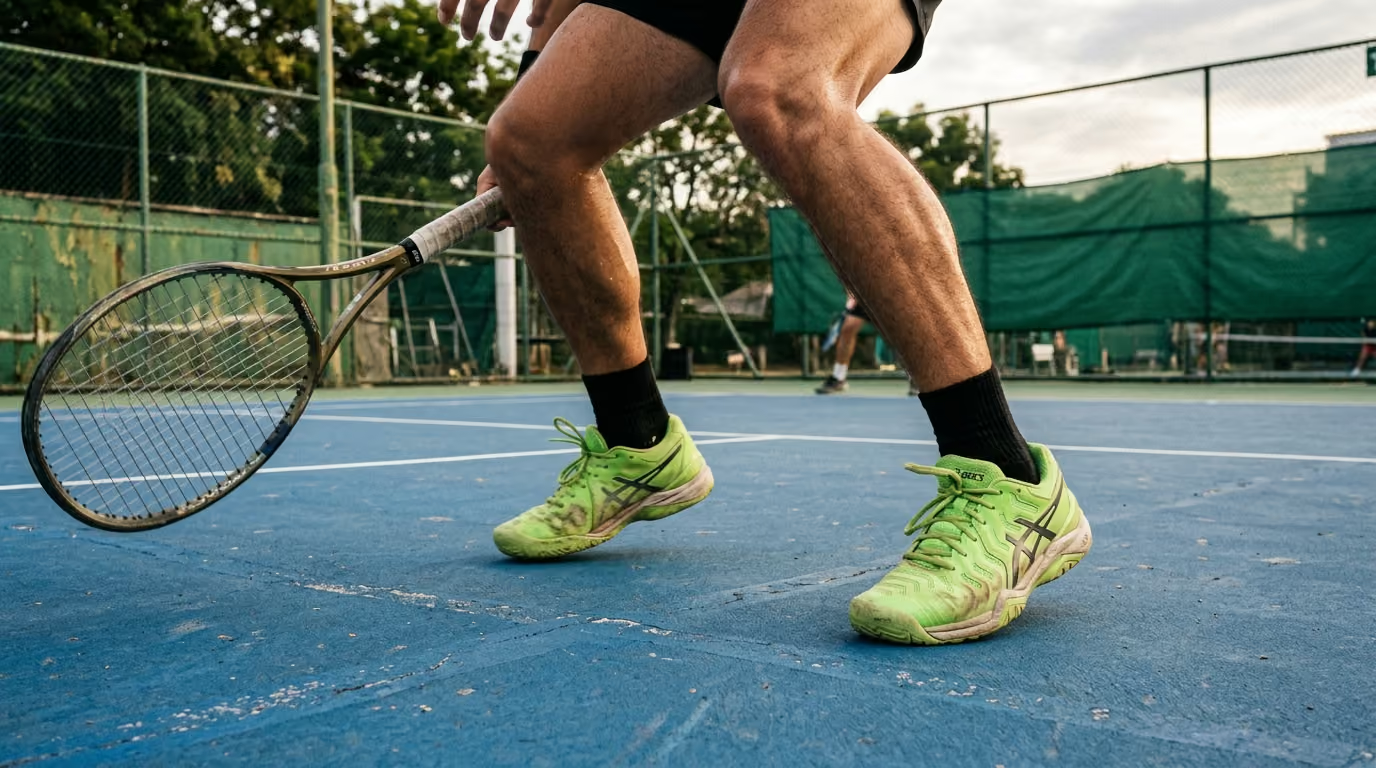
Racquet sports players can achieve improved hip strength and mobility, leading to enhanced on-court performance and reduced injury risk.




Have you ever searched online for how to fix stiff hips after a long singles match? Many players believe the answer to court stiffness is simply more passive stretching. However, to move efficiently and protect your joints on the court, you need active hip capacity rather than just passive flexibility.
This means building a hip joint that can produce, absorb, and redirect force across its entire range of movement. By combining targeted strength training with dynamic mobility, you can move faster and protect your lower back and knees from strain.
I remember finishing a tough two hour padel match on a cold Tuesday night and waking up the next morning feeling like my lower back was locked in concrete. For a long time, I just accepted this as the price of playing hard in my forties. But once I started spending just ten minutes on targeted hip mobility before heading to the club, the stiffness almost completely vanished. It taught me that we do not have to accept pain as a default state of aging. At Evercourts, our team believes in using practical, science-backed movement plans to support your athletic longevity. By integrating targeted mobility and movement resources into your weekly routine, you can build a more resilient body and stay on the court without pain or frustration.
To understand how to train your hips, we must first define what hip capacity actually means. Many players confuse flexibility with mobility, which can lead to inefficient training habits. Let us look at how sports science literature defines these key movement concepts.
Passive range of motion is how far a joint can be moved by an external force. This occurs when a partner or a strap stretches your leg while your muscles are completely relaxed. Active range of motion is how far you can move and control that joint using your own muscles.
Usable range refers to the active range you can access with appropriate alignment, speed, balance, and force during a match. Capacity is the strength, coordination, tissue tolerance, and endurance needed to repeatedly use that range under match stress. Mobility is your movement capacity at a joint, which involves both range and control. Flexibility is a narrower term that generally refers to the available range of tissue, which is often assessed passively.
Current sports science shows that passive stretching is not the only way to improve how you move on court. In fact, a systematic review published in the journal Healthcare showed that resistance training improves joint range of motion just as effectively as static stretching. Another large meta-analysis confirmed that external-load training can increase your range of motion with an impressive effect size of 0.73.
These findings suggest that strength training through a full range of motion does double duty. It builds tissue tolerance while simultaneously making your joints more supple. For a racquet athlete, this means we do not need to spend hours on a yoga mat to move better. Instead, we should focus on loaded, active exercises that challenge our hips at their outer limits.
This distinction is highly relevant because elite tennis players often present with unique hip adaptations. A study in the Journal of Science and Medicine in Sport found that elite tennis players frequently show restricted active and passive internal rotation. Approximately 30 percent of male players show significant limitations in internal rotation. Yet, these athletes still perform at the highest levels without pain.
This proves that having more passive flexibility is not always necessary for excellent court performance. We should focus on building strength within the range of motion you actually use. This is why we prioritize active, loaded exercises over long sessions of passive static stretching.
Let us look at the specific tasks your hips must perform during a match. We can organize these movements into three main challenges: lunging, lateral movement, and rotation.
A court lunge is not just a long step forward. It is a rapid transition from speed into a single-leg braking position, followed by a forceful pushback. The hip must rapidly flex to lower your center of mass. It must control adduction and abduction so your knee does not collapse.
Finally, the hip must work eccentrically to absorb your landing force, then concentrically to propel you back to the center of the court. In badminton research, scientists have analyzed different types of lunges. They found that a step-in lunge produces much lower horizontal reaction forces and lower peak hip joint power than a kick lunge. This shows that the way you step changes how hard your hip muscles have to work.
We can divide lunging ability into three qualities: reach, brake, and recover. Reach is your ability to physically get to the ball. Brake is your ability to absorb that momentum without losing balance. Recover is your ability to push back to the ready position.
Most traditional stretching programs only train your reach. To perform well, you must train your ability to brake and recover. This requires building strength in your glutes, hamstrings, and inner thighs to manage the sudden stop.
Lateral shuffles, crossover steps, and split-step reactions require your hip muscles to coordinate in milliseconds. Your hips must keep your pelvis level while your weight shifts over one leg. They must also produce lateral force to push you toward the ball.
During these movements, the hip muscles control the thigh bone as it rotates inward. We can distinguish between planned lateral strength and reactive lateral strength. A slow lateral squat builds control and strength in a predictable environment. A reactive lateral bound teaches your nervous system to apply that strength when you have to react to an opponent's shot.
Both qualities are important for court longevity. Without planned strength, your joints lack the stability to handle the impact of a sudden direction change. Without reactive strength, you will feel slow when trying to reach a wide ball.
Every stroke you hit requires coordinated rotation through your lower body, pelvis, trunk, and shoulders. Your hips do not work in isolation during a forehand or backhand. They help create, transmit, and absorb rotational forces from the ground up.
Training should focus on controlling this rotation rather than simply chasing extreme angles. We want to build strength in both internal and external rotation. This helps protect your lower back, which often tries to twist too much when your hips are stiff.
By improving your hip rotation, you can hit harder with less effort. The power comes from the ground, transfers through your hips, and moves into your arm. If your hips are stiff, this energy chain breaks down.
Your hip movement might look perfect during the first five minutes of a warm-up. However, fatigue can change your biomechanics as the match goes on. A 2025 meta-analysis of badminton players found a significant reduction in hip range of motion after fatigue.
This reduction in movement can alter landing mechanics and increase the risk of adductor or abductor strains. Therefore, our training must progress from fresh, controlled movements to exercises performed under moderate fatigue. This ensures your technique holds up during a long third set or a deep tiebreaker. To learn more about building this type of physical resilience, you can read our injury prevention resources for detailed guidelines.
To build a targeted training program, we need to look at the primary muscle groups that control your hips. Each group plays a specific role when you move on the court.
The gluteus maximus is the largest muscle in your hip and the primary driver of hip extension. It helps you sprint forward, explode out of a low lunge, and maintain an athletic posture.
To train this muscle effectively, we must progress from stable, two-legged movements to single-leg challenges. Exercises like front-foot-elevated split squats and single-leg deadlifts are highly effective because they mimic the unilateral demands of court sports.
Many fitness influencers focus solely on low-load activation drills like glute bridges. While these are fine for a warm-up, they do not build the force capacity needed for fast deceleration. You must gradually expose your glutes to meaningful external loads to build true court strength.
The gluteus medius sits on the side of your hip and stabilizes your pelvis when you stand on one leg. If this muscle is weak, your pelvis may drop or your knee may cave inward when you land from a jump or take a wide step.
We can train the abductors using lateral lunges, single-leg squats, and lateral bounds. However, we should clarify a common misconception about these muscles. Some coaches claim that strengthening your abductors will automatically prevent groin injuries.
A 2025 systematic review found no direct relationship between abductor strength and future groin pain. While abductor training is vital for movement control, it should not be treated as a standalone solution for groin issues. Instead, we must look at the balance between your abductors and your adductors. You can refer to our strength and conditioning resources to find balanced program design templates.
Your adductors run along the inside of your thigh and are highly active during racquet sports. They pull your leg back under your body after a wide reach and stabilize your pelvis during lateral movement.
Because these muscles work hard during cutting and braking, they are frequently injured. A 2026 systematic review of competitive sports injuries reported that hip and groin issues represent 11 percent of all injuries, with a seasonal prevalence of 19 percent.
To protect these tissues, we can use the Copenhagen adduction exercise, which has strong scientific backing. A meta-analysis of randomized trials showed that Copenhagen training improved eccentric hip adductor strength by 0.49 Nm/kg.
In football research, a Copenhagen adductor program was associated with a 41 percent lower risk of groin problems. While these studies were done on football players, the principles of progressive loading apply directly to racquet sports.
However, the Copenhagen exercise is very demanding. It can cause significant muscle soreness and temporary stiffness if you do too much too soon. You should introduce this exercise gradually and avoid doing it right before a competitive match.
The deep external rotators sit beneath your glutes and act like the rotator cuff of your hip joint. They control the alignment of your femur when your foot is planted and your body is rotating.
We can train these muscles using active 90/90 transitions and hip airplanes. These movements teach your hip to rotate independently of your lower back. This independent movement is essential for hitting powerful, fluid groundstrokes.
When these rotators are weak, players often compensate by twisting their knees or lower back. This can lead to chronic wear and tear over time. Keeping these muscles active ensures that rotation occurs where it is supposed to.
Your hip flexors pull your thigh toward your chest, which is crucial for quick recovery steps and knee drive. Passive stretching of the hip flexors can make them feel looser, but it does not build strength.
We prefer exercises like resisted marching and split-stance hip-flexor lifts. These movements teach the hip flexors to produce force while you maintain a stable trunk. This stability helps you recover your footing quickly after a deep lunge.
Strong hip flexors also help you maintain a low, athletic stance without fatiguing. If these muscles are weak, your body will naturally stand up taller, making it harder to reach low balls.
Before starting a new training routine, it is helpful to assess how your hips actually move. You do not need expensive laboratory equipment to do this. We can use several simple field assessments to identify your movement patterns.
Sit on a sturdy table or chair with your knees bent at a 90-degree angle. Keep your thighs flat on the seat and rotate your lower leg outward to test internal rotation, then inward to test external rotation.
Compare the range of motion between your left and right hips. A major difference between sides is common in racquet athletes due to the asymmetric nature of the sports. However, if one side has a massive restriction or feels painful, it warrants closer attention.
Make sure you do not tilt your pelvis to make the movement look larger. The goal is to see how much pure rotation your hip joint can achieve. Write down your results so you can track your progress over time.
Kneel on one knee with your other foot flat on the floor in front of you. Keep your torso tall and gently shift your weight forward to feel a stretch in the front of your back hip.
Watch closely to see if you achieve this movement by arching your lower back instead of moving your hip. If you must arch your back to feel a stretch, you may lack true hip extension. This compensation often leads to lower back stiffness after playing.
To correct this, squeeze your glute on the kneeling side before you shift forward. This stabilizes your pelvis and forces the movement to come from the hip joint itself.
Stand with your feet wide apart and perform a lateral lunge to one side, keeping the opposite leg straight. Note how deep you can go while keeping your heel on the floor and your chest relatively upright.
This test evaluates both your adductor flexibility and your single-leg strength. If you feel a sharp pinch in the front of your hip, do not force the movement. This pinch can indicate joint compression, which requires a modified approach.
If you can easily go deep on one side but struggle on the other, you have an asymmetry. This suggests you should spend more time building strength on your weaker side.
Stand on one leg in front of a mirror and slowly perform a shallow single-leg squat. Observe whether your pelvis tilts, your knee caves inward, or your torso sways side to side.
If you struggle to stay balanced, your gluteus medius and deep rotators may need more targeted strength work. Excellent court movement requires a stable base, and this test shows if your hips can provide that stability.
Try to hold the bottom of the squat for three seconds. If your ankle or knee starts to shake violently, it is a sign that your hip stabilizers are fatiguing quickly.
Set up a marker on the court and perform a fast forward lunge, reaching your racquet toward an imaginary ball. Focus on how your body brakes the momentum and how many steps you need to return to your starting position.
This integrated test is highly valuable because it combines range, control, and force. If you can stretch deeply but struggle to push back efficiently, your training should focus on eccentric strength rather than passive flexibility. For more performance tips, check out our court performance resources.
While tennis, pickleball, and padel all place high demands on the hips, the specific movement patterns differ. Understanding these nuances allows you to tailor your training to your preferred sport.
Tennis involves a large playing area, which requires high-velocity sprints and long, deep lunges. Players must frequently slide on clay or decelerate hard on hard courts, placing extreme eccentric load on the adductors and glutes.
Because tennis matches can last several hours, repeated-effort endurance is a major factor. Tennis players should prioritize building robust eccentric strength through lateral lunges and split squats. This helps the hips handle the high-impact forces of hard-court play. To learn more about tennis-specific strategies, visit our tennis articles.
Additionally, tennis players must handle high-speed rotational forces during groundstrokes. This requires excellent stability in the core and hips to prevent injury.
Pickleball is played on a much smaller court, which reduces the need for long sprints but increases the demand for quick, low-profile lateral movements. Players spend a significant amount of time in a deep athletic crouch near the non-volley zone line.
This sustained low position requires excellent isometric endurance of the glutes and quadriceps. Pickleball players often suffer from hip flexor tightness because they spend so much time bent forward at the waist.
For pickleball, training should focus on maintaining hip mobility in a deep stance and building endurance in the glutes. Exercises like isometric split squats and lateral band walks are highly beneficial. You can read more about these specific court demands in our pickleball articles.
The speed of the game also requires rapid, short-range reactions. This means your hip stabilizers must be incredibly fast to respond to quick ball changes.
Padel combines elements of tennis and squash, featuring rapid changes of direction, frequent overheads, and plays off the back glass. The enclosed court requires constant rotational adjustments and quick recovery steps.
Padel players must rotate their hips quickly to turn and run after balls that bounce off the walls. This demands excellent active internal and external rotation of the hip joint.
Padel training should emphasize rotational mobility and reactive lateral movement. Exercises like hip airplanes, rotational medicine-ball throws, and lateral bounds will help you navigate the unique angles of the padel court. For more insights into this fast-growing sport, check out our padel articles.
The overhead play in padel also requires a strong transfer of power from the hips through the upper body. This makes hip extension strength vital for powerful smashes.
To help you build usable hip capacity, we have designed a progressive training framework. It follows a four-stage progression: Range, Control, Force, and Speed. This ensures you build a safe and effective foundation before moving to explosive court drills.
The goal of this phase is to develop a comfortable range of motion, basic single-leg control, and low-level tissue tolerance. This phase is perfect for players recovering from a break or those experiencing general tightness.
Perform these exercises two to three times per week, either as a standalone session or as part of your warm-up:
Focus on slow, deliberate movements during this phase. Do not rush through the exercises, as the goal is to build movement awareness.
Once you can control your movements in Phase 1, you can progress to building strength under load. This phase focuses on making your lunges and lateral positions stronger.
Perform these exercises twice a week, allowing at least 48 hours of recovery between sessions:
You can gradually increase the weight or resistance as these exercises become easier. Always prioritize proper form over the amount of weight you lift.
In this phase, we transition your built strength into explosive, court-relevant actions. This phase should only be started once you have a strong foundation of loaded strength.
Perform these dynamic drills once or twice a week when you are feeling fresh:
Concentrate on generating speed and power during these movements. Ensure you maintain control during the landings to protect your joints.
To protect your hips during long matches, you must train your muscles to maintain control when you are tired. This phase uses short, high-intensity intervals to mimic match conditions.
Try this court movement block at the end of a practice session:
Monitor your movement quality closely during this drill. If your knees begin to cave or your trunk collapses, stop the drill and rest. The goal is to train under fatigue, not to practice poor movement habits.
Even well-intentioned training programs can go off course if you fall into common movement traps. Let us look at the most frequent mistakes players make when training their hips.
As we discussed earlier, having flexible hips on a treatment table does not mean you can move well on the court. Some players can perform a deep static stretch but completely lose pelvic control during a fast lateral lunge.
Always prioritize active movement assessments over passive flexibility screens. Your ability to control your body weight under speed and load is what matters during a match.
More mobility is not always better. Racquet sports require you to access specific positions efficiently, not to have the joint laxity of a gymnast.
Forcing your hips into extreme angles can irritate the joint capsule and lead to impingement. Focus on building strength and control within the range of motion required by your sport, and do not force movements that cause discomfort.
If you have previously injured your groin, you are at a much higher risk for future injuries. A systematic review in the British Journal of Sports Medicine identified prior groin injury as the most prominent risk factor in field-based sports, with odds ratios ranging from 2.6 to 7.3.
Do not rush back to high-speed cutting and lunging after an injury. Progress your training volume carefully, and ensure your adductor strength has fully recovered before playing competitive matches.
It is normal to feel some muscle soreness when starting a new program, especially after doing Copenhagen adduction exercises. However, severe soreness that alters how you walk or play is a sign of excessive loading.
Track your next-day response to training. If your muscles feel stiff and sore for more than 48 hours, reduce the intensity or volume of your exercises.
While exercise is excellent for athletic longevity, some symptoms require professional medical advice. You should consult a qualified physiotherapist or sports physician if you experience any of the following warning signs:
A professional can provide an accurate diagnosis and ensure your training plan is safe for your specific joint anatomy. If you want to connect with our team or have questions about finding a specialist, you can reach out via our contact page.
How you manage your recovery between matches has a direct impact on your hip health. When your hip muscles are chronically fatigued, they lose their ability to absorb shock, which transfers more stress to your bones and cartilage.
Building muscular capacity through targeted strength training actually reduces your recovery time. Stronger muscles suffer less microscopic damage during high-intensity matches, meaning you wake up with less stiffness the next morning.
Additionally, keeping your adductors and glutes strong helps maintain optimal joint alignment. This balanced tension prevents uneven wear and tear on your hip labrum, supporting your athletic longevity.
Prioritize active recovery on your rest days. Instead of sitting still, perform ten minutes of light mobility work, such as active 90/90 transitions and gentle hip rocks. This keeps blood flowing to the tissues and speeds up the healing process, ensuring you are ready for your next match. For additional recovery protocols, feel free to read our recovery science resources.
To help you get started this week, here is a simple checklist you can implement immediately. You do not need to change your entire routine overnight. Focus on making small, consistent improvements.
Follow Evercourts for practical insights on tennis, pickleball and padel performance, movement, recovery and healthy ageing. Stay connected for new articles, research-led guidance and ideas to help you play well and keep playing for years.


Read practical guidance for better movement, smarter preparation and a game that keeps working for you.
explore the Blog