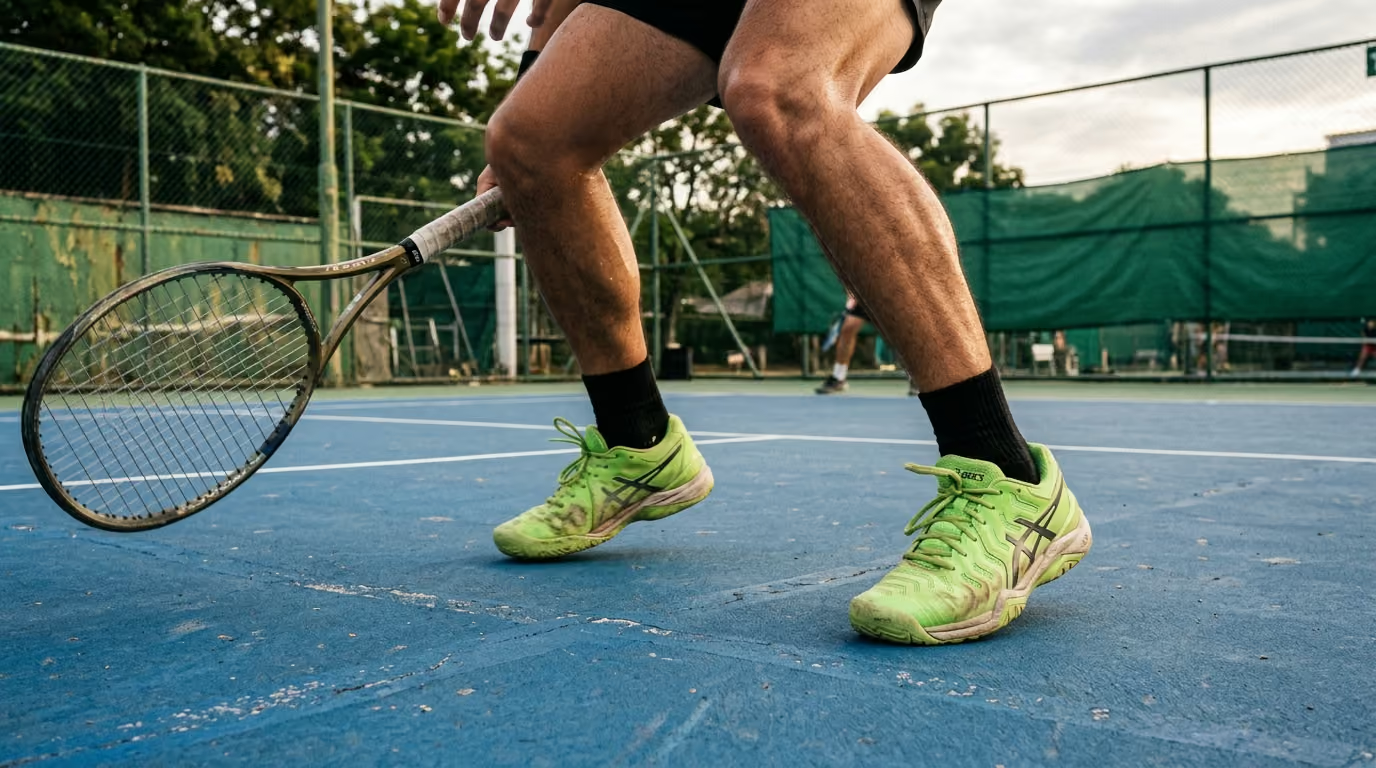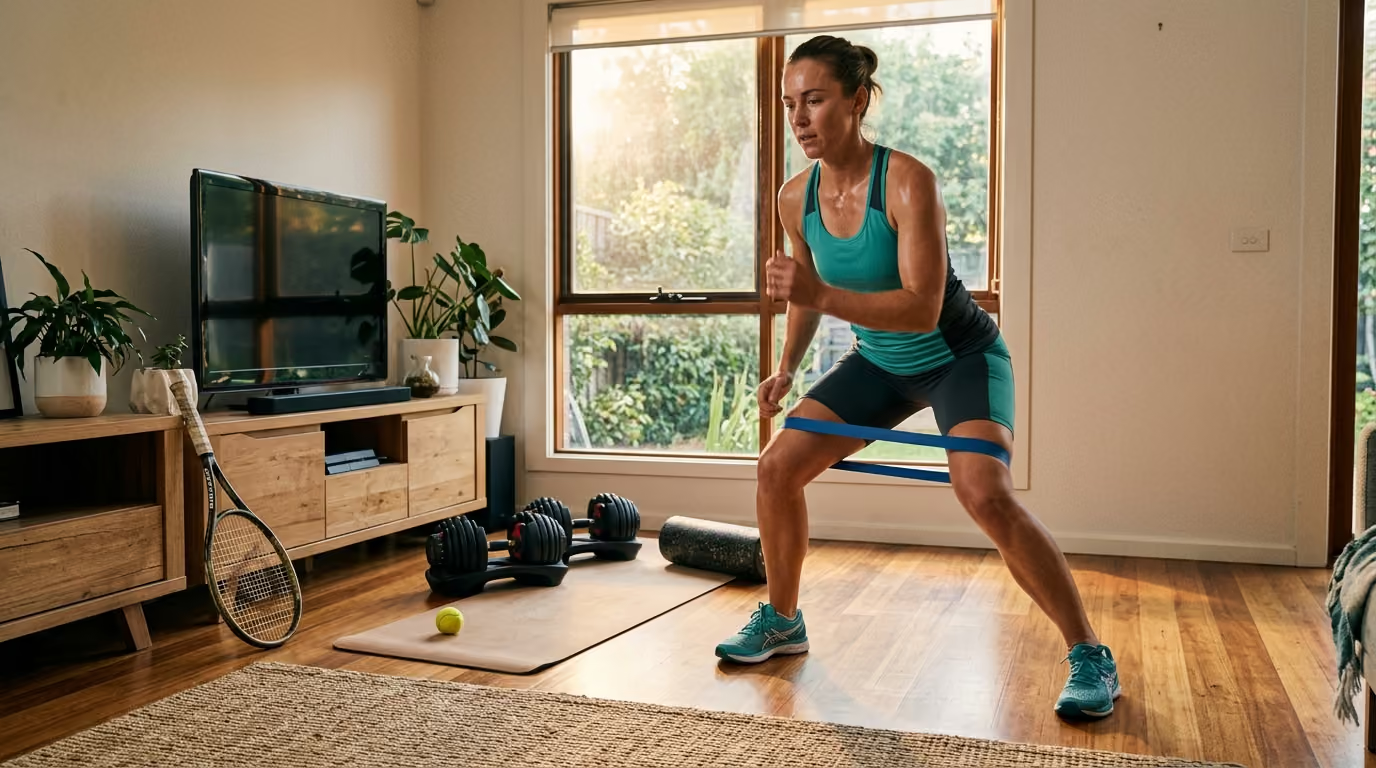

Many believe a commercial gym is essential for racquet sports conditioning, but exceptional court strength and joint durability are achievable with simple home equipment.




Many court athletes find themselves searching for ways to stay fit when they cannot make it to a commercial gym. You might have searched for how to maintain tennis power at home, or how to protect your knees for pickleball using only basic equipment. The definitive answer is that you do not need a commercial gym to develop exceptional court strength, directional power, and joint durability. Consistent training with simple tools like bands, bodyweight, and adjustable weights is highly effective for building athletic longevity.
Racquet sports require unique physical preparation due to their intermittent nature. Unlike continuous activities like running, court sports consist of rapid bursts of maximum effort separated by brief periods of rest. Research published in a comprehensive physiological review shows that during a typical tennis match, points generally last between five and seven seconds. This means your body relies heavily on the anaerobic ATP-PC energy system for explosive movements, while using the aerobic system to recover between points.
The physical demands scale differently across different racquet disciplines. For example, badminton involves exceptional cardiovascular stress. Badminton matches often present high average heart rates and elevated blood lactate levels, reflecting the constant jumping and rapid changes of direction. Table tennis features extremely short travel distances but demands highly explosive rotational speed and rapid technical adjustments.
Developing these qualities at home requires a whole-body approach rather than focusing on isolated muscles. The human body transfers force from the ground, through the legs and trunk, and finally into the racquet or paddle. A major systematic review confirmed that core strength training directly improves balance, agility, core endurance, and ball velocity in court athletes. This kinetic chain operates best when the core is trained to transfer power rather than just perform endless sit-ups.
To train the core effectively for court sports, you must look beyond basic flexion. Your trunk muscles must resist unwanted movement just as much as they produce rotation. A comprehensive home program should train your body to resist extension, resist side-bending, and control rotation during high-speed movements. This comprehensive approach ensures that the power generated by your legs is not lost as it travels up to your arm.
To build an effective home routine, you must focus on five essential movement qualities. The first is force production, which is your ability to push hard against the court surface to initiate movement. You can develop this quality using unilateral exercises like split squats and single-leg deadlifts. These exercises train your legs to support your bodyweight during deep lunges and low-stance plays.
The second quality is the rate of force development, which determines how quickly you can accelerate or change direction. This requires power training, which uses fast contraction velocities. At home, you can train this using bodyweight jumps, lateral hops, or quick medicine ball throws. These movements train your nervous system to activate muscle fibers rapidly.
Third, you need strength endurance to maintain your movement quality during a long third set or a prolonged tiebreaker. This is trained by performing higher repetitions or grouping exercises into circuits with controlled recovery times. Fourth, movement capacity involves your balance, coordination, and ability to decelerate safely. Finally, tissue capacity refers to the durability of your tendons, muscles, and ligaments under repetitive stress. You can find more detail on how to organize these qualities in our strength and conditioning resources.
To build these qualities, you must distinguish between general physical preparation and sport-specific preparation. General physical preparation focuses on building a solid foundation of strength, movement, and cardiovascular fitness. This involves basic movement patterns like squatting, lunging, pushing, pulling, and carrying weights. These exercises build the structural capacity of your muscles and joints, preparing them for more intense work.
Sport-specific preparation modifies these basic movements to mimic the unique demands of your sport. This does not mean copying your strokes with a dumbbell in hand. Instead, it means performing exercises in single-leg stances, adding rotational elements, or utilizing rapid braking movements. By blending general and sport-specific preparation, you build a body that is both strong and highly functional on the court.
While the fundamental physical needs remain similar, each sport requires a slightly different emphasis. These variations are driven by court size, equipment weight, and common movement patterns.
Tennis players must cover a larger court area than pickleball or padel players. This larger area means you must generate significant lateral force to slide or sprint to the sidelines. Your home routine should emphasize lateral lunges, skater bounds, and deep split squats. These movements prepare your adductors and glutes for the wide, sliding stops common on clay and hard courts.
Pickleball involves a smaller court but requires rapid, short-distance acceleration. You spend a significant portion of the match in a low, loaded athletic stance near the non-volley zone line. This position places exceptional stress on your quadriceps, patellar tendons, and lower back. Your home training should focus on isometric squat holds, lateral shuffles, and hand-eye coordination drills. These exercises help you maintain a low center of gravity without developing early muscle fatigue.
Padel players must handle a high volume of overhead shots, wall rebounds, and rapid multi-directional transitions. The sport demands excellent thoracic mobility and shoulder rotational strength to manage frequent lobs and smashes. Your home program should highlight shoulder external rotation with bands, overhead carries, and rotational core work. This helps protect the rotator cuff from the repetitive overhead strain inherent to the sport.
Badminton players require exceptional vertical jumping power and rapid ankle-deceleration capacity. You must constantly leap for overhead smashes and then drop rapidly into low defensive lunges. Your home routine should prioritize Achilles tendon durability, calf strength, and elastic jump training. Exercises like ankle pogo hops, single-leg box drops, and deep lunges prepare your lower limbs for these rapid, high-impact changes.
Squash matches are characterized by long, grueling rallies with minimal rest between points. Players must constantly lunge deep into the corners of the court, often reaching far forward while maintaining a flat back. Your home program should focus heavily on single-leg strength endurance and hamstring capacity. Movements like Bulgarian split squats, single-leg Romanian deadlifts, and slider hamstring curls will help you tolerate these repetitive, deep lunges.
Table tennis players operate in a very small physical space but must react with incredible speed. Your success depends on your ability to rotate your torso rapidly to generate spin and ball velocity. Your home exercises should highlight rapid, controlled rotational core work and lateral foot agility. Exercises like band twists, medicine ball tosses, and quick-step ladder drills train your body for these explosive micro-movements. You can check our specific mobility and movement plans to target these individual joint demands.
One frequent error is trying to make strength exercises look exactly like your sport strokes. Some players attach a resistance band to a wall and mimic a forehand or backhand swing against tension. This practice can actually disrupt your natural stroke mechanics and place abnormal stress on your shoulder joint. The purpose of off-court training is to build general qualities like trunk stiffness and shoulder stability, not to practice tennis technique under load.
Another common mistake is assuming that a home workout must result in extreme fatigue to be effective. High-intensity conditioning circuits have their place, but they should not dominate your program. If you are constantly exhausted from your home sessions, your court practice and match play will suffer. Focus instead on progressive overload, movement quality, and matching your training volume to your current playing schedule.
Many players also fall into the trap of using unstable training tools incorrectly. Performing heavy squats on a balance board or a soft foam pad decreases the force your muscles can produce. While balance training has its place, it should not replace stable strength exercises. If you want to build true strength, keep your feet on a solid, stable floor where your muscles can work against a firm surface.
Finally, some athletes treat plyometrics as a form of high-fatigue cardio. They perform hundreds of continuous jumps with little rest, which degrades their landing mechanics and increases joint stress. Plyometric training should focus on maximum speed, explosive power, and perfect landing quality. Keep your repetitions low, focus on quality, and allow full recovery between sets to get the best results.
A well-planned home strength routine does more than make you faster, it also helps you recover between matches. Regular resistance training increases the thickness and stiffness of your tendons, which helps them store and release energy. This structural change reduces the strain on your joints during explosive court movements.
Stronger muscles also absorb more of the impact forces when you land from a jump or brake hard during a change of direction. This protective effect prevents excessive wear on your knees, hips, and lower back. By maintaining your muscle mass and tissue capacity, you support your healthy aging and athletic longevity. Additionally, integrating basic recovery science principles ensures that your muscles adapt optimally to the training stress.
Strength training also improves your overall movement efficiency, which means you burn less energy during a match. When your muscles are strong, they do not have to work as hard to produce the same court speed. This efficiency delays the onset of fatigue, allowing you to maintain your technical skill late into a game. It also means you will wake up with less muscle soreness the day after a tough match.
Furthermore, a consistent strength routine helps correct the muscle imbalances that naturally develop from playing racquet sports. Because court sports are highly asymmetrical, one side of your body often becomes much stronger than the other. Home exercises like single-arm rows and unilateral lunges help balance these forces. This structural balance keeps your joints moving smoothly and reduces the risk of chronic overuse issues.
To get the most out of training at home, you must understand how to use your equipment safely and effectively. You do not need to buy every tool at once. Starting with one or two key items allows you to build a highly functional routine.
Resistance bands are incredibly versatile, portable, and cost-effective. They are excellent for horizontal pulling movements, rotator cuff care, and anti-rotation exercises. However, bands have a unique resistance profile. The tension increases as the band stretches, meaning the exercise is easiest at the start and hardest at the end.
To track your progress with bands, you cannot rely on simple weight numbers. Instead, you should record the band thickness, your distance from the anchor point, the tempo of the movement, and your total repetitions. Always inspect your bands for small tears or discoloration before each session. Secure them to heavy, stable objects and avoid anchoring them to light furniture or doors that might open.
Adjustable dumbbells are the gold standard for home strength training. They allow you to apply precise external loads to exercises like split squats, Romanian deadlifts, and rows. Dumbbells are particularly useful for unilateral loading, where you hold a weight on only one side of your body.
This offset loading forces your core muscles to contract hard to keep your torso upright. It mimics the uneven forces you experience when reaching for a wide ball on the court. While unilateral training is highly effective, remember that it is not inherently superior to bilateral training. It is simply a practical tool to build balance, address strength asymmetries, and maximize a limited weight set.
Kettlebells offer unique benefits for dynamic, ballistic movements. While you can use them for traditional strength exercises like goblet squats, they excel at power-based movements like swings and cleans. The kettlebell swing is a hip-hinge exercise that builds explosive power in your hamstrings and glutes.
You must distinguish between ballistic power movements and controlled strength movements. A swing should be performed with maximum speed and explosive hip extension. A split squat or overhead press, on the other hand, requires a controlled tempo to build raw strength. Do not attempt high-speed kettlebell exercises until you can perform a basic bodyweight hinge with perfect form.
Suspension trainers utilize your bodyweight against gravity. By changing your feet position or body angle, you can easily make an exercise harder or easier. They are exceptionally useful for upper-body pulling exercises, which are often difficult to perform at home without heavy machinery.
Suspension trainers are also excellent for travel because they fold into a small bag and can be anchored to hotel doors. When using a suspension trainer, always check the security of the door anchor. Ensure the door opens away from you so your bodyweight pulls the door shut rather than open. Keep your core tight during every exercise to prevent your lower back from sagging.
Pure bodyweight training requires zero equipment but demands a deep understanding of movement mechanics. You can make bodyweight exercises more challenging by changing your leverage. For example, moving from a standard floor push-up to a feet-elevated push-up increases the load on your chest and shoulders.
You can also progress by increasing your range of motion, adding pauses, or slowing down the lowering phase of the movement. Adding a three-second pause at the bottom of a split squat significantly increases muscle activation without adding any external weight. Avoid using highly unstable surfaces like wobble boards in an attempt to make bodyweight exercises harder. Unstable surfaces decrease the force your muscles can produce, making them less effective for building true strength.
To continue making progress at home, you must apply the principle of progressive overload. If you perform the exact same workout every week, your body will stop adapting. You need a systematic way to challenge your muscles over time.
When you want to make an exercise harder, do not immediately reach for a heavier weight. Instead, follow this structured hierarchy to ensure safe and steady progress:
The double progression method is a highly practical way to manage your training variables at home. First, you choose a target repetition range, such as eight to twelve repetitions. Next, you select a load that allows you to perform eight repetitions with good form, leaving one or two repetitions in reserve.
You keep using this exact same load in your future workouts until you can complete all of your sets at the top end of the range, which is twelve repetitions. Once you achieve this, you increase the weight or difficulty of the exercise and return to the bottom of the range at eight repetitions.
Here is a five-week example using the split squat:
This structured approach prevents you from guessing your weights and ensures that your muscles receive a consistent stimulus.
Using specific movement tempos is an excellent way to increase exercise difficulty when your weight selection is limited. A standard tempo can be written as a four-digit code, such as 3-1-1-0. The first digit represents the lowering phase, which in this case takes three seconds.
The second digit is the pause at the bottom, which is one second. The third digit is the rising phase, which takes one second. The final digit is the pause at the top, which is zero seconds.
Slowing down the lowering phase increases the time your muscles spend under tension. This is highly effective for building tissue capacity and preparing your tendons for the high forces of court play. However, when you are training for explosive power, you should always attempt to perform the rising phase as fast as possible.
Before you begin any strength or power session at home, you must prepare your body for work. A random assortment of static stretches is not sufficient. Your warm-up should systematically raise your body temperature, improve joint mobility, and activate your key muscle groups.
An effective home warm-up should follow a logical flow that transitions from slow, controlled movements to faster, sport-specific actions.
Complete this short routine before your strength sessions to optimize your movement quality:
This entire routine takes less than ten minutes but significantly improves your readiness to train. It also serves as an excellent tool for injury prevention strategies.
Having a clear plan is key to staying consistent. Below are three practical templates designed for different schedules and goals.
This program is ideal for players who already spend several days a week on the court and want to maintain their physical baseline.
Day 1: Lower-body strength and acceleration focus
Day 2: Hinge, lateral power, and upper-body focus
This template is best for players who want to build strength, power, and conditioning during the off-season or a lighter match schedule.
Use this quick, equipment-free routine in a hotel room to preserve your fitness while traveling for tournaments or business:
This routine takes twenty minutes but keeps your key movement patterns active and ready for your return to the court.
To see how these principles apply in the real world, consider how different players adapt their home programs to meet their specific needs.
This player does not need a high volume of extra training, as their match play already provides substantial cardiovascular stress. Their primary goal is maintaining joint health and preventing common overuse injuries.
Their home program consists of two 30-minute sessions per week. They focus on unilateral leg strength to protect their knees, and band work to keep their shoulders stable. They avoid high-fatigue conditioning circuits at home, choosing instead to save their energy for their court matches.
This player can run for hours but struggles to stop quickly on the court, often sliding out of position. They do not need more aerobic running. Instead, their home program prioritizes eccentric strength and landing mechanics.
They perform lateral bounds with a focus on holding the landing, and deep split squats with a slow, controlled lowering phase. This specific training builds the deceleration capacity of their quadriceps and hips. As a result, they can brake faster on the court and recover their position more efficiently.
This athlete has highly developed technical skills but lacks the explosive leg power to step quickly into deep corners. Their table tennis matches involve short, rapid movements rather than long-distance sprints.
Their home program focuses on developing maximum leg power in a short range of motion. They perform low-volume, high-velocity jumps and explosive lateral hops. They also use heavy kettlebell swings to build power in their hips. Within a few weeks, their court movement becomes sharper and more explosive.
This young athlete spends significant time traveling for junior tournaments, making consistent gym access impossible. Their primary need is a simple routine that maintains their movement quality without causing excessive muscle soreness before matches.
They travel with a single light resistance band and a jump rope. Their routine consists of fifteen-minute micro-sessions performed in their hotel room. They focus on light hopping, single-leg hinges, and band rows to keep their posture and joints primed for tournament play.
This competitive player has several years of strength training experience but currently has only a pair of thirty-pound adjustable dumbbells at home. They cannot perform heavy traditional squats or deadlifts with this limited load.
Instead of trying to lift heavy, they create overload by using mechanically disadvantageous positions and slow movement tempos. They perform rear-foot-elevated split squats with a five-second lowering phase and a two-second pause at the bottom. This challenging variation stimulates their muscles effectively without requiring hundreds of pounds of external weight.
While building strength at home is highly effective, you must listen to your body and recognize the difference between normal training fatigue and potential injury. Mild muscle soreness that develops a day or two after a workout is normal, especially when starting a new routine. However, sharp, sudden, or persistent pain is a sign that something is wrong.
If you experience joint pain, swelling, or localized tenderness in your tendons, you should stop the provoking exercise immediately. Paying close attention to pain in areas like the patellar tendon, Achilles tendon, or rotator cuff is crucial. Persistent pain that does not improve after a few days of rest requires a professional evaluation.
You should consult a qualified healthcare provider, such as a physical therapist or sports medicine physician, if you notice any red flags. These include sharp pain during movement, joint instability, numbness, tingling, or swelling that limits your range of motion. A professional can provide a precise diagnosis, assess your movement mechanics, and design a customized rehabilitation plan. Do not attempt to work through pain, as this can turn a minor issue into a chronic injury that keeps you off the court for months.
Furthermore, you should seek guidance if you experience recurring pain that always returns when you increase your playing volume. This often indicates a biomechanical issue or a specific strength deficit that requires a targeted assessment. A sports physical therapist can help you identify these weak links and adjust your home program accordingly. Remember, the goal of strength training is to keep you playing the sports you love, not to force you to play through unnecessary pain.
To put this guide into practice this week, follow these simple steps to build your home routine:
Follow Evercourts for practical insights on tennis, pickleball and padel performance, movement, recovery and healthy ageing. Stay connected for new articles, research-led guidance and ideas to help you play well and keep playing for years.


Read practical guidance for better movement, smarter preparation and a game that keeps working for you.
explore the Blog