
Court conditions significantly influence the physical demands and injury risks in racquet sports by altering biomechanical loads on an athlete's body.




Many athletes assume a court is simply a neutral stage where skill is displayed. In reality, court environments act as active physical forces that change the mechanical load on your body. Treating all racquet sports as identical conditioning challenges is a common path to chronic fatigue and joint issues. The physical demands of a match are not defined solely by your opponent. They are shaped by the surface texture, court dimensions, ambient temperature, and your choice of footwear. Each of these elements alters how your muscles produce and absorb force.
Court conditions directly modify the mechanical cost of play by shifting how forces are absorbed and produced. When you move between hard, clay, or indoor surfaces, your muscles must adapt to different traction levels and rally durations. Adjusting your strength, conditioning, and recovery to these specific environmental factors is necessary to maintain athletic longevity and play without pain. Understanding these variables allows you to build a resilient body that can withstand the unique challenges of your sport.
Current sports science shows that surface compliance and friction change how the body handles impact. Research on tennis biomechanics indicates that hard acrylic surfaces produce higher vertical ground-reaction forces during sudden stops than clay courts. Clay allows controlled sliding, which spreads the braking force over a longer time window. This extension of stopping time reduces the peak rate of force development on your joints.
A study on foot-plant mechanics found that different court surfaces significantly alter the coefficient of friction and vertical impact forces. Interestingly, the researchers noted that movement velocity often exerts a stronger influence on peak impact force than the stiffness of the surface itself. This means that faster players may experience higher joint stresses regardless of the court material. Your movement speed and braking style are just as critical as the surface material.
In contrast, natural grass or modern low-bounce synthetic turf presents a different set of challenges. These surfaces are highly compliant but have lower, less predictable friction. The ball stays low, which forces the player to sustain deep knee flexion and produce rapid, low-altitude lateral pushes. This creates a highly localized metabolic demand in the quadriceps and calves.
Compliance and stiffness must also be evaluated through the lens of energy return. A very stiff surface, like concrete-backed acrylic, returns almost all energy directly back into your bones and joints. This increases the wear on your articular cartilage over years of play. A more compliant surface absorbs some of that energy, but it requires your muscles to work harder to produce push-off force.
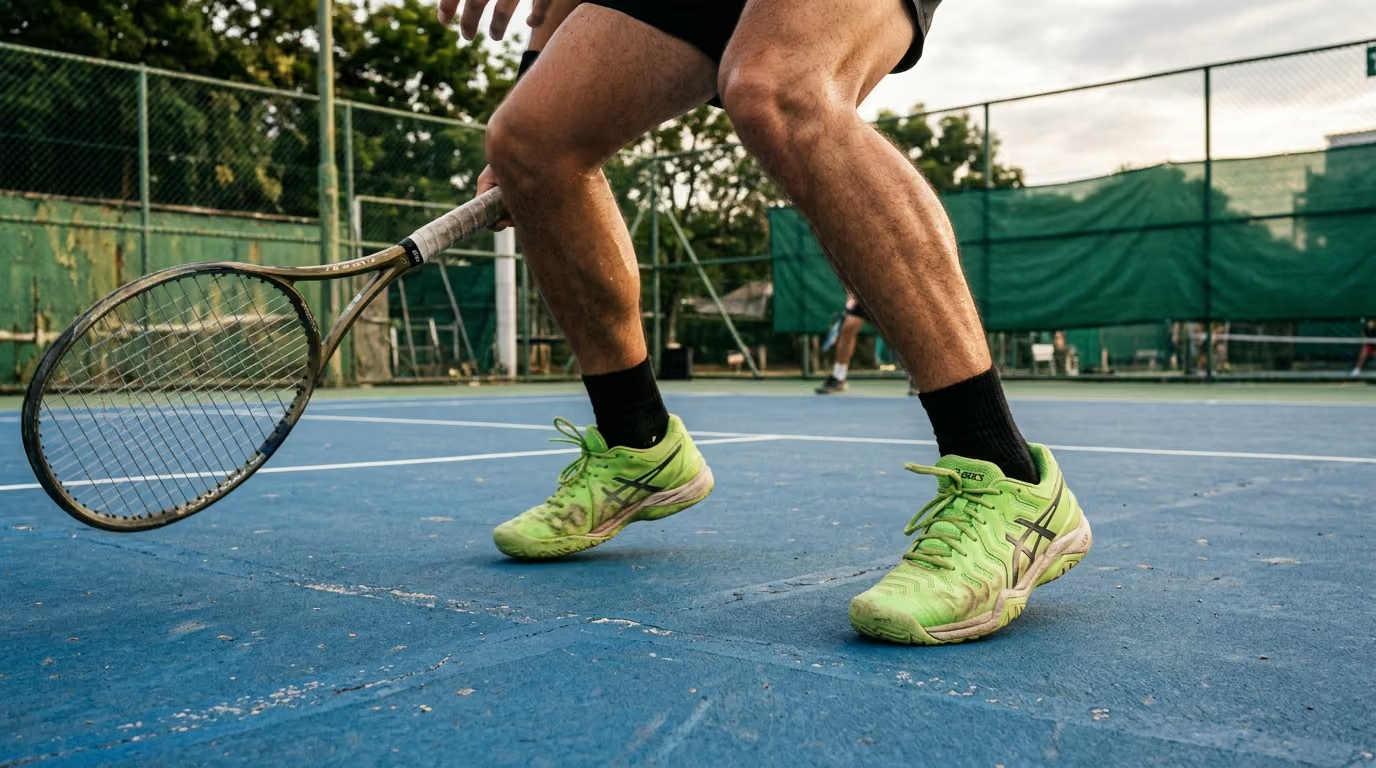
Acrylic hard courts are composed of concrete or asphalt topped with synthetic resins and silica sand. This combination creates a high-friction surface that yields almost no give underfoot. When you stop, the transition from high velocity to a dead halt occurs in milliseconds. The vertical ground reaction forces during a hard-court stop can be up to three to five times your body weight.
This abrupt stop places massive eccentric demands on your quadriceps and patellar tendons. The muscle must lengthen rapidly under load to absorb your momentum. If your lower-body eccentric strength is insufficient, your joints and spine absorb the remaining shock. This mechanical stress can lead to micro-tears in your connective tissues over time.
This is why patellar tendonitis and plantar fasciitis are highly prevalent among players who train exclusively on hard courts. To protect these tissues, your training must focus on building eccentric strength and tendon stiffness. Without this specific preparation, your body will struggle to buffer the high impact forces returned by hard acrylic.
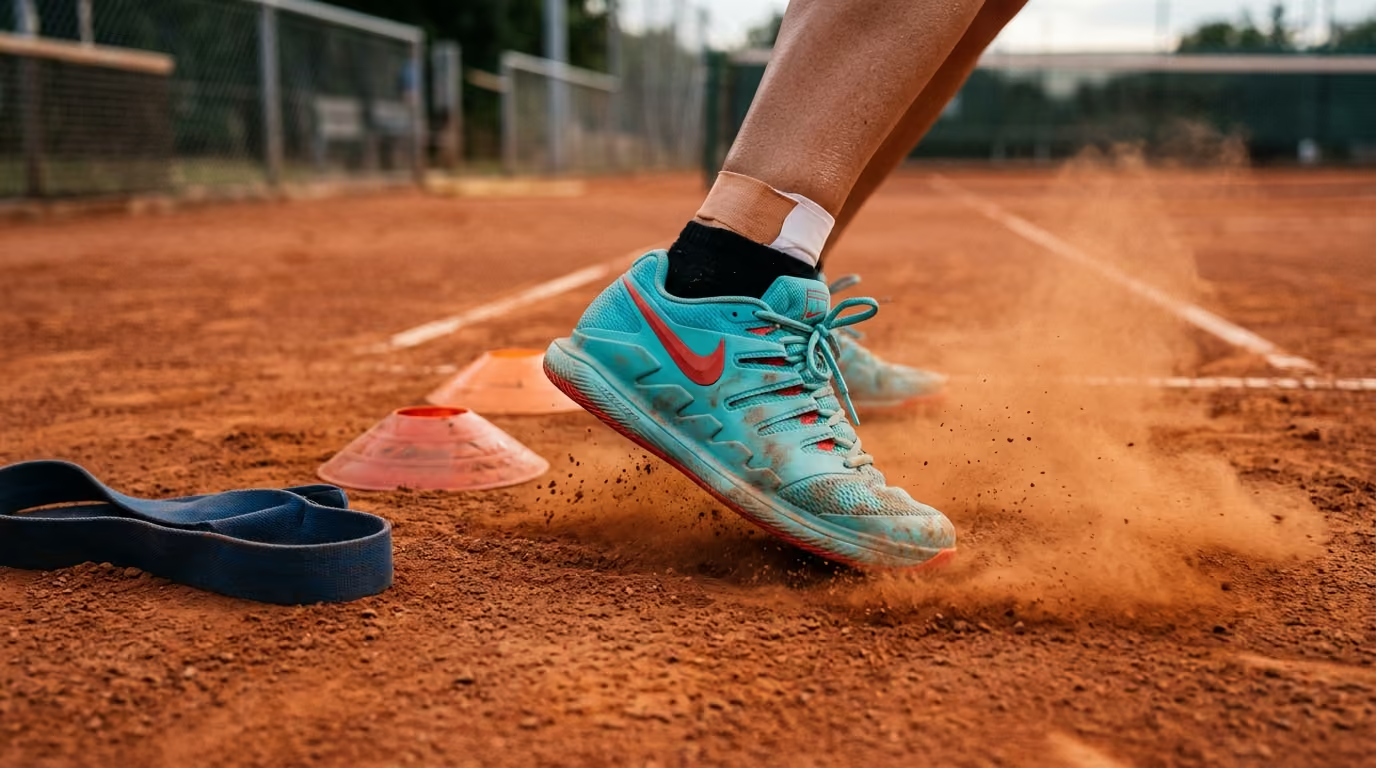
Clay courts offer a compliant surface made of crushed brick or stone. This material allows the foot to slide before coming to a complete stop. The slide acts as a natural shock absorber, reducing the peak force experienced by your joints. The stopping phase on clay can extend past 200 milliseconds, which is much longer than on hard courts.
However, sliding requires excellent coordination and strength in your adductor muscle group. As your foot slides outward, your inner thigh muscles must contract to control the width of your stance. If your adductors are weak, your foot can slip too far, leading to severe groin strains. Your hips must also maintain stability throughout the entire sliding motion.
Additionally, recovering from a slide requires you to push off from an unstable, wide base. This movement demands strong gluteal muscles and deep trunk stability to redirect your center of mass. Without this strength, your lower back will compensate to pull you back to the center of the court. This compensation often leads to muscle spasms, stiffness, and chronic lower-back discomfort.
Natural grass or damp synthetic turf has the lowest friction coefficient of any court surface. The ball skids and stays very low, which changes your entire movement profile. You cannot rely on high-bounce preparations; you must bend from your hips and knees to strike the ball. This requirement alters the mechanical workload of every point.
This prolonged low posture requires high isometric endurance in your quadriceps and gluteus maximus. Your thighs will experience a deep burn as you hold these positions across long games. The lack of reliable traction also means you must use shorter, more controlled steps to avoid slipping. This stepping pattern increases the workload on your calves and ankles.
Furthermore, the ankle complex must work harder to stabilize your foot on uneven natural turf. The micro-adjustments required to balance on grass can fatigue your stabilizing muscles quickly. This makes ankle stiffness and reactive balance training highly important for grass-court players. If you ignore these stabilizing muscles, your risk of rolling an ankle increases significantly on natural surfaces.
A singles tennis court is 23.77 meters long and 8.23 meters wide, expanding to 10.97 meters for doubles. This expansive space allows players to reach higher running speeds and cover greater total distances during a match. You must prepare your body to accelerate over longer distances and decelerate from higher velocities.
According to comparative research, tennis players cover more distance and perform more high-speed sprints than padel or pickleball players. The larger court requires longer acceleration phases and substantial decelerations from high velocities. This creates high eccentric demand on the quadriceps, calves, and adductors during wide-court recovery steps. You must build the physical capacity to handle these wide-angle braking forces repeatedly.
To perform well in tennis, your conditioning must include aerobic intervals that support recovery between long baseline rallies. You also need repeated-sprint training to maintain your acceleration capacity throughout a three-set match. This dual requirement makes tennis a highly complex sport to program for. You cannot rely on short-distance drills alone to prepare for the spatial demands of a full tennis court.
A pickleball court measures exactly 20 feet by 44 feet for both singles and doubles play. The non-volley zone, commonly called the kitchen, restricts volleying within 7 feet of the net. This design forces players into compact, rapid lateral shuffles and prolonged low isometric holds. The movement profile is highly dense and localized.
Because the court is small, you rarely reach maximal sprinting speeds. Instead, your conditioning should focus on rapid acceleration bursts and quick lateral recovery steps. The physical tax is concentrated in the lower limbs rather than distributed across long-distance running musculature. This means your calves, ankles, and knees bear the brunt of the physical workload.
This constant lateral shuffling requires excellent lateral hip strength and ankle stability. The adductor and abductor muscles must work continuously to guide your feet as you guard the kitchen line. Without this specific conditioning, players often experience lateral knee pain and hip tightness. Your training must prioritize local muscular endurance and rapid split-step reactions over long-distance running.
Padel courts measure 20 meters by 10 meters and are enclosed by glass and metal walls. The presence of walls means the ball remains in play longer, creating extended rallies. A systematic review noted that padel is highly intermittent with frequent short, explosive movements, even though running velocities are lower than in tennis. This unique structure alters how you accumulate fatigue.
One review reported that over half of padel movements involve lateral displacements, while a significant portion are frontal. This high frequency of multi-directional changes requires excellent multi-planar agility. You must be able to transition from a lateral shuffle to a forward sprint seamlessly. Your training must emphasize these rapid transitions to keep you moving efficiently.
Furthermore, the walls require you to turn your hips and shoulders rapidly to play ball rebounds. This constant twisting places a high demand on your core musculature and thoracic spine. Padel players must therefore train their rotational trunk stability to avoid lower-back strains. If your core cannot handle this rotational load, your spine will suffer from the repetitive twisting forces.
The concept of a traction budget is critical for preventing lower-limb injuries. Traction represents the amount of horizontal force your shoe can transmit before slipping on the court. High-traction hard courts allow immediate force transfer but increase the rotational strain on your knees and ankles. You must balance your need for speed with your joint safety.
If your shoe has too much grip, your foot can stick to the ground while your knee and hip continue to rotate. This sudden rotational block can lead to acute ligament injuries or chronic joint irritation. Conversely, too little traction can cause slipping, hesitation, and uncontrolled braking. This lack of traction can lead to muscle strains as your body tries to over-correct.
The goal is matched traction, not maximum traction. You must select footwear that allows a small amount of slip under extreme force to protect your joints. This is particularly important for older athletes whose tendons are less compliant. Managing your traction budget is a practical way to support your physical longevity on the court.
A clay-court shoe features a full herringbone tread pattern designed to release clay dust and prevent clogging. This tread pattern allows for controlled sliding on clay surfaces without losing traction during push-offs. Using a clay shoe on a hard court, however, will wear down the tread rapidly and offer unpredictable grip. It can also cause you to stop too abruptly, increasing joint stress.
Hard-court shoes feature a more durable outsole with a modified herringbone design. This pattern provides the perfect balance of grip and slide on abrasive acrylic surfaces. It also includes reinforced toe caps to withstand the friction of toe-dragging during serves. The rubber compound is specifically formulated to handle high temperatures and abrasive wear.
Pickleball and padel shoes often have unique rubber compounds optimized for indoor wood, outdoor acrylic, or synthetic turf surfaces. Using the wrong shoe for these courts can compromise your movement speed and safety. Always match your shoe outsole to the specific surface you play on. This simple equipment choice has a massive impact on your joint health and movement efficiency.
Using running shoes on a racquet court is a common error that compromises safety. Running shoes are designed for linear, forward movement and have thick, cushioned midsoles. They lack the lateral wall support and torsional stiffness required for rapid changes of direction. This makes them highly unstable during sudden side-to-side cuts.
During a sudden lateral cut, the high sole of a running shoe can roll over, causing a severe ankle sprain. Running shoes also have high-traction outsoles that can stick too aggressively to hard court surfaces. This increases the shear forces transmitted through your knees and hips. Your body is forced to absorb rotational forces that your shoes should be helping to mitigate.
Investing in a dedicated court shoe is one of the most effective ways to protect your lower limbs. A proper court shoe features a low profile to keep your center of mass close to the ground. It also includes lateral outriggers to support your foot during sharp, side-to-side cuts. This design distributes lateral forces evenly across the foot and ankle structure, reducing injury risk.
To prepare your body for different court environments, you must adjust your training exercises. Your gym sessions should directly address the mechanical demands of your primary playing surface. Below is a structured approach to matching your exercises to the court environment.
Developing base strength is essential for generating power on the court. These exercises focus on building strong muscles that can produce high forces under control.
These movements ensure your lower body has the structural capacity to produce force on any surface.
Stopping is just as important as starting in racquet sports. These exercises teach your muscles and tendons to absorb force safely and efficiently.
By mastering these exercises, you can reduce the joint impact experienced on hard court surfaces.
Racquet sports are played primarily in the frontal plane, requiring excellent side-to-side power. These exercises improve your lateral power and hip control.
These exercises prepare your hips for the wide, lateral movements common in all court sports.
Your lower leg acts as a spring, transferring force from your body to the court. These drills build stiff, resilient ankles and Achilles tendons.
Stiff ankles allow for faster acceleration and protect your Achilles tendon from sudden overload.
Rotational power is the key to strong strokes and a healthy spine. These exercises build core stiffness and trunk control.
A strong, stable core prevents excessive twisting in your lower back during powerful strokes.
Preventing shoulder fatigue is essential for consistent striking and injury prevention. These drills target the stabilizing muscles of your upper body.
These upper-body exercises help you maintain stroke mechanics even during long, fatiguing matches.
Although tennis, pickleball, and padel are all racquet sports, their physical demands are highly distinct. Treating them as interchangeable can lead to poor conditioning and overuse injuries. Let us examine how the physical demands differ across these three sports.
Tennis requires a combination of high-speed running, rotational power, and repeated-sprint ability. Because the court is large, you must train your aerobic system to support recovery between long baseline rallies. Your conditioning should include interval runs that last between ten and thirty seconds, followed by complete rest. This helps maintain your power output across multiple sets.
Additionally, the serve in tennis creates unique overhead demands on the shoulder joint and thoracic spine. You must include specific rotator-cuff strengthening and upper-back mobility exercises in your weekly routine. This helps prevent shoulder impingement and elbow tendonitis from repeated serving. To maintain your physical capabilities and stay healthy, you can find tailored advice in our player health articles.
Tennis players must also focus on single-leg stability because of the wide open-stance ground strokes used to recover from deep corners. The force required to push off from a wide lateral stance is massive. Training your adductors and glutes is critical to maintaining hip health across a long season. If your hips lack stability, your knees and lower back will absorb the excess force.
Pickleball demands exceptional reaction speed, low-body endurance, and short lateral agility. Because the court is small, you rarely reach maximal sprinting speeds. Instead, your conditioning should focus on rapid acceleration bursts and quick lateral recovery steps. This requires excellent calf and Achilles tendon capacity to handle the frequent, sudden movements.
Furthermore, players spend significant time at the kitchen line in a bent-knee position. This posture places a high isometric load on the quadriceps and patellar tendons. To support this, include deep squats and wall sits in your strength program. These exercises build the muscular endurance needed to hold low positions without placing excessive stress on your knees.
Older pickleball players should also pay close attention to calf and Achilles tendon health. The frequent short steps and sudden reactions can overload the lower leg if it lacks stiffness. Regular calf strengthening and progressive ankle drills are essential for athletic longevity. You can read more about developing these capacities on the Evercourts strength and conditioning page.
Padel is characterized by long rallies, frequent overhead hits, and rapid transitions after wall rebounds. Because the ball bounces off the walls, you must constantly adjust your footwork and turn your hips. Your training must emphasize rotational trunk strength and multi-directional agility. This helps you react quickly to unpredictable ball paths off the glass.
The high frequency of lobs and smashes in padel also places a major load on the shoulder girdle. Unlike tennis, where serving is highly structured, padel requires overhead actions from various defensive positions. You must build excellent scapular stability to handle these unexpected reaching motions. This training protects your shoulder joint from repetitive strain injuries.
The constant turning and twisting in padel also require great mobility in your hips and thoracic spine. If your hips are stiff, your lower back will twist excessively to compensate, leading to pain. Including regular rotational mobility drills in your warm-up is crucial for a healthy spine. Explore more specific training ideas on our court performance resource portal to improve your movement quality.
Many recreational players make systematic errors when transitioning between different court environments. Recognizing these mistakes can protect your joints and improve your court performance.
The most frequent error is moving from clay to hard courts while maintaining the exact same weekly playing hours. Hard courts do not allow sliding, meaning your joints absorb the entire deceleration force abruptly. If you transition instantly, the sudden increase in impact can overload your Achilles tendons and knees. Your body needs time to adapt to the higher mechanical stress.
Instead, you should reduce your court time by thirty percent during the first two weeks on a harder surface. This simple reduction gives your tendons and cartilage time to adapt to the higher forces. You can gradually increase your playing volume as your body acclimates to the hard surface. This progressive approach is key to preventing painful overuse injuries.
Additionally, you should avoid heavy strength training during these transition weeks. Adding extra weight lifting to an already stressed musculoskeletal system can trigger overuse injuries. Focus instead on light mobility work, low-impact recovery, and tissue quality. For more practical advice on equipment and healthy play, check out our court life articles for active players.
Many players wear standard running shoes to play pickleball or tennis because they feel cushioned and comfortable. However, running shoes are designed for straight-line movement and have thick, unstable midsoles. During a sudden lateral cut, the high sole can roll over, causing a severe ankle sprain. This equipment mistake is a leading cause of preventable court injuries.
Always wear a proper court shoe with a low profile, rigid heel counter, and lateral wrap-around outsole. This design stabilizes your foot during lateral shifts and reduces rotational stress on your knees. Proper court shoes also have durable outsoles that can withstand the friction of hard court surfaces. Investing in correct footwear is a simple way to protect your joints and improve your stability.
Another common mistake is believing that static stretching after a match will prevent muscle soreness from hard braking. While stretching can temporarily improve range of motion, it does not build the strength required to decelerate your body safely. Deceleration is an active, strength-dependent process that requires strong, resilient muscle fibers.
To improve deceleration control, you must perform active eccentric exercises in the gym. Doing heavy split squats and drop landings prepares your muscle fibers to absorb force under load. Static stretching alone will not protect your tendons from the high-velocity impacts of court sports. Your training must balance flexibility with active force absorption.
Environmental factors like heat, humidity, and wind can alter the physiological cost of play as much as the surface itself. Playing in hot, humid conditions increases cardiovascular strain and accelerates neuromuscular fatigue. Understanding how to manage these stressors is critical for maintaining performance. Your body must work much harder to cool itself in challenging environments.
According to the American College of Sports Medicine, dehydration of just two percent of body mass can impair physical and cognitive performance. To prevent this, players should consume approximately 500 milliliters of fluid two hours before stepping onto the court. During play, aim to drink small amounts at every changeover to replace sweat loss. This helps maintain your blood volume and supports efficient cardiovascular function.
Furthermore, when matches exceed one hour, consuming a sports drink with sodium and carbohydrates is highly beneficial. Sodium helps your body retain fluids, while carbohydrates maintain your energy levels and prevent early cramping. These general guidelines should be tailored to your individual sweat rate and the ambient temperature. Managing your hydration is a simple way to maintain your movement quality during long, hot matches.
Individual sweat rates can vary dramatically based on your fitness level, genetics, and acclimatization. To determine your sweat rate, weigh yourself before and after a hard match. Any weight lost represents fluid loss that should be replaced with interest during recovery. This objective data helps you design a precise hydration plan for future matches.
Wind also increases the physical demand by forcing you to make micro-adjustments to your footwork. When playing in windy conditions, your muscles work harder to stabilize your torso during late swing corrections. You cannot rely on smooth, predictable movement patterns when the wind is blowing. Do not underestimate the fatigue of a windy match, even if the rallies are short.
Playing at high altitudes presents another physical challenge due to the lower oxygen concentration in the air. Your heart rate will rise faster, and you will feel out of breath much sooner than at sea level. You must pace yourself carefully and extend your recovery times between rallies in high-altitude environments. Your body needs several days to adjust to the reduced oxygen availability.
Indoor courts can also create unique environmental stresses. Lack of natural airflow can lead to stagnant, humid air that makes heat dissipation difficult. Ensure you take regular breaks and step into ventilated areas to cool down when playing indoors. You can find comprehensive guides on managing physical strain on our recovery science resources page.
Your recovery strategy should match the specific type of fatigue induced by your court environment. Different court conditions create distinct forms of muscle and joint stress that require tailored recovery methods. If you ignore these differences, your recovery will be incomplete.
Hard courts and fast surfaces create high mechanical fatigue, which manifests as joint stiffness, tendon soreness, and muscular micro-tears. After a long session on hard courts, prioritize low-impact active recovery and tissue decompression. This helps relieve the high impact stress accumulated during play.
These methods help restore normal muscle length and relieve tension on your joints.
Additionally, you should consider wearing compression socks after long hard-court sessions. Compression socks can help reduce muscle vibration and improve blood circulation in your lower legs. This simple habit can noticeably decrease next-day calf stiffness and foot fatigue. It is an easy, passive way to support your lower-limb recovery.
Long rallies on clay or matches in high heat create metabolic fatigue, leaving your energy reserves depleted and your body dehydrated. Your recovery should focus on hydration, nutrition, and cooling. This helps your body return to a state of balance.
Matching your recovery to your physical output ensures you return to the court feeling refreshed. To learn more about maintaining your physical health, visit our athletic longevity resources.
You should also plan your training weeks with clear recovery windows. Avoid scheduling heavy lower-body strength sessions on the day immediately following a long, hot singles match. Your muscles need time to restore glycogen reserves before handling high external loads again. This periodization is essential for preventing chronic fatigue and overtraining.
While general soreness is common after playing racquet sports, certain symptoms require professional medical evaluation. Ignoring persistent pain can turn minor issues into chronic injuries that keep you off the court for months. You must learn to distinguish between normal fatigue and structural damage.
You should consult a qualified healthcare provider, such as a physical therapist or sports physician, if you experience any of the following warning signs:
These signs can indicate a ligament tear, nerve compression, or acute tendon damage. Seeking early intervention can prevent these issues from worsening and speed up your recovery time. A professional can provide a precise diagnosis and guide your rehabilitation.
Sometimes, injuries do not start with a sudden pop or twist. Instead, they present as a dull, persistent ache that gradually worsens over several weeks. This slow onset is common in overuse injuries like tendinopathy and joint wear.
If you experience morning stiffness in your Achilles tendon that lasts for more than thirty minutes, this is a clear sign of tendon overload. Similarly, persistent knee pain when climbing stairs or standing after sitting can indicate patellar tendonitis. These symptoms suggest that your training volume has exceeded your tissue's capacity to adapt.
Do not try to play through these symptoms by taking anti-inflammatory medications. Masking the pain can lead to structural damage in your tendons that takes months to heal. A qualified physical therapist can identify your movement imbalances and design a safe rehab program. To learn more about injury prevention strategies, browse our injury prevention guides.
By understanding and adapting to your playing environment, you can protect your body, improve your performance, and continue playing the sports you love for a lifetime.
Follow Evercourts for practical insights on tennis, pickleball and padel performance, movement, recovery and healthy ageing. Stay connected for new articles, research-led guidance and ideas to help you play well and keep playing for years.


Read practical guidance for better movement, smarter preparation and a game that keeps working for you.
explore the Blog