
While many players assume court surfaces have minimal impact on racquet sports, the ground beneath your feet significantly alters strategy and physical demands.




Most players believe they play the same sport regardless of the court surface. They assume a tennis, pickleball, or padel match is defined entirely by the rules and their opponent. In reality, the ground beneath your feet is an active participant in every single point.
Adapting to different court surfaces requires adjusting your movement timing, stroke preparation, and tactical pacing to match how the ball bounces and how the ground grips your footwear. Changing these variables allows you to maintain balance, reduce joint stress, and execute more effective strategies. Understanding these surface-specific physical demands is the foundation of long-term athletic longevity on the court.
Many athletes analyze courts using a simple fast versus slow comparison. This approach overlooks how a court surface actually behaves. A court with a fast ball response can impose slow movement demands if the traction is unreliable. To prepare effectively, players must look at the court as an active component of their athletic system.
To understand any playing environment, you must analyze it through five linked physical variables. These elements dictate how you run, strike, and recover during a match.
First is ball response. This includes the pace of the ball after it hits the ground, the height of the bounce, and how much the ball skids or grips.
Second is player-surface interaction. This covers the traction underfoot, the sliding potential of the material, and the amount of shock transmitted through your joints.
Third is movement geography. This defines how far you must travel to reach a wide ball and where you should position yourself to recover.
Fourth is tactical time. This is the precise window of time you have to recognize the incoming ball, prepare your swing, strike, and return to a neutral position.
Fifth is preparation and recovery cost. This encompasses your choice of footwear, your warm-up exercises, hydration needs, and the physical recovery required after play.
The International Tennis Federation, or ITF, classifies playing surfaces using an objective metric called the Court Pace Rating. Rather than relying on subjective player opinions, the ITF measures the physical change in ball velocity before and after it interacts with the ground. This system places courts into five distinct categories.
This classification system demonstrates that material labels alone do not dictate speed. An acrylic court can be engineered to play slowly by adding specific texturing materials to the paint. Conversely, a carpet court can be designed to play exceptionally fast. You can learn more about managing these demands by reviewing the resources on improving your performance on different court surfaces.
Acrylic hard courts are the most common surfaces in modern racquet sports. They consist of a rigid base, usually concrete or asphalt, coated with layers of acrylic resin. These courts offer a highly predictable bounce but place unique physical demands on your lower joints.
Hard courts provide immense traction. This high friction allows for rapid acceleration, but it also creates high braking forces when you stop. A study published in the Journal of Applied Biomechanics analyzed the running forehand foot plant across several court surfaces. The researchers found significant differences in peak vertical force and peak braking force when comparing acrylic courts to other options.
Because the surface does not slide, your body must absorb all of the kinetic energy when you halt. This energy travels upward through your shoes, ankles, knees, and lower back. Over time, these high-impact stops can strain your connective tissues if your movement mechanics are inefficient.
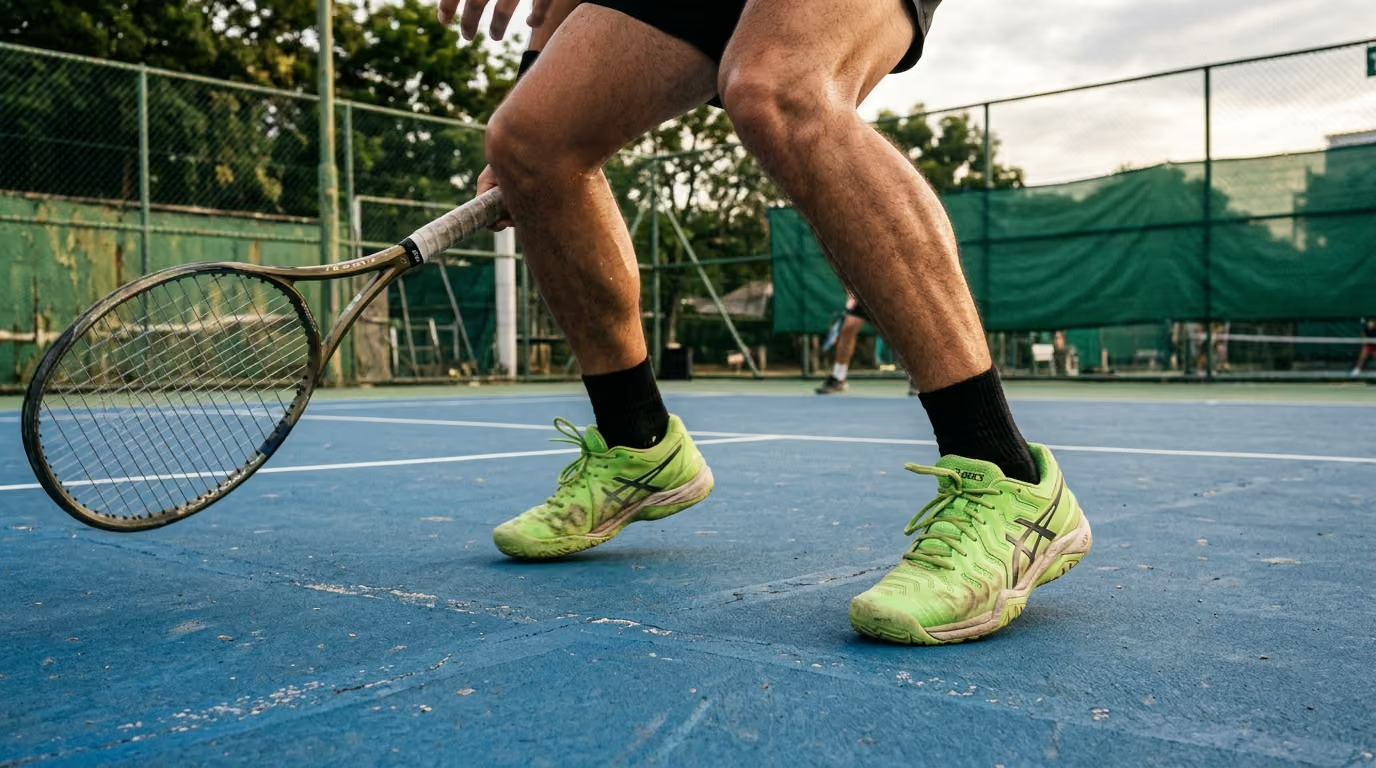
To move safely on hard courts, you must choose footwear designed specifically for high-grip environments. Hard-court shoes feature durable outsoles with modified herringbone tread patterns. This design offers a balance of grip and durability. The midsoles are typically thicker to provide ample cushioning against the rigid base.
When moving on hard courts, try to avoid sudden, jarring stops whenever possible. Use small adjustment steps to decelerate gradually as you approach the ball. When hit wide, practice sliding your outer foot slightly if you are using modern hard-court sliding techniques. If you do not slide, ensure you bend your knees deeply to absorb the braking force through your leg muscles rather than your joints.
On a standard medium-paced hard court, consistency and court positioning are your primary goals. Because the bounce is highly predictable, your opponent can easily time their shots if you hit with average depth. You must focus on hitting targets that push your opponent behind their baseline.
If the hard court is fast, shorten your backswing to compensate for the reduced reaction time. Focus on a first-strike strategy, looking to attack with your serve and first groundstroke. If the court is slow or heavily cushioned, prepare for longer rallies. You must build your points patiently, using depth and angle to create an opening before attempting a finishing shot.
Clay courts represent a completely different physical environment. Classified by the ITF as Category 1 Slow, clay demands patience, physical endurance, and specialized movement skills. The loose mineral surface acts as a natural brake on the ball while allowing players to slide.
When a ball hits a clay court, the loose particles slide against the felt of the ball. This interaction causes a significant reduction in horizontal velocity. The ball slows down dramatically and bounces relatively high.
This slow speed gives the receiving player more tactical time. It is much harder to hit an outright winner on clay because your opponent has more time to run the ball down. Consequently, clay court matches often feature longer rallies and a higher physical workload.
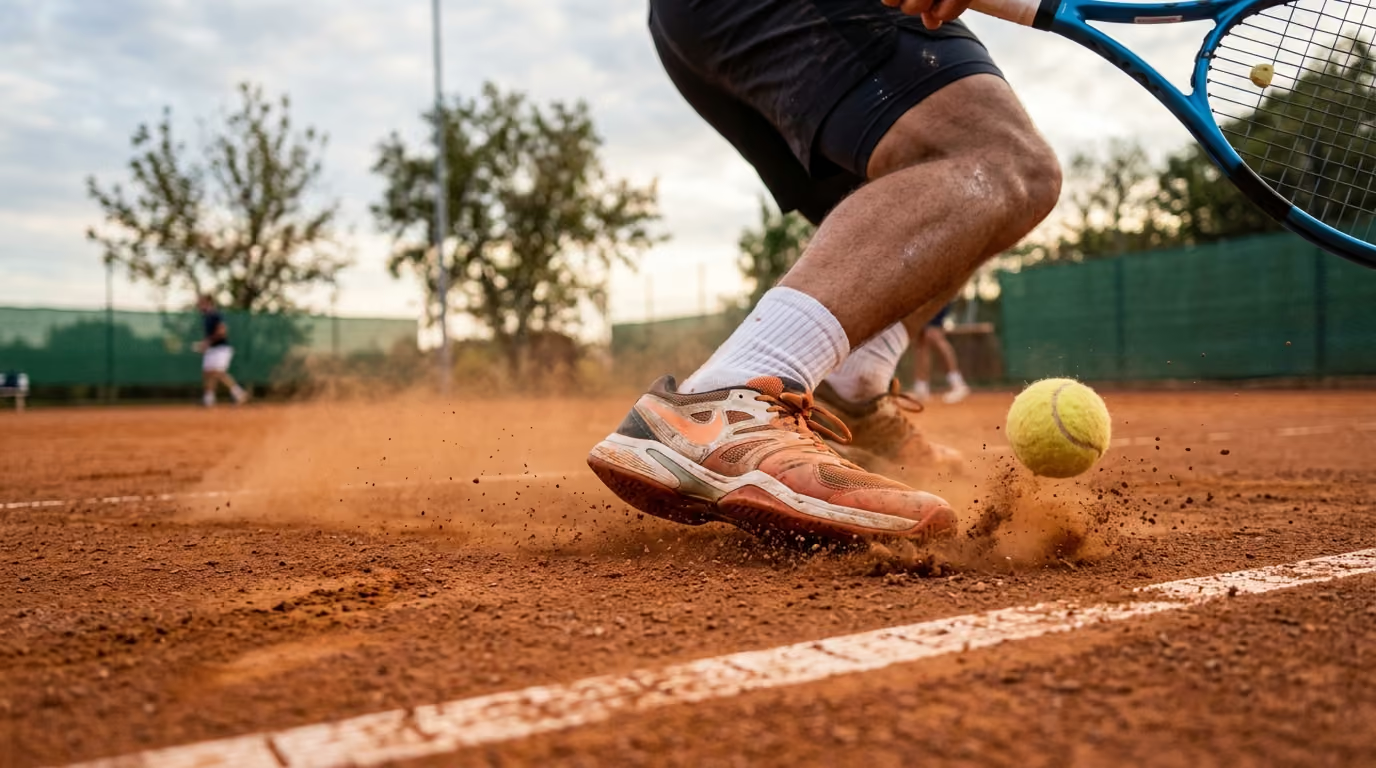
Sliding is not a passive consequence of playing on clay. It is an active movement skill that must be practiced. Sliding allows you to decelerate smoothly while reaching for a wide ball, saving valuable fractions of a second during recovery.
To slide safely, you must initiate the slide before you strike the ball. Keep your center of mass low and centered between your feet. Your trunk must remain stable and upright while your feet slide beneath you.
As you complete the slide and hit the ball, push off your outside foot to start your recovery run immediately. If you slide too late, you will strike the ball from an unstable position. This mistake reduces your shot control and increases the risk of groin or hip strain.
Never wear hard-court shoes on clay. The tread pattern on a hard-court shoe will quickly clog with loose clay particles, turning the sole into a slippery surface.
Clay-court shoes feature a full herringbone tread pattern. This deep, zig-zag groove design allows clay to enter the sole to provide grip, then releases the clay as the shoe flexes. This mechanism ensures predictable traction and controlled sliding. You can read more about appropriate footwear choices by looking at our guides on injury prevention strategies for court sports.
Natural grass and artificial turf surfaces sit at the fastest end of the ITF pace scale. These surfaces reward quick reactions, low preparation stances, and aggressive tactics.
Unlike clay, grass and artificial turf allow the ball to retain much of its forward velocity after the bounce. The grass blades compress under the ball, causing it to skid rather than rise. This creates a low, fast bounce that rarely rises above the waist.
This low profile requires you to adapt your preparation stance. You must play with a lower center of gravity, bending your knees deeply to get under the ball. Your backswing must be compact. There is simply not enough time for a long, looping wind-up when the ball skids off the turf.
Grass courts can be slick, especially when moisture is present. To maintain traction, you must use shorter, more frequent steps. Avoid overstriding, as this reduces your ability to change direction quickly and increases the risk of slipping.
Keep your weight on the balls of your feet. This posture allows for immediate lateral movement. When stopping, distribute your weight evenly across both feet rather than planting a single foot hard into the ground.
In sports like padel, artificial grass is the standard playing surface. According to the construction code from the Sports and Play Construction Association, or SAPCA, padel courts utilize sand-dressed or sand-filled artificial grass. The pile height of this turf typically ranges from 10 to 15 millimeters.
The silica sand infill is critical for two reasons. It helps the turf blades stand upright, and it provides a controlled amount of slide for the players. If the sand is distributed unevenly, you will experience sudden changes in traction. You might slide smoothly in one area but stick abruptly in another, which can cause significant stress on your knees.
Indoor courts offer an environment free from external weather variables. While this predictability is an advantage, it introduces specific lighting, spatial, and acoustic factors that alter how you play.
Without wind or sun to worry about, your tactical execution can be much more precise. The ball flies through the air with consistent resistance, making your depth control highly reliable. This stability allows you to play closer to the lines and use riskier targets.
However, the lack of environmental distraction means the pace of play often feels faster. Visual processing is quicker indoors because the background is stable. This allows you to read the ball early, but it also means your opponent can do the same.
Indoor facilities alter how you hear the ball. The sound of the ball striking the racket is louder and sharper indoors. Many players rely on sound to judge the speed and spin of an incoming shot.
If you are accustomed to playing outdoors, the indoor acoustics can initially distort your timing. It is common to feel rushed because the loud sound of your opponent's strike suggests the ball is traveling faster than it actually is.
Indoor air is often dry and climate-controlled, which can dry out the court surface. This dry environment can cause some indoor surfaces to feel more slippery or more grippy than their outdoor counterparts.
Furthermore, indoor courts do not experience the natural weathering that helps clean outdoor surfaces. Dust can accumulate quickly, reducing traction in high-traffic areas like the baseline. You must pay close attention to your footing during your warm-up to identify any slick spots.
Outdoor courts are dynamic environments. When you play outside, you must adapt to weather conditions that actively modify the physical properties of the court surface.
High temperatures affect both the ball and the court. On a hot day, the air inside a tennis, pickleball, or padel ball expands. This expansion makes the ball livelier, causing it to bounce higher and travel faster through the air.
At the same time, extreme heat can soften the binder materials used in acrylic hard courts. This softening can increase the friction underfoot, making the surface feel sticky. This sticky sensation raises the frictional demand on your lower joints during sudden stops, requiring extra focus on optimizing your movement patterns and court agility.
Moisture is a significant hazard on non-porous surfaces like acrylic hard courts or outdoor padel glass. Even a light mist can turn an acrylic court into a highly slippery surface.
Humidity also affects clay courts, but in a different way. High humidity prevents the clay from drying out, keeping the surface damp and heavy. A damp clay court slows the ball down even more than usual, resulting in a heavier ball that is difficult to hit with depth. You must adjust your strategy to hit with more spin and safety clearance over the net.
Wind forces you to abandon high-risk strategies. When playing in windy conditions, increase your targets away from the lines. Use the wind to your advantage by hitting high, looping balls when it is at your back, forcing your opponent to defend from deep positions.
Additionally, outdoor courts suffer from uneven wear due to sun exposure and rain runoff. The baseline area often loses its texture faster than the rest of the court. This localized wear means you may experience varying levels of grip as you move from the back of the court toward the net.
While the physical principles of surface interaction apply to all sports, the tactical execution differs significantly depending on whether you are playing tennis, pickleball, or padel.
Tennis players experience the widest variety of playing surfaces. The sport's physical demands are well-documented. A systematic review published in Sports Medicine analyzed the physical workloads of international-level tennis players.
The review reported that male players average 5.5 seconds per rally, running approximately 9.6 meters per point. Female players average 6.4 seconds per rally, covering 8.2 meters. The effective playing time sits around 18.6% for men and 20% for women.
On clay, these averages often shift toward longer rallies and greater distances covered. In contrast, grass tennis requires shorter, more explosive efforts. Your physical preparation must reflect these differences. Prepare for clay with high-volume aerobic training, and prepare for grass with short, high-intensity plyometric exercises.
Pickleball is played almost exclusively on acrylic hard courts, though indoor gym floors are also common. Because the pickleball is made of lightweight plastic with holes, it is highly sensitive to surface texture and wind.
On a standard outdoor hard court, the ball bounces predictably. However, if the court surface is worn, the ball will stay low, making it difficult to execute the soft dink shots that define high-level pickleball.
When playing indoors on a polished wood or synthetic gym floor, the ball skids significantly more. The plastic ball cannot grip the smooth floor, resulting in a fast, low bounce. To adapt, you must stay low in your stance and expect faster hand exchanges at the kitchen line.
Padel introduces a unique element: the interaction between the artificial turf, the glass walls, and the metal mesh fence. The game requires a deep understanding of how the ball behaves after hitting these different surfaces.
When the outdoor temperature rises, the glass walls expand slightly, and the ball becomes more pressurized. This combination causes the ball to bounce high off the glass, making it easier for players to hit aggressive overhead smashes.
On a damp day, the moisture on the glass causes the ball to slide downward upon impact. Instead of bouncing up, the ball drops rapidly toward the floor. In this scenario, you must shorten your defensive preparation and get your racket under the ball quickly as it leaves the glass.
Many recreational players struggle to adapt to different environments because they fall victim to common, preventable mistakes. Avoiding these errors is essential for maintaining your athletic longevity.
Assuming that every hard court or clay court is identical is a costly mistake. An old, worn clay court that has not been watered can play as fast as a medium hard court. Similarly, an acrylic hard court with a coarse paint texture can play incredibly slowly.
Always treat each court as a unique environment. Do not rely on past experiences with the same named surface. Take the time to assess the current state of the court you are playing on today.
Many players believe that more traction is always better. They seek out the grippiest shoes available, hoping to improve their acceleration. However, excessive traction can be dangerous.
If your shoe grips the surface too aggressively during a rapid change of direction, your foot can become stuck. This sudden stop forces your knees and ankles to twist, which can lead to ligament sprains or joint pain. The ideal shoe provides predictable traction that allows for a small, controlled amount of release at the end of a hard stop.
Players often warm up in the center of the court and assume the entire surface is uniform. This oversight can lead to unexpected slips during a match.
The areas around the baseline and the service lines receive the most foot traffic. As a result, the textured coating in these zones wears down much faster than the corners or the areas near the net. Always test the traction in multiple zones of the court during your warm-up.
Changing surfaces changes the mechanical stress placed on your body. If you do not adapt your recovery routine, you risk developing chronic overuse injuries.
Playing on acrylic hard courts exposes your lower body to repetitive, high-impact forces. This constant pounding can cause micro-trauma in your tendons and joint cartilage.
To support your recovery after a hard-court session, prioritize strategies that reduce inflammation and ease muscle tension. Use a foam roller on your calves and quadriceps to release tight muscle fibers. Consider using ice or cold-water immersion to soothe aching joints, and ensure you allow sufficient rest before your next high-impact session. You can explore more recovery techniques by reading our articles on evidence-based athletic recovery science.
Clay courts reduce joint impact, but they increase the metabolic demand on your muscles. The sliding movement and longer rallies require constant rotational power from your core and hips.
After playing on clay, focus on stretching your hip flexors, glutes, and lower back. Dynamic stretching and active recovery, such as light cycling, can help flush metabolic waste from your muscles. This approach prevents the deep muscle soreness that often follows long clay-court baseline battles.
The low bounce of grass and turf requires continuous knee flexion. Staying low in your stance places an exceptional workload on your patellar tendons and Achilles tendons.
To protect these tissues, prioritize eccentric strengthening exercises during your off-court training. Eccentric calf raises and single-leg squats help build tendon resilience. After playing, spend extra time stretching your calves and soleus muscles to maintain ankle mobility.
To ensure your body and equipment are prepared for a specific court, you should perform a structured evaluation before you begin playing. This simple process can save you from injury and improve your performance.
Perform this quick routine during the first ten minutes of your warm-up session to assess the court's characteristics.
Use the feedback from this audit to select your footwear and adjust your movement expectations for the match.
When playing on a new surface for the first time in several months, do not jump straight into a competitive match. Use a progressive training sequence to let your body adapt to the physical demands.
Start with low-speed hitting from the midcourt to find your timing. Gradually move back to the baseline, adding small lateral steps to reach the ball. Next, practice moderate deceleration, focusing on smooth foot plants.
Once you feel comfortable, introduce open-stance shots and recovery slides if you are on clay. Finish the session by playing a few practice points at match speed. This gradual ramp-up allows your muscles and tendons to adapt to the specific forces of the surface, supporting your long-term strength and conditioning goals.
While minor soreness is a normal part of athletic adaptation, you must learn to distinguish between general fatigue and signs of potential injury.
If you experience sharp, localized pain during or after a match, do not try to play through it. This is especially important when transitioning to a new surface.
Pay close attention to persistent pain in your Achilles tendon, knee joint, or lower back. If you notice swelling, joint instability, or pain that does not improve after forty-eight hours of rest, it is time to seek professional advice.
If you experience any of these symptoms, consult a qualified healthcare professional, such as a sports physiotherapist or an orthopedic specialist. They can provide an accurate diagnosis and design a targeted rehabilitation program.
An expert can also analyze your movement mechanics to identify any imbalances that may be contributing to your discomfort. Addressing these issues early is the best way to protect your body and ensure your athletic longevity on the court.
The court surface is never neutral. By understanding the physical forces at play and adapting your movement, tactics, and recovery accordingly, you can perform at your best while protecting your body for years of enjoyable play.
Follow Evercourts for practical insights on tennis, pickleball and padel performance, movement, recovery and healthy ageing. Stay connected for new articles, research-led guidance and ideas to help you play well and keep playing for years.


Read practical guidance for better movement, smarter preparation and a game that keeps working for you.
explore the Blog