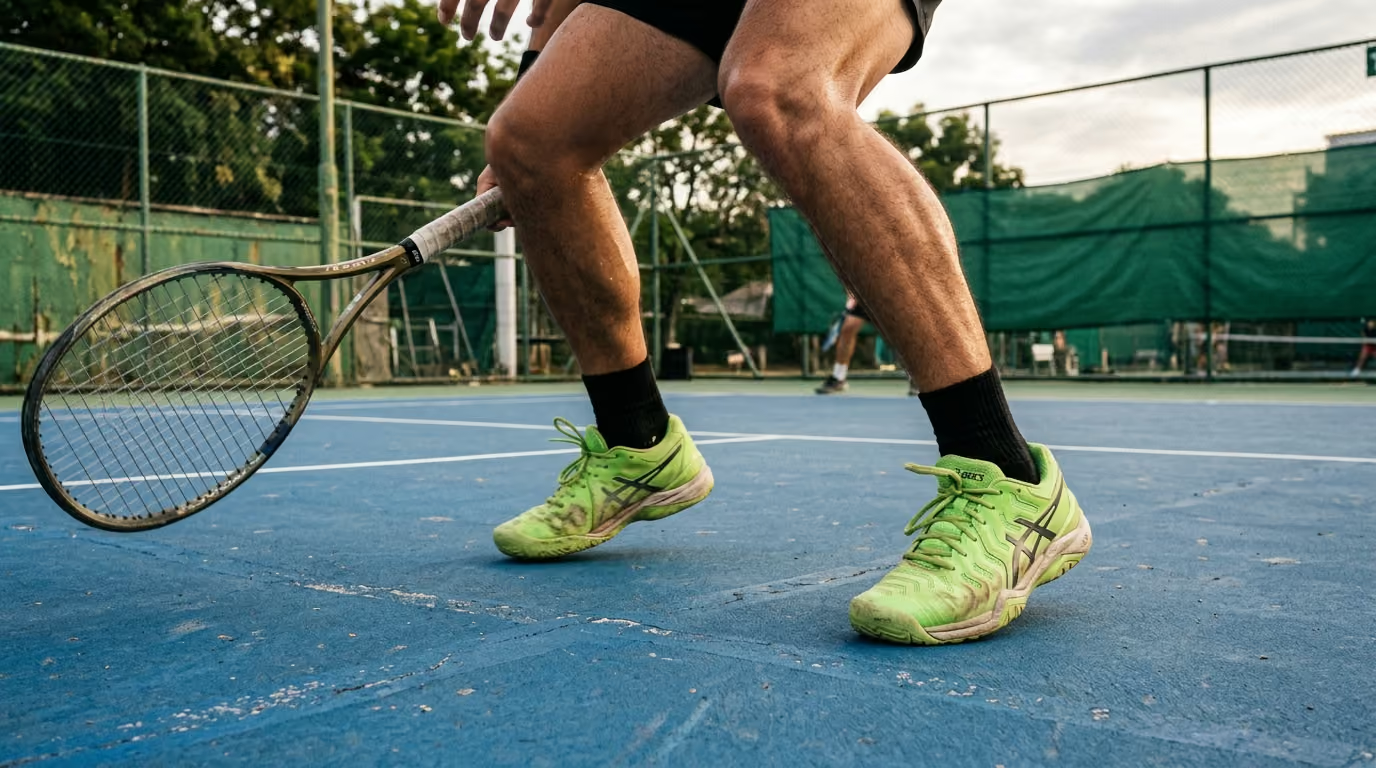
Five hours of sleep and residual physical fatigue significantly impair a tennis player's skill, timing, and decision-making on the court.




You step onto the court for a weekend match, feeling eager to play. Your first few groundstrokes fly deep, and your movement feels slightly slow. You try to adjust your swing, assuming your technique is failing you. Yet, the real culprit is not your wrist angle or your footwork preparation. It is the cumulative effect of a busy week, five hours of sleep, and residual physical fatigue.
Proper physical and cognitive recovery dictates your ability to hit targets, read opponents, and move efficiently on the court. When you play without sufficient rest, your reaction times slow down, your coordination falters, and your decision-making becomes rushed. Prioritizing rest allows you to maintain clean technique and sharp focus, ensuring your practice hours actually reinforce good movement habits.
Recovery is not a simple, single event. It is a complex process where different physical and mental systems return to baseline at different speeds. You might feel mentally alert while your muscles are still exhausted. Conversely, your body might feel fresh while your brain remains drained from a stressful week at work.
To understand how recovery affects your court play, we must look at it through a multidimensional lens. Each dimension plays a specific role in how you swing, move, and think during a match. When one system lags behind, your overall performance suffers.
Metabolic recovery involves replenishing your body energy stores. During intense rallies, your muscles rely heavily on glycogen and creatine phosphate. When these energy systems are depleted, your muscles cannot contract with the same speed or power. This depletion leaves you feeling heavy, slow, and unable to sustain long rallies.
Without proper metabolic recovery, your muscles fatigue much earlier in a match. You might start the first set with excellent energy, but find yourself struggling by the second. This drop in physical energy directly affects your ability to get into position for your shots.
Neuromuscular recovery refers to the communication between your brain and your muscles. Your nervous system must send rapid signals to coordinate complex movements like serves, overheads, and sudden direction changes. When neuromuscular fatigue is present, your rate of force development drops. You will notice a delayed first step and a decreased ability to decelerate safely.
Neuromuscular fatigue can persist even when you do not feel muscle soreness. This silent fatigue affects your timing and coordination. You might find yourself hitting the ball slightly late, leading to inconsistent contact points.
Perceptual recovery involves your visual attention and anticipation. Your brain must constantly process ball speed, spin, and opponent position. Cognitive recovery restores your working memory, decision-making, and focus. If you lack cognitive recovery, you will make poor tactical choices and misread the play.
A tired brain struggles to filter out distractions. You might lose track of the score or fail to notice your opponent positioning. This mental lag makes it difficult to execute any tactical plan effectively.
Technical recovery is the return of your stable stroke mechanics and timing. Psychological recovery refers to your motivation, mood, and perceived effort. When you are psychologically fatigued, every physical effort feels significantly harder than usual. This makes it difficult to maintain the mental discipline required for competitive matches.
Psychological fatigue often leads to frustration on the court. You might lose your temper over simple errors or give up on tough points early. This emotional drain can ruin your enjoyment of the game.
In our experience, players often confuse feeling energetic with being fully recovered. You might have the motivation to play, but your nervous system may still be recovering. This performance-readiness profile is always changing, and understanding it is key to athletic longevity.
Sleep is the cornerstone of athletic preparation and overall wellness. Current research shows a direct link between sleep quality and your ability to execute high-precision movements. When sleep is restricted, your motor control and spatial awareness are compromised.
According to the American College of Sports Medicine, sleep restriction impairs attention, motor learning, and reaction times. Even a single night of sleep deprivation can lead to measurable declines in athletic tasks. For example, research on precision tasks like dart throwing showed significant accuracy drops after just one night of limited sleep. While dart throwing is not a court sport, it demonstrates how fine motor control degrades under fatigue.
On the court, a fraction of a second determines whether you hit a clean winner or a late error. Sleep debt directly slows your cognitive processing speed. This delay means you detect the ball later, take longer to plan your response, and initiate your movement slowly.
Our team has observed this pattern in our own play. I used to think a tough conditioning block was the only way to improve my court endurance. Then I started tracking my sleep. I noticed that on days I slept less than six hours, my reaction time at the net was noticeably sluggish, and I felt gassed by the second set. Prioritizing consistent rest did more for my late match stamina than any extra sprints ever did. Recovery is the true foundation of performance.
For comprehensive guidelines on sleep hygiene and recovery protocols, you can read our recovery science resources.
In addition to slowing your reactions, chronic sleep loss may elevate your risk of physical setbacks. Some sports medicine studies show that sleeping seven hours or less per night for two weeks is associated with a higher rate of musculoskeletal injuries. The theory is that fatigued tissues are less resilient, and slow reaction times lead to clumsy movements.
However, the scientific evidence on adult athletes is not entirely one-sided. A systematic review published in 2021 analyzed twelve cohort studies. It concluded that there is limited evidence directly linking poor sleep to adult injuries as an independent risk factor. This means we cannot say sleep loss guarantees an injury, but it certainly reduces your physical margin for error.
Chronic sleep loss also affects how your body adapts to training. If you are not sleeping enough, your muscles and tendons cannot repair properly. This slow rate of tissue repair can lead to chronic soreness and stiffness over time.
It is vital to distinguish between physical exhaustion and mental fatigue. Physical fatigue stems from muscular work, while mental fatigue comes from prolonged cognitive strain. Both types of fatigue degrade your performance, but they do so in different ways.
A 2026 meta-analysis on mental fatigue in athletes provides valuable insights. The researchers found that mental fatigue was strongly associated with poorer sport-specific reaction times, technical execution, and decision-making. The negative impact on decision-making was particularly consistent across the studies analyzed.
Racket sports require continuous scanning and tactical adjustment. You must read your opponent body language, track the ball flight, and select the correct target. When you are mentally fatigued, your visual search patterns change. You look at the wrong cues, miss open lanes, and make hasty decisions.
Research in basketball supports this cognitive breakdown. Mentally fatigued players tend to use a "take-the-first" heuristic. This means they settle for the first available option, even if it is a low-percentage shot. On a tennis, pickleball, or padel court, this leads to premature attacking shots or predictable ball placement.
Physical fatigue also has a massive impact on stroke accuracy. A study on tennis performance analyzed groundstroke hitting accuracy under intermittent fatigue protocols. The researchers found that groundstroke accuracy decreased by 69% by the end of the high-intensity session.
Interestingly, service accuracy to the right court declined by 30%. This shows that physical exhaustion dramatically degrades your ability to hit targets. However, your ability to generate power often remains unchanged, which creates a deceptive performance profile.
Understanding these differences helps you identify why your game is breaking down. If you are missing targets but still swinging hard, you are likely experiencing physical fatigue. If you are making poor tactical choices, mental fatigue is the probable culprit.
One of the most dangerous aspects of fatigue is that it can mask your actual physical decline. You might feel like you are hitting the ball just as hard as you did in the first game. In reality, your body is using inefficient mechanics to maintain that power, sacrificing your precision in the process.
Research on professional tennis players confirms this phenomenon. Across multiple high-intensity protocols, players showed very small declines in serve velocity, ranging from 0.4% to 2.8%. However, their serve accuracy declined by 25% to 41% during the same trials.
When your primary moving muscles fatigue, your nervous system recruits secondary muscles to complete the swing. For example, if your legs are tired, you must stop bending your knees on your serve. To make up for the loss of upward drive, you must whip your shoulder or wrist harder.
This compensation allows you to maintain ball speed, but it ruins your consistency. Your contact point shifts, your balance wavers, and your ball placement becomes erratic. Over time, these compensatory movements increase the stress on your joints, leading to overuse issues.
Compensatory mechanics are difficult to detect on your own. You might feel like your stroke is normal, but a camera would show major changes in your posture. These changes are your body way of surviving the physical workload at the expense of your technique.
If you continue to practice in this state, you are not improving your skill. Instead, you are teaching your brain to use compromised mechanics. This is why a well-recovered, shorter practice session is always more valuable than a high-volume workout performed in a state of exhaustion.
To build the physical foundation needed to resist these mechanical breakdowns, explore our strength and conditioning resources.
Racket sports are defined by rapid bursts of acceleration, sharp braking, and quick changes of direction. Your footwork is the bridge between your physical fitness and your technical execution. When you are tired, this bridge begins to crumble.
A study examining change of direction mechanics found that acute fatigue significantly reduces braking-phase impulse. It also alters the very first step an athlete takes after redirecting. In simple terms, fatigued players struggle to slow down efficiently.
Safe and efficient movement requires excellent deceleration. When you run toward a ball, you must absorb force through your hips, knees, and ankles to stop your momentum. This controlled braking sets up a stable platform for your swing.
If your braking ability is compromised, you will run past the ball or slide out of position. You will find yourself reaching for shots rather than hitting them from a balanced stance. This off-balance hitting is a primary cause of unforced errors across all court sports.
Poor braking also increases the time it takes to return to the center of the court. When you are late recovering, your opponent has an open target. This puts you under constant defensive pressure throughout the rally.
Fatigue also alters lower-limb mechanics during sharp cutting actions. Research on athletes performing repeated directional changes showed a shift in muscle activation and joint loading under fatigue. Instead of using their glutes and quadriceps to absorb force, fatigued players often upright their posture.
This upright stance increases the shear stress on the knees and ankles. It also slows down your transition back to the center of the court. When you cannot recover your position quickly, you leave the court open for your opponent.
Improving your movement quality under pressure is essential for long-term health. For more on this, check out our mobility and movement resources.
While all racket sports share a reliance on recovery, the specific physical and mental demands vary by sport. Understanding these differences helps you tailor your recovery and training strategies to your preferred game.
Tennis involves a large court, long sprint distances, and high-intensity deceleration. Points can last anywhere from a few seconds to over twenty shots, requiring exceptional cardiovascular and neuromuscular endurance.
Under fatigue, tennis players see massive declines in groundstroke and service accuracy. Because the court is large, even a tiny deviation in racket face angle at contact can cause the ball to land several feet out. Recovery in tennis must focus on restoring total-body power and lower-limb stiffness to handle the heavy braking demands. For tailored advice on tennis physical preparation, view our tennis articles.
Pickleball is played on a much smaller court, which dramatically reduces the total running distance. However, it requires exceptionally fast hand-eye coordination and rapid reflex volleys at the kitchen line.
In pickleball, mental fatigue and sleep loss are particularly damaging. A slow reaction time of just a few milliseconds can prevent you from defending a fast speed-up shot. Furthermore, pickleball requires immense patience during long dink rallies. When you are tired, you lose this cognitive control, leading you to attack balls that are too low, resulting in errors. Read more about managing these unique court demands in our pickleball articles.
Padel is played in an enclosed glass cage, combining high-speed racket work with complex spatial awareness. Players must calculate ball rebounds off the glass walls while adjusting their positioning on the fly.
This constant calculation requires peak visual attention and cognitive freshness. When padel players are fatigued, their ability to read the ball spin off the wall deteriorates. They often find themselves too close to the glass or mistiming their overhead adjustments. To optimize your performance in this fast-growing sport, visit our padel articles.
To apply this science to your weekly routine, you need practical frameworks. These tools will help you assess your readiness, structure your practices, and make smart decisions on the court.
Every time you plan a practice session, you should ask yourself two simple questions. First, how much work do you want to complete? Second, how well do you need to perform that work?
If your goal is conditioning, high-volume, fatigued repetitions are acceptable. However, if you are trying to learn a new technique or refine your accuracy, you must be fully recovered. Practicing complex skills while exhausted only reinforces faulty movement patterns and slow reactions.
We can divide your performance-readiness into three simple zones. This coaching model helps you decide when to push forward and when to stop.
When you make an error on court, do not immediately assume your technique is broken. Instead, use this diagnostic sequence to find the first process that failed.
By tracking the root cause of your errors, you will often find that "technical" mistakes are actually movement or decision failures caused by fatigue.
Many recreational and competitive players make consistent mistakes when managing their recovery. Avoiding these pitfalls will protect your athletic longevity and help you get the most out of your training.
The most common mistake is assuming you are recovered because your muscles are no longer sore. Muscle soreness is merely one sensory signal from your body.
Your central nervous system, cognitive processing speed, and joint stiffness can remain compromised long after soreness fades. If you schedule a high-intensity session based only on how your muscles feel, you may experience slow reaction times and poor timing on court.
Another error is tracking only total play time or distance covered on court. These general metrics do not capture the actual wear and tear of a session.
A slow, doubles practice and an intense singles match can cover the same total distance. However, the singles match involves far more explosive accelerations, hard decelerations, and high-velocity swings. It is these high-intensity efforts that drive neuromuscular fatigue, requiring much longer recovery times.
For further reading on how to balance your training loads and avoid overuse injuries, take a look at our injury prevention resources.
Allowing adequate recovery between matches is not just about playing better next weekend. It is a critical component of healthy aging and maintaining your physical capabilities for decades.
When you play through chronic fatigue, your movement strategies change. As we discussed, fatigued players tend to land heavier, brake later, and upright their posture during cuts. This shift in mechanics changes how forces are distributed throughout your musculoskeletal system.
Your tendons, ligaments, and joints rely on coordinated muscle contraction to absorb impact forces. When your muscles are tired and slow to react, they cannot protect these passive structures effectively.
Instead of the force being absorbed by your large muscle groups, it is transferred directly to your knee joints, Achilles tendons, and lower back. Over time, this repetitive stress can lead to chronic tendinopathies, joint irritation, and early wear. Prioritizing rest allows these tissues to repair and adapt, ensuring they remain strong and resilient.
To discover more about maintaining your physical durability as you age, read our healthy aging and athletic longevity resources.
While general fatigue and mild muscle soreness are normal parts of training, certain signs indicate a need for professional guidance. It is important to know when to step back and consult a qualified healthcare provider.
If you experience persistent joint pain that does not improve after forty-eight hours of rest, you should seek professional advice. Localized swelling, clicking sounds accompanied by pain, or a feeling of joint instability are also clear warning signs. These symptoms suggest structural irritation rather than simple muscle fatigue.
Systemic signs can also indicate a deeper issue. If you suffer from chronic sleep disturbances, unexplained physical exhaustion, or persistent morning joint stiffness, consult a medical professional. A sports physiotherapist or sports medicine physician can help you identify underlying movement dysfunctions or recovery deficits, helping you return to the court safely.
You should return to this guide whenever you feel your game has hit a plateau, or when you notice a sudden rise in unforced errors during late-match play. It is also highly useful to review these frameworks at the start of a new competitive season or when adjusting your weekly training volume.
Understanding the deep relationship between rest and court performance ensures you can enjoy your favorite sport with clarity and confidence.
Follow Evercourts for practical insights on tennis, pickleball and padel performance, movement, recovery and healthy ageing. Stay connected for new articles, research-led guidance and ideas to help you play well and keep playing for years.


Read practical guidance for better movement, smarter preparation and a game that keeps working for you.
explore the Blog