
A player’s review framework helps analyze racquet sports matches by objectively describing events before explaining or judging them.




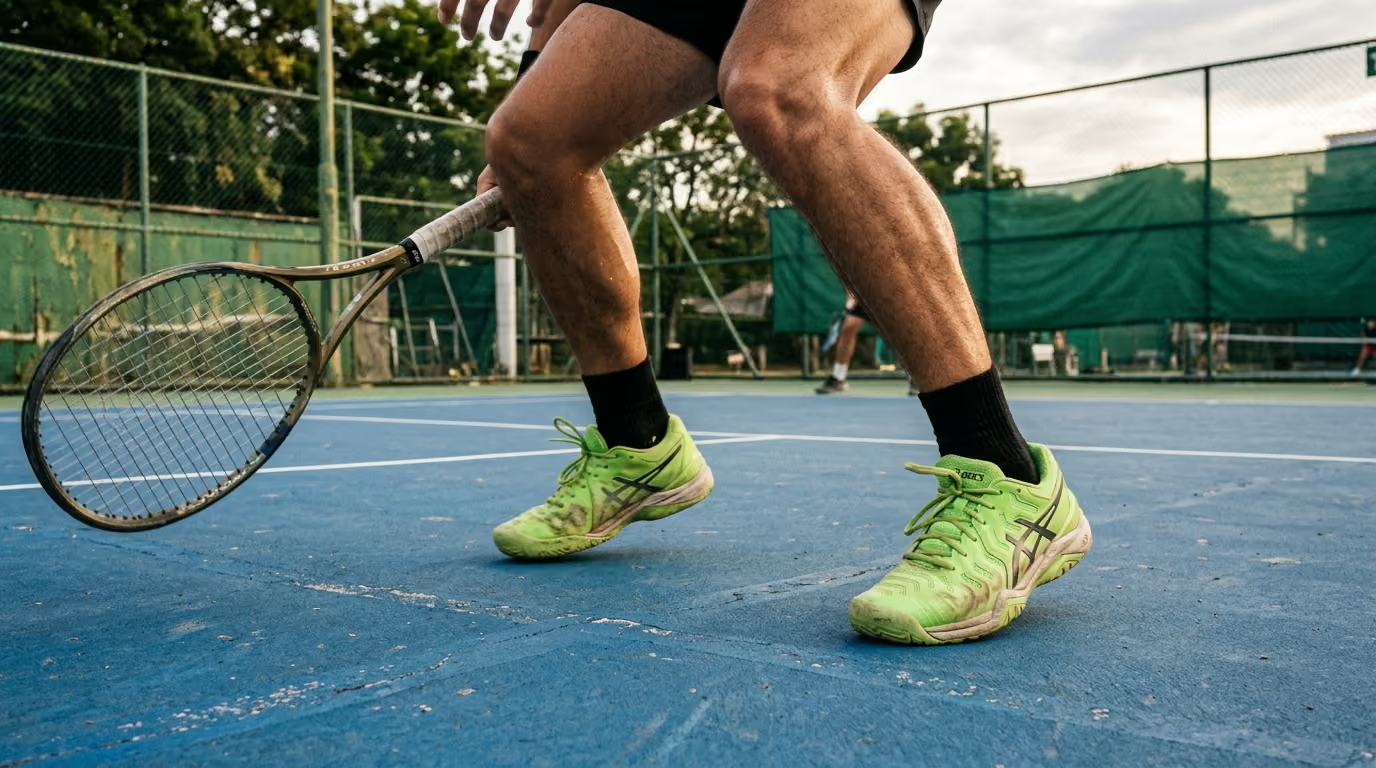
You walk off the court after a hard-fought match. Your shoes are covered in clay, court dust, or blue court paint. You feel a heavy mix of physical exhaustion and mental frustration. Your immediate instinct is to blame your backhand, your serve, or perhaps your general lack of focus. You tell yourself you played terribly, but you do not actually know why the match slipped away. This is the classic post-match trap that many adult racquet sports players fall into.
To analyze a racquet sports match effectively, a player must describe the events objectively before trying to explain or judge them. By separating the score progression, tactical patterns, movement quality, and emotional reactions, you can identify repeatable trends. This structured approach allows you to convert subjective frustrations into specific, actionable training goals for your next practice session.
By using objective methods, you can protect your peace of mind and improve your athletic longevity. This comprehensive guide provides a practical framework to break down your performances. You can use this system whether you play singles tennis, competitive pickleball, or fast-paced padel. It is built to turn your post-match reflections into a powerful tool for steady development. You can find more structured tools in our library of court sports training resources.
Modern sports science has shifted away from simple intuition. Researchers now use systematic tracking to understand what actually decides matches. Performance analysis is widely used in competitive tennis to evaluate tactics, technique, and movement. It also provides valuable educational feedback for players and coaches.
According to sports science literature, match analysis can cover serve and return performance, rally length, and stroke selection. It also includes winners and errors, timing, distance covered, court position, and point profiles. The same fundamental logic applies to pickleball and padel, although court sizes and scoring systems change the physiological demands.
Research shows that different match formats place unique demands on your body. For example, a study of collegiate tennis players published in the Journal of Strength and Conditioning Research compared singles and doubles play. The researchers found that singles matches produced higher mean and peak heart rates. Singles players also showed greater movement parameters, except for average speed. This means you cannot analyze your physical performance in doubles using the same standards as singles.
Surface dynamics also play a major role in your statistics. Research on Grand Slam tennis tournaments shows that the indicators distinguishing winners from losers vary depending on the court surface. An analysis of matches at the US Open and the French Open revealed that surface speed alters successful match strategies.
On clay, rally lengths are longer, which demands greater patience and physical endurance. On hard courts, the first strike of the ball has a much larger influence on the outcome. Therefore, you must always look at your match statistics through the lens of your playing environment.
The science of self-analysis also involves how you reflect on your performance. A study on elite sports training reported that structured post-event reflection provides tailored insights. These insights complement objective, numbers-based feedback.
Combining your personal feelings with hard data is more effective than relying on statistics alone. This prevents you from reducing a complex match to a few visible mistakes. It also helps you understand how physical fatigue and mental stress interact on the court.
The final score of a match is too compressed to tell the real story. Losing a tennis match six-four, six-four does not mean you were outplayed in every game. To understand what happened, you must break the match into distinct phases. Reconstructing the score helps you identify where the momentum shifted and how you handled pressure.
To build a basic score map, divide your match into six distinct phases. The first phase is the opening sequence, which includes the first few games or points. Next, identify the first major lead or deficit that occurred. After that, look for the first major momentum shift where the score began to change direction.
The remaining phases of your score map focus on high-pressure moments. Note the specific pressure games or points, such as trying to break serve or facing game points. Reconstruct the end of each set or game, and analyze the final closing sequence of the match. For badminton, squash, or pickleball, you can track runs of consecutive points. You should also evaluate points played immediately after interval breaks.
By mapping these phases, you can view the match as a sequence of score-state problems. Different score states require different psychological and tactical approaches. A player might perform exceptionally well when the score is neutral but struggle when protecting a lead.
To make your score map more practical, you can tag points using six score-state categories.
The first category is Neutral, where neither player has a clear, immediate advantage. The second is Opportunity, which includes break points, game points, or match points. The third is Protection, which occurs when you are attempting to defend a lead.
The final three categories help you analyze pressure and momentum. Recovery points are those played when you are trying to stop a consecutive run of lost points. Closing points occur when you are near the very end of a game, set, or match. Deciding points are high-leverage situations, such as a tiebreak or a sudden-death point.
Once you have categorized these moments, ask yourself a few questions. Did your shot selection change during opportunity or protection states? Did your serve or return targets become more conservative? Did your physical movement quality deteriorate during deciding points?
The goal of this analysis is not to blame yourself for feeling pressure. The goal is to see if your actual behavior on the court changed when the stakes were high.
A statistic is only valuable when it helps you answer a specific tactical or training question. Tracking too many numbers can create the illusion of progress while hiding the real issues. A practical dashboard should combine volume, execution quality, match context, and the eventual consequence of the play. To refine your tactical approach, explore our dedicated court performance strategies.
Your dashboard should divide data into four main areas. The first area is the serve, which is your primary opportunity to start the point with an advantage. The second area is the return, which is your first chance to neutralize your opponent. The third is the rally profile, and the fourth is your net-play or transition success.
When analyzing your serve, do not look at your first-serve percentage in isolation. Instead, track how many first-serve points you actually won. Note how many double faults you committed, and look at the outcome of your first shot after the serve.
Ask yourself which serve direction produced the most playable advantages. A modest first-serve percentage that sets up an easy forehand is often better than a high percentage of passive serves.
For your return statistics, distinguish between simply putting the ball in play and starting the rally successfully. A return that lands in but allows your opponent to attack immediately is statistically successful but tactically poor. Track your return depth, your direction, and your success rate against first versus second serves. Note whether you attempted to neutralize the ball or go on the attack right away.
Your rally profile should track how long the exchanges lasted and where the errors occurred. Research indicates that rally length, stroke selection, and positional play are vital performance indicators. To make your rally analysis useful, avoid grouping all errors together. Instead, classify your errors into six distinct categories:
By categorizing your errors this way, you can target your practices more effectively. If most of your misses are movement errors, technical drills will not solve the issue. You will need to focus on footwork, anticipation, and early racquet preparation.
In racquet sports, a single shot has very little meaning outside of its sequence. Instead of evaluating your backhand as an isolated stroke, you must review your patterns of play. A pattern is a repeatable sequence of shots designed to create a specific advantage.
To analyze your patterns, you can use a simple, table-free worksheet structure. For each recurring exchange, write down the starting situation. Next, record your intended response and what actually happened on the court. Finally, note your opponent's reply, the overall outcome of the rally, the suspected cause of the result, and your next training action.
For example, a common pattern in tennis starts with a wide serve. Your intended response is a deep cross-court return to neutralize the point. If you hit a short return down the line instead, your opponent can easily attack your open court. By documenting this sequence, you might find that late preparation under wide serves is your real weakness.
You should evaluate every tactical choice using four specific dimensions. First, consider the intention. What were you trying to achieve with that specific shot? Second, examine the execution. Was the ball hit with the correct height, depth, and spin?
The third dimension is the opponent's response. Did your shot make them uncomfortable, or did they reply with an unexpectedly effective stroke? Fourth, look at the net result. Did your tactical choice improve your probability of winning the point? This helps you separate a good decision that missed from a poor decision that happened to land in.
Rate your tactical patterns on a simple scale from A to E. An A rating means the pattern was highly effective and repeatable. A B rating means the pattern worked but was inconsistent. A C rating means the pattern was neutral.
A D rating represents a pattern that was repeatedly exposed and became a liability. Finally, use an E rating for tactics that were not tested sufficiently during the match. This prevents you from abandoning a good strategy after only one unsuccessful attempt.
Physical movement on the court should be analyzed as a performance variable, not just a matter of fitness. A technical breakdown is often a movement breakdown in disguise. If you cannot arrive at the ball early, you cannot execute your strokes with consistency.
Research on tennis movement shows that elite players cover significant distances during matches. International male players cover roughly 9.6 meters per point, while female players cover about 8.2 meters. Total match distances can range from 1.0 to 3.4 kilometers.
Crucially, roughly 80 to 90 percent of this distance consists of lower-speed movements, rapid accelerations, and sudden decelerations. This means racquet-sport fatigue is not about continuous running. It is about your body's ability to stop, change direction, and recover balance hundreds of times.
To evaluate your movement quality during a match, look for signs of late preparation. Tag your physical errors using specific movement categories. These include a late first step, poor split-step timing, inefficient crossover steps, and inadequate recovery back to the base position.
You should also look for poor braking, improper spacing from the ball, and a loss of posture due to fatigue. If you find yourself reaching for the ball rather than moving your feet, your positioning is the primary issue.
Compare your movement in different match contexts to find the root cause of your errors. Note whether your technique breaks down only when you are stretched wide or late. Compare your footwork during the fresh opening games with your movement during the fatigued final games.
If your strokes remain consistent when you are balanced but fail when you are late, stop trying to rebuild your swing. Instead, design your practice sessions to improve your split-step timing and lateral movement.
Your mental state on the court is not an abstract personality trait. It is a set of behaviors that directly affect your physical execution. To analyze your mental game objectively, avoid vague statements like "I got too nervous." Instead, use a structured model to break down emotional events.
The Event-Response-Consequence model helps you analyze high-stress moments logically. First, identify the specific event, such as missing an easy overhead. Second, record your interpretation of that event. What did you tell yourself immediately after the miss?
Third, note the emotion or physical arousal you felt, such as embarrassment, anger, or a racing heart. Fourth, identify where your attention went. Were you focusing on the previous error, or were you planning the next point?
Finally, document the behavior change and its consequence. Did you rush your next serve, leading to a double fault? How many points did it take before you returned to your normal routine?
This model helps you view emotional regulation as a trainable performance skill. You do not need to eliminate natural feelings of frustration or anxiety.
The more valuable target is reducing your recovery time. A player who recovers their focus in ten seconds will perform better than a player who broods for three games.
Sports psychology research provides useful insights into how you talk to yourself on the court. A scoping review of self-talk studies distinguished organic, spontaneous self-talk from strategic self-talk.
The researchers found a consistent relationship between the emotional tone of your spontaneous thoughts and your physical performance. Strategic self-talk interventions can support motivation, confidence, and cognitive control on the court.
The practical lesson is to pay attention to the type of self-talk you use. Note whether your inner dialogue is instructional, motivational, evaluative, or distracting.
Instructional cues like "bounce-hit" or "keep your head down" are highly effective for fine-skill tasks. Motivational cues are often better for high-effort movements. If your self-talk is purely evaluative, such as calling yourself "idiotic," it will likely hurt your performance.
While the general analysis framework applies to all court sports, the specific details differ by discipline. Tennis, pickleball, and padel have unique court dimensions, equipment, and tactical structures. You must adapt your review to match these sport-specific demands.
In tennis, the court is large, the ball bounces high, and the physical space you must cover is extensive. Your analysis should focus heavily on court positioning and rally depth. Because of the court size, the battle between offense and defense is highly pronounced.
Key indicators to track include your baseline recovery position and your success in neutral rallies. You should also analyze your transition from the baseline to the net.
Pay close attention to your second-serve performance and how often you get pulled wide. In tennis, a single deep shot can completely change the defensive dynamic of a point.
Pickleball is played on a much smaller court with a non-volley zone, commonly known as the kitchen. This layout shifts the tactical focus to short-game patience and quick hand-eye coordination.
The physical demands involve short, explosive lateral bursts rather than long sprints. If you want to dive deeper into these safety and movement principles, review our guide on athletic longevity and safety.
Your pickleball match review must prioritize three specific areas. First, evaluate the depth of your return of serve. A shallow return allows the serving team to move to the kitchen line too easily.
Second, analyze the success of your third-shot drop versus your third-shot drive. Third, track your patience during dink rallies. Note whether you missed because of poor technique or because you attacked a ball that was too low.
Padel is almost always played as a doubles game within an enclosed glass and mesh cage. The presence of the walls means points are rarely ended by raw power alone.
Instead, padel is a game of physical chess, where you must use the glass to reset the point. The physical demands involve constant low-squatting movements and overhead actions.
When analyzing a padel match, focus on your team's control of the net. Track how often you lost the net position and how effectively you used the lob to regain it.
Analyze your positioning when defending off the back glass. You should also evaluate your communication with your partner, particularly on balls down the middle of the court.
Most recreational players make predictable errors when they try to review their own matches. These mistakes can lead to useless training plans and increased frustration. By recognizing these traps, you can keep your analysis objective and constructive.
A major pitfall is treating the final score as the complete explanation for how you played. A score tells you who won, but it never tells you why.
You can play excellent tactical points and still lose to an opponent who performed slightly better on key points. Conversely, winning a match does not prove that your shot selection was intelligent. Always separate the quality of your decisions from the final result.
Another frequent error is counting your winners and unforced errors without any context. Many players look at a high unforced error count and assume they had a terrible day.
However, those errors might have occurred because your opponent was hitting exceptionally deep, heavy balls. In that case, the misses were actually forced errors. If you do not look at what happened before the mistake, you will solve the wrong problem in practice.
Many players also fall into the trap of using video analysis solely to find faults. Watching only your mistakes creates confirmation bias and damages your confidence.
To prevent this, balance your review by watching successful points as well. Analyze what you did right when you won a clean service game or executed a perfect transition. Understanding your strengths is just as important as identifying your weaknesses.
Finally, avoid the mistake of creating a massive list of corrections after a loss. Trying to fix five different technical and tactical issues at once is overwhelming.
It leads to mental fatigue and poor focus during your next match. Instead, select one primary change, one supporting change, and one positive habit to preserve. Keep your training focus narrow and manageable.
A complete match review must look at your physical state before, during, and after the game. Monitoring your training load is essential to prevent injury and support healthy aging. The International Olympic Committee consensus on athlete load recommends frequent monitoring of well-being, pain, and functional limitations. To understand the recovery processes that keep you on the court, explore the science of sports recovery.
Keep a consistent record of your physical state within a few hours of completing a match. Rate your session perceived exertion on a scale from one to ten.
Document the total match duration and note any local muscle soreness or joint pain. You should also record your sleep quality from the night before, your hydration levels, and any unusual fatigue.
This practice is highly valuable for older athletes who want to maintain their physical capabilities. By tracking these variables, you can detect recurring relationships between your workload and your performance.
For example, you might notice that your movement quality declines significantly in the second set of matches when you sleep less than seven hours. You might also find that shoulder stiffness after serving is linked to a lack of proper warm-up.
A systematic review of junior and competitive tennis found that playing multiple matches per day can negatively affect physical performance. It reduces your vertical jump height, sprint times, and change-of-direction speed.
It is also associated with increased muscle soreness, joint pain, psychological stress, and compromised movement. If you do not monitor these physical signals, you risk overtraining or developing chronic injuries.
Your recovery observations should always remain descriptive rather than diagnostic. Do not assume that a sore elbow means you have chronic tendonitis.
Instead, record the sensation objectively and note when it occurs. If the discomfort persists across multiple matches or interferes with daily life, seek professional medical advice.
While self-monitoring is a great tool for court sports performance, it is not a substitute for qualified medical care. You must know when to stop analyzing your movement and consult a professional. Recreational players often try to play through discomfort, which can turn minor strains into long-term issues.
Consult a physiotherapist or sports medicine physician if you experience any clear warning signs. These include persistent pain that does not improve after seventy-two hours of rest.
You should also seek help for joint swelling, sharp pain during specific movements, or a sudden reduction in your range of motion. If you feel numbness, tingling, or weakness in your limbs, stop playing immediately.
Playing through pain forces your body to compensate by altering your movement patterns. This compensation can lead to secondary injuries in other joints.
A qualified professional can identify the root cause of your physical limitations. They can help you design a safe rehabilitation program so you can continue playing for years to come.
To make this framework highly practical, use this four-phase protocol after your competitive matches. It is designed to take you from initial emotional reactions to a concrete practice plan.
Complete this brief step within two hours of leaving the court. Write down a simple, neutral description of the match.
Identify three things you did well and three areas that caused difficulty. Note where the score shifted, and record any unusual physical sensations or joint soreness. Do not make major technical changes while you are still tired or frustrated.
Within forty-eight hours, reconstruct the match details using your score map and statistics. Group your points into the score-state categories of neutral, opportunity, protection, recovery, closing, and deciding.
Classify your errors by their cause rather than just their stroke type. Identify your most common serving and returning patterns, and rate their effectiveness.
Analyze your data to find the single most important pattern that affected the outcome. Do not focus on a spectacular but rare shot.
Instead, look for a trend that occurred repeatedly throughout the match. You can calculate a simple priority score by multiplying how often a pattern occurred by its overall consequence on the score.
Convert your priority pattern into one specific action for your next practice session. Your action must fall into one of four categories: technical, tactical, physical, or psychological.
Define a clear trigger, your desired response, a specific practice drill, and a success measure. For example, if you struggled with wide serves, design a drill where you practice hitting ten returns past the service line.
You can copy and use this simple template after your matches to keep your self-analysis consistent and productive.
You should return to this match-review framework whenever you feel stuck in a performance plateau or find yourself repeating the same mistakes on the court. It is also useful to review these steps at the start of a new competitive season or when transitioning to a different court surface.
Analyzing your matches with structured, objective metrics is the most reliable way to improve your skills. By focusing on repeatable patterns rather than raw outcomes, you can build athletic longevity and keep enjoying your sport for years to come.
Follow Evercourts for practical insights on tennis, pickleball and padel performance, movement, recovery and healthy ageing. Stay connected for new articles, research-led guidance and ideas to help you play well and keep playing for years.


Read practical guidance for better movement, smarter preparation and a game that keeps working for you.
explore the Blog