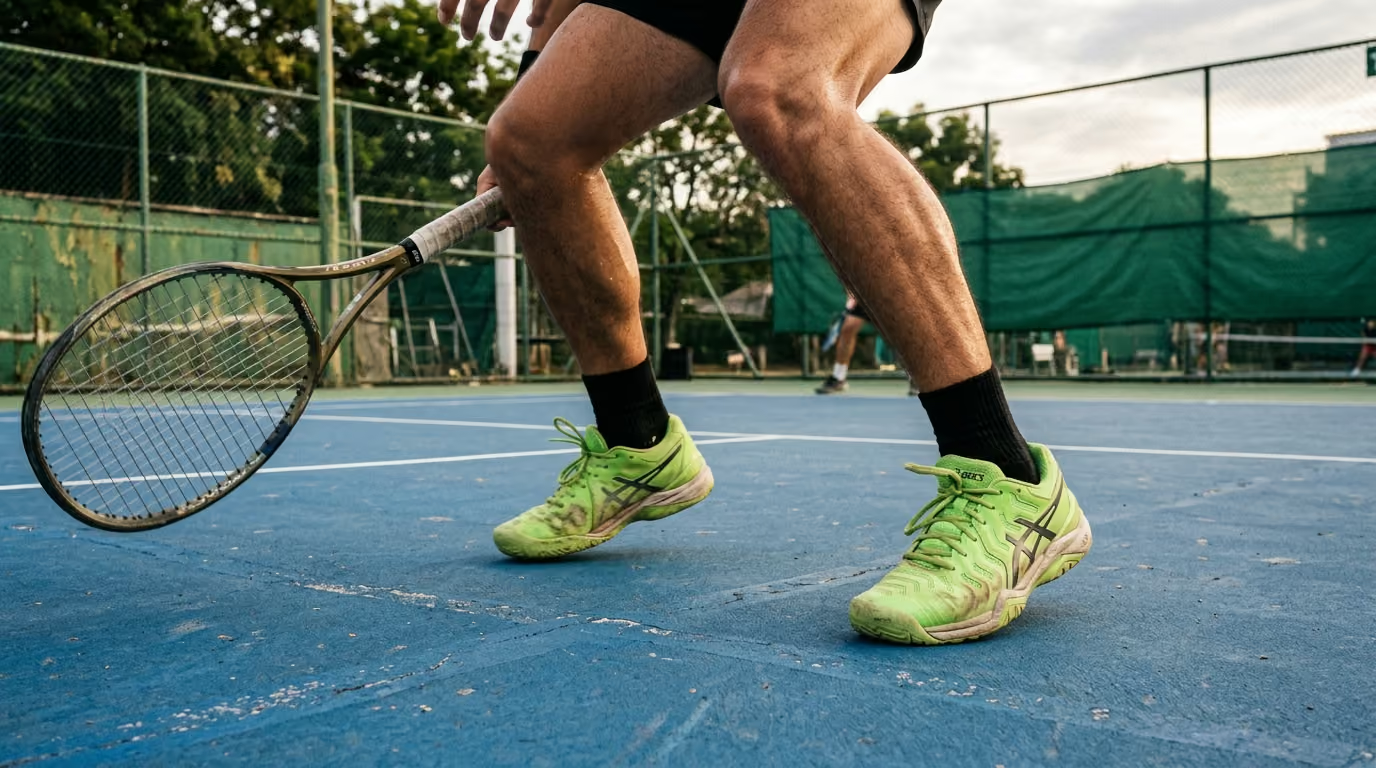
A 16 percent reduction in all-cause mortality is associated with playing racquet sports for 7.5 to 15 metabolic-equivalent hours per week.




Amateur sports culture often pressures players to train with the intensity of professional athletes. We are told to buy the exact equipment, copy the six-day training schedules, and maintain high intensity year-round. For the working adult, this all-or-nothing mindset is a recipe for physical breakdown and scheduling crises.
A truly sustainable competitive program requires a completely different approach. We must build a system around your actual resources, which change from week to week. Designing a program built around healthy aging and athletic longevity ensures you can play at your highest level without letting your sport become another stressful chore.
To balance competitive racquet sports with a busy life, you must manage your total physical and mental load rather than focusing only on court time. This is accomplished by establishing a baseline of minimum effective consistency, using flexible scheduling frameworks, and modifying your training intensity based on daily energy levels. Taking this approach protects your performance, prevents overuse injuries, and allows you to enjoy the competitive experience for years to come.
Many competitive players believe that missing a single week of practice will ruin their progress. This belief causes unnecessary anxiety and often leads to overtraining when players try to make up for lost time. In our experience, consistency is much better measured over a rolling four to eight week period. A disrupted week does not matter if you return to a sensible, moderate routine rather than attempting to compensate with excessive volume.
Current sports science supports this flexible approach to physical activity. The World Health Organization recommends that adults complete 150 to 300 minutes of moderate aerobic activity per week, or 75 to 150 minutes of vigorous activity. They also recommend muscle-strengthening activities involving major muscle groups on at least two days per week. These targets are general health guidelines, not minimum requirements for a high regional ranking. You can maintain a competitive standard on a modest number of well-planned sessions.
The long-term benefits of racquet sports do not depend on an exhausting, professional-level tournament schedule. A large cohort study of 272,550 older adults published in JAMA Network Open examined the health impact of leisure activities. The researchers found that participating in 7.5 to less than 15 metabolic-equivalent hours per week of moderate-to-vigorous activity was associated with lower mortality. In that study, playing racquet sports within this range was associated with a 16 percent reduction in all-cause mortality compared with nonparticipation.
Furthermore, research published in the British Journal of Sports Medicine reported that racquet-sport participation was associated with a 47 percent lower risk of all-cause mortality. It was also associated with a 59 percent lower risk of cardiovascular mortality in the studied population. These findings represent observational associations rather than direct proof of cause. However, they highlight how keeping a consistent connection to your sport supports your body over time.
To protect this consistency, we recommend establishing a minimum viable training week. This is the smallest schedule that keeps you connected to your sport during a busy period.
During weeks with heavy work deadlines or family demands, your minimum viable week might include:
Using this floor prevents you from completely detaching from the court during busy times. It allows you to preserve your skills and fitness without adding extra stress to your life. When your schedule opens up again, you can scale your training back up safely.
Your body does not distinguish between the physical stress of a singles match and the mental stress of a difficult workday. The International Olympic Committee stresses that training load is not limited to court time. In their consensus statements, they define load broadly to include training, competition, psychological stress, travel, and rapid changes in daily workload.
To plan your training, you must look at your total life load. You can express this with a simple equation:
Total load = sport load + work load + caregiving load + travel load + emotional load + sleep disruption.
Understanding this formula explains why a two-hour practice feels manageable during a quiet week but causes extreme exhaustion during a week with overtime or poor sleep. The IOC recommends monitoring both external load, which includes minutes played and tournament rounds, and internal load, which includes your perceived exertion and mood.
To measure this practically, use the Session-RPE method. After every session, rate your physical exertion on a scale of one to ten, then multiply that rating by the duration of the session in minutes.
Tracking these numbers helps you see the actual cost of your court time. It prevents you from assuming that two sessions of equal length demand the same recovery.
We also recommend applying the one hard thing rule to your daily schedule. This rule means you should avoid scheduling multiple high-stress events on the same day. If you have an intense presentation at work, make that day a rest day or an easy technical session. If you have a high-stakes league match, schedule your demanding physical tasks for the day before or the day after.
Managing your court commitments alongside your physical needs can be found in our comprehensive resource library for player health.
To prevent your competitive schedule from colliding with your daily obligations, you need a structured planning system. We recommend using a three-layer calendar that separates your long-term goals from your daily execution.
At the start of the year, map out your major obligations and athletic goals. Mark your major tournaments, league seasons, work busy periods, family holidays, and planned travel.
The purpose of this map is not to fill every weekend with matches. It is to spot potential conflicts before they turn into stressful emergencies. If you see a major tournament scheduled during a busy work month, you can choose to skip that event or adjust your performance expectations in advance.
Every four to six weeks, define a specific training or competition focus. Select one primary tournament or league match as your chief priority for the block.
Designate one or two secondary events that you can treat as optional if your energy levels drop. Plan a lighter week with reduced volume at the end of the block to allow your body to recover.
Each week, build a realistic schedule around your fixed responsibilities. Categorize your activities using an A, B, and C priority structure to keep your training manageable:
We also suggest using the anchor-session model to organize your week. An anchor session is a recurring, non-negotiable appointment in your calendar, such as a Wednesday evening league match or a Saturday morning coaching clinic. The rest of your training can shift around this anchor, which is far more realistic than trying to follow a rigid daily schedule.
Even the best calendar cannot predict how you will feel when you wake up. To protect your body, you need a daily decision tool to adjust your training based on your immediate physical state. The traffic-light readiness system categorizes your physical preparation into three levels.
You slept well, your mood is stable, and you have only minor muscle soreness. You feel motivated and have no concerning physical pain.
Your action plan is to follow your scheduled training session exactly as written. This is the ideal state for high-intensity drilling, heavy lifting, or demanding singles matches.
Your sleep was interrupted, you are managing high stress at work, or you have persistent joint stiffness. Your motivation is low, and your coordination feels slightly off.
Your action plan is to modify your training session. Shorten your practice by thirty minutes, reduce your physical intensity, or switch from a singles match to a doubles session. Focus on technical consistency and fluid movement rather than raw power.
You are experiencing sharp joint pain, systemic illness, extreme fatigue, or severe sleep loss. You are managing a major family or work emergency.
Your action plan is to cancel your court session immediately. Replace it with complete rest, light mobility work, or medical treatment if necessary. Do not try to make up for the missed session later in the week.
The IOC recommends letting psychological stressors guide your daily training decisions. Treating life stress as a physical variable is a practical necessity for long-term health. Proactively managing tendon and joint health with structured injury prevention strategies will help you make these adjustments before minor issues turn into serious setbacks.
To make this system work, you must design if-then contingency plans for your key training sessions:
Using these contingency plans keeps you in control of your training. It stops a missed session from turning into a missed month.
While all racquet sports share common physical principles, they place different demands on your body and your schedule. Understanding these differences helps you customize your training and recovery routines.
Tennis requires you to cover a large court area, which subjects your joints to high rotational forces and demanding single-leg control. The service motion places high stress on your shoulder, thoracic spine, and lower back.
Because tennis matches can last over two hours with unpredictable finish times, you must plan for significant recovery blocks. You will need longer warm-ups and dedicated travel buffers to protect your joints from the impact of hard courts.
Pickleball is played on a smaller court, which reduces your total running distance but increases your rapid starts, stops, and lateral lunges. The game demands constant low-to-high transitions, requiring you to stay in a deep knee-bend position for long periods.
The high density of quick reflexes can cause chronic wrist, elbow, and shoulder tendon issues if you do not manage your weekly game volume. Because games are short, players often overcommit by playing multiple matches back-to-back, which can quickly create a massive spike in weekly physical load.
Padel combines elements of tennis and squash, requiring multi-directional lunging, overhead shots, and rotational trunk power. The court walls create complex rebound physics, forcing you to adjust your positioning constantly.
I remember finishing a tough two hour padel match on a cold Tuesday night and waking up the next morning feeling like my lower back was locked in concrete. For a long time, I just accepted this as the price of playing hard in my forties. But once I started spending just ten minutes on targeted hip mobility before heading to the club, the stiffness almost completely vanished. It taught me that we do not have to accept pain as a default state of aging.
To help you choose the best approach for your sport, explore our dedicated resources for court performance and training strategies.
Recovery is not an optional reward for completing your training. It is the physiological process that allows your body to adapt to the work you do.
The IOC consensus literature highlights that physical responses vary widely between individual athletes. Therefore, your recovery routine must be customized to your specific lifestyle.
To check your daily recovery status, ask yourself these basic questions:
Sleep is your most effective recovery tool. A 2021 expert consensus review published in the British Journal of Sports Medicine states that seven to nine hours of nighttime sleep is appropriate for healthy adults. However, athletes may need more sleep depending on their training load and age.
Another sports-medicine review warns that specific sleep guidelines for athletes are not yet firmly established. Rather than aiming for a rigid, unrealistic number of hours, focus on protecting a consistent sleep window and managing your training load when sleep is disrupted.
Supporting your body off the court requires intelligent strength and conditioning programs. Your off-court physical work should support your play, not use up your limited recovery energy. For a competitive racquet sports player, a time-efficient strength program should focus on:
Heavy resistance training should be scheduled carefully. The United States Tennis Association recovery guidelines recommend resting the involved muscle groups for one to two days after heavy lifting. Avoid scheduling a heavy lower-body workout immediately before an important league match or tournament.
Finally, you must avoid fitness debt thinking. When life forces you to miss a week of training, do not try to make up for it by doubling your training volume the following week. This sudden load spike is a common cause of soft-tissue injuries.
Instead, restart your training slightly below your previous peak and rebuild your volume gradually. When returning after an extended break, follow a structured progression:
This progressive approach allows your tendons and muscles to adapt safely to the physical demands of competition.
Athlete burnout is a physical and psychological issue that can affect players at any level. According to sports-medicine research, burnout is a multidimensional syndrome defined by three main characteristics:
Research reviews note that athlete burnout can emerge from chronic daily stress and does not require extreme overtraining. In working adults, high work stress, caregiving responsibilities, financial pressures, or a lack of personal control over your schedule can cause burnout, even when your weekly court hours are relatively low.
To protect your relationship with your sport, you must separate your personal identity from your match results. While winning is a satisfying part of competitive play, it should not be your only measure of a successful week.
Focus on setting process-oriented goals that remain entirely under your control. This shift in perspective protects your mental energy and helps you maintain your enthusiasm for competition.
Some effective process-oriented goals for racquet sports include:
You should also protect your athletic autonomy. Make sure you retain complete control over which tournaments you enter, how often you play, and when you choose to take a break. When competitive sport becomes another obligation in a crowded adult life, it loses its value as a source of energy and stress relief.
For more guidance on balancing your sport with your lifestyle, see our competition and court lifestyle resources.
Adult life is full of changing responsibilities. To sustain your play, you must adapt your competitive schedule to your specific life stage and circumstances.
If you manage high-pressure work deadlines, build your training calendar around your predictable busy periods. Do not schedule a major tournament during a demanding month at work.
Instead, treat those weeks as a maintenance phase with shorter, highly focused training sessions. Use your tournament dates as pre-planned personal leave to protect your competitive schedule from last-minute work requests.
If you are raising young children, replace your expectations of long training blocks with shorter, highly structured sessions. Coordinate your training with your family calendar, and establish backup childcare options well in advance of tournaments.
Focus on short, high-value practices close to home, and use home-based strength and mobility routines to stay fit without long commutes to the club.
If you are caring for an aging parent or an ill family member, your schedule can change without warning. A systematic review of physical activity among informal caregivers in the United Kingdom found that approximately 17 percent of the adult population are caregivers. The majority reported being unable to exercise as much as they would like due to fatigue and lack of time.
To maintain your connection to your sport, replace a rigid weekly training schedule with a flexible menu of physical options. Select local tournaments with forgiving cancellation policies, and focus on short, high-quality practice matches rather than long tournament trips.
If you travel regularly for work, treat your travel days as scheduled recovery times rather than trying to fit in intense training sessions. Pack resistance bands and use your hotel room for structured mobility and strength exercises.
Avoid playing high-intensity competitive matches immediately after long flights. Give your body time to adjust, protect your sleep, and use low-intensity hitting sessions to transition back to the court.
While learning to manage your daily physical load is an important skill, you must recognize when an injury requires professional medical care. Do not try to push through physical issues that could cause long-term damage to your joints.
You should seek an evaluation from a qualified physiotherapist or sports medicine physician if you experience any of the following warning signs:
Understanding the physiology of rest and recovery is essential for physical health. To learn more about how to support your body's natural healing processes, review our comprehensive articles on recovery science.
Working with a clinical expert can help you design a safe, gradual return-to-play plan that protects your long-term athletic health.
An effective competitive program is one that fits comfortably into your life. By managing your physical capacity, protecting your recovery, and keeping your athletic goals in perspective, you can play competitive racquet sports at a high level for years to come.
Follow Evercourts for practical insights on tennis, pickleball and padel performance, movement, recovery and healthy ageing. Stay connected for new articles, research-led guidance and ideas to help you play well and keep playing for years.


Read practical guidance for better movement, smarter preparation and a game that keeps working for you.
explore the Blog