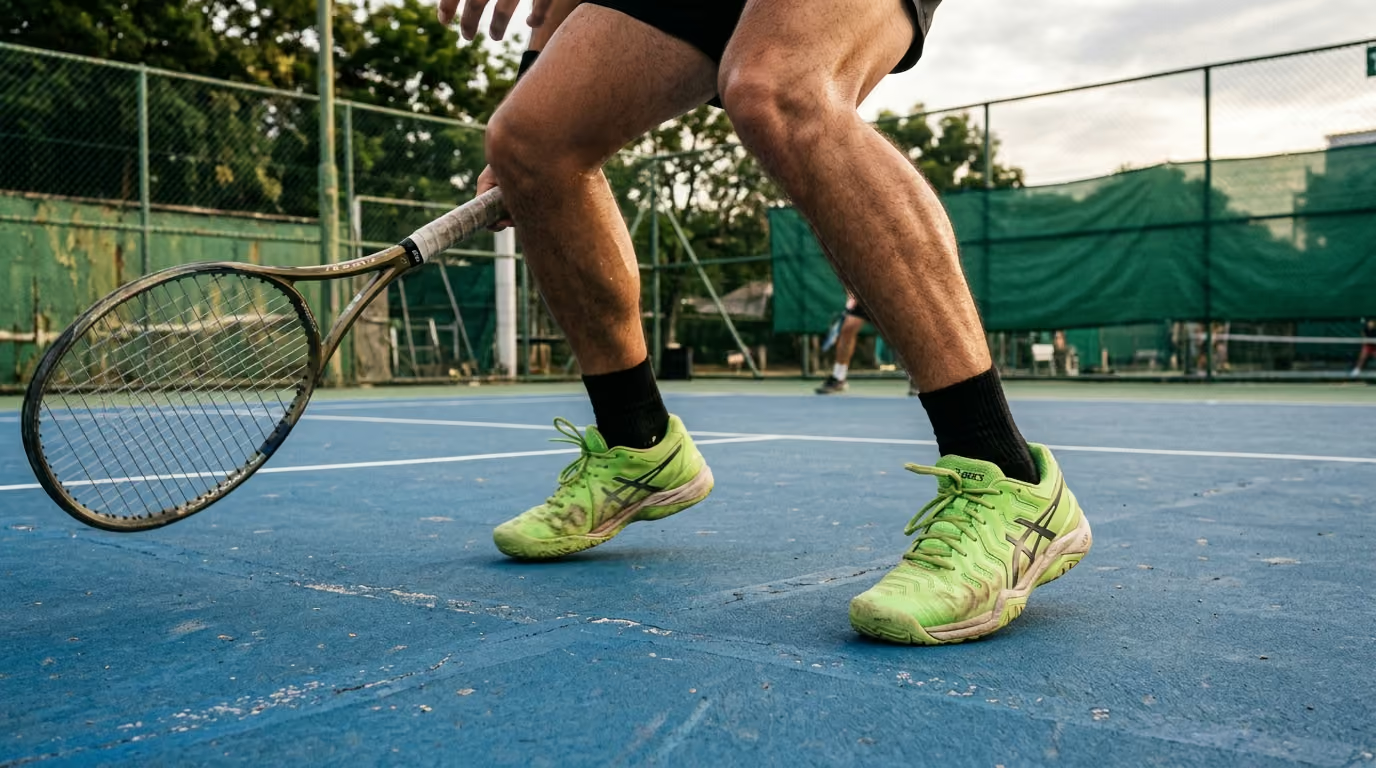

Racquet sport players can successfully integrate strength training and court time into a cohesive weekly schedule that supports performance and recovery.




Many racquet sport players struggle to find the ideal balance between gym sessions and match play. If you spend your week rushing from the weight room to competitive games, you may find yourself feeling chronically fatigued, stiff, or slightly slower on the ball. It is common to wonder how to build physical strength without showing up to your league matches with heavy, unresponsive legs.
Adult racquet sport players can balance strength training and court play by managing weekly volume, limiting heavy lower-body lifts before intense match days, and focusing on a minimum effective dose of resistance work. This structured approach allows players to maintain athletic longevity, build power, and protect vital recovery windows. By treating court hours as a core part of your training load, you can enjoy both physical progress and better play.
To build a balanced weekly schedule, we must first view court time as a significant physical training load. Tennis, pickleball, and padel are not merely recreational hobbies that occur in a vacuum. These sports are highly demanding, intermittent activities characterized by repeated, explosive movements. Your body must constantly accelerate, decelerate, change direction, and execute strokes under pressure.
Research shows that tennis matches are dominated by short, high-intensity efforts. Average work bouts typically last between 3 and 15 seconds. These sprints are followed by work-to-rest ratios that range from 1:2 to 1:5. Match play consists of repeated 4 to 10 second high-intensity sprints, separated by 10 to 20 seconds of recovery.
These brief efforts place immense strain on your cardiorespiratory and muscular systems. Every sudden stop on the court requires your muscles to absorb force eccentrically. This deceleration work is highly fatiguing and often leads to microscopic muscle damage. Because of this, a two-hour singles match is not just a game. It is a highly stressful training session that demands respect during weekly planning.
Recognizing these metabolic and mechanical demands helps us plan better. If you treat a hard three-set match as simple leisure, you will likely over-schedule your gym sessions. This oversight is a primary cause of persistent fatigue and declining performance. To play well for years, you must classify every court session by its true physiological cost.
When you lift weights and play court sports in the same week, you are engaging in concurrent training. Concurrent training simply means developing strength and cardiovascular endurance at the same time. For many years, athletes believed that endurance work completely canceled out strength gains. Modern sports science paints a much more nuanced picture of this relationship.
A comprehensive meta-analysis studied trained team-sport athletes who performed concurrent training. The researchers found that well-designed concurrent programs did not impair overall physical fitness development. In fact, combining resistance work with conditioning still produced significant improvements in maximal lower-body strength. This means you do not have to choose between being strong and being fast on the court.
However, explosive power is more sensitive to scheduling errors. Another systematic review indicated that high volumes of endurance work can reduce improvements in explosive strength. This is highly relevant to court players who rely on rapid jumping, sprinting, and first-step acceleration. If your legs are constantly tired from poorly scheduled running or drilling, your explosive power will suffer first.
The risk of this interference increases under specific conditions. It occurs when your total conditioning volume is too high, or when sessions are scheduled too close together. It also happens when you train to muscular failure too often in the gym. By understanding these limits, you can arrange your weekly sessions to minimize interference and protect your vertical jump and sprint speed.
To organize a successful week, you must manipulate four primary variables. These variables are frequency, volume, intensity, and recovery. Balancing these factors keeps you progressing in the gym while keeping you fresh for your matches.
Training frequency refers to how many sessions you perform each week. For general resistance training, the American College of Sports Medicine recommends lifting two to three days per week for novices. They suggest three to four days for intermediate trainees. However, these guidelines are designed for individuals who only lift weights.
If you are on the court three times a week, your strength training frequency must adjust. A realistic frequency for a busy court player is two full-body strength sessions per week. This allows you to stimulate muscle growth and protect your joints without overwhelming your schedule.
Volume represents the total amount of work you perform. In the gym, volume is measured by sets, repetitions, and weight lifted. On the court, volume is determined by play duration, match count, and high-intensity movements.
A traditional singles match can easily last two hours, sometimes stretching longer. Research shows that playing multiple matches in a single day significantly reduces jump and sprint performance. It also elevates soreness and physical pain for days afterward. To keep your total volume manageable, you must count every hour on the court toward your weekly movement budget.
Intensity describes the physical effort required by a session. External intensity includes the speed of your sprints, the weight on a barbell, or the pace of a rally. Internal intensity is how hard your body works, measured by heart rate and your rating of perceived exertion.
The American College of Sports Medicine recommends training with loads equal to an 8 to 12 repetition maximum for novice lifters. For intermediate lifters, they recommend a wider range used in a periodized fashion. This includes heavier work in the 1 to 6 repetition maximum range with longer rest periods. High-intensity lifting is highly effective, but it requires substantial recovery time.
Your acute workload is the stress of your current training week. Your chronic workload is the capacity you have built over the past month. A sudden spike in acute load, like playing a surprise weekend tournament, can trigger joint pain and muscle strain.
Instead of using complex formulas, you can track simple markers to monitor these loads. Write down your daily session duration, your perceived exertion, and your morning muscle soreness. If your acute match play doubles in a single week, you should proactively lower your gym volume. This simple habit keeps your training stress within safe boundaries.
To avoid chronic fatigue, you should structure your weekly schedule using specific planning frameworks. The most effective approach is the hard-easy system. This system groups demanding sessions together on the same day, leaving other days completely free for recovery.
Many recreational players make the mistake of performing moderately hard workouts every day. They play a medium-intensity singles match on Monday, lift weights on Tuesday, and play doubles on Wednesday. This pattern never allows the body to return to baseline. By the weekend, accumulated fatigue makes high-performance play impossible.
Under a hard-easy framework, you schedule a hard court session and a strength session on the same day or back-to-back. This creates a highly demanding block of training, followed by a day of complete rest or low-intensity mobility. This structure ensures that your hard days are highly productive, and your recovery days are genuinely restorative.
The priority-session framework is another excellent tool. Each week, identify your primary goal, such as league match performance or general strength progression. The priority session of the week should always be performed when you are most rested. If fatigue begins to accumulate during the week, the lowest-priority session is the first one you should shorten or skip.
If you are highly active, you will eventually have to lift weights and play on the court on the same day. Managing these double-session days requires careful sequencing. Without a plan, you risk injuring yourself or performing poorly in both workouts.
A good general guideline is to separate your strength session and your court session by four to eight hours. Research suggests this time window is sufficient to reduce acute performance interference. It gives your nervous system time to calm down and allows you to replenish your energy stores with a meal.
When sequencing these sessions, put your priority quality first. If your primary goal is court performance, you should play your match in the morning and lift weights in the afternoon. If your priority is building lower-body dynamic strength, you should perform your gym workout first. Research shows that lifting before endurance training leads to better dynamic strength gains.
You should also follow the 48-hour lower-body rule. Avoid performing a heavy, high-volume leg workout within 48 hours of a high-priority match. Decelerating, jumping, and lunging on the court require optimal lower-body freshness. If your quadriceps and glutes are deeply sore from heavy squats, your court movement will be slow, awkward, and potentially unsafe.
If you must lift close to a match, modify your exercise selection. Focus on upper-body movements, core stability, and low-volume power work like light medicine ball throws. This maintains your training momentum without leaving your legs heavy and unresponsive for competition. To find more ideas on structuring these gym routines, you can review our strength and conditioning resources for court athletes.
No single schedule works for every player. Your weekly plan must reflect your competitive schedule, your playing frequency, and your personal recovery capacity. Below are four highly detailed, practical training templates designed for different scenarios.
This template is ideal for consistent club players who want to build strength while playing three times per week. It places a full recovery day before your hardest court effort.
This schedule is designed for dedicated players with a high weekly court volume. To prevent overtraining, the second weekly strength session is reduced to a short maintenance workout.
Use this template when you have a high-stakes league match scheduled for Wednesday night. It prioritizes freshness for mid-week competition.
During a tournament week, your goal shifts entirely from building fitness to maximizing freshness. Your gym work becomes minimal and recovery takes center stage.
While tennis, pickleball, and padel share similar court concepts, they place distinct physical demands on your body. Understanding these differences allows you to customize your strength program for your specific sport.
Tennis is played on a large court, requiring longer sprint distances and higher top speeds. Matches often last two to four hours, demanding high cardiovascular endurance. The tennis serve is a complex, high-velocity overhead motion that places extreme stress on the shoulder joint, thoracic spine, and abdominal muscles.
Your strength training must address these demands. Focus on unilateral leg exercises, like lunges and step-ups, to handle the deep, wide lunges required on court. Include thorough rotator cuff conditioning and thoracic mobility exercises to protect your shoulder from repetitive serving.
Pickleball is played on a much smaller court, meaning you cover shorter distances but must react much faster. The game is played in a semi-squatted stance near the kitchen line, requiring excellent isometric endurance in your quadriceps and glutes. The rapid, short-range exchanges demand exceptional wrist, elbow, and ankle stability.
Your gym sessions should focus on building lower-body endurance and rapid deceleration capacity. Exercises like deep goblet squats, lateral band walks, and calf raises are highly valuable. These movements build the physical capacity needed to hold a low athletic stance without straining your knees or lower back.
Padel combines elements of tennis and squash, utilizing glass walls for rebounds. The sport involves frequent overhead actions, such as the bandeja and vibora, which are hit with a bent arm. Padel players must constantly rotate their torsos and execute rapid changes of direction on a turf surface.
I remember finishing a tough two hour padel match on a cold Tuesday night and waking up the next morning feeling like my lower back was locked in concrete. For a long time, I just accepted this as the price of playing hard in my forties. But once I started spending just ten minutes on targeted hip mobility before heading to the club, the stiffness almost completely vanished. It taught me that we do not have to accept pain as a default state of aging. To support these specific movement patterns, padel players should focus heavily on rotational core strength, hip mobility, and shoulder blade stability.
To protect your joints from the specific physical demands of these different court sports, you can read our detailed injury prevention strategies.
Many recreational court players base their weekly routines on outdated training advice. Correcting these common myths can immediately improve your performance and physical longevity.
One of the most common errors is assuming that court play does not count as physical conditioning. Many players think that unless they are running on a treadmill, they are not training their cardiovascular system. As a result, they add extra interval training or long runs to their weekly schedule.
In reality, the high-intensity, intermittent nature of racquet sports is a highly potent form of metabolic conditioning. The sprinting, braking, and lateral movement in a typical singles match provide all the high-intensity conditioning most players need. Adding extra running on top of frequent play often leads to joint issues and systemic exhaustion.
While high-volume lifting programs are excellent for maximizing muscle growth, they are rarely appropriate for active court players. Every extra set you perform in the gym requires recovery energy. If you perform five sets of heavy squats to failure, your body will spend the next three days repairing that muscle damage.
For a court player, the goal of strength training is to support your play, not to make you too sore to move. You should use a minimum effective dose of resistance training. This means performing the smallest volume of lifting that still allows you to maintain your strength, protect your joints, and perform well.
You do not need to worry that playing racquet sports will destroy your hard-earned gym gains. While extreme endurance training can interfere with muscle hypertrophy, the intermittent nature of court sports is much more compatible with strength training.
As long as you manage your total weekly volume, you can build muscle and improve your court speed simultaneously. The key is scheduling your heavy lifting sessions away from your high-intensity matches. This allows your body to adapt to both stimuli without experiencing excessive physical conflict.
Many players spend substantial money on massage guns, compression boots, and expensive supplements, hoping to erase physical fatigue. While these tools can feel pleasant, they are minor details compared to the fundamentals of recovery.
No massage tool can make up for a chronic lack of sleep, poor hydration, or inadequate nutrition. If you want to recover quickly, prioritize a consistent sleep schedule and eat balanced meals. These foundational habits are the true drivers of tissue repair and athletic performance. For a deeper understanding of how the body recovers from exercise, you can explore our overview of recovery science protocols.
As we navigate different stages of our playing lives, our physical capacities and recovery rates naturally evolve. Adjusting your training approach based on your age, experience, and physical history is essential for staying on the court for years to come.
Older players often experience a natural decline in muscle mass, bone density, and tendon elasticity. However, this does not mean you should stop lifting weights or avoid playing hard. Instead, it highlights the vital importance of consistent resistance training to maintain your physical capabilities.
If you are an older player, you may need more recovery time between your high-intensity court sessions. You might benefit from performing two shorter, low-volume strength sessions instead of one long, exhausting workout. Focus on building tendon durability with controlled eccentric exercises, and prioritize exercises that challenge your single-leg balance and coordination. To explore more about maintaining your physical capabilities as you age, read our resources on healthy aging and athletic longevity.
If you are returning to racquet sports after several months or years away, you must resist the temptation to match your old playing volume immediately. Your cardiovascular fitness may return quickly, but your tendons, ligaments, and bones take much longer to adapt to the impact of court play.
Start with one or two short court sessions per week, and keep your initial matches friendly rather than highly competitive. In the gym, focus on basic movement patterns with moderate weights in the 8 to 12 repetition range. This gradual reintroduction gives your connective tissues time to rebuild their tolerance to high forces. If you are planning your return to active play, you can find helpful guidance in our section on mobility and movement practices.
If you struggle with chronic issues like tennis elbow, Achilles stiffness, or patellar tendinopathy, your training must be highly strategic. Tendons do not respond well to sudden spikes in volume, nor do they recover well with complete, prolonged rest. Instead, they require progressive, controlled loading to heal and grow stronger.
Ensure your strength program includes specific, slow resistance training for your vulnerable areas. For example, if you have a history of Achilles issues, perform slow, heavy calf raises with a focus on the eccentric lowering phase. Avoid playing on highly hard surfaces when you are already fatigued, as tired muscles cannot protect your joints from impact forces.
If you have a busy work schedule or family commitments, you may feel you do not have time for a full gym program. In these situations, a weekly strength microdose is highly effective. You can maintain your physical strength and protect your joints with just one or two 15-minute workouts per week.
A simple, highly effective microdose routine can be performed with minimal equipment. Complete two sets of a single-leg exercise, two sets of an upper-body pull, two sets of an upper-body press, and a brief core exercise. This small, consistent effort is vastly superior to doing nothing, and it will not interfere with your weekly court time.
To manage your training schedule effectively, you need a simple way to monitor your recovery. You do not need expensive tracking devices or laboratory tests. A daily subjective questionnaire can provide all the information you need to make smart training decisions.
Every morning, ask yourself the following simple questions. Give each variable a mental rating of green (excellent), yellow (moderate), or red (poor).
If most of your answers are green, your body is fully recovered and ready for a hard lifting or court session.
If you have several yellow markers, your body is showing early signs of fatigue. You do not need to skip your workout, but you should adjust your training. Reduce your lifting volume by cutting out a few sets, or focus on technical drilling on the court instead of playing intense competitive points.
If you hit any red markers, particularly regarding sharp joint pain or severe physical exhaustion, it is time to rest. Forcing a hard workout when you are in the red zone significantly increases your risk of injury. Replace your planned session with a walk, gentle mobility work, or a dedicated rest day.
While mild muscle soreness and general fatigue are normal parts of training, you must learn to distinguish them from injury. Ignoring persistent pain in the hope that it will go away is a common mistake that can lead to chronic, long-term issues.
You should consult a qualified healthcare professional, such as a physical therapist or sports medicine physician, if you experience any of the following warning signs:
A physical therapist can identify the underlying cause of your discomfort and design a targeted rehabilitation plan. Addressing small issues early allows you to make minor adjustments to your weekly schedule, keeping you active and pain-free on the court.
To put this weekly planning guide into action, focus on these practical steps over the next seven days:
Follow Evercourts for practical insights on tennis, pickleball and padel performance, movement, recovery and healthy ageing. Stay connected for new articles, research-led guidance and ideas to help you play well and keep playing for years.


Read practical guidance for better movement, smarter preparation and a game that keeps working for you.
explore the Blog