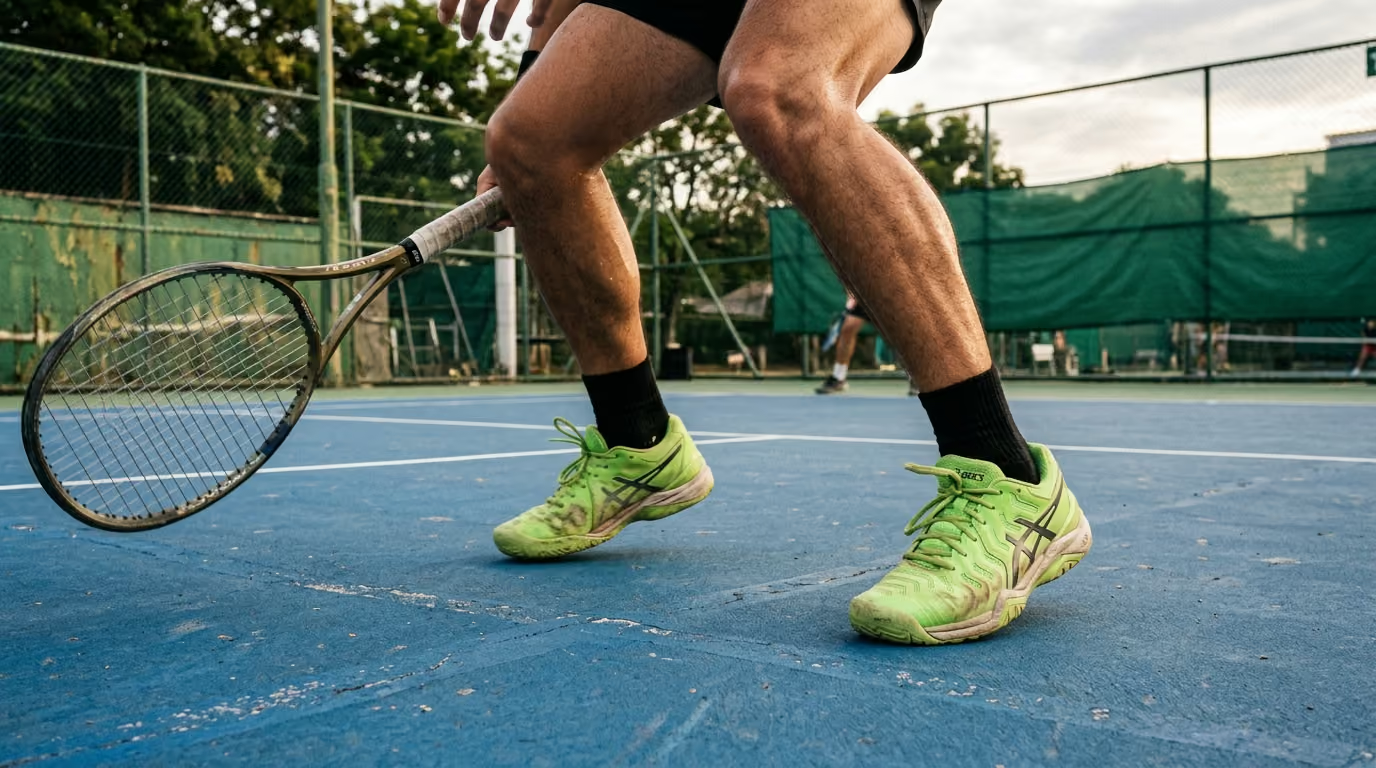
While many believe hitting harder means twisting the spine faster, true rotational power in racquet sports comes from coordinated force transfer through the entire body.




Many court players believe that hitting a ball harder requires twisting the spine faster. In reality, attempting to forcefully twist the lower back is a fast track to injury and produces a weak, arm-driven stroke. Rotational power in racquet sports is generated by pushing against the ground, transferring that force through a stable trunk, and releasing it through the arm in a coordinated sequence.
To improve your velocity on the court, you must train your body to function as a unified system. This guide provides a comprehensive, research-led framework for developing rotational power that protects your joints and enhances your performance.
True rotational power is not a simple twisting movement. It is the coordinated transfer of mechanical energy through linked body segments. This sequence is known as the kinetic chain.
In a tennis serve, a padel overhead, or a pickleball drive, force begins at the ground. Your feet press into the court, creating ground-reaction force. This energy travels upward through your ankles, knees, and hips, causing the pelvis to rotate.
As the pelvis rotates, it pulls the torso along with it. The trunk acts as a vital bridge, transmitting this force to the shoulder, arm, and finally the racket or paddle.
Research highlights the critical role of the lower body in this sequence. Biomechanical analyses of the tennis serve reveal that approximately 51% of total kinetic energy and 54% to 60% of total force are generated by the legs and torso.
If your lower body is weak, your upper body must overcompensate to generate power. This compensation reduces shot velocity and increases the physical stress placed on your shoulder and elbow.
Segment velocities also demonstrate why sequencing is more important than raw muscular effort from the arm. Three-dimensional motion tracking of professional tennis players reveals a clear acceleration hierarchy.
During the serve, the pelvis rotates at speeds between 197 and 416 degrees per second. The thorax accelerates faster, reaching speeds between 415 and 618 degrees per second.
The upper arm reaches internal rotation velocities between 1,404 and 1,962 degrees per second. These figures show that the smaller, distal segments accelerate much faster than the larger, proximal segments.
The shoulder joint does not generate this high-speed rotation independently. Instead, its primary role is to transform linear kinetic energy from the lower body into rotational energy for the arm.
To maximize this transfer, players utilize pelvic-trunk separation. This refers to the physical stretch created when the hips begin to rotate forward while the shoulders remain back.
This separation stretches the muscles of the core, storing elastic energy like a rubber band. When the trunk follows the hips, this stored energy is released rapidly, accelerating the arm.
However, more separation is not always better. You must possess the strength and control to stabilize this position. Otherwise, excessive separation can strain your lower back or shoulder.
To optimize your athletic preparation on court, you must train the legs and trunk to produce power, rather than relying solely on the arm to drive your strokes. If you want to dive deeper into the overall structure of court training, you can read our overview on athletic preparation on court to see how rotational training fits into a broader athletic plan.
Before you can express power quickly, you must build a solid foundation of general strength. Strength training increases the amount of force you can apply against the ground. It also prepares your connective tissues to handle the high deceleration demands of competitive play.
Your lower body serves as the engine of your strokes. If you lack lower-body strength, your rotational power will always be limited. Integrating dedicated strength work into your routine is essential for long-term improvement.
The split squat is a foundational exercise for court athletes. It mimics the staggered stances commonly used during groundstrokes and overheads.
To perform a split squat, stand with one foot forward and one foot back. Keep your chest upright and lower your hips until your back knee is just above the floor.
Drive through your front heel to return to the starting position. This movement builds single-leg strength, improves hip stability, and prepares your lower body to absorb force. For more details on integrating these movements into a structured routine, check out our strength and conditioning guidelines for court athletes.
The Romanian deadlift targets the posterior chain, including the glutes, hamstrings, and lower back. These muscles are responsible for producing powerful hip extension during your swings.
Stand with your feet hip-width apart, holding a barbell or dumbbells in front of your thighs. Keep a slight bend in your knees and hinge at your hips, pushing your glutes backward.
Lower the weight along your shins until you feel a stretch in your hamstrings. Contract your glutes and push your hips forward to return to standing.
Step-ups develop unilateral power and balance. Place one foot on a sturdy box or bench that is approximately mid-shin height.
Drive through your top foot to lift your body upward until your leg is fully extended. Lower yourself back to the ground under control.
This exercise improves knee alignment and strengthens the quadriceps. It helps you maintain a stable lower body when hitting on the run.
The Pallof press is an exceptional exercise for developing anti-rotation strength. This quality allows your core to resist unwanted movement and transfer force efficiently.
Stand perpendicular to a cable machine or a resistance band anchored at chest height. Hold the handle with both hands close to your chest.
Press the cable straight out in front of you, resisting the temptation to let the resistance twist your torso. Hold the extended position for two seconds, then return your hands to your chest under control.
Medicine balls are incredibly effective tools for developing rotational power. They allow you to throw with maximum effort without having to slow the movement down at the end.
This ballistic action closely replicates the high-speed release of a racket or paddle swing. To get the most out of medicine-ball training, you should follow a progressive framework.
Begin with movements that teach you to control your pelvis and ribcage. Tall-kneeling and half-kneeling exercises are ideal for this phase.
Kneel on both knees perpendicular to a wall, holding a light medicine ball at your chest. Rotate your shoulders slightly away from the wall, then toss the ball into the wall using your core.
Catch the ball and return to the starting position under control. This exercise isolates the trunk and shoulder girdle, helping you feel the rotation of your upper body over a stable lower base.
Once you can control your torso, move to a standing stance. Stand with your feet wider than shoulder-width apart, facing perpendicular to a solid wall.
Hold a medicine ball in both hands near your rear hip. Push your back foot into the ground, rotate your hips toward the wall, and throw the ball horizontally with maximum effort.
Focus on driving the movement from your hips rather than using only your arms. The throw should feel like a coordinated wave of energy traveling from the ground up.
Staggered throws introduce the concept of weight transfer. Stand with one foot forward and the other foot back, mirroring your natural hitting stance.
Load your weight onto your back leg, then quickly shift your weight forward as you release the ball. This movement teaches you to transfer linear momentum into rotational acceleration.
It is a vital skill for hitting deep groundstrokes and powerful overheads. It also trains your front leg to act as a strong brake, which stabilizes your body during the release.
The final stage adds movement to the throw. Perform a side-shuffle or a crossover step before releasing the ball into the wall.
This variation closely mimics the real-world demands of court play. You must organize your body, plant your feet, and rotate while moving at high speed.
It requires excellent timing, coordination, and deceleration capacity. Keep the volume low to ensure every repetition is performed with maximum velocity.
To optimize your results, keep your medicine-ball sets to 3 to 6 repetitions per side. Use a light ball, typically between 2 and 4 kilograms.
Rest for at least three minutes between sets to allow your nervous system to recover. If your throwing distance or movement quality begins to decline, stop the set immediately.
Comparing your seated and standing throws is a great way to assess your performance. If your standing throw is significantly longer than your seated throw, your legs are contributing well to your power production. If the distances are similar, you need to focus on using your lower body to drive your rotation.
While medicine balls are perfect for high-speed, ballistic power, cables provide continuous external resistance throughout the entire range of motion. This constant tension allows you to build rotational strength, refine your path of movement, and improve your deceleration control.
Standing cable chops train the diagonal patterns used in racquet sports. Set the cable pulley to a high position and stand perpendicular to the machine.
Grasp the handle with both hands and pull it diagonally down and across your body. Rotate your torso and pivot your back foot as you complete the movement.
Return to the starting position under control, resisting the pull of the weight. This exercise strengthens the obliques and teaches your hips to rotate in unison with your upper body.
Standing cable lifts work the opposite diagonal pattern, which is crucial for low-to-high stroke paths. Set the pulley to a low position near the floor.
Hold the handle and pull it diagonally upward and across your body, finishing with your hands above your opposite shoulder.
Pivot your back foot to protect your lower back and allow your hips to rotate fully. This movement directly supports the upward lift required to generate heavy topspin.
The split-stance cable press combines trunk rotation with upper-body pressing strength. Stand in a split stance with your back to the cable machine, holding the handle in the hand opposite your forward foot.
Press the cable forward while slightly rotating your torso. This movement mirrors the mechanics of a closed-stance forehand or drive.
It teaches you to maintain a strong, stable core while expressing upper-body force. Keep your front knee aligned over your ankle throughout the movement.
Landmine rotations bridge the gap between strength work and ballistic throwing. Place one end of a barbell in a landmine attachment or a secure corner.
Hold the opposite end of the bar with both hands, standing with your feet shoulder-width apart. Keep your arms straight and arc the bar down toward one hip, rotating your torso and pivoting your opposite foot.
Explosively reverse the movement, driving the bar up and over to your opposite hip. Keep your core braced to protect your spine at the bottom of the arc.
Using cables and landmines allows you to adjust the resistance to match your technical ability. Use lighter weights to prioritize movement speed, and heavier loads to build rotational strength. For comprehensive guidance on how to structure these exercises safely, consult our injury prevention strategies to ensure your joints remain protected.
While the fundamental rules of the kinetic chain apply to all court sports, the specific demands of each sport require distinct mechanical adjustments. Understanding these nuances will help you tailor your training to the sport you play.
Tennis is characterized by large, explosive movements, heavy equipment, and a spacious playing area. Players have the time and space to wind up, creating significant pelvic-trunk separation.
This sport requires both open and closed stances. In a closed stance, you step forward with your non-dominant foot, allowing for a long, linear-to-rotational transfer of force.
In an open stance, your feet remain parallel to the net. You must load your outer hip deeply and rotate your pelvis against a fixed foot.
Tennis training should emphasize deep lateral loading, expansive medicine-ball throws, and robust rotational braking. If you want to dive deeper into tennis-specific movement, check out our selection of tennis development and stroke mechanics articles.
Pickleball is played on a much smaller court, using lightweight paddles and a plastic ball. The game features rapid exchanges, especially near the non-volley zone, commonly called the kitchen line.
At the kitchen line, you do not have the time or space for a large wind-up or a deep weight transfer. Instead, you must produce rotational power from a static, low, and wide stance.
The movement must be quick, compact, and highly controlled. Your training should focus on short-range cable punches, rapid anti-rotation holds, and wrist deceleration.
These exercises help you generate quick paddle speed without compromising your court position or balance. For more tactical and physical tips, read our curated pickleball strategy and training resources.
Padel blends elements of tennis and squash, utilizing a solid, perforated racket and a court surrounded by glass walls. The physical demands of padel are unique due to the frequent use of overhead shots, such as the bandeja and víbora, and the necessity of playing off the rebound of the glass.
The bandeja and víbora are sliced overheads designed to keep the ball low and maintain net position. Unlike a tennis smash, these shots require you to rotate your upper body while moving laterally or backward.
This demands exceptional thoracic mobility, shoulder stability, and core control under dynamic conditions. Swings in padel are generally more compact than in tennis to prevent the racket from striking the glass walls.
Your conditioning should focus on lateral movement, overhead rotation, and rapid recovery steps. Explore our padel court movement and conditioning articles to learn how to move efficiently in the cage.
Many dedicated players spend hours training their rotation, only to end up with sore backs and slower strokes. This frustration is usually the result of a few common training misconceptions.
The most common mistake is attempting to twist through the lower back. Anatomically, the lumbar vertebrae are designed for flexion and extension, offering very limited rotational range.
The joints in your lower back permit only about 5 to 15 degrees of total rotation. Forcing rotation here can lead to muscle strains, disc herniations, and chronic pain.
True rotation must come from the hips and the thoracic spine, which is your upper and middle back. The hip is a highly mobile ball-and-socket joint, and the thoracic vertebrae are physically structured to allow for rotation.
Your training should focus on mobilizing your hips and upper back, while training your lower back to remain stable and resist excessive twisting.
While pelvic-trunk separation is a key feature of powerful strokes, forcing excessive separation can be counterproductive. If you lack the flexibility or core strength to control this stretch, your body will compensate by Arching your lower back or straining your shoulder.
Focus on creating a comfortable, controlled coil. The goal is to build a smooth, repeatable transition rather than forcing your body into extreme, unstable positions.
Many players select the heaviest medicine ball available, believing it will build the most power. However, an excessively heavy ball slows down your movement speed and alters your mechanics.
This turns a speed-power exercise into a slow, grinding strength drill. It also teaches your nervous system to move slowly, which is the opposite of what you want on the court.
Keep your medicine balls light, typically between 2 and 4 kilograms. Prioritize maximum movement speed, clean technique, and explosive release on every single throw.
Do not confuse a power training session with a cardiovascular conditioning workout. Power development relies on the phosphagen energy system, which requires short efforts and long rest periods.
If you perform your rotational throws in a state of high fatigue, your velocity will drop, your coordination will suffer, and your risk of injury will increase.
Keep your repetitions low, focus on maximum effort, and take full rest intervals between sets. Save your conditioning work for the end of your training session.
I remember finishing a tough two hour padel match on a cold Tuesday night and waking up the next morning feeling like my lower back was locked in concrete. For a long time, I just accepted this as the price of playing hard in my forties.
But once I started spending just ten minutes on targeted hip mobility before heading to the club, the stiffness almost completely vanished. It taught me that we do not have to accept pain as a default state of healthy aging.
Racquet sports are inherently asymmetrical. You swing with one dominant arm, rotate predominantly in one direction, and load one side of your body more heavily than the other.
Over time, this repetitive, one-sided stress can lead to significant muscle imbalances, joint stiffness, and chronic discomfort. To maintain your athletic longevity, you must actively manage your recovery and joint health.
To counteract these asymmetrical demands, ensure your training program includes bilateral and non-dominant side work. While you should train your dominant side for sport-specific power, performing throws and rotations on your non-dominant side helps maintain structural balance.
This balanced approach preserves joint alignment, prevents muscle tightness, and protects your spine from uneven wear.
A dedicated daily mobility routine is highly effective for maintaining joint health. Focus on exercises that target hip rotation, thoracic mobility, and ankle flexibility.
Active thoracic open-books, 90-90 hip sweeps, and calf stretches are excellent choices for court athletes. For more scientific insights into tissue repair and managing post-match stiffness, visit our recovery science resources.
To help you integrate these concepts, here are two practical weekly templates designed for different athletic levels. These templates balance strength work, ballistic power, and recovery.
This template is designed for players who are new to structured strength and conditioning. It focuses on building general strength, mastering basic movement patterns, and introducing light rotational power.
This template is designed for experienced players with a solid strength foundation. It utilizes contrast training, which pairs a heavy strength exercise with a biomechanically similar ballistic movement to enhance power production.
To track your progress, perform a simple assessment battery every 6 to 8 weeks. Measure your standing medicine-ball throw distance on both your dominant and non-dominant sides.
A narrowing gap between your sides indicates improved structural balance. You can also monitor your vertical jump height as an indicator of lower-body power, and track your serve or stroke velocity using a pocket radar gun.
While a structured training program can significantly improve your performance and joint health, you must listen to your body. Racquet sports involve repetitive, high-velocity movements that can occasionally lead to overuse injuries.
If you experience any of these red flags, stop training immediately and consult a qualified sports physiotherapist or healthcare professional. Attempting to work through sharp or persistent pain will only worsen the injury and prolong your time away from the court.
A professional can identify movement restrictions, address muscle imbalances, and design a safe rehab program. For more guidance on managing aches and pains, check out our injury prevention resources.
Building rotational power requires patience, consistent effort, and a focus on movement quality over raw force. By training your body to function as a unified kinetic chain, you can increase your power, protect your joints, and continue playing the sports you love for years to come.
Follow Evercourts for practical insights on tennis, pickleball and padel performance, movement, recovery and healthy ageing. Stay connected for new articles, research-led guidance and ideas to help you play well and keep playing for years.


Read practical guidance for better movement, smarter preparation and a game that keeps working for you.
explore the Blog